Navigation Quest Packet Level 1
Adventure Mode
XP:
15/100
Explorer:
Date:
Active Quest
Welcome, Adventurer! In video games, a minimap helps you navigate dangerous zones and track loot. In the real world, wild explorers use space satellites and coordinates to survive. Let's unlock the skills you need to navigate both worlds!
Task 1: Grammar Glitch Repair
An elite hacker glitched our wilderness navigation guide! Find and circle the 3 spelling errors and 2 punctuation errors. Then, rewrite the passage correctly below.
wilderness explorers use handheld GPS systems to find there way through dark forests? The device connects to twenty-four satelites orbiting high above Earth. This amazing technology keeps hikers safe and prevent them from getting lost.
Task 2: Vocabulary Decoding
Draw a straight line to match each core term with its survival definition.
1. Coordinate
2. Navigation
3. Satellite
4. Topographic
A spacecraft that orbits Earth to send and receive signals.
A pair of numbers (or lat/long) pinpointing an exact spot.
The process of plotting a path to travel safely from place to place.
A type of map that shows natural features and hills with contour lines.
LEVEL 1 DIRECTIVE: ACQUIRE BEARING PAGE 1/3
Reading Lore
Adventure Mode
XP:
45/100
Minimaps in the Wild: How Satellites Guide Us
PASSAGE LEVEL: 5TH GRADE
If you have ever played a survival video game, you know how vital the minimap is. With a single glance, you can spot enemies, locate treasure chest coordinates, and find the safe pathway home. In real life, professional search-and-rescue teams, arctic scientists, and deep-wilderness explorers use almost the exact same tool. They rely on handheld GPS units and satellite communication systems to survive.
This technology is powered by the Global Positioning System (GPS), a network of over twenty-four satellites orbiting high above the Earth. These satellites continually beam precise signals down to Earth. A receiver, such as a phone or wilderness device, catches signals from at least four satellites to instantly calculate its own exact location coordinates .
However, unlike in video games, real-life screens do not show glowing markers for hazards. Explorers must overlay their digital coordinates onto topographic maps . These special maps show steep hills, canyons, and peaks using closely packed brown wavy lines called "contour lines." Understanding topographic maps helps explorers plan paths around steep, unclimbable mountains. Without satellites and coordinates, explorers in remote regions like Antarctica or deep rainforests would be completely blind to the world around them.
Task 3: Loot Box Questions
1. According to the text, how many satellites are in the GPS network?
A Exactly four satellites
B Over twenty-four satellites
2. What do the brown "contour lines" represent on a topographic map?
A Steepness and natural earth features
B The pathways of GPS satellites
3. Why must real-world explorers match digital GPS coordinates to topographic maps?
LEVEL 1 DIRECTIVE: RETRIEVE DATA PAGE 2/3
Survival Build
Adventure Mode
XP:
85/100
Design Prompt: Your Adventure HUD Visor
Imagine you have been selected to explore a completely uncharted, dense volcanic island. You have been outfitted with high-tech HUD (Heads-Up Display) Glasses . Design the digital layout of your visor HUD and describe how its navigation features help you explore safely.
Part A: Draw Your Visor Display HUD Use symbols for minimap, battery, coordinates, and health.
Part B: Describe Your HUD Mechanics
Explain how your minimap works, what coordinates are tracked, and how the topographic layers keep you safe. (Aim for 4-5 complete sentences using at least two vocabulary words!)
LEVEL 1 DIRECTIVE: EXECUTE EXPLORATION MISSION COMPLETE: +100 XP
Navigation Quest Teacher Guide Teacher Guide
Level 1: Minimaps & GPS
Adventure Mode Sequence Lesson Duration: 45-60 mins
Session Core Objective
Bridge the student's gaming passion with practical outdoor skills. Connect digital minimaps (e.g. Minecraft/Fortnite HUDs) to GPS technology and topographic maps while refining editing skills, word matching, and descriptive writing.
1. Glitch Warm-Up
Review capitalization, spelling, and subject-verb agreement on Page 1.
2. Decryption & Reading
Define core vocabulary before tackling the "Minimaps in the Wild" passage.
3. Creative Action
Guide the student to design and write about their volcanic island adventure HUD.
Master Answer Key
Task 1: Grammar Glitch Repair Key
Spelling fixes: there → their, satelites → satellites.
Punctuation fix: replace the question mark at the end of sentence 1 with a period (.).
Subject-Verb Agreement fix: prevent → prevents (to match singular subject "technology").
Correct Passage: "Wilderness explorers use handheld GPS systems to find their way through dark forests. The device connects to twenty-four satellites orbiting high above Earth. This amazing technology keeps hikers safe and prevents them from getting lost."
Task 2: Vocabulary Decoding Match
1. Coordinate → Pair of numbers (lat/long)
2. Navigation → Process of plotting a path
3. Satellite → Spacecraft orbiting Earth
4. Topographic → Map showing natural contour lines
Task 3: Comprehension Key
Question 1 (Satellites in network): B (Over twenty-four satellites)
Question 2 (Contour lines): A (Steepness and natural earth features)
Question 3 (Connecting topo & coordinates): Sample Answer: GPS coordinates only give numbers. Exploring without topo map lines means an adventurer wouldn't know if a straight route is blocked by a giant cliff or deep ravine.
Socratic Dialogue Starters
“Think & Share”: Ask, “In Minecraft, what happens when you travel off your map's edge? How does satellite coordinates map matching prevent that in real life?”
“The Visor Prompt”: If they get stuck during Part B of HUD Design: “If your HUD showed battery life, why is battery tracking a matter of life or death in a snowstorm?”
LEVEL 1 GUIDE: READY FOR DEPLOYMENT PAGE 1/1
Expedition Log Packet Level 2
Adventure Mode
XP:
45/100
Explorer:
Date:
Active Quest
Welcome back, Adventurer! Video games track missions in Quest Logs and carry gear in limited Inventory Slots. Over 200 years ago, famous explorers kept hand-written journals to track their daily quests. Let's decode their narratives!
Task 1: Quest Log Glitch Repair
A coding error has glitched our historical explorer data! Find and circle 3 spelling errors and 2 pronoun glitches. Then, write the polished passage below.
Lewis and Clark loaded their wooden boats with heavy boxes of provissions. Him and their crew sailed up the river, hoping to find a path to the Pacific ocean. Every explorer wrote in their daily jurnal, making sure to protect it from wet weather.
Task 2: Expedition Vocabulary
Draw a straight line to match each expedition word with its correct definition.
1. Expedition
2. Journal
3. Narrative
4. Provisions
Food, supplies, and gear needed for a long journey.
A carefully organized journey made for a specific purpose.
A story or spoken account of events that happened.
A written record of daily events, thoughts, and observations.
LEVEL 2 DIRECTIVE: OPEN JOURNAL PAGE 1/3
Reading Lore
Adventure Mode
XP:
65/100
The Ultimate Quest Log: Journals of Lewis & Clark
PASSAGE LEVEL: 5TH GRADE
Imagine loading up your gaming character with hundreds of pounds of dried meat, scientific instruments, trading beads, and heavy wool tents. In video games, your character inventory displays all your gear on a simple grid. In the year 1804, President Thomas Jefferson commissioned Captains Meriwether Lewis and William Clark to lead a real-world expedition across the vast American West. Their quest objectives were incredibly difficult: mapping a waterway path to the Pacific Ocean, documenting hundreds of unknown species of plants and animals, and building friendly connections with Native American tribes along the way.
To keep track of their massive task list, the captains and several of their crew members maintained detailed hand-written journals . These heavy, leather-bound books functioned exactly like video game quest logs. Every evening by campfire, the captains scribbled down the day's events: the distance traveled up the muddy Missouri River, encounters with dangerous grizzly bears, and descriptions of strange plants.
The journals also served as a precise inventory management sheet. Every single canoe paddle, barrel of flour, and bullet was meticulously counted and logged as . If inventory was lost to a capsized canoe or ruined by river dampness, the captains had to quickly adapt. Without their physical logs, Lewis and Clark could have easily forgotten their objectives, miscounted their food, or lost their maps in the deep wilderness.
Expedition Log Teacher Guide Teacher Guide
Level 2: Quest Logs & Expeditions
Adventure Mode Sequence Lesson Duration: 45-60 mins
Session Core Objective
Bridge the student's gaming passion for managing "inventories" and "quests" with historical expeditions (like Lewis and Clark). Focus on pronouns, spelling accuracy (jurnal/provisions), and narrative journaling.
1. Glitch Warm-Up
Address pronoun glitches (him/they) and spelling in the boat cargo story on Page 1.
2. Decryption & Reading
Connect the concepts of quest chains and loot-bag management to real 1804 explorers.
3. Creative Action
Help student design their 6-slot wood-trek gear list and write an immersive Day 1 diary.
Master Answer Key
Task 1: Quest Log Glitch Repair Key
Spelling fixes: provissions → provisions, ocean → Ocean, jurnal → journal.
Pronoun fixes: Change Him → He (or change "Him and their crew" to They), and change "every explorer wrote in their..." to his (singular pronoun matching "every explorer").
Correct Passage: "Lewis and Clark loaded their wooden boats with heavy boxes of provisions. They sailed up the river, hoping to find a path to the Pacific Ocean. Every explorer wrote in his daily journal, making sure to protect it from wet weather."
Task 2: Vocabulary Decoding Match
1. Expedition → Organized journey for a purpose
2. Journal → Written record of daily events
3. Narrative → Story or account of events
4. Provisions → Food, supplies, and gear needed
Task 3: Comprehension Key
Question 1 (Primary objectives): B (Building high-tech satellites for mapping)
Question 2 (Quest Log similarity): A (They tracked daily objectives and counted supplies)
Question 3 (Losing provisions consequence): Sample Answer: If provisions like flour or canoes capsized, they could run out of food in remote areas or lose critical maps, putting the survival of the entire team at extreme risk. They would have to forage or seek trade immediately.
Socratic Dialogue Starters
“Inventory Check”: Ask, “If Lewis and Clark had to trade all their scientific journals for extra boxes of dried beef, would their mission still succeed? Why or why not?”
“Quest Logs”: Ask, “In a game, your quest logs automatically update when you reach a checkpoint. How did the explorers know they reached a 'checkpoint' in the middle of an unmapped mountain range?”
LEVEL 2 GUIDE: READY FOR DEPLOYMENT PAGE 1/1
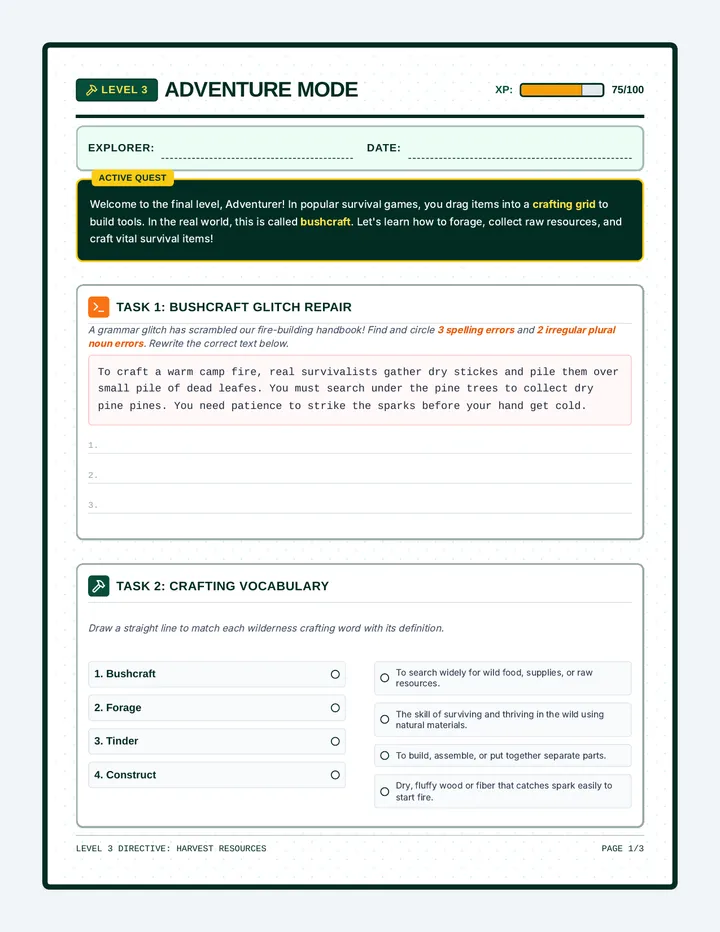
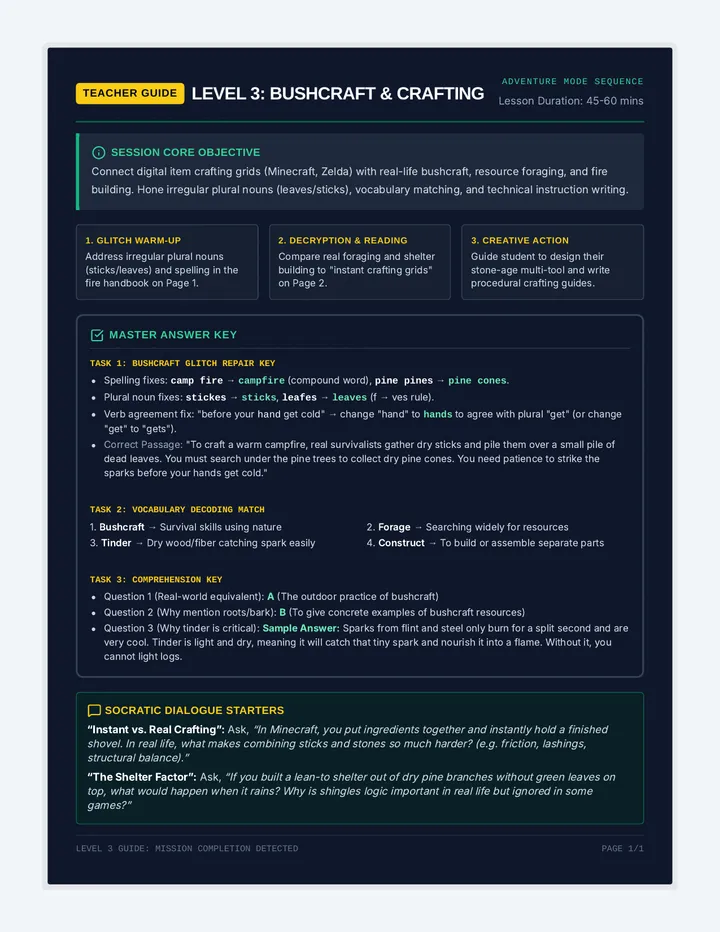
Crafting Survival Packet Level 3
Adventure Mode
XP:
75/100
Explorer:
Date:
Active Quest
Welcome to the final level, Adventurer! In popular survival games, you drag items into a crafting grid to build tools. In the real world, this is called bushcraft. Let's learn how to forage, collect raw resources, and craft vital survival items!
Task 1: Bushcraft Glitch Repair
A grammar glitch has scrambled our fire-building handbook! Find and circle 3 spelling errors and 2 irregular plural noun errors. Rewrite the correct text below.
To craft a warm camp fire, real survivalists gather dry stickes and pile them over small pile of dead leafes. You must search under the pine trees to collect dry pine pines. You need patience to strike the sparks before your hand get cold.
Task 2: Crafting Vocabulary
Draw a straight line to match each wilderness crafting word with its definition.
1. Bushcraft
2. Forage
3. Tinder
4. Construct
To search widely for wild food, supplies, or raw resources.
The skill of surviving and thriving in the wild using natural materials.
To build, assemble, or put together separate parts.
Dry, fluffy wood or fiber that catches spark easily to start fire.
LEVEL 3 DIRECTIVE: HARVEST RESOURCES PAGE 1/3
Reading Lore
Adventure Mode
XP:
85/100
Crafting in the Wild: Real-World Bushcraft
PASSAGE LEVEL: 5TH GRADE
In sandbox video games like Minecraft, survival depends on how quickly you can punch trees to collect wood, mine cobblestone, and drag them into a small 3x3 crafting grid. By combining raw materials, you can instantly construct stone axes, torches, and sturdy wood shelters. In real-life outdoor survival, this practice of making tools and shelters out of nature is a celebrated art form called bushcraft .
Real wilderness experts don't have magical inventory boxes that snap items together instantly. Instead, they must carefully forage in forests to gather raw resources. For instance, to build a water-resistant lean-to shelter, an outdoorsman must locate heavy branches for a frame, tie them together using flexible pine roots as natural rope, and shingles the roof with thick layers of overlapping cedar bark and green leaves.
Fire building is another ultimate test of bushcraft crafting. Instead of dragging coal and a stick together, you have to forage for tinder —fine, dry fibers like shaved birch bark or dried grass that catch sparks instantly. Real bushcraft requires a deep understanding of natural resources. Knowing which trees provide the strongest wood or which plants are edible is the key to converting raw wilderness into a safe campsite.
Crafting Survival Teacher Guide Teacher Guide
Level 3: Bushcraft & Crafting
Adventure Mode Sequence Lesson Duration: 45-60 mins
Session Core Objective
Connect digital item crafting grids (Minecraft, Zelda) with real-life bushcraft, resource foraging, and fire building. Hone irregular plural nouns (leaves/sticks), vocabulary matching, and technical instruction writing.
1. Glitch Warm-Up
Address irregular plural nouns (sticks/leaves) and spelling in the fire handbook on Page 1.
2. Decryption & Reading
Compare real foraging and shelter building to "instant crafting grids" on Page 2.
3. Creative Action
Guide student to design their stone-age multi-tool and write procedural crafting guides.
Master Answer Key
Task 1: Bushcraft Glitch Repair Key
Spelling fixes: camp fire → campfire (compound word), pine pines → pine cones.
Plural noun fixes: stickes → sticks, leafes → leaves (f → ves rule).
Verb agreement fix: "before your hand get cold" → change "hand" to hands to agree with plural "get" (or change "get" to "gets").
Correct Passage: "To craft a warm campfire, real survivalists gather dry sticks and pile them over a small pile of dead leaves. You must search under the pine trees to collect dry pine cones. You need patience to strike the sparks before your hands get cold."
Task 2: Vocabulary Decoding Match
1. Bushcraft → Survival skills using nature
2. Forage → Searching widely for resources
3. Tinder → Dry wood/fiber catching spark easily
4. Construct → To build or assemble separate parts
Task 3: Comprehension Key
Question 1 (Real-world equivalent): A (The outdoor practice of bushcraft)
Question 2 (Why mention roots/bark): B (To give concrete examples of bushcraft resources)
Question 3 (Why tinder is critical): Sample Answer: Sparks from flint and steel only burn for a split second and are very cool. Tinder is light and dry, meaning it will catch that tiny spark and nourish it into a flame. Without it, you cannot light logs.
Socratic Dialogue Starters
“Instant vs. Real Crafting”: Ask, “In Minecraft, you put ingredients together and instantly hold a finished shovel. In real life, what makes combining sticks and stones so much harder? (e.g. friction, lashings, structural balance).”
“The Shelter Factor”: Ask, “If you built a lean-to shelter out of dry pine branches without green leaves on top, what would happen when it rains? Why is shingles logic important in real life but ignored in some games?”