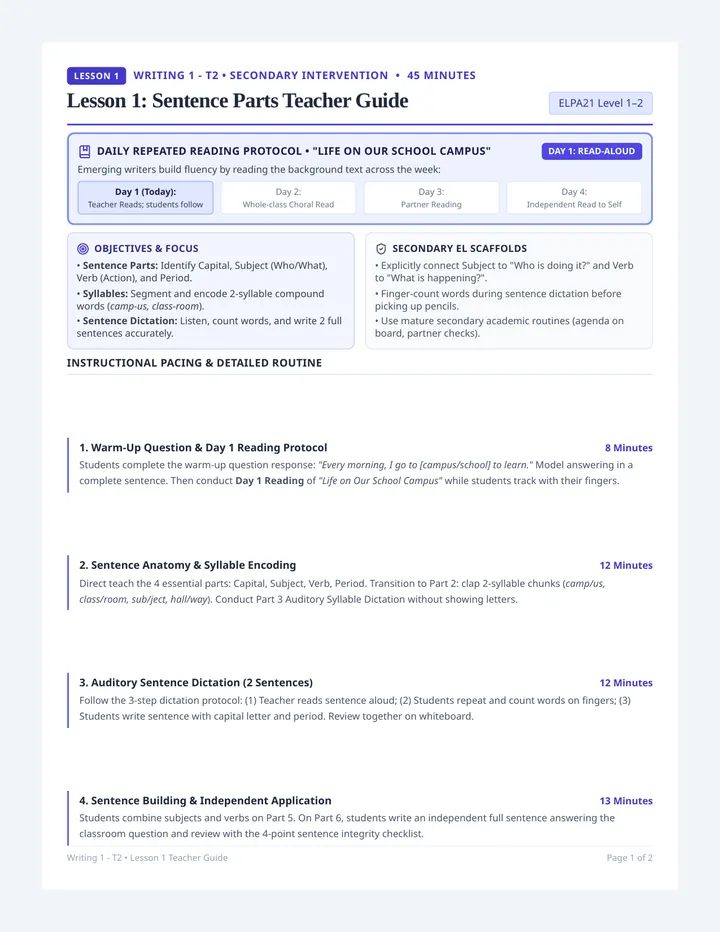
Sentence Descriptions Teacher GuideWeek 1 • Lesson 1 UHS - Writing 1 - T3 • What Does It Look Like? • 30 Min Lesson 1: Describe the Who and What ELPA21 Level 1–2 Week 1 Goal: Add Descriptions to Complete Sentences Essential Question: What Does It Look Like? Students expand complete sentences by adding meaningful descriptive details. Lesson 1 focuses on describing the who and what by placing adjectives directly in front of nouns. Lesson 1 Core Targets • Sentence Target: Add adjectives to describe subject and object nouns. • Spelling Target: Short vs. long vowel patterns (CVC: plan, hop, tap → CVCe: plane, hope, tape). • Target Vocabulary: large, small, crowded, quiet, bright, colorful, hardworking. Emerging EL Scaffolds • Magic-e Chant: "Magic-e sits at the end and makes the vowel say its name." • Adjective Pocket: Emphasize English syntax: adjective sits right before the noun. • Choral Reading: Read the expanded ladder aloud together to hear sentence cadence. Lesson 1 Step-by-Step Pacing (30 Minutes) 1. Spelling Warm-Up (Short vs. Long Vowels: CVC & CVCe) 5 Minutes Dictate pairs: plan → plane, hop → hope. Have students articulate the short vowel sound, then demonstrate how adding silent 'e' turns the vowel into its long sound. Students encode tap → tape. 2. Vocabulary & Adjective Concepts 5 Minutes Introduce adjectives answering "What does it look like?" (large, crowded, quiet, bright, hardworking). Contrast with vague words: "A room" vs. "A crowded classroom." 3. Modeled Writing Practice (Expansion Ladder) 5 Minutes Model on board: The students work. → The hardworking students work. → The hardworking students work in the classroom. Highlight the adjective position. 4. Student Practice & Exit Check 15 Minutes Students complete Part 4 (expanding The teacher speaks and The athlete trains) and write their Lesson 1 exit sentence describing who and what. UHS - Writing 1 - T3 • Week 1 Guide Page 1 of 2 Week 1 • Lesson 2 UHS - Writing 1 - T3 • How and Where Details • 30 Min Lesson 2: Describe the How and Where Session 2 Guide Lesson 2 Core Targets • Sentence Target: Add adverbs (how) and prepositional phrases (where). • Spelling Target: Consonant blends (cl-, st-) and digraphs (sh-, th-). • Target Vocabulary: carefully, quickly, slowly, loudly, quietly, across, through, beside. Modeled Script: Lesson 2 "Now let's describe how the students work: The hardworking students work carefully. And where? The hardworking students work carefully together in the classroom." Lesson 2 Step-by-Step Pacing (30 Minutes) 1. Spelling Warm-Up (5 Min): Guide consonant blends (cl-ass, st-ep) and digraphs (sh-are, th-ink). Students listen, segment initial sound chunks, and record on Page 2. 2. Vocabulary & How/Where Bank (5 Min): Review -ly adverbs answering how (carefully, quickly) and prepositions answering where (across, through, beside). 3. Modeled Writing (5 Min): Show how adverbs describe the action verb and prepositional phrases anchor the setting. 4. Student Practice (10 Min): Students expand The runner moves and The artist paints on Activity Sheet Page 2. 5. End-of-Week Outcome (5 Min): Students independently produce 1 complete sentence with at least two meaningful descriptive details. Week 1 End-of-Week Outcome Rubric (ELPA21 Level 1–2) Score Descriptive Expansion (≥2 Details) Sentence Syntax & Mechanics 4 - Adv Includes 2+ vivid details (adjective before noun + precise adverb/where phrase). Flawless capital letter, subject, action verb, and terminal period. 3 - Prof Includes 2 descriptive details that clearly describe who, what, how, or where. Complete sentence structure; minor handwriting or punctuation slip. 2 - Dev Includes only 1 descriptive detail, or misplaces adjective after the noun. Missing capital, period, or action verb (sentence fragment). 1 - Beg Isolated words or base sentence with no descriptive details added. Lacks sentence boundaries; illegible encoding without complete thought. UHS - Writing 1 - T3 • Week 1 Guide Page 2 of 2
Sentence Descriptions Activity SheetUHS - Writing 1 - T3 • Week 1 • Lesson 1 • Describe Who & What ELPA21 Level 1–2 Lesson 1 Target Describe the Who and What Name: Date: Part 1 Spelling Target • Short vs. Long Vowels (CVC & CVCe) 5 Min Listen to the vowel sound. Short vowels end in a consonant (CVC). Magic-e makes the vowel say its name (CVCe): Short /a/ → Long /ā/ plan → plane CVC → CVCe Short /o/ → Long /ō/ hop → hope CVC → CVCe Listen & Encode: tap → Add magic-e Target Vocabulary • Adjectives That Describe What It Looks Like: Placed in front of nouns large small crowded quiet bright colorful hardworking Model Writing Practice • Expanding the Who and What Study the Steps The students work. Base Sentence The hardworking students work. + Adjective (Who) The hardworking students work in the classroom. + What/Where Detail Practice Your Turn • Expand Who & What 10 Min 1. Base Sentence: The teacher speaks. + Adjective: The teacher speaks. + Detail: The teacher speaks . 2. Base Sentence: The athlete trains. + Adjective: The athlete trains. + Detail: The athlete trains . Lesson 1 Exit Sentence • Describe the Who & What 5 Min Write 1 complete sentence with 1 descriptive adjective describing a subject noun: UHS - Writing 1 - T3 • Week 1 • Lesson 1 Page 1 of 2 UHS - Writing 1 - T3 • Week 1 • Lesson 2 • Describe How & Where ELPA21 Level 1–2 Lesson 2 Target Describe the How and Where Session 2 • Page 2 Part 1 Spelling Target • Consonant Blends & Digraphs 5 Min Blends keep their sounds (cl-, st-). Digraphs make one new sound (sh-, th-). Listen and encode: cl- class Consonant Blend st- step Consonant Blend sh- share Consonant Digraph th- think Consonant Digraph How Words (Adverbs): carefully quickly slowly loudly quietly Where Words (Prepositions): across through beside in the room Model Writing Practice • Adding How and Where Study the Steps The students work. Base Sentence The hardworking students work carefully. + How (Adverb) The hardworking students work carefully together in the classroom. + How & Where Practice • Add How & Where 10 Min 1. Base Sentence: The runner moves. The runner moves across . 2. Base Sentence: The artist paints. The artist paints beside . Week 1 Outcome • Independent Descriptive Sentence Exit Goal Write 1 independent complete sentence with at least two meaningful descriptive details (e.g., an adjective for who/what + an adverb or prepositional phrase for how/where): Outcome Self-Check: Capital Letter Detail 1 (Who/What) Detail 2 (How/Where) Period (.) UHS - Writing 1 - T3 • Week 1 • Lesson 2 Page 2 of 2
Writing 1 T3 Master SlidesMaster Slide Deck • 5-Week Intervention Arc ELPA21 Level 1–2 Union High School • 5 Weeks • 2 Lessons Per Week UHS - Writing 1 - T3 From Descriptive Sentence Expansion to Independent Multi-Sentence Academic Reasoning. Secondary Emerging Writers Workshop Slide 1 of 31 UHS - Writing 1 - T3 • Curricular Architecture 5-Week Developmental Progression Core Questions Week 1 Add descriptions to complete sentences What does it look like? Week 2 Use precise language in sentences What is a better word? Week 3 Elaborate on ideas with reasons How and why does it happen? Week 4 Develop connected writing How do sentences connect? Week 5 Write independently & publish How can I apply learning? Each week contains 2 focused 30-minute lessons! Overview • Slide 2 of 31 UHS - Writing 1 - T3 • Week 1 • Lesson 1 Lesson 1: Describe the Who and What Activity Sheet: Page 1 Week 1 Overall Goal: Students will expand complete sentences by adding meaningful descriptive details answering: "What does it look like?" 🎯 Sentence Target Add adjectives directly in front of nouns to describe people and objects. 🔤 Spelling Target Short and long vowel patterns: CVC words vs. CVCe magic-e words. 📚 Target Words large, small, crowded, quiet, bright, colorful, hardworking. Turn to Activity Sheet Page 1! Week 1 • Slide 3 of 31 UHS - Writing 1 - T3 • Week 1 • Lesson 1 • Part 1 (5 Min) Spelling Target: CVC vs. CVCe Vowels Activity Sheet: Part 1 Rule: CVC words have short vowels. Magic-e at the end makes the vowel say its name (long vowel)! Short /a/ → Long /ā/ plan (CVC) ↓ + magic-e plane (CVCe) Short /o/ → Long /ō/ hop (CVC) ↓ + magic-e hope (CVCe) Your Turn to Encode tap (CVC) ↓ + magic-e tape Write your answers in Part 1 on your activity sheet! Lesson 1 • Slide 4 of 31 UHS - Writing 1 - T3 • Week 1 • Lesson 1 • Model (5 Min) Writing Practice: Who & What Activity Sheet: Part 3 Step 1: Base Sentence "The students work." Noun + Verb Step 2: Add Adjective (Describe the Who) "The hardworking students work." + Adjective Step 3: Add Detail (Describe the Where / What) "The hardworking students work in the classroom." + Setting Detail Notice: The adjective goes directly in front of the noun "students"! Lesson 1 • Slide 5 of 31 UHS - Writing 1 - T3 • Week 1 • Lesson 1 • Practice & Exit Your Turn: Expand Who and What Activity Sheet: Part 4 & 5 Adjectives Bank: large small crowded quiet bright colorful hardworking Sentence 1: "The teacher speaks." Add an adjective + detail on Page 1. Sentence 2: "The athlete trains." Add an adjective + detail on Page 1. Complete the Lesson 1 exit check at the bottom of Page 1! Lesson 1 • Slide 6 of 31 UHS - Writing 1 - T3 • Week 1 • Lesson 2 Lesson 2: Describe the How and Where Activity Sheet: Page 2 Lesson 2 Target: Add descriptive phrases and adverbs to explain how and where something happens! 🎯 Sentence Target Add adverbs (-ly) for how and prepositional phrases for where. 🔤 Spelling Target Consonant blends (cl-, st-) and digraphs (sh-, th-). 📚 How & Where Words carefully, quickly, slowly, loudly, quietly, across, through, beside. Turn to Activity Sheet Page 2! Week 1 • Slide 7 of 31 UHS - Writing 1 - T3 • Week 1 • Lesson 2 • Part 1 (5 Min) Spelling: Blends & Digraphs Activity Sheet: Part 1 Consonant Blends Both sounds are heard cl- class st- step Consonant Digraphs Two letters make 1 new sound sh- share th- think Blend sounds together or say one new sound! Lesson 2 • Slide 8 of 31 UHS - Writing 1 - T3 • Week 1 • Lesson 2 • Model (5 Min) Writing Practice: How & Where Activity Sheet: Part 3 Step 1: Base Sentence "The students work." Base Step 2: Add How (Adverb) "The hardworking students work carefully." + How (-ly) Step 3: Add How + Where (Complete Scene) "The hardworking students work carefully together in the classroom." + How & Where Adverbs tell how; prepositional phrases tell where! Lesson 2 • Slide 9 of 31 UHS - Writing 1 - T3 • Week 1 • End-of-Week Outcome Independent Descriptive Sentence Activity Sheet: Part 5 End-of-Week Outcome Target: Independently write a complete sentence with at least two meaningful descriptive details (e.g., an adjective for who/what + an adverb or prepositional phrase for how/where). Self-Check Success Criteria: ✓ Capital Letter ✓ Detail 1 (Who/What) ✓ Detail 2 (How/Where) ✓ Period (.) Write your final sentence on Activity Sheet Page 2! Week 1 • Slide 10 of 31 UHS - Writing 1 - T3 • Week 2 Progression Week 2: Use Precise Language What is a better word? Question: "What is a better word to communicate my idea?" Vague Word good too general Precise Adjectives skilled, talented gives clear picture Affix Encoding re-, un-, dis- expand word power Replace general words with specific academic language! Week 2 • Slide 11 of 31 UHS - Writing 1 - T3 • Week 2 • Sentence Building Precise Words in School Activities School Clubs Sentence Dictation 1: "We replay the soccer game." Sentence Dictation 2: "The team unpacks new boxes." Expansion with Precise Details: "Skilled students practice chess in the library after school." Precise words communicate exact meaning! Week 2 • Slide 12 of 31 UHS - Writing 1 - T3 • Week 3 Progression Week 3: Elaborate on Ideas How and why does it happen? Question: "How and why does something happen in our community?" Restating the Question Turn prompt questions directly into full academic statements. Suffix Morphemes Encode suffixes: -er, -or, -ful, -less (worker, helpful, careful). Elaborating ideas gives your reader evidence! Week 3 • Slide 13 of 31 UHS - Writing 1 - T3 • Week 3 • Question Responses Restating Questions & Reasoning Community Workers Academic Restatement Formula: Question: "Why is a clean school campus important?" Answer: "A clean school campus is important because students can focus safely on lessons." Sentence Dictation 1: "The worker is very helpful." Sentence Dictation 2: "Careful builders wear hard hats." Full sentence answers build secondary writing power! Week 3 • Slide 14 of 31 UHS - Writing 1 - T3 • Week 4 Progression Week 4: Connected Writing How do sentences connect? Question: "How do my sentences work together to explain a reason?" Sentence 1: Claim Answers the prompt directly with an academic statement. Sentence 2: Reason Begins with "This is because..." to explain the cause. Sentences work together as a team! Week 4 • Slide 15 of 31 UHS - Writing 1 - T3 • Week 4 • Reasoning Structure The Connected Two-Sentence Pair Digital Tools Connected Pair Model: Sentence 1 (Answer): "Digital laptops help secondary students learn." Sentence 2 (Reason): "This is because students type essays quickly." Sentence Dictation 1: "Computers help us work quickly." Sentence Dictation 2: "The class makes safe choices." Notice the 2 capital letters and 2 periods! Week 4 • Slide 16 of 31 UHS - Writing 1 - T3 • Week 5 Culminating Showcase Independent Authors Week 5 Capstone Question: "How Can I Apply Everything I Have Learned?" You will independently write a complete multi-sentence academic response with descriptive details, precise language, and reasoned evidence! Pathway A: Graduation Goals • Pathway B: Career Pathways Week 5 • Slide 17 of 31 UHS - Writing 1 - T3 • Week 5 • Capstone Choice Choose Your Showcase Pathway Project Sheet: Part 3 Pathway A School Graduation Prompt: Why is graduating from school important to your future? "Graduating from school is important. This is because..." Pathway B Community Career Prompt: Which career in our community do you want to explore? Why? "I want to explore a career as a [builder/nurse]. This is because..." Circle Pathway A or B on your project sheet! Week 5 • Slide 18 of 31 UHS - Writing 1 - T3 • Week 5 • Exemplars Read & Analyze Published Models Exemplar Analysis Model A (Pathway A: Graduation): "Graduating from school is my most important academic goal. This is because a diploma opens doors to technical colleges and a successful career." ✓ 2 Sentences • Answer + Reason with "This is because" Model B (Pathway B: Career): "I want to explore a career as a helpful community builder. This is because skilled builders construct safe homes and schools for families." ✓ 2 Sentences • Answer + Reason with "This is because" Write your published draft on Page 2! Week 5 • Slide 19 of 31 UHS - Writing 1 - T3 • Week 5 • Self-Assessment Author's Success Checklist Project Sheet: Step 4 1 Sentence 1 Answers Prompt Restates question words and gives main goal. 2 Sentence 2 Explains Reason Begins with "This is because" or "Because". 3 Two Capital Letters Start of Sentence 1 and start of Sentence 2. 4 Two Periods (.) End of Sentence 1 and end of Sentence 2. Check off all 4 criteria before submitting your published work! Week 5 • Slide 20 of 31 UHS - Writing 1 - T3 • Scoring Criteria 4-Point Scoring Criteria Teacher Evaluation 4 - Adv 2–3 complete sentences with direct prompt answer, clear reason using "because", precise vocabulary, and accurate mechanics. 3 - Prof 2 sentences with prompt answer and reason; minor capitalization, punctuation, or spelling slip. 2 - Dev 1 complete sentence; second sentence is fragmented or missing punctuation separating thoughts. 1 - Beg Isolated words or sketch only without sentence structure. Teacher scores (1–4) on the project strip! Rubric • Slide 21 of 31 UHS - Writing 1 - T3 • Celebration Writers Workshop Complete 🎓 ✍️ ⭐ Author's Chair Celebration! Stand up and read your published academic response to the class! You have mastered sentence descriptions, precise words, causal reasoning, and connected writing. Congratulations Secondary Writers! UHS - Writing 1 - T3 • Sequence Complete Conclusion • Slide 22 of 31 UHS - Writing 1 - T3 • Complete Curricular Summary Your Complete Writing Journey Weeks 1–5 Arc Week 1 Add descriptions: Adjectives, adverbs, and prepositional details What does it look like? Week 2 Use precise language: Specific vocabulary and affix encoding What is a better word? Week 3 Elaborate on ideas: Prompt restatement and explanatory conjunctions How and why does it happen? Week 4 Develop connected writing: Linking claims and reasons How do sentences connect? Week 5 Write independently: Multi-sentence capstone & author's chair How can I apply learning? From word descriptions to published academic writing! Summary • Slide 23 of 31 UHS - Writing 1 - T3 • Routine Architecture Weekly Writing Routine Checklist Every Session 1. Spelling & Phonics Warm-Up Listen, segment sounds, encode patterns (CVC/CVCe, blends, affixes). 2. Vocabulary & Concept Anchor Explore target academic words and language anchors. 3. Modeled Writing Ladder Watch teacher expand basic sentences step-by-step. 4. Independent Application & Exit Check Practice expanding sentences and write an exit sentence with checklist. Consistent routines build confident secondary writers! Routine • Slide 24 of 31 UHS - Writing 1 - T3 • Reading to Writing Bridge Showcase Reader & Cloze Bank Future Goals Reader 5 Cloze Practice Words: 1. graduation 2. diploma 3. successful 4. career 5. community Read the story on Future Goals Background Reader Page 2 and write each word in the numbered blanks to complete your reading practice. Cross off each word as you fill in the blanks! Reader • Slide 25 of 31 UHS - Writing 1 - T3 • Vocabulary Cumulative Academic Word Bank Project Sheet: Page 1 🏫 School & Community Nouns: diploma, campus, library, builder, doctor, teacher ⚡ Active Verbs: prepare, study, graduate, explain, build, help 🧩 Affix Descriptors: helpful, successful, safely, quickly, careful 🔗 Reasoning Connectors: because, this is because, for example Circle at least 3 words you will include in your writing! Vocabulary • Slide 26 of 31 UHS - Writing 1 - T3 • Planning Plan Your Academic Response Project Sheet: Page 2 1 Sentence 1: Direct Answer Restate prompt words and give your primary statement. 2 Sentence 2: Reason & Explanation Begin with "This is because..." and state your evidence or fact. Draft your response before writing your final published sentences! Planning • Slide 27 of 31 UHS - Writing 1 - T3 • Warm-Up Prompt What Goal Do You Have? Project Sheet: Page 1 Question: "What important goal do you have for this school year?" Warm-Up Word Bank: pass all classes learn English graduate Sentence Model: "This school year, my goal is to pass all classes." Write your complete sentence on Page 1! Warm-Up • Slide 28 of 31 UHS - Writing 1 - T3 • Cumulative Review Cumulative Affixes & Dictation Project Sheet: Part 1 & 2 Cumulative Affix Dictation: Teacher reads: 1. re-write | 2. help-ful | 3. safe-ly Dictation 1 (5 Words): "Graduation opens many new doors." Dictation 2 (5 Words): "Students prepare for great careers." Check capital letters and ending periods in both sentences! Review • Slide 29 of 31 UHS - Writing 1 - T3 • Showcase Ready Empowered Secondary Communicators 🎓 💼 ✍️ Published Authors Showcase You are now ready to independently write your published two-sentence academic piece. Remember your tools: descriptive adjectives, adverbs, precise vocabulary, and reasoning connectors! Union High School • Secondary Academic Writing Showcase • Slide 30 of 31 UHS - Writing 1 - T3 Union High School Writers ⭐ 🏆 ⭐ Your Voice Matters in Writing! Writing in complete English sentences with descriptive details, precise language, and reasoned evidence gives you the power to succeed across high school and beyond. Keep writing every single day! Conclusion • Slide 31 of 31
Campus Life Background ReaderUHS - Writing 1 - T3 • Week 1 • Lesson 1 • Campus Life Reader ELPA21 Level 1–2 Lesson 1 Reader Life on Our School Campus Read about places and people on campus before you write your complete sentences. Name: Date: Target Campus Words (2 Syllables) 🏫 cam-pus school grounds 📚 class-room room for lessons 📖 li-brar-y quiet study hall 🚪 hall-way walk to class Background Reading • Navigating the Campus 🏫 1. The School Campus The school campus is large and exciting. Every morning, hundreds of students arrive by bus or on foot. They carry notebooks and walk through the main doors ready to begin their school day. 📚 2. Inside the Classroom Each classroom has rows of student desks and a digital whiteboard. The teacher explains new ideas, and students practice speaking, reading, and writing English together. 📖 3. The School Library The library is a quiet space for focus. Students find books on high shelves, use computers for online homework, and get help from the librarian. 🚪 4. Passing in the Hallway When the bell rings, students walk quickly through the hallway. Lockers line the walls. Friends say hello and move to their next academic class on time. Reading to Writing Bridge • Complete the Sentence Students study quiet books inside the . The main school grounds are called the . UHS - Writing 1 - T3 • Week 1 • Lesson 1 Resource Page 1 of 2 UHS - Writing 1 - T3 • Week 1 • Lesson 1 • Cloze Practice Fill in the Blanks • Campus Life Session 1 • Page 2 Cloze Word Bank (5 Target Words): Cross out each word as you use it campus classroom teacher books library Reading Task Read the Story and Write the Missing Words Read the passage below based on Page 1. Write the correct word from the bank on each blank line: Every morning, students arrive at the large (1) ready to learn. Students walk into the bright (2) and sit at their desks to begin the lesson. The helpful (3) explains English sentences and writes key notes on the board. Later in the afternoon, students visit the quiet (4) to study and work on projects. They choose interesting (5) to read silently and improve their vocabulary! Cloze Reading Self-Check: Used all 5 words Spelled words correctly Read sentences aloud UHS - Writing 1 - T3 • Week 1 • Lesson 1 Resource Page 2 of 2
Intervention Overview GuideIntervention Overview UHS - Writing 1 - T3 • 5-Week Sequence Roadmap • Secondary EL (ELPA21 Level 1–2) Curriculum Focuses & Assessment Framework A systematic secondary writing intervention progressing across 5 developmental questions from descriptive sentence expansion to independent academic writing. 5 Weeks • 2 Lessons / Wk 5-Week Curricular Progression & Core Inquiry Questions Session Arc: Warm-Up → Concept → Model → Practice → Outcome Check Week Developmental Target Essential Student Question Spelling / Phonics Target Key Student Writing Outcome Week 1 Add descriptions: Expand complete sentences with adjectives, adverbs, and prepositional phrases. "What does it look like?" L1: Short/long vowels (CVC vs CVCe). L2: Blends (cl-, st-) & digraphs (sh-, th-). Independently write a complete sentence with at least two meaningful descriptive details. Week 2 Use precise language: Replace general words with vivid verbs and specific nouns. "What is a better word to communicate my idea?" Prefix morphemes: re-, un-, dis- (meaning & structural chunks). Rewrite basic sentences substituting vague words with precise academic choices. Week 3 Elaborate on ideas: Restate prompts and link claims with causal conjunctions. "How and why does something happen?" Suffix morphemes: -er, -or, -ful, -less. Restate prompt questions into 1 complete academic answer explaining reasons. Week 4 Develop connected writing: Link statements using Because or This is because. "How do my sentences work together?" Multi-syllable affixes: -tion, -ment, -ly. Construct a cohesive 2-sentence response (Sentence 1 = Answer; Sentence 2 = Reason). Week 5 Write independently: Synthesize all prior skills into published capstone pieces. "How can I apply everything I have learned?" Cumulative syllable and affix encoding synthesis. Independently publish a 2–3 sentence reasoned response with self-editing and oral presentation. Intervention Assessment Architecture 1. Formative Checks Daily • Phonics Warm-Up: Auditory sound segmenting and spelling encoding. • Syntax Checks: Verification of Capital, Subject, Verb, and Punctuation. • Exit Sentence: Daily check verifying session-specific target. 2. Summative Capstone Week 5 • Choice Pathways: Students select Graduation or Career topic. • Multi-Sentence Piece: Claim + Reasoning with connective transitions. • Author's Chair: Oral reading celebration building confidence. 3. Progress Tracking Growth • W1 Baseline: Expanding sentences with ≥2 descriptive details. • W2–W3 Arc: Word precision and prompt restatements. • W4–W5 Mastery: Autonomous linking of claim to evidence. Sequence Master Assessment Rubric (ELPA21 Level 1–2 Aligned) Criteria: Description, Syntax, Reasoning & Mechanics Proficiency Sentence Description & Syntax Reasoning & Elaboration Spelling & Word Knowledge Mechanics & Spacing 4 - Advanced 2–3 complete, cohesive sentences; vivid adjectives, adverbs, and prepositional details. Clearly explains cause with Because or This is because. Accurately encodes target vowel patterns, blends, and affixes. Flawless capital letters, clean word spacing, and terminal periods. 3 - Proficient Expanded sentence with at least 2 descriptive details and clear predicate. Provides relevant reason; connector may have minor comma slip. Phonetically accurate spelling; recognizable phonemic approximations. Includes initial capital and period; legible handwriting and spacing. 2 - Developing 1 sentence; only 1 detail included or misplaces adjective after noun. Attempts reason but incomplete thought or isolated connector. Encodes initial sounds only; needs oral repetition from teacher. Inconsistent capitalization (lowercase starts) or missing end punctuation. 1 - Emerging Isolated words or copied prompt phrases without descriptive expansion. No causal reasoning or explanatory attempt provided. Initial letter sounds only; unable to segment sound boundaries. No capitalization or end punctuation demonstrated. Instructional Tip Evaluate students against the Week 1 outcome: independently writing a complete sentence with at least two meaningful descriptive details. UHS - Writing 1 - T3 • Master Curriculum Framework • Page 1 of 1
Sentence Building Teacher GuideLesson 2 Writing 1 - T2 • Secondary Intervention • 45 Minutes Lesson 2: Sentence Building Teacher Guide ELPA21 Level 1–2 Daily Repeated Reading Protocol • "Joining School Clubs & Teams" Day 2: Choral Read Emerging secondary writers build fluency through repeated reading routines: Day 1: Teacher Read-Aloud Day 2 (Today): Whole-class Choral Read Day 3: Partner Reading Day 4: Independent Read to Self Objectives & Focus • Sentence Building: Expand basic sentences by adding Where and When details. • Affixes: Segment and encode prefixes (re-, un-, dis-) + base words. • Sentence Dictation: Listen, count words, and write 2 full sentences. Secondary EL Scaffolds • Anchor prefix meanings: re- = again, un- = opposite, dis- = not. • Color-code expansion phrases: blue for Subject, green for Verb, orange for Where/When. • Practice oral sentence stretching before students write. Instructional Pacing & Detailed Routine 1. Warm-Up Question & Day 2 Choral Reading 8 Minutes Students write 1 sentence for the warm-up question: "After classes, I like to join the [activity]." Review sentence parts (Subject + Verb). Conduct Day 2 Whole-Class Choral Reading of "Joining School Clubs & Teams" in unison. 2. Review & Prefix Affix Encoding 12 Minutes Briefly check Part 1 sentence subjects and verbs. Direct teach prefixes re-, un-, dis- on Part 2. Guide students through encoding prefix boxes. Conduct Part 3 Auditory Prefix Dictation without showing letters. 3. Auditory Sentence Dictation (2 Sentences) 12 Minutes Read each sentence 3 times. Have students repeat, tap fingers for each word (5 words), and write on lines with capital letters and periods. Review on board. 4. Sentence Expansion & Application 13 Minutes Model adding prepositional phrases (Where: on the field, When: after school) to expand sentences on Part 5. Have students answer the study location question on Part 6 and check off their checklist. Writing 1 - T2 • Lesson 2 Teacher Guide Page 1 of 2 Writing 1 - T2 • Lesson 2 Scripts & Assessment Lesson 2: Scripts & Formative Rubric Lesson 2 Guide Part 3 Prefix Dictation Script (Teacher Read-Aloud) Say each word clearly, identify the prefix, and have students write Prefix + Base word: Word 1: re-write "Rewrite the clean draft." Prefix: re + write Word 2: un-lock "Unlock the sports gym." Prefix: un + lock Word 3: dis-agree "We can disagree calmly." Prefix: dis + agree Part 4 Sentence Dictation Script (2 Complete Sentences) Read each sentence 3 times clearly. Remind students: Capital letter at the start, spaces between words, period at the end: Sentence 1 (5 Words): "We replay the soccer game." • Subject: We • Verb: replay | Object: the soccer game • Mechanics: Capital W, Period . Sentence 2 (5 Words): "The team unpacks new boxes." • Subject: The team • Verb: unpacks | Object: new boxes • Mechanics: Capital T, Period . Common Expansion Errors • Floating Details: Writing "On the field" without the subject and verb. • Prefix Misplacement: Writing "read-re" instead of "re-read". • Subject-Verb Agreement: Omitting the -s on 3rd person singular ("The team unpacks"). Differentiation Strategies • Support (Level 1): Provide sticky notes with prepositional phrases ("in the room", "at 3 PM") to attach to sentences. • Extension (Level 2): Add both Where AND When to the independent sentence on Part 6. Formative Writing Assessment Rubric (ELPA21 Level 1–2) Score Prefixes & Sentence Dictation Sentence Expansion & Mechanics 4 - Adv Encodes prefix + base words correctly and writes both dictated sentences with 100% accuracy. Expands sentences with meaningful Where/When phrases, correct capitalization, and punctuation. 3 - Prof Encodes prefixes accurately; writes dictated sentences with minor spelling slips. Adds a detail phrase to simple sentences; minor capitalization or punctuation slip. 2 - Dev Confuses prefix spelling (e.g. un vs dis); misses several words in dictation. Appends disconnected words without forming a grammatical expanded sentence. 1 - Beg Unable to segment prefix from base; writes random initial letters. Copies single words only; does not write an expanded complete sentence. Writing 1 - T2 • Lesson 2 Teacher Guide Page 2 of 2
Sentence Building Activity SheetWriting 1 - T2 • Lesson 2 • Sentence Building & Prefixes ELPA21 Level 1–2 Lesson 2 Resource Sentence Building with Prefixes Name: Date: Warm-Up Lesson 2 Warm-Up • Write 1 Complete Sentence 5 Minutes Question: What school activity do you like after classes? Word Bank: soccer team art club music band chess club After classes, I like to join the . Part 1 Sentence Parts Check • Circle Subject & Underline Verb Circle the Subject (Who/What) and underline the Verb (Action): The soccer coach explains the new play. Active students practice after school. Part 2 Prefix Affix Encoding • Prefix + Base Word A prefix is a word part added to the start. Write the prefix and base word in the boxes: 1. re-read read again re read 2. un-pack open boxes 3. re-play play again 4. dis-like not like Part 3 Auditory Prefix Dictation • Listen & Split Listen to your teacher say 3 prefix words. Write the prefix and the base word: Word 1: Word 2: Word 3: Writing 1 - T2 • Lesson 2 • Sentence Building with Prefixes Page 1 of 2 Writing 1 - T2 • Lesson 2 • Sentence Construction Expanding Sentences with Details Lesson 2 • Page 2 Part 4 Auditory Sentence Dictation (2 Sentences) Teacher Dictation Listen as your teacher reads each sentence 3 times. Count words. Write the full sentence with a capital letter and a period: 1 Sentence 1 (5 Words): Capital Period (.) 2 Sentence 2 (5 Words): Capital Period (.) Part 5 Sentence Expansion • Add Where & When Make simple sentences richer by adding details about Where or When: Simple: Students meet. Expanded: Students meet in the gymnasium (where) after school (when). 1. Expand: "The soccer team practices." (Add: on the field) 2. Expand: "The art club paints." (Add: in the studio) Part 6 Independent Application • Answer with an Expanded Detail Question: Where do you like to study with your friends? Write 1 complete expanded sentence: Expanded Sentence Checklist: Capital Letter Subject + Verb Added Detail Period (.) Writing 1 - T2 • Lesson 2 • Sentence Building with Prefixes Page 2 of 2
School Clubs Background ReaderWriting 1 - T2 • Lesson 2 • School Clubs Reader ELPA21 Level 1–2 Lesson 2 Resource Joining School Clubs & Teams Read about after-school activities before expanding your descriptive sentences. Name: Date: Target Prefix Words (re-, un-, dis-) ⚽ re-play play again 📦 un-pack open supplies 🔄 re-start begin again 🤝 dis-agree different views Background Reading • After-School Campus Life 🏅 1. Discovering After-School Clubs When the final bell rings at 3:00 PM, students join interesting clubs. Joining an after-school group helps newcomers make new friends, learn hobbies, and speak English with confidence. ⚽ 2. School Athletics The soccer team meets on the green field every afternoon. Athletes run drills, pass the ball, and listen to the coach. If a drill is confusing, the players re-start the play until it is perfect. 🤖 3. The Robotics Club In the technology lab, members of the robotics club un-pack boxes of metal gears, motors, and computer wires. Teammates work side-by-side to solve engineering puzzles. 🎨 4. The Visual Arts Studio Students in the art club paint colorful murals in the art room. They discuss their artwork respectfully. Even when students dis-agree on color choices, they support each other. Reading to Writing Bridge • Add the Detail Where does the soccer team practice? On the . When do club meetings begin? At . Writing 1 - T2 • Lesson 2 Resource • School Clubs Reader Page 1 of 2 Writing 1 - T2 • Lesson 2 • Cloze Reading Practice Fill in the Blanks • After-School Teams Lesson 2 • Page 2 Cloze Word Bank (5 Target Words): Cross out each word as you use it clubs team unpack restart friends Reading Task Read the Story and Write the Missing Words Read the passage below based on Page 1. Write the correct word from the bank on each blank line: After the school day finishes, many students join active (1) to practice their skills. The dedicated soccer (2) runs drills together on the grass field. If a soccer play fails, the players (3) the action and try again. Inside the robotics lab, students (4) electronic parts to build machines. Working in teams helps students make new (5) and build community! Cloze Reading Self-Check: Used all 5 words Spelled words correctly Read sentences aloud Writing 1 - T2 • Lesson 2 Resource • School Clubs Reader Page 2 of 2
Question Responses Teacher GuideLesson 3 Writing 1 - T2 • Secondary Intervention • 45 Minutes Lesson 3: Question Responses Teacher Guide ELPA21 Level 1–2 Daily Repeated Reading Protocol • "Workers in Our Community" Day 3: Partner Read Emerging secondary writers build fluency through collaborative partner reading: Day 1: Teacher Read-Aloud Day 2: Whole-class Choral Read Day 3 (Today): Partner Reading Day 4: Independent Read to Self Objectives & Focus • Sentence Building: Restate prompt words to answer in a complete sentence. • Affixes: Segment and encode suffixes (-er, -or, -ful, -less) + base words. • Sentence Dictation: Listen, count words, and write 2 full sentences. Secondary EL Scaffolds • Teach "restate" explicitly: take words from the question to start the answer. • Pair students heterogeneously for Day 3 partner reading (Partner A/B take turns). • Emphasize that single-word answers (e.g. "Doctor") are not acceptable in academic writing. Instructional Pacing & Detailed Routine 1. Warm-Up Question & Day 3 Partner Reading 8 Minutes Students write 1 complete sentence for the warm-up question: "A clean school campus is important because [reason]." Distribute Community Careers Background Reader. Conduct Day 3 Partner Reading: Partner A reads Sections 1 & 2; Partner B reads Sections 3 & 4. 2. Review & Suffix Affix Encoding 12 Minutes Review Part 1 expansion check. Direct teach suffixes -er, -or, -ful, -less on Part 2. Guide students through encoding base word + suffix boxes. Conduct Part 3 Auditory Suffix Dictation without showing letters. 3. Auditory Sentence Dictation (2 Sentences) 12 Minutes Read each sentence 3 times. Have students repeat, tap fingers for 5 words, and write on lines with capital letters and periods. Review on board. 4. Restating Questions & Application 13 Minutes Model how to restate the prompt into an academic sentence on Part 5. Have students write their independent career sentence on Part 6 and self-check with the checklist. Writing 1 - T2 • Lesson 3 Teacher Guide Page 1 of 2 Writing 1 - T2 • Lesson 3 Scripts & Assessment Lesson 3: Scripts & Formative Rubric Lesson 3 Guide Part 3 Suffix Dictation Script (Teacher Read-Aloud) Say each word clearly, identify the suffix, and have students write Base word + Suffix: Word 1: build-er "The builder makes homes." Suffix: build + er Word 2: use-ful "Hard hats are useful." Suffix: use + ful Word 3: help-less "No worker is helpless." Suffix: help + less Part 4 Sentence Dictation Script (2 Complete Sentences) Read each sentence 3 times clearly. Remind students: Capital letter at the start, spaces between words, period at the end: Sentence 1 (5 Words): "The worker is very helpful." • Subject: The worker • Verb: is | Predicate: very helpful • Mechanics: Capital T, Period . Sentence 2 (5 Words): "Careful builders wear hard hats." • Subject: Careful builders • Verb: wear | Object: hard hats • Mechanics: Capital C, Period . Common Restatement Errors • One-Word Answers: Writing just "Hospital" instead of "The doctor works in the hospital." • Leaving Question Words in Answer: Writing "Where the doctor works". • Suffix Doubling: Writing -full with two L's instead of -ful. Differentiation Strategies • Support (Level 1): Physically cross out the question word (What / Where) and underline the restatement words. • Extension (Level 2): Add a reason with because to the restated sentence. Formative Writing Assessment Rubric (ELPA21 Level 1–2) Score Suffixes & Sentence Dictation Question Restatement & Mechanics 4 - Adv Encodes base + suffix words correctly and writes both dictated sentences with 100% accuracy. Restates prompt clearly to form a complete, grammatically sound academic sentence with correct mechanics. 3 - Prof Encodes suffixes accurately; writes dictated sentences with minor spelling slips. Restates prompt into full sentence; minor capitalization or end punctuation slip. 2 - Dev Confuses suffix spelling (e.g. -er vs -or); misses several words in dictation. Writes incomplete phrase or copies question without answering directly. 1 - Beg Unable to segment suffix from base; writes random initial letters. Writes isolated one-word answer without sentence structure. Writing 1 - T2 • Lesson 3 Teacher Guide Page 2 of 2
Question Responses Activity SheetWriting 1 - T2 • Lesson 3 • Question Responses & Suffixes ELPA21 Level 1–2 Lesson 3 Resource Answering Questions with Suffixes Name: Date: Warm-Up Lesson 3 Warm-Up • Write 1 Complete Sentence 5 Minutes Question: Why is a clean school campus important? Word Bank: students focus safe campus healthy stay proud A clean school campus is important because . Part 1 Review • Identify Subject, Verb, and Where Detail Underline the Subject and double-underline the Where Detail: The librarian sorts books inside the school library. Paramedics help people at the community clinic. Part 2 Suffix Affix Encoding • Base Word + Suffix A suffix is a word part added to the end. Write the base word and the suffix in the boxes: 1. work-er one who works work er 2. help-ful giving help 3. act-or one who acts 4. care-less without care Part 3 Auditory Suffix Dictation • Listen & Split Listen to your teacher say 3 suffix words. Write the base word and the suffix: Word 1: Word 2: Word 3: Writing 1 - T2 • Lesson 3 • Answering Questions with Suffixes Page 1 of 2 Writing 1 - T2 • Lesson 3 • Sentence Construction Restating Questions to Form Answers Lesson 3 • Page 2 Part 4 Auditory Sentence Dictation (2 Sentences) Teacher Dictation Listen as your teacher reads each sentence 3 times. Count words. Write the full sentence with a capital letter and a period: 1 Sentence 1 (5 Words): Capital Period (.) 2 Sentence 2 (5 Words): Capital Period (.) Part 5 Sentence Building • Restate the Question Turn a question into an academic answer by reusing the question words: Question: What does the community doctor do? Restatement: The community doctor treats sick patients with care. 1. Question: Where does the librarian work? Restatement frame: The librarian works... 2. Question: How do builders protect themselves? Restatement frame: Builders protect themselves by... Part 6 Independent Application • Answer in a Full Sentence Question: Which community job do you respect the most? Why? Write 1 complete sentence: Question-Answer Checklist: Capital Letter Restated Words Gave Answer Period (.) Writing 1 - T2 • Lesson 3 • Answering Questions with Suffixes Page 2 of 2
Community Careers Background ReaderWriting 1 - T2 • Lesson 3 • Community Careers Reader ELPA21 Level 1–2 Lesson 3 Resource Workers in Our Community Read about essential neighborhood jobs before writing restated question responses. Name: Date: Target Suffix Words (-er, -or, -ful) 👷 work-er holds a job 🤝 help-ful assists others 🩺 doc-tor heals people 🏗️ build-er makes houses Background Reading • Essential Community Roles 🏙️ 1. Our City Workers In every town, dedicated people keep communities safe and functional. Each worker brings specialized skills to make our city a better place for families and youth. 🩺 2. Healthcare Professionals The neighborhood doctor and nurses provide medical attention. They are extremely help-ful when someone feels sick, offering checkups and medicine. 🏗️ 3. Construction Builders A careful build-er constructs strong houses, bridges, and school buildings. Builders read blueprints, pour concrete, and wear safety equipment to avoid accidents. 📚 4. Dedicated Educators A dedicated teacher guides students through complex academic ideas. Teachers help teenagers prepare for graduation, college, and future technical careers. Reading to Writing Bridge • Restate the Question Question: Who provides medicine? Restatement: The provides medicine. Question: What does a builder make? Restatement: A builder makes . Writing 1 - T2 • Lesson 3 Resource • Community Careers Reader Page 1 of 2 Writing 1 - T2 • Lesson 3 • Cloze Reading Practice Fill in the Blanks • Community Workers Lesson 3 • Page 2 Cloze Word Bank (5 Target Words): Cross out each word as you use it worker helpful doctor builder teacher Reading Task Read the Story and Write the Missing Words Read the passage below based on Page 1. Write the correct word from the bank on each blank line: In our city, every essential (1) has an important role in helping the public. When a patient is sick, a caring (2) provides checkups and gives medicine. Nurses and clinic staff are always very (3) when families visit the hospital. Outside, a skilled (4) works carefully to build safe homes and schools. Inside the classroom, an encouraging (5) prepares teenagers for graduation and success! Cloze Reading Self-Check: Used all 5 words Spelled words correctly Read sentences aloud Writing 1 - T2 • Lesson 3 Resource • Community Careers Reader Page 2 of 2
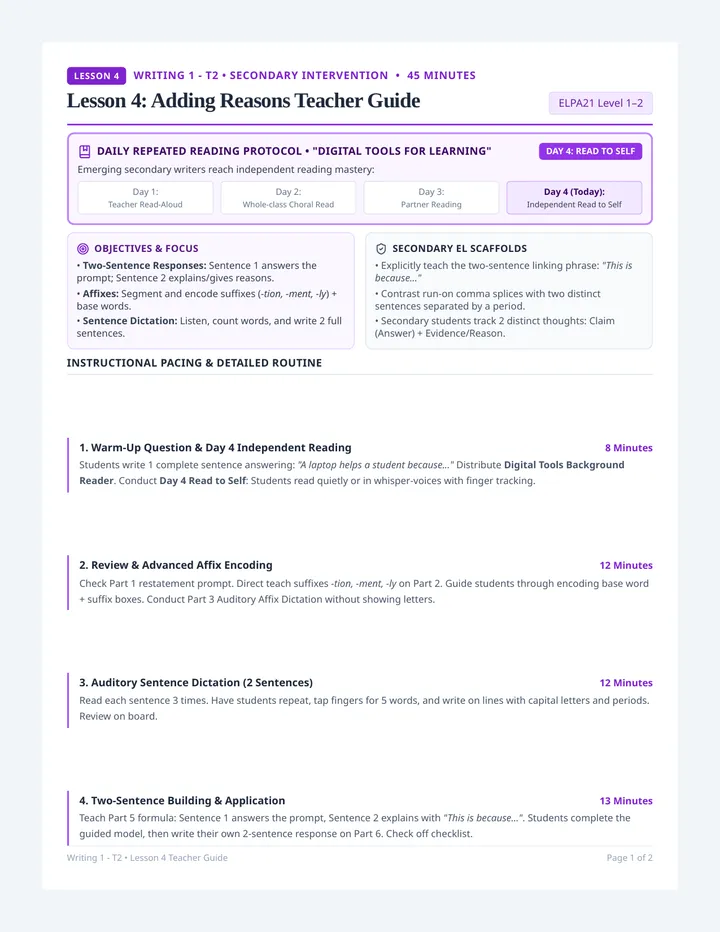
Adding Reasons Teacher GuideLesson 4 Writing 1 - T2 • Secondary Intervention • 45 Minutes Lesson 4: Adding Reasons Teacher Guide ELPA21 Level 1–2 Daily Repeated Reading Protocol • "Digital Tools for Learning" Day 4: Read to Self Emerging secondary writers reach independent reading mastery: Day 1: Teacher Read-Aloud Day 2: Whole-class Choral Read Day 3: Partner Reading Day 4 (Today): Independent Read to Self Objectives & Focus • Two-Sentence Responses: Sentence 1 answers the prompt; Sentence 2 explains/gives reasons. • Affixes: Segment and encode suffixes (-tion, -ment, -ly) + base words. • Sentence Dictation: Listen, count words, and write 2 full sentences. Secondary EL Scaffolds • Explicitly teach the two-sentence linking phrase: "This is because..." • Contrast run-on comma splices with two distinct sentences separated by a period. • Secondary students track 2 distinct thoughts: Claim (Answer) + Evidence/Reason. Instructional Pacing & Detailed Routine 1. Warm-Up Question & Day 4 Independent Reading 8 Minutes Students write 1 complete sentence answering: "A laptop helps a student because..." Distribute Digital Tools Background Reader. Conduct Day 4 Read to Self: Students read quietly or in whisper-voices with finger tracking. 2. Review & Advanced Affix Encoding 12 Minutes Check Part 1 restatement prompt. Direct teach suffixes -tion, -ment, -ly on Part 2. Guide students through encoding base word + suffix boxes. Conduct Part 3 Auditory Affix Dictation without showing letters. 3. Auditory Sentence Dictation (2 Sentences) 12 Minutes Read each sentence 3 times. Have students repeat, tap fingers for 5 words, and write on lines with capital letters and periods. Review on board. 4. Two-Sentence Building & Application 13 Minutes Teach Part 5 formula: Sentence 1 answers the prompt, Sentence 2 explains with "This is because...". Students complete the guided model, then write their own 2-sentence response on Part 6. Check off checklist. Writing 1 - T2 • Lesson 4 Teacher Guide Page 1 of 2 Writing 1 - T2 • Lesson 4 Scripts & Assessment Lesson 4: Scripts & Formative Rubric Lesson 4 Guide Part 3 Affix Dictation Script (Teacher Read-Aloud) Say each word clearly, identify the suffix, and have students write Base word + Suffix: Word 1: in-ven-tion "Laptops are a great invention." Suffix: invent + tion Word 2: pay-ment "Online shopping needs payment." Suffix: pay + ment Word 3: clear-ly "Write your statements clearly." Suffix: clear + ly Part 4 Sentence Dictation Script (2 Complete Sentences) Read each sentence 3 times clearly. Remind students: Capital letter at the start, spaces between words, period at the end: Sentence 1 (5 Words): "Computers help us work quickly." • Subject: Computers • Verb: help | Object/Adverb: us work quickly • Mechanics: Capital C, Period . Sentence 2 (5 Words): "The class makes safe choices." • Subject: The class • Verb: makes | Object: safe choices • Mechanics: Capital T, Period . Common Two-Sentence Errors • Run-On Sentence: Merging both sentences with no period: "Laptops help this is because..." • Fragment Reason: Starting with "Because find facts quickly" without subject/verb. • Lower-Case Second Sentence: Forgetting to capitalize the second sentence. Differentiation Strategies • Support (Level 1): Provide Sentence 2 starter cards: "This is because [Subject] can [Verb]." • Extension (Level 2): Use "For example," or "Furthermore," to introduce Sentence 2. Formative Writing Assessment Rubric (ELPA21 Level 1–2) Score Affixes & Sentence Dictation Two-Sentence Response & Reasoning 4 - Adv Encodes base + affix words correctly and writes both dictated sentences with 100% accuracy. Writes 2 distinct, complete sentences: Sentence 1 directly answers prompt; Sentence 2 provides clear reasoning with correct mechanics. 3 - Prof Encodes affixes accurately; writes dictated sentences with minor spelling slips. Writes 2 sentences with answer and reason; minor punctuation or capitalization slip. 2 - Dev Confuses affix spelling (e.g. -tion vs -sion); misses several words in dictation. Writes 1 sentence only or produces run-on sentence without clear separation. 1 - Beg Unable to segment affix; writes isolated letters. Writes fragmented words without answering prompt or giving reasons. Writing 1 - T2 • Lesson 4 Teacher Guide Page 2 of 2
Adding Reasons Activity SheetWriting 1 - T2 • Lesson 4 • Two Sentences with Reasoning ELPA21 Level 1–2 Lesson 4 Resource Adding Reasons & Explanations Name: Date: Warm-Up Lesson 4 Warm-Up • Write 1 Complete Sentence 5 Minutes Question: How does a laptop computer help a student in school? Word Bank: type essays research facts finish homework send emails A laptop helps a student because it allows them to . Part 1 Review • Restate & Answer Turn this question into a single complete sentence: "Why do classes use internet search?" Answer: Classes use internet search because . Part 2 Affix Encoding • Suffixes (-tion, -ment, -ly) Write the base word and the suffix in the boxes: 1. ac-tion doing something ac tion 2. state-ment sentence or idea 3. quick-ly in a fast way 4. safe-ly without danger Part 3 Auditory Affix Dictation • Listen & Split Listen to your teacher say 3 words. Write the base word and the suffix: Word 1: Word 2: Word 3: Writing 1 - T2 • Lesson 4 • Adding Reasons & Explanations Page 1 of 2 Writing 1 - T2 • Lesson 4 • Sentence Construction Writing Two Connected Sentences Lesson 4 • Page 2 Part 4 Auditory Sentence Dictation (2 Sentences) Teacher Dictation Listen as your teacher reads each sentence 3 times. Count words. Write the full sentence with a capital letter and a period: 1 Sentence 1 (5 Words): Capital Period (.) 2 Sentence 2 (5 Words): Capital Period (.) Part 5 The Two-Sentence Formula • Answer + Reasoning Secondary writers answer a question with 2 connected sentences: Sentence 1: Direct Answer Restate the question and provide your main answer. "Digital tablets help students learn." Sentence 2: Reason / Explanation Begin with "This is because..." or "For example..." "This is because they can find facts quickly." Guided Practice Prompt: "Why is typing practice helpful?" Sentence 1: Typing practice is helpful for students. Sentence 2: This is because . Part 6 Independent Application • Write Two Sentences Prompt: Which technology tool helps you the most at school? Why? Sentence 1 (Answer the prompt): Sentence 2 (Explain or give reason): Two-Sentence Integrity Checklist: Sentence 1 Answers Sentence 2 Explains 2 Capital Letters 2 Periods (.) Writing 1 - T2 • Lesson 4 • Adding Reasons & Explanations Page 2 of 2
Digital Tools Background ReaderWriting 1 - T2 • Lesson 4 • Digital Tools Reader ELPA21 Level 1–2 Lesson 4 Resource Digital Tools for Learning Read about technology in education before writing two connected sentences with reasons. Name: Date: Target Suffix Words (-tion, -ment, -ly) ⚡ quick-ly in fast speed 🔒 safe-ly with protection 🎯 ac-tion doing an activity 💬 state-ment clear written idea Background Reading • Technology for Secondary Learning 💻 1. Laptops on Campus Today, most schools assign a personal laptop or tablet to every student. Having a computer allows teenagers to organize digital folders, submit essays, and communicate with instructors. 🔍 2. Researching Facts Quickly Students use school internet databases to find scientific facts quick-ly. Instead of searching through heavy books, a fast keyword search brings accurate articles in seconds. 🛡️ 3. Practicing Digital Safety Students must navigate the internet safe-ly. Teachers remind classes to never share personal passwords, keep web cameras off during public browsing, and avoid suspicious links. 🌐 4. Language Learning Software Digital language tools support emerging bilingual learners. Students listen to spoken audio clips and complete interactive grammar exercises. This regular ac-tion strengthens writing speed. Reading to Writing Bridge • Connect Answer + Reason Sentence 1 (Answer): Online search helps students research facts. Sentence 2 (Reason): This is because internet articles appear very . Writing 1 - T2 • Lesson 4 Resource • Digital Tools Reader Page 1 of 2 Writing 1 - T2 • Lesson 4 • Cloze Reading Practice Fill in the Blanks • Digital Technology Lesson 4 • Page 2 Cloze Word Bank (5 Target Words): Cross out each word as you use it laptop research quickly safely action Reading Task Read the Story and Write the Missing Words Read the passage below based on Page 1. Write the correct word from the bank on each blank line: In modern classes, every student carries a personal (1) to complete daily academic assignments. Students use internet browsers to conduct (2) for science and history projects. Online databases help teenagers find accurate facts very (3) without wasting time. Teachers remind everyone to browse (4) by keeping private passwords protected. Taking positive (5) online prepares teenagers for future college and workplace technology! Cloze Reading Self-Check: Used all 5 words Spelled words correctly Read sentences aloud Writing 1 - T2 • Lesson 4 Resource • Digital Tools Reader Page 2 of 2
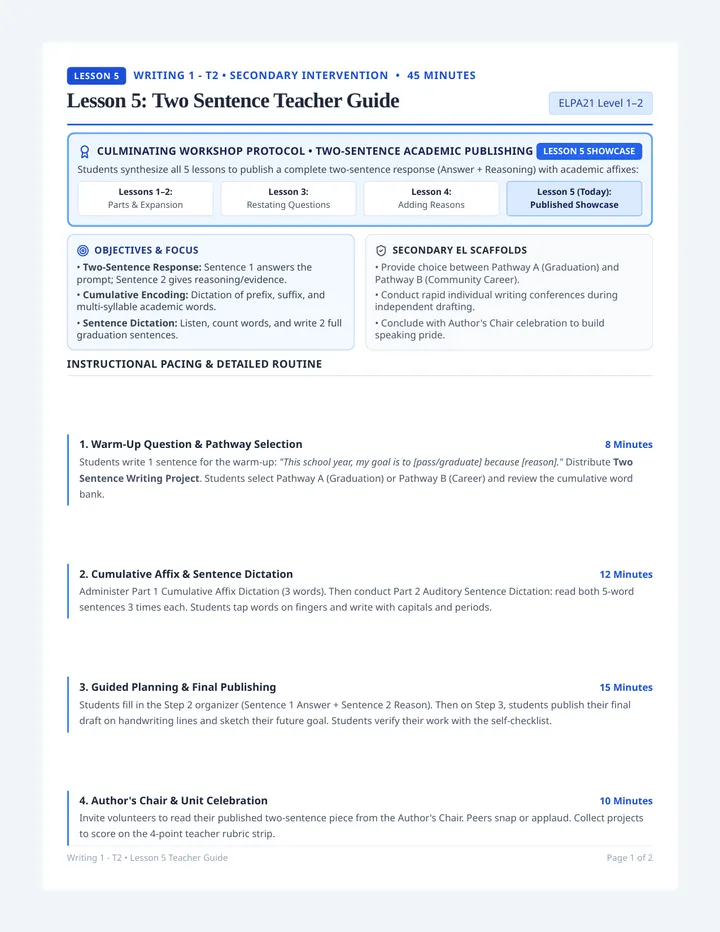
Two Sentence Teacher GuideLesson 5 Writing 1 - T2 • Secondary Intervention • 45 Minutes Lesson 5: Two Sentence Teacher Guide ELPA21 Level 1–2 Culminating Workshop Protocol • Two-Sentence Academic Publishing Lesson 5 Showcase Students synthesize all 5 lessons to publish a complete two-sentence response (Answer + Reasoning) with academic affixes: Lessons 1–2: Parts & Expansion Lesson 3: Restating Questions Lesson 4: Adding Reasons Lesson 5 (Today): Published Showcase Objectives & Focus • Two-Sentence Response: Sentence 1 answers the prompt; Sentence 2 gives reasoning/evidence. • Cumulative Encoding: Dictation of prefix, suffix, and multi-syllable academic words. • Sentence Dictation: Listen, count words, and write 2 full graduation sentences. Secondary EL Scaffolds • Provide choice between Pathway A (Graduation) and Pathway B (Community Career). • Conduct rapid individual writing conferences during independent drafting. • Conclude with Author's Chair celebration to build speaking pride. Instructional Pacing & Detailed Routine 1. Warm-Up Question & Pathway Selection 8 Minutes Students write 1 sentence for the warm-up: "This school year, my goal is to [pass/graduate] because [reason]." Distribute Two Sentence Writing Project. Students select Pathway A (Graduation) or Pathway B (Career) and review the cumulative word bank. 2. Cumulative Affix & Sentence Dictation 12 Minutes Administer Part 1 Cumulative Affix Dictation (3 words). Then conduct Part 2 Auditory Sentence Dictation: read both 5-word sentences 3 times each. Students tap words on fingers and write with capitals and periods. 3. Guided Planning & Final Publishing 15 Minutes Students fill in the Step 2 organizer (Sentence 1 Answer + Sentence 2 Reason). Then on Step 3, students publish their final draft on handwriting lines and sketch their future goal. Students verify their work with the self-checklist. 4. Author's Chair & Unit Celebration 10 Minutes Invite volunteers to read their published two-sentence piece from the Author's Chair. Peers snap or applaud. Collect projects to score on the 4-point teacher rubric strip. Writing 1 - T2 • Lesson 5 Teacher Guide Page 1 of 2 Writing 1 - T2 • Lesson 5 Scripts & Assessment Lesson 5: Scripts & Summative Rubric Lesson 5 Guide Part 1 Cumulative Affix Dictation Script (Teacher Read-Aloud) Say each word clearly, identify the affix part, and have students write in the boxes: Word 1: re-write "Rewrite your clean draft." Prefix: re + write Word 2: help-ful "Classmates are helpful." Suffix: help + ful Word 3: safe-ly "We study safely online." Suffix: safe + ly Part 2 Sentence Dictation Script (2 Complete Sentences) Read each sentence 3 times clearly. Remind students: Capital letter at the start, spaces between words, period at the end: Sentence 1 (5 Words): "Graduation opens many new doors." • Subject: Graduation • Verb: opens | Object: many new doors • Mechanics: Capital G, Period . Sentence 2 (5 Words): "Students prepare for great careers." • Subject: Students • Verb: prepare | Phrase: for great careers • Mechanics: Capital S, Period . 1-Minute Conferencing Prompts • "Point to where you answer the question." (Check Sentence 1). • "Read me your reason. Did you start with 'This is because'?" • "Touch the period between your two sentences." Benchmark Success Criteria • Exactly 2 complete sentences (or 3 sentences with extension). • Clear prompt response + logical explanation or reason. • Both sentences capitalized with ending periods. Summative Writing Rubric (ELPA21 Level 1–2 Standards) Score Dictation & Affix Accuracy Published Two-Sentence Response 4 - Adv Encodes all 3 cumulative words and writes both dictated sentences with 100% accuracy. Writes 2–3 connected sentences: Sentence 1 clearly answers prompt; Sentence 2 provides strong explanation with 'because'; correct mechanics throughout. 3 - Prof Encodes 2–3 words accurately; writes sentences with minor phonetic slips. Writes 2 sentences with prompt answer and logical reason; minor capitalization or end punctuation slip. 2 - Dev Confuses affix parts; misses several words in auditory dictation. Writes 1 complete sentence or produces run-on sentence without punctuation separating the two thoughts. 1 - Beg Unable to segment affixes; writes initial sounds only. Draws picture and writes isolated words or incomplete phrases without sentence structure. Writing 1 - T2 • Lesson 5 Teacher Guide Page 2 of 2
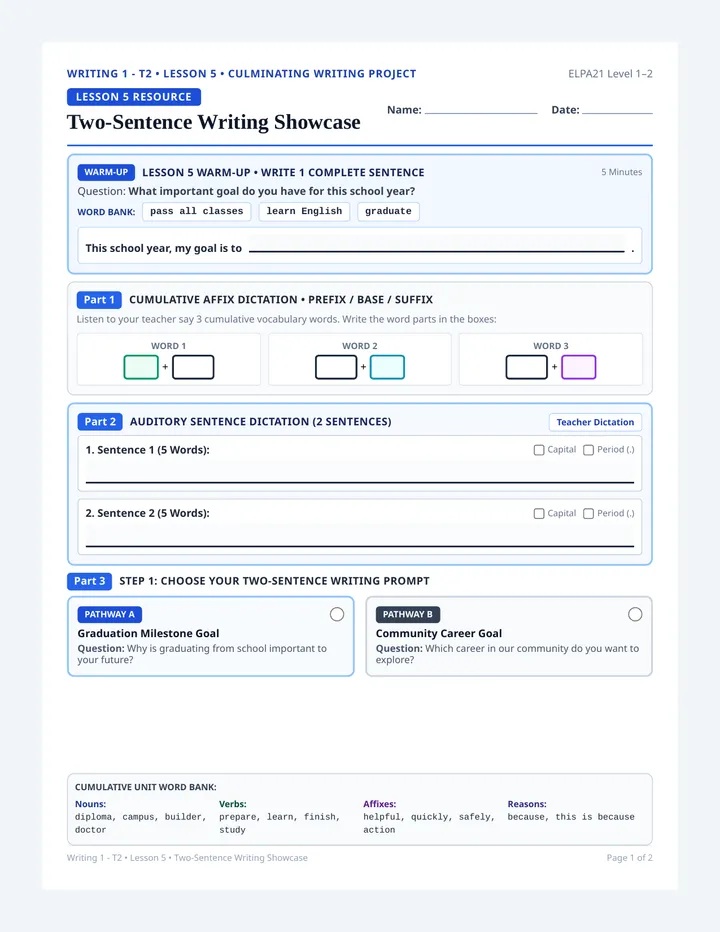
Two Sentence Writing ProjectWriting 1 - T2 • Lesson 5 • Culminating Writing Project ELPA21 Level 1–2 Lesson 5 Resource Two-Sentence Writing Showcase Name: Date: Warm-Up Lesson 5 Warm-Up • Write 1 Complete Sentence 5 Minutes Question: What important goal do you have for this school year? Word Bank: pass all classes learn English graduate This school year, my goal is to . Part 1 Cumulative Affix Dictation • Prefix / Base / Suffix Listen to your teacher say 3 cumulative vocabulary words. Write the word parts in the boxes: Word 1 Word 2 Word 3 Part 2 Auditory Sentence Dictation (2 Sentences) Teacher Dictation 1. Sentence 1 (5 Words): Capital Period (.) 2. Sentence 2 (5 Words): Capital Period (.) Part 3 Step 1: Choose Your Two-Sentence Writing Prompt Pathway A Graduation Milestone Goal Question: Why is graduating from school important to your future? Pathway B Community Career Goal Question: Which career in our community do you want to explore? Cumulative Unit Word Bank: Nouns: diploma, campus, builder, doctor Verbs: prepare, learn, finish, study Affixes: helpful, quickly, safely, action Reasons: because, this is because Writing 1 - T2 • Lesson 5 • Two-Sentence Writing Showcase Page 1 of 2 Writing 1 - T2 • Lesson 5 • Publishing & Assessment Writing & Publishing Your Response Lesson 5 • Page 2 Step 2 Two-Sentence Academic Plan Sentence 1: Direct Answer (Restate prompt + Answer): Sentence 2: Reason / Explanation (Start with "This is because..."): Step 3 Published Final Draft • Write in Best Handwriting 🎓 💼 🏫 Draw your career or graduation goal here Author's Self-Monitoring Checklist: Sentence 1 Answers Sentence 2 Explains 2 Capital Letters 2 Periods (.) Teacher Evaluation (ELPA21 Level 1–2 Writing Criteria): Score: _____ / 4 4 - Advanced 2 full sentences; clear answer + clear reason with "because"; accurate affixes & mechanics. 3 - Proficient 2 sentences with answer and reason; minor capitalization, spelling, or punctuation slip. 2 - Developing 1 sentence completed; reason is fragmented or relies heavily on copied word bank words. 1 - Beginning Isolated words or drawing only; does not write complete sentences. Writing 1 - T2 • Lesson 5 • Two-Sentence Writing Showcase Page 2 of 2
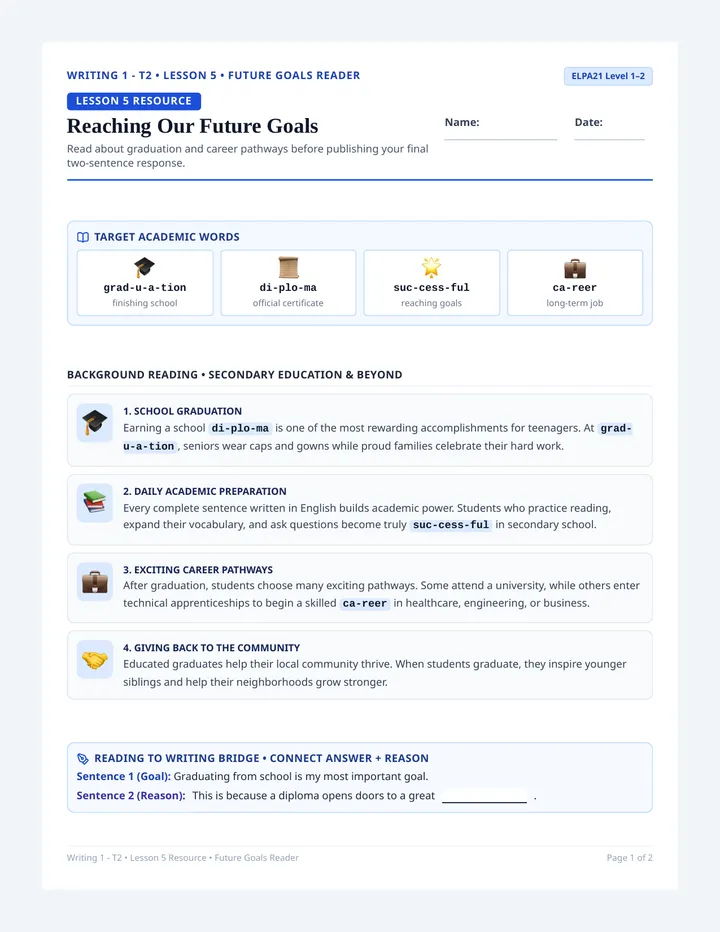
Future Goals Background ReaderWriting 1 - T2 • Lesson 5 • Future Goals Reader ELPA21 Level 1–2 Lesson 5 Resource Reaching Our Future Goals Read about graduation and career pathways before publishing your final two-sentence response. Name: Date: Target Academic Words 🎓 grad-u-a-tion finishing school 📜 di-plo-ma official certificate 🌟 suc-cess-ful reaching goals 💼 ca-reer long-term job Background Reading • Secondary Education & Beyond 🎓 1. School Graduation Earning a school di-plo-ma is one of the most rewarding accomplishments for teenagers. At grad-u-a-tion, seniors wear caps and gowns while proud families celebrate their hard work. 📚 2. Daily Academic Preparation Every complete sentence written in English builds academic power. Students who practice reading, expand their vocabulary, and ask questions become truly suc-cess-ful in secondary school. 💼 3. Exciting Career Pathways After graduation, students choose many exciting pathways. Some attend a university, while others enter technical apprenticeships to begin a skilled ca-reer in healthcare, engineering, or business. 🤝 4. Giving Back to the Community Educated graduates help their local community thrive. When students graduate, they inspire younger siblings and help their neighborhoods grow stronger. Reading to Writing Bridge • Connect Answer + Reason Sentence 1 (Goal): Graduating from school is my most important goal. Sentence 2 (Reason): This is because a diploma opens doors to a great . Writing 1 - T2 • Lesson 5 Resource • Future Goals Reader Page 1 of 2 Writing 1 - T2 • Lesson 5 • Cloze Reading Practice Fill in the Blanks • Future Pathways Lesson 5 • Page 2 Cloze Word Bank (5 Target Words): Cross out each word as you use it graduation diploma successful career community Reading Task Read the Story and Write the Missing Words Read the passage below based on Page 1. Write the correct word from the bank on each blank line: Reaching school (1) is an inspiring milestone for secondary English learners. When students earn a (2) , they prove their dedication and academic ability. Practicing writing full sentences every day helps teenagers become (3) in all subject areas. Graduates can train for a technical (4) or continue their education in college. Every skilled graduate makes our (5) stronger, prouder, and more united! Cloze Reading Self-Check: Used all 5 words Spelled words correctly Read sentences aloud Writing 1 - T2 • Lesson 5 Resource • Future Goals Reader Page 2 of 2