Text Feature Tracker Worksheet
CKLA Grade 3 • Unit 2 Review
Text Feature Tracker
Name:
Date: Score:
Nonfiction authors use text features to organize animal classification facts, clarify new scientific words, and help readers locate information quickly.
1 Part 1: Text Feature Match-Up
Write the letter of the matching purpose in each box.
1. Table of Contents
2. Heading & Subheading
3. Bold Print Words
4. Caption
5. Diagram with Labels
6. Glossary
7. Sidebar / Fact Box
A. Explains or gives more details about an illustration or photograph.
B. An alphabetical list of domain vocabulary words and definitions at the back.
C. Calls attention to important scientific vocabulary words in the text.
D. Shows the internal or external parts of an animal using clear pointers.
E. Lists chapter titles and beginning page numbers at the front of the book.
F. Tells the main topic or focus of the entire section or upcoming passage.
G. Provides bonus facts or interesting tidbits set apart from the main story.
2 Part 2: Identify Features on a Page
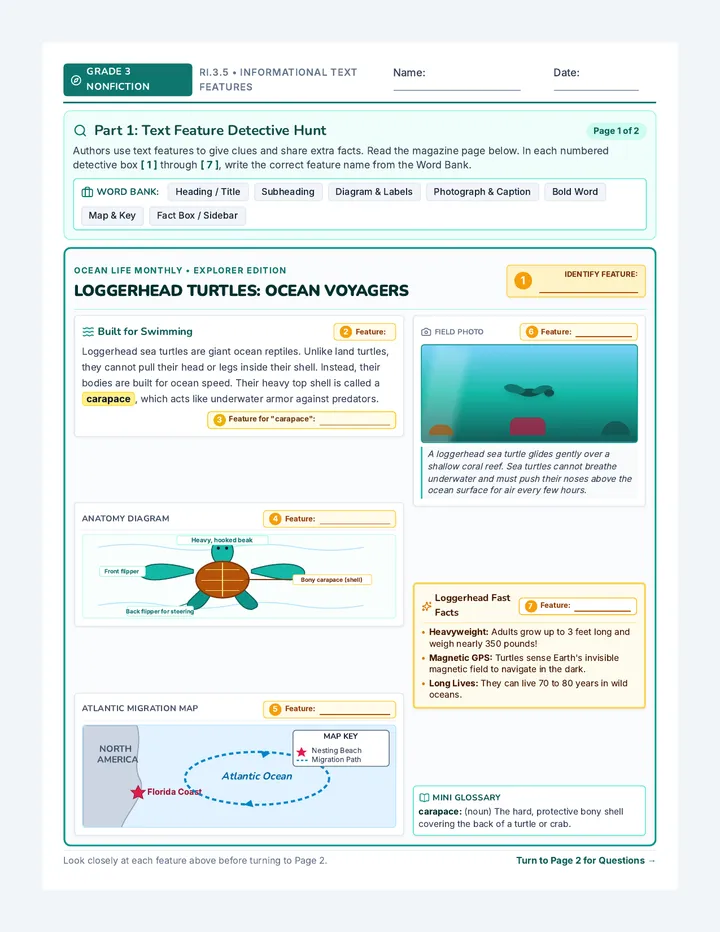
Use the Word Bank to name each numbered feature [1]–[5].
WORD BANK
Heading Subheading Bold Print Diagram with Labels Sidebar (Fact Box) Caption
Rattenborough's Guide • Page 14
[ 1 ]
Cold-Blooded Reptiles
[ 2 ]
Chameleons in the Canopy
Reptiles are [ 3 ]ectothermic vertebrates, which means they cannot control their own internal body temperature. Chameleons have specialized scales and skin cells that allow them to practice camouflage when hiding from predators or stalking insects.
Chameleon Anatomy Diagram [ 4 ]
← Independent Eyes Sticky Tongue → Grasping Claws ↓
Rattenborough's Fact Box [ 5 ]
Did you know? A chameleon can shoot its tongue out at twice the length of its body to snatch flies!
[Photograph: Panther Chameleon]
A chameleon basks on a branch to warm its blood.
[ 1 ]
[ 2 ]
[ 3 ]
[ 4 ]
[ 5 ]
CKLA Grade 3 • Unit 2: Classification of Animals Page 1 of 2
Text Feature Detective
CKLA Grade 3 Unit 2 • Animal Classification Reading Skills
Student Name:
3 Part 3: Text Feature Detective Scenarios
Fill in the bubble next to the best text feature for each situation.
- You need to know what page chapter 4, "Warm-Blooded Mammals," begins. Where should you look first?
A. Glossary
B. Table of Contents
C. Diagram with Labels
D. Photo Caption
- You encounter the bold word exoskeleton and do not know what it means. Which feature provides the definition?
A. Section Heading
B. Sidebar Fact Box
C. Glossary
D. Table of Contents
- You are reading about fish and want to see where gill slits are and how water flows through them. What feature helps most?
A. Labeled Diagram
B. Subheading
C. Bold Print
D. Table of Contents
- You see a photo of a poison dart frog. Which text feature will explain why its skin is brightly colored blue and yellow?
A. Glossary
B. Photo Caption
C. Table of Contents
D. Main Heading
- While reading about reptiles, you want to find an extra fun fact about animal records that is set apart from the main story. Where is it?
A. Glossary
B. Sidebar / Fact Box
C. Table of Contents
D. Labeled Diagram
- Before you begin reading a new page, which text feature tells you what main animal group or topic the passage will be about?
A. Heading / Subheading
B. Glossary
C. Photo Caption
D. Bold Print
Reader Checklist:
Read headings first Examine diagrams & captions Look up bold words in glossary
CKLA Grade 3 • Unit 2: Classification of Animals Page 2 of 2