Slide Sleuth Guided Notes
Slide Sleuth
Active Presentation & Guided Notes Companion
Name:
Date: Period:
Presentation Title / Topic:
Presenter:
Essential Question:
Strategy Tip: Watch for bold text, repeated themes, and key visuals on screen. Summarize points in your own words rather than copying word-for-word.
1. Main Claims & Road Map
Capture major claims stated in introductory & concept slides
Slide # _____ Core Idea Opening Concept
What is the central concept or argument introduced on this slide?
Key Supporting Evidence or Fact Given:
Slide # _____ Deep Dive Developing Concept
What new principle, rule, or mechanism is explained?
Key Example or Application Shared:
2. Slide Vocabulary Decoders
Track 3 critical academic terms introduced in the presentation
Term & Slide #
Definition In Your Own Words
Memory Cue / Symbol
Term 1:
Slide # ___
Term 2:
Slide # ___
Term 3:
Slide # ___
3. Misconception Buster Checkpoint
Identify a common mistake, myth, or confusion that the slides addressed:
Common Mistake or Misconception:
Accurate Fact (Slide Evidence):
Slide Sleuth • Guided Notes Framework Page 1 of 2 • Continue to Diagram & Synthesis →
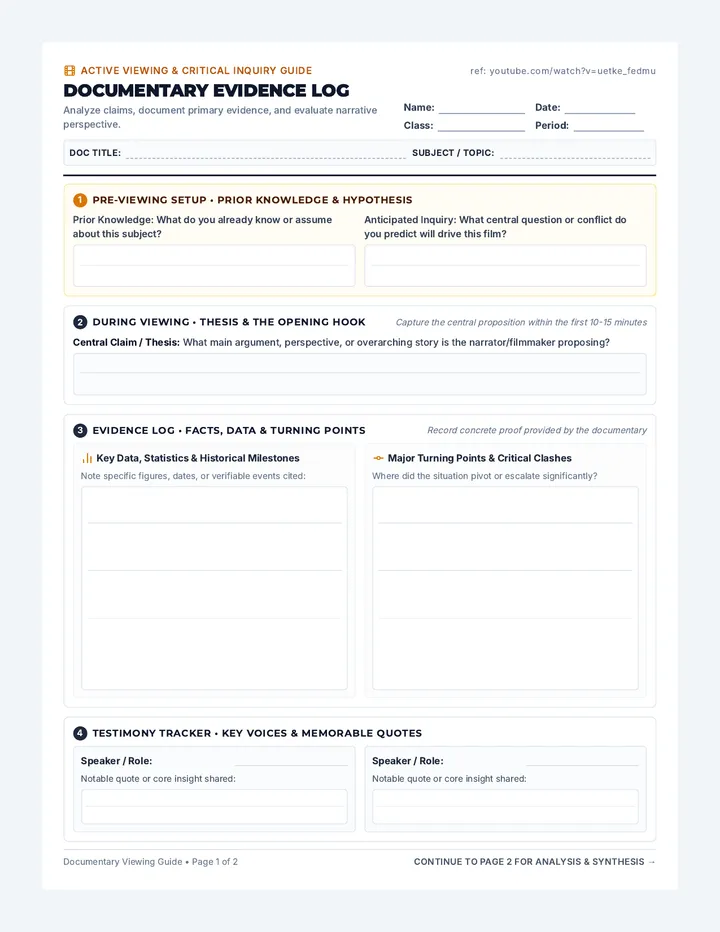
SLIDE SLEUTH • PART II: DIAGRAMS & SYNTHESIS
Name:
Topic:
4. Slide Diagram & Model Breakdown
Recreate and unpack the presentation's primary visual
Visual / Diagram Sketch: Slide # _____
Label key parts, arrows, stages, or variables
Key Components & Labels:
What do the main arrows, colors, or sections represent?
Why This Visual Matters:
How does this graphic clarify the spoken content?
5. Logical Flow & Cause-and-Effect
Trigger / Input / Condition (Slide # ___):
Result / Consequence / Output (Slide # ___):
6. 3-2-1 Slide Synthesis
Consolidate your learning before moving on
3 Big Takeaways Every Student Should Master:
2 Questions Raised or Real-World Connections:
A.
B.
1 One-Sentence Executive Summary of the Presentation:
Self-Check: Clear & Understood Need Review
Teacher / Peer Check: