POV and Vocab Anchor Chart
NC 5th Grade ELA Anchor Chart
Point of View & Power Words
Spotlight: RL.5.6 & RI.5.4 How Perspective & Vocabulary Shape Meaning
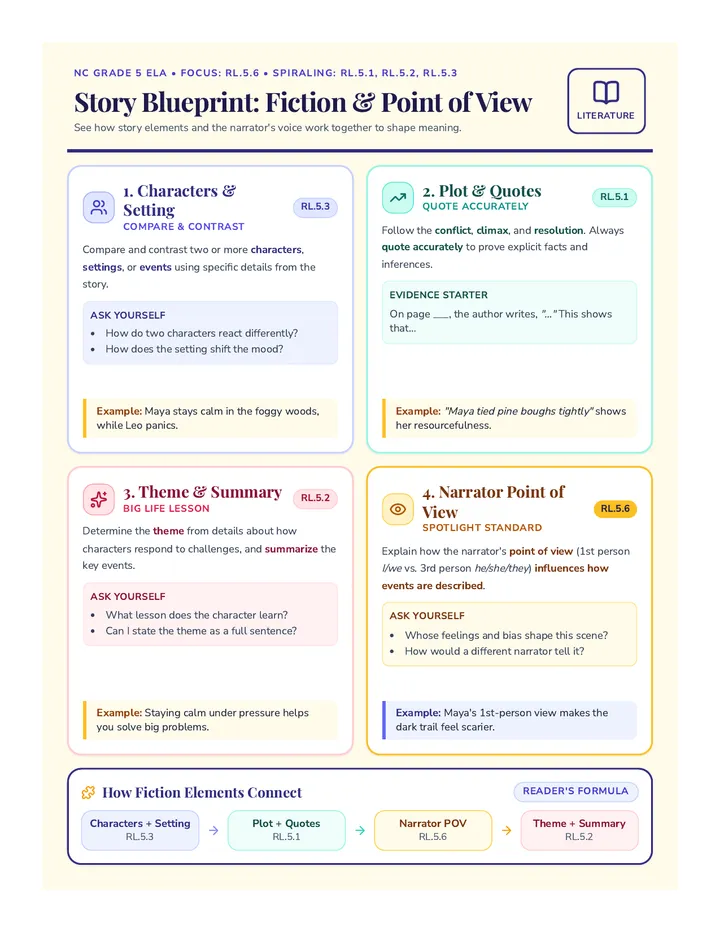
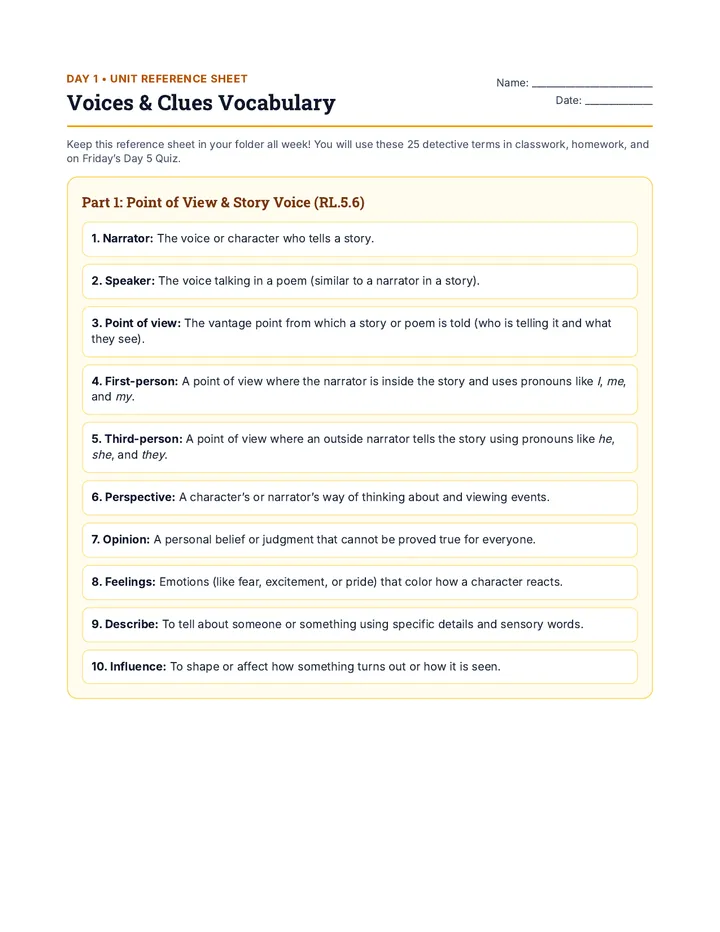
Narrator's Point of View
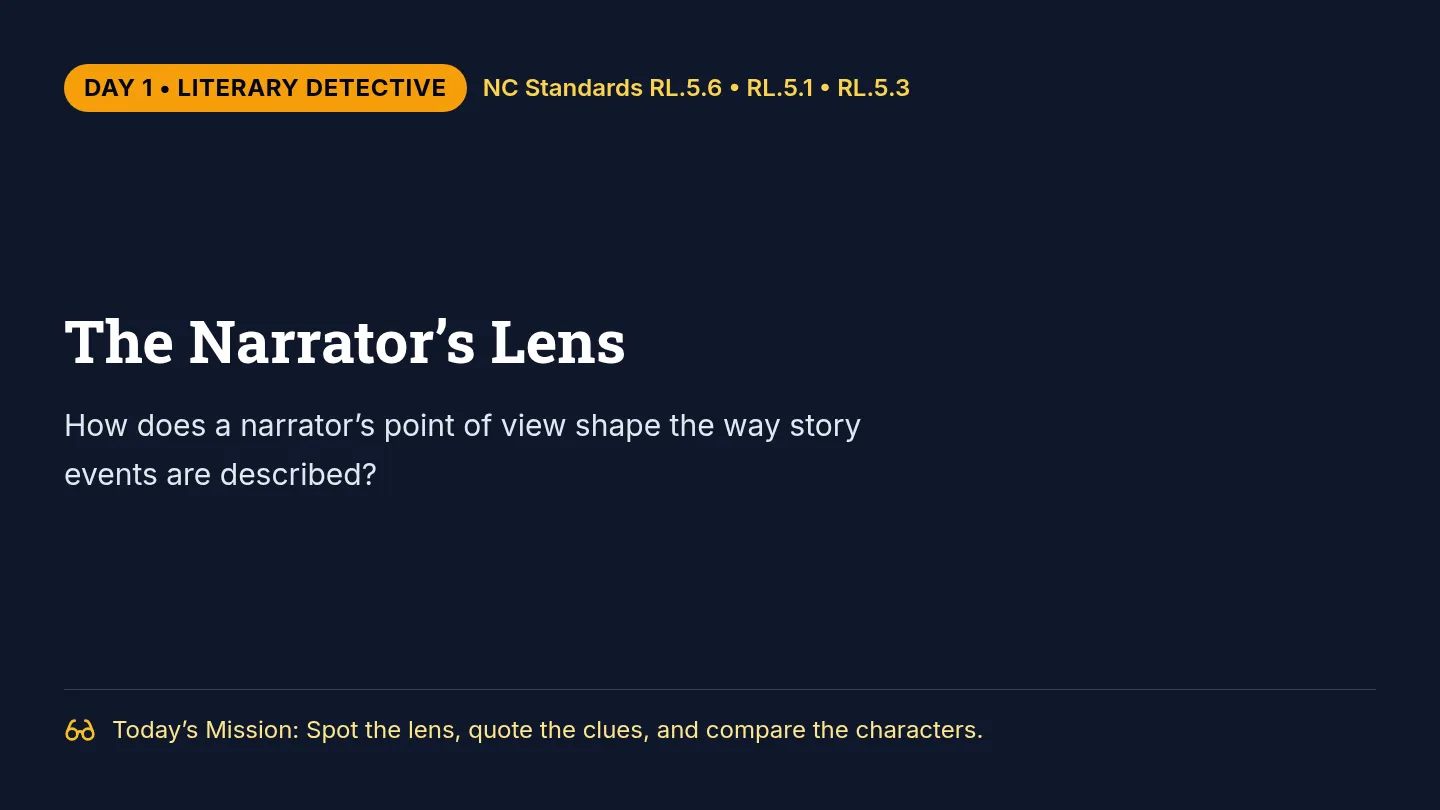
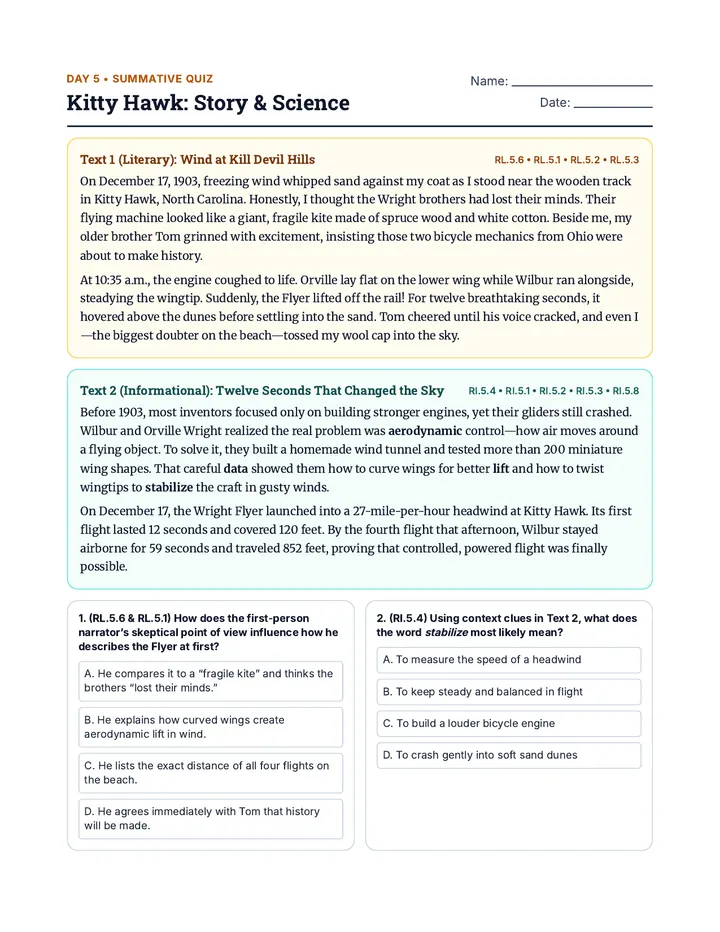
Describe how a narrator's or speaker's POV influences how events are described.
RL.5.6
First-Person POV I, me, my, we
The narrator is inside the story. We only know their thoughts, feelings, and bias.
"My stomach dropped when Maya took the last map. She always hogs the best gear!"
Third-Person POV he, she, they
An outside observer tells the story—either focused on one character (limited) or many (omniscient).
"Maya grabbed the last map, worried the storm would hit before anyone else was ready."
Ask Yourself: How would this event sound different if another character told it? Look for opinion words, exaggerations, and hidden motives.
Academic & Domain-Specific Words
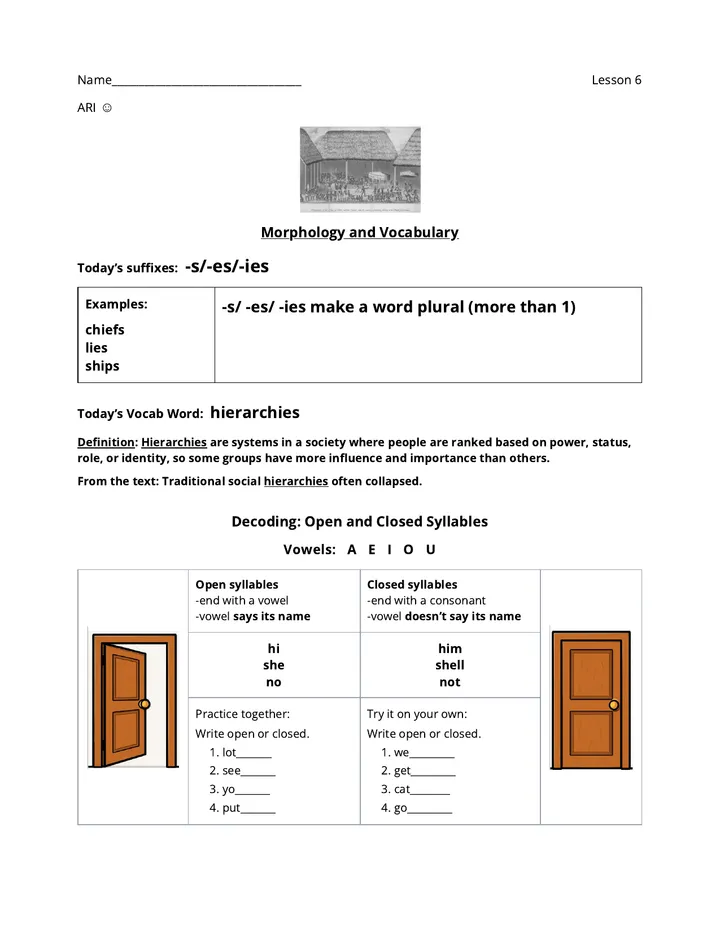
Determine the meaning of general academic and subject-specific words in 5th grade texts.
RI.5.4
Tier 2 • Academic
High-utility words used across all subjects to explain ideas precisely.
analyze significant consequence contrast
Tier 3 • Domain-Specific
Expert words tied to a specific topic (science, history, math).
ecosystem photosynthesis amendment
1. Word Parts
Check prefixes, roots & suffixes
2. Context Clues
Read before & after the word
3. Text Features
Use glossaries, captions & bold print
4. Plug It In
Swap in a synonym to test sense
Always Spiral Back: Quote Accurately! RL.5.1 & RI.5.1
Support every claim about POV, vocabulary, or meaning with an exact quote + inference: "On page ___, the text states, '...' This shows..."
Spiraled Comprehension Toolkit
Connect Every Clue in the Text
Spiral: RL.5.1–5.3 & RI.5.1–5.3, 5.8
Literature Lens (RL)
Quote & Infer RL.5.1
Combine exact quotes with background knowledge to explain what the text says explicitly and what it implies.
Stem: "The author writes, '...' which leads me to infer..."
Theme & Summary RL.5.2
Find the life lesson (theme) by watching how characters respond to challenges or how a speaker reflects. Summarize key events in order without opinions.
Ask: "What did the character learn after facing trouble?"
Compare Story Elements RL.5.3
Compare and contrast two or more characters, settings, or events using specific details about how they interact.
Look for: dialogue, choices, and shifting relationships.
POV Link (RL.5.6):
A narrator's POV shapes how we judge characters (RL.5.3) and uncover the theme (RL.5.2)!
Informational Lens (RI)
Quote & Infer RI.5.1
Cite exact facts and quotes from the article when explaining explicit information or drawing inferences.
2+ Main Ideas & Summary RI.5.2
Identify two or more main ideas and explain how key details support each one. Summarize concisely.
Explain Relationships RI.5.3
Explain how people, events, ideas, or concepts interact in historical, scientific, or technical texts (cause/effect, steps).
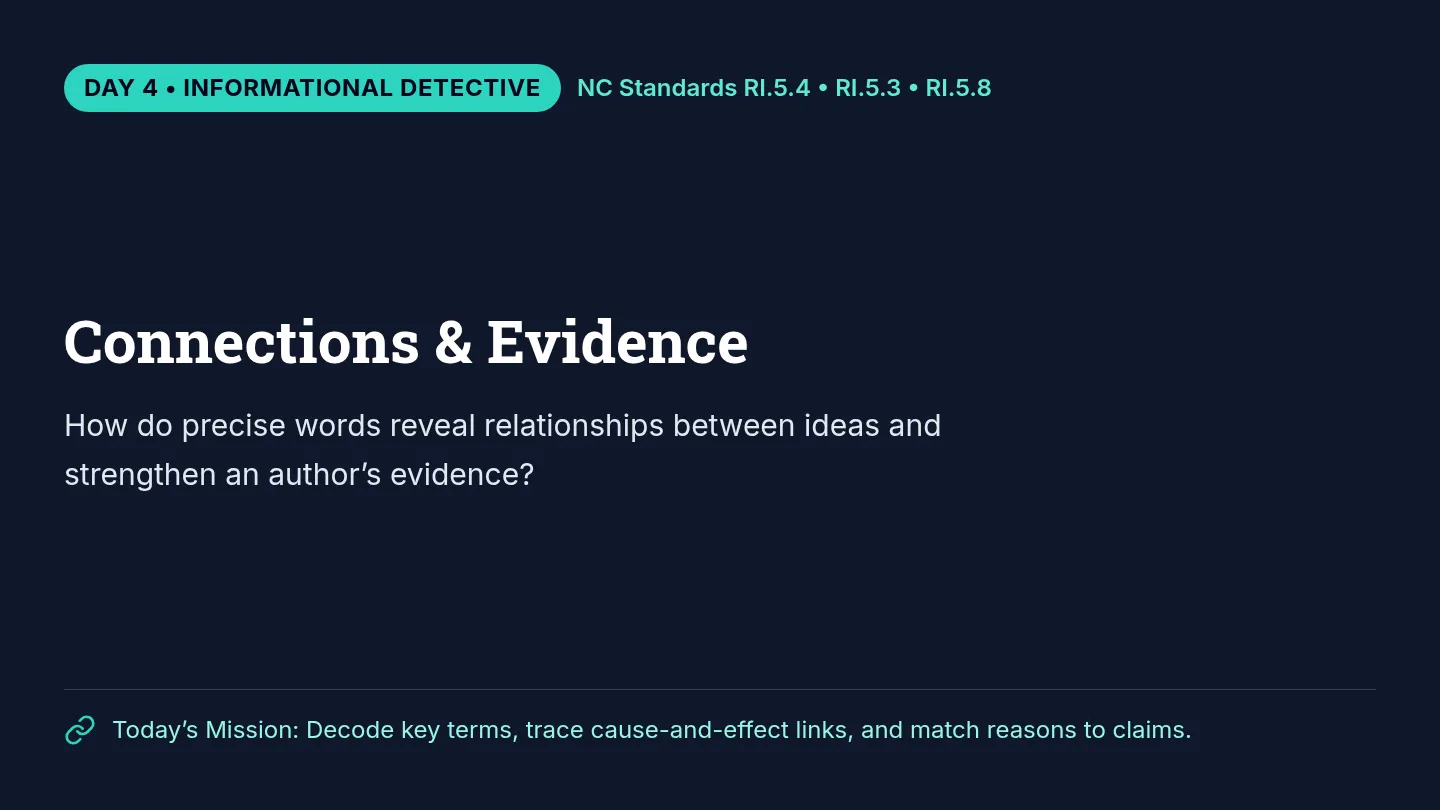
Reasons & Evidence RI.5.8
Match the author's specific reasons and evidence to the exact point(s) they support.
Vocab Link (RI.5.4):
Domain-specific words unlock main ideas (RI.5.2), relationships (RI.5.3), and evidence (RI.5.8)!
5th Grade Reader's Checklist:
1. Who's telling it? (RL.5.6) 2. What do key words mean? (RI.5.4) 3. Can I quote proof? (RL/RI.5.1)