Narrator Lens Slides Day 1 • Literary Detective NC Standards RL.5.6 • RL.5.1 • RL.5.3
The Narrator’s Lens
How does a narrator’s point of view shape the way story events are described?
Today’s Mission: Spot the lens, quote the clues, and compare the characters.
Today’s Detective Targets
RL.5.6
Point of View
Describe how a narrator’s point of view influences how events are described.
RL.5.1
Quote Clues
Quote accurately from the text when explaining ideas and drawing inferences.
RL.5.3
Compare Characters
Compare and contrast two characters using specific details from the story.
Anchor Concept • RL.5.6
Point of View Is a Camera Filter
A narrator doesn’t just report facts—their feelings, role, and attitude tint every detail they share.
1st-Person Narrator (“I / Me”)
Inside the action! We hear their inner worries, excitement, and opinions—sometimes exaggerating what happens.
3rd-Person Narrator (“He / She / They”)
Outside the action! Can zoom into one character’s thoughts or observe multiple characters from above.
Guided Model • RL.5.6 + RL.5.1
Spot the Influenced Words
“The gymnasium clock glared down like an angry judge. My cardboard volcano looked pathetic and soggy beside Leo’s gleaming solar rover.”
Narrator’s Feeling
Nervous and insecure about her project.
How It Shapes the Event
Makes the clock seem hostile and her own work seem ruined.
Turn & Talk
If Leo were telling the story instead, how might he describe the exact same science fair morning?
Sentence Starter: “If Leo narrated, he might describe the gym as ___ because he feels ___.”
Storm Fair Worksheet Day 1 • Classwork Case File
The Rain-Soaked Volcano
Name: _________________________
Date: ______________
RL.5.6 Point of View RL.5.1 Quoting Text RL.5.3 Compare Characters
Directions: Read Maya’s story carefully. Choose the best answer for each multiple-choice question.
1 The sky opened up just as my mom pulled into the school drop-off lane. I clutched my paper-mâché volcano like a fragile treasure, but a gust of wind yanked my umbrella backward. Fat raindrops splattered across the painted crater, turning my carefully mixed brown lava streaks into muddy puddles. My stomach twisted into a tight knot.
2 Inside the gymnasium, everything felt too loud and too bright. Banners snapped in the draft from the doors, and judges in clipboards marched up and down the aisles like stern inspectors. Beside our table, my partner Leo was whistling softly while he arranged our baking-soda bottles in a neat row.
3 “Look at it,” I groaned, pointing at a soggy flap of newspaper peeling off the base. “Our whole display is ruined before the fair even starts.”
4 Leo tilted his head and grinned. “Ruined? No way! That wet streak actually looks like real cooled magma after a rainstorm. Plus, the eruption still works.” He handed me a paper towel and tapped the neatly labeled poster board behind us. “Nobody’s going to stare at one damp corner when the volcano shoots foam three feet high.”
5 I stared at the damp cardboard, still half-convinced the judges would deduct points for messy edges. Yet when Leo tested the funnel and winked, my shoulders finally dropped an inch.
1. (RL.5.6 & RL.5.1) Which quote from paragraph 2 BEST shows how Maya’s nervous point of view makes the judges seem intimidating?
A. “Banners snapped in the draft from the doors...”
B. “...judges in clipboards marched up and down the aisles like stern inspectors.”
C. “Beside our table, my partner Leo was whistling softly...”
D. “...he arranged our baking-soda bottles in a neat row.”
The Rain-Soaked Volcano • Page 2 RL.5.6 • RL.5.1 • RL.5.3
2. (RL.5.3) How does Leo’s reaction to the damp volcano contrast with Maya’s reaction in paragraphs 3–4?
A. Leo blames Maya for forgetting her umbrella, while Maya stays calm.
B. Leo worries the judges will deduct points, while Maya ignores the problem.
C. Leo stays optimistic and sees the wet streak as realistic, while Maya fears the display is ruined.
D. Leo asks to rebuild the volcano from scratch, while Maya wants to leave early.
3. (RL.5.6) If Leo were the first-person narrator of this story instead of Maya, how would his description of the morning most likely change?
A. He would focus on the excitement of the foam eruption rather than the damp cardboard.
B. He would describe the gymnasium lights as blinding and scary.
C. He would complain that the rain ruined their poster board.
D. He would avoid talking to the judges or testing the funnel.
Exit Ticket • Check Your Lens
4. (RL.5.6 & RL.5.1) Which detail from paragraph 5 shows that Maya’s point of view begins to shift by the end of the passage?
A. “My stomach twisted into a tight knot.”
B. “...when Leo tested the funnel and winked, my shoulders finally dropped an inch.”
C. “...a gust of wind yanked my umbrella backward.”
D. “...everything felt too loud and too bright.”
Narrator Lens Teacher Guide Day 1 Teacher Guide • Voices and Clues
Narrator Lens Launch
Grade 5 ELA • 45 Minutes
Focus: RL.5.6 • Spiral: RL.5.1, RL.5.3
1. Launch (10 min)
Use Narrator Lens Slides 1–3 . Introduce POV as a camera filter: a narrator’s feelings tint what they notice and how they describe it.
2. Model (10 min)
Project Slide 4 . Think aloud: underline “glared down like an angry judge” and model eliminating distractor quotes (RL.5.1).
3. Practice (25 min)
Slide 5 Turn & Talk, then students complete Storm Fair Worksheet . Assign Storm Fair Homework for evening practice.
Differentiation & Support
Scaffold: Have students underline feeling words in the passage before tackling the multiple-choice stems.
Extend: Ask early finishers to explain in the margin why each distractor in Question 3 does not match Leo’s personality.
Answer Key • Storm Fair Worksheet (Classwork)
1. B (RL.5.6 & RL.5.1) — “...judges in clipboards marched up and down the aisles like stern inspectors.”
2. C (RL.5.3) — Leo stays optimistic and sees the wet streak as realistic, while Maya fears the display is ruined.
3. A (RL.5.6) — He would focus on the excitement of the foam eruption rather than the damp cardboard.
4. B (RL.5.6 & RL.5.1) — “...when Leo tested the funnel and winked, my shoulders finally dropped an inch.”
Answer Key • Storm Fair Homework
1. A (RL.5.6) — Curtains/stands seem trapping and chaotic.
2. B (RL.5.1) — “...scary hallway suddenly looked bright again.”
3. B (RL.5.3) — Zoe stays calm and helpful vs. overwhelmed narrator.
4. B (RL.5.6) — Helping her friend find a misplaced bow.
Storm Fair Homework Day 1 • Homework Practice
The Missing Violin Bow
Name: _________________________
Date: ______________
Five minutes before the winter concert, I unzipped my violin case and gasped. My bow was gone! Backstage, the velvet curtains looked like giant dark walls closing in on me. Music stands cluttered the narrow hallway like an obstacle course. Beside me, my stand partner Zoe calmly tuned her strings and hummed our opening melody. “Check your music folder,” she suggested with a grin. “Last week you tucked it behind your sheet music.” Sure enough, the wooden bow slid right out, and the scary hallway suddenly looked bright again.
1. (RL.5.6) How does the narrator’s panic influence the way the backstage hallway is described?
A. It makes the curtains and stands seem trapping and chaotic.
B. It makes the hallway seem warm and welcoming.
C. It shows the narrator dislikes playing the violin.
D. It proves the concert was canceled due to weather.
2. (RL.5.1) Which quote BEST proves the narrator’s point of view changes after finding the bow?
A. “I unzipped my violin case and gasped.”
B. “...the scary hallway suddenly looked bright again.”
C. “Music stands cluttered the narrow hallway...”
D. “Five minutes before the winter concert...”
3. (RL.5.3) How does Zoe’s behavior contrast with the narrator’s behavior before the bow is found?
A. Zoe panics about the curtains while the narrator hums.
B. Zoe stays calm and helpful while the narrator feels overwhelmed.
C. Zoe forgets her own violin while the narrator helps her.
D. Both Zoe and the narrator decide to leave the stage.
4. (RL.5.6) If Zoe told this story, which detail would she most likely emphasize?
A. How terrifying the velvet curtains looked
B. How fun it was to help her friend find a misplaced bow
C. Why the music stands were impossible to walk past
D. How angry she felt about waiting five minutes
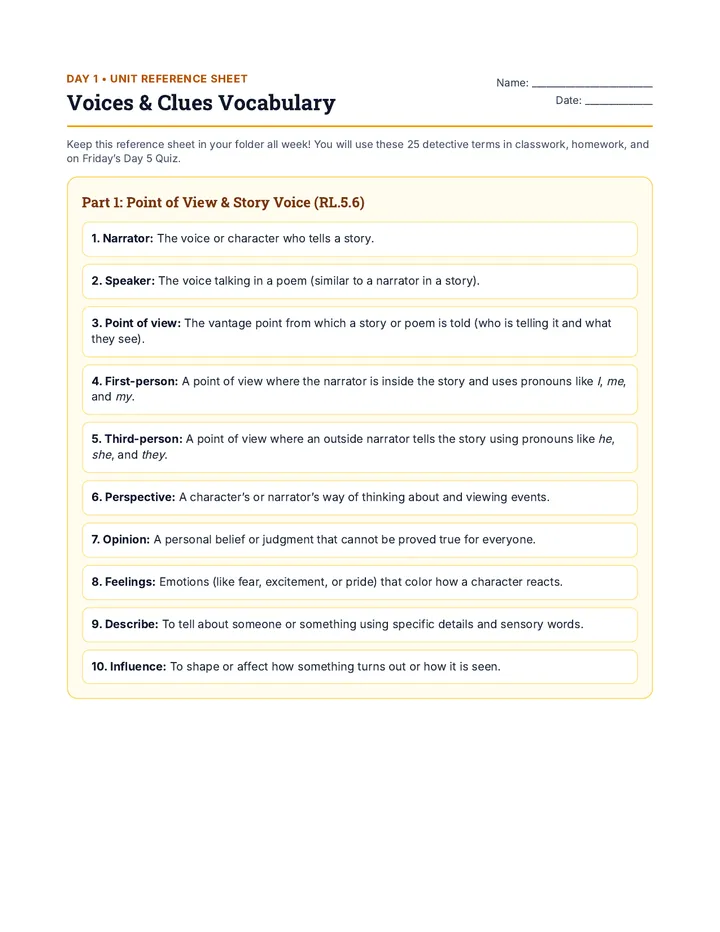
Unit Vocabulary Sheet Day 1 • Unit Reference Sheet
Voices & Clues Vocabulary
Name: _________________________
Date: ______________
Keep this reference sheet in your folder all week! You will use these 25 detective terms in classwork, homework, and on Friday’s Day 5 Quiz.
Part 1: Point of View & Story Voice (RL.5.6)
1. Narrator: The voice or character who tells a story.
2. Speaker: The voice talking in a poem (similar to a narrator in a story).
3. Point of view: The vantage point from which a story or poem is told (who is telling it and what they see).
4. First-person: A point of view where the narrator is inside the story and uses pronouns like I , me , and my .
5. Third-person: A point of view where an outside narrator tells the story using pronouns like he , she , and they .
6. Perspective: A character’s or narrator’s way of thinking about and viewing events.
7. Opinion: A personal belief or judgment that cannot be proved true for everyone.
8. Feelings: Emotions (like fear, excitement, or pride) that color how a character reacts.
9. Describe: To tell about someone or something using specific details and sensory words.
10. Influence: To shape or affect how something turns out or how it is seen.
Voices & Clues Vocabulary • Page 2 RI.5.4 & Word Detective Tools
Part 2: Word Detective & Informational Text (RI.5.4)
11. Context clues: Hints in surrounding words and sentences that help you figure out an unknown word.
12. Domain-specific: Specialized words belonging to a particular subject, such as science or history (e.g., bioluminescence ).
13. General academic: High-utility words used across many school subjects to explain ideas (e.g., adapt , transform , clarify ).
14. Definition: A direct explanation of what a word means, often set off by commas or dashes in a text.
15. Restatement: Repeating an idea or word in simpler, clearer words right after it appears.
16. Example: A specific sample or instance given to show what a word or idea looks like in action.
17. Inference: A logical conclusion made by combining text clues with what you already know.
18. Glossary: An alphabetical mini-dictionary at the back of a book that defines key terms.
19. Index: An alphabetical list at the back of a book showing which pages cover specific topics.
20. Root word: The base part of a word that holds its core meaning (e.g., bio = life, port = carry).
21. Prefix: A word part added to the beginning of a root word to change its meaning (e.g., un- , re- ).
22. Suffix: A word part added to the end of a root word that often changes its part of speech (e.g., -able , -tion ).
23. Technical vocabulary: Precise terms used by experts in a field, such as engineering, medicine, or ecology.
24. Text features: Visual or structural aids (headings, bold words, captions, diagrams) that help readers locate information.
25. Clarify: To make an idea or word clearer and easier to understand.
Theme Voices Slides Day 2 • Literary Detective NC Standards RL.5.6 • RL.5.2 • RL.5.1
Two Voices, One Theme
How does comparing two narrators’ points of view help us uncover a story’s deeper theme?
Today’s Mission: Compare two perspectives on the same event and summarize the lesson learned.
Day 2 Detective Targets
RL.5.6
Shift the Lens
Explain how different narrators describe the exact same event in different ways.
RL.5.2
Theme & Summary
Determine the theme from how characters respond to challenges and summarize the text.
RL.5.1
Prove It
Quote accurately from both accounts to support your theme statement.
Bridge Strategy • RL.5.6 → RL.5.2
From Perspective to Theme
Step 1: Notice
What words does each narrator use for the same place or event?
Step 2: Connect
How do their responses to the challenge change by the end?
Step 3: Theme
State the universal lesson about life or teamwork—not just character names.
Model Comparison • RL.5.6
Same Saturday Morning, Two Lenses
Marcus’s Lens (Reluctant)
“The empty lot was a dusty jungle of weeds, and dragging trash bags in the heat felt like punishment.”
Elena’s Lens (Hopeful)
“Underneath the weeds, I saw sun-drenched soil waiting for tomatoes and neighbors laughing together.”
Turn & Talk
When people see a messy problem differently, what helps them work together? Share a possible theme before we read today’s full text.
Sentence Starter: “A theme that fits this situation is ___ because ___.”
Two Sides Garden Worksheet Day 2 • Classwork Case File
Two Sides of Oak Street Lot
Name: _________________________
Date: ______________
RL.5.6 Point of View RL.5.2 Theme & Summary RL.5.1 Quoting Text
Account A: Marcus’s Perspective
When my dad told me we had to spend Saturday clearing the vacant lot on Oak Street, I groaned into my cereal. That cracked concrete pad in the corner was the only smooth spot on our block to practice skateboard ollies. Now Elena’s family wanted to dig it up for raised garden beds. For the first hour, I dragged heavy branches and stared at the weeds like they were stealing my weekend.
Then Mrs. Kim from next door wheeled out a cooler of cold lemonade, and Elena handed me a pair of work gloves. “Wait until you see the bench we’re building by the concrete,” she said. “We’re leaving the corner pad open for bikes and boards.” Suddenly, the dusty lot didn’t feel like a chore anymore—it felt like ours.
Account B: Elena’s Perspective
For months, I walked past the Oak Street lot and pictured rows of bright red tomatoes instead of rusted cans and waist-high thistles. On Saturday morning, I arrived early with a sketch of our community garden. My neighbor Marcus stood by the gate with his arms crossed, scowling at our shovels.
I realized Marcus thought we were erasing his favorite skate spot. Once I showed him the corner on my map labeled Wheels & Rest Zone , his whole face lit up. By noon, Marcus had hauled twice as many rocks as anyone else, proving that even the most stubborn doubter can become a team’s strongest builder.
1. (RL.5.6 & RL.5.1) How do Marcus’s and Elena’s descriptions of the vacant lot differ at the start of Saturday morning?
A. Marcus sees weeds “stealing my weekend,” while Elena pictures “rows of bright red tomatoes.”
B. Marcus is excited to plant vegetables, while Elena wants to build a skate park.
C. Both narrators agree the lot is too muddy to clean up on Saturday.
D. Elena dislikes the rusted cans, while Marcus wants to collect them for art.
Two Sides of Oak Street Lot • Page 2 RL.5.6 • RL.5.2 • RL.5.1
2. (RL.5.2) Which statement BEST expresses a central theme supported by both accounts?
A. Skateboarding is more important to neighborhoods than growing food.
B. Listening to others’ needs and including everyone turns doubters into teammates.
C. Gardening projects always take longer when neighbors bring lemonade.
D. Working alone is faster than sharing a map with friends.
3. (RL.5.2) Which choice is the BEST objective summary of the events on Oak Street?
A. Marcus is unfair to Elena until Mrs. Kim forces him to wear work gloves and haul rocks.
B. Marcus dreads clearing the lot because he fears losing his skate pad, but once Elena shows him the map saving that corner, he happily joins the cleanup.
C. Elena draws a map of tomatoes and decides that Marcus should only practice ollies on Sunday.
D. Neighbors argue all morning about weeds and never finish clearing the Oak Street lot.
Exit Ticket • Check Your Lens
4. (RL.5.6) Why does Marcus’s description of the lot change from “stealing my weekend” to “it felt like ours”?
A. His dad promised to buy him a new skateboard if he finished early.
B. He realized the community plan included his skate spot and welcomed his help.
C. Mrs. Kim told him that weeds were dangerous for the neighborhood.
D. He decided he liked growing tomatoes more than riding his skateboard.
Theme Voices Teacher Guide Day 2 Teacher Guide • Voices and Clues
Theme Through Voices
Grade 5 ELA • 45 Minutes
Focus: RL.5.6 • Spiral: RL.5.2, RL.5.1
1. Launch (10 min)
Use Theme Voices Slides 1–3 . Review how POV shapes word choice, then introduce the 3-step bridge from POV to Theme (RL.5.2).
2. Model (10 min)
Project Slide 4 . Compare Marcus’s “dusty jungle of weeds” with Elena’s “sun-drenched soil.” Model spotting objective summaries.
3. Practice (25 min)
Slide 5 Turn & Talk, then students complete Two Sides Garden Worksheet . Assign Theme Voices Homework .
Differentiation & Misconception Watch
Common Misconception: Students confuse summary opinions (“Marcus is unfair”) with objective summaries (RL.5.2).
Scaffold: Have students cross out any answer choice in Q3 that uses judgment words before selecting.
Answer Key • Two Sides Garden Worksheet (Classwork)
1. A (RL.5.6 & RL.5.1) — Marcus sees weeds “stealing my weekend,” while Elena pictures “rows of bright red tomatoes.”
2. B (RL.5.2) — Listening to others’ needs and including everyone turns doubters into teammates.
3. B (RL.5.2) — Objective summary covering Marcus’s worry, Elena’s map, and their teamwork.
4. B (RL.5.6) — He realized the community plan included his skate spot and welcomed his help.
Answer Key • Theme Voices Homework
1. A (RL.5.6) — Nora expects misery vs. Priya cheering.
2. B (RL.5.1) — “Then I noticed Nora sitting alone...”
3. A (RL.5.2) — Finding a role that fits strengths includes everyone.
4. B (RL.5.2) — Objective summary of the recess vote & role.
Theme Voices Homework Day 2 • Homework Practice
The Rainy Recess Vote
Name: _________________________
Date: ______________
Nora’s Note: When thunder canceled outdoor recess, Mr. Diaz let our class vote between silent board games and a loud relay race in the gym. I voted for board games because I needed quiet time to finish my comic strip. When the relay race won, I slumped in my seat, sure the next twenty minutes would be miserable. Then Priya invited me to be the scorekeeper and announcer. Calling out team points turned out to be the best part of my day.
Priya’s Note: After sitting through math, I was bursting with energy and cheered when the relay race won. Then I noticed Nora sitting alone with her sketchbook, looking left out. I knew she hated noisy races, so I asked if she wanted to run the scoreboard with a megaphone. Hearing her funny play-by-play announcements made the whole class laugh harder than ever.
1. (RL.5.6) How do Nora’s and Priya’s points of view shape their first reactions to the relay race vote?
A. Nora expects to be miserable, while Priya cheers with energy.
B. Both girls are angry that Mr. Diaz canceled outdoor recess.
C. Priya wants quiet time to draw, while Nora wants to run.
D. Both girls prefer silent board games over gym activities.
2. (RL.5.1) Which quote from Priya’s note BEST shows she notices Nora’s feelings?
A. “After sitting through math, I was bursting with energy...”
B. “Then I noticed Nora sitting alone with her sketchbook, looking left out.”
C. “Hearing her funny play-by-play announcements...”
D. “...made the whole class laugh harder than ever.”
3. (RL.5.2) What is the BEST theme for these paired notes?
A. Finding a role that fits someone’s strengths can include everyone in the fun.
B. Outdoor recess is always better than indoor gym games.
C. Drawing comic strips should not be allowed during school.
D. Class votes are unfair when only one game can win.
4. (RL.5.2) Which sentence BEST summarizes the events of the passage?
A. Nora draws a comic strip while Priya wins the relay race alone.
B. When a noisy gym race wins the recess vote, Priya invites quiet Nora to announce scores, making the game fun for both.
C. Mr. Diaz cancels recess because thunder frightens the class.
D. The class votes for board games, and Nora wins every match.
Word Detective Slides Day 3 • Informational Detective NC Standards RI.5.4 • RI.5.1 • RI.5.2
Word Detective Lab
How do we crack the meaning of academic and science words to uncover a text’s main ideas?
Today’s Mission: Decode domain-specific vocabulary, quote evidence, and find two main ideas.
Day 3 Detective Targets
RI.5.4
Crack the Words
Determine the meaning of general academic and domain-specific words and phrases.
RI.5.1
Quote Evidence
Quote accurately from the text when explaining facts and drawing inferences.
RI.5.2
Two Main Ideas
Determine two or more main ideas and explain how key details support them.
Anchor Concept • RI.5.4
Two Word Families in Informational Texts
Domain-Specific Words
Specialized terms tied to one topic (science, history, math).
Examples: bioluminescence, ecosystem, photosynthesis
General Academic Words
High-utility words used across many subjects to explain ideas.
Examples: emit, adapt, contrast, essential
Guided Model • RI.5.4
Use Clues + Word Parts Together
“In the pitch-black midnight zone, anglerfish rely on bioluminescence—a chemical reaction that produces living light—to lure prey.”
Word Parts (Morphology)
bio- (life) + lumen (light) = living light
Context Clue
Dashed definition right in the sentence: “produces living light.”
Turn & Talk
Why might deep-sea animals need to emit (send out) their own light instead of relying on sunlight?
Sentence Starter: “Deep-sea creatures might emit light to ___ because ___.”
Living Lights Worksheet Day 3 • Classwork Case File
Living Lights of the Midnight Zone
Name: _________________________
Date: ______________
RI.5.4 Vocabulary RI.5.1 Quoting Text RI.5.2 Two Main Ideas
Directions: Read the science article. Choose the best answer for each multiple-choice question.
1 More than 3,000 feet below the ocean’s surface lies the midnight zone, a freezing realm where sunlight never reaches. Despite the total darkness, life thrives here. Over millions of years, deep-sea animals have adapted to this extreme habitat by developing a remarkable survival tool: bioluminescence , the ability of a living organism to produce its own light through a chemical reaction inside its body.
2 Ocean creatures use living light for very different purposes. Some predators , like the deep-sea anglerfish, dangle a glowing lure right in front of their jaws to attract curious shrimp and small fish. Meanwhile, tiny lanternfish use rows of light-producing organs along their bellies as camouflage . By matching the faint blue glow filtering from above, lanternfish erase their own shadows so larger hunters swimming below cannot spot them.
3 Other sea creatures emit sudden flashes of light to escape danger. When startled, the vampire squid releases a swirling cloud of glowing mucus instead of dark ink. That bright burst confuses attackers long enough for the squid to jet away into the dark.
1. (RI.5.4 & RI.5.1) Based on paragraph 1, what does the academic word adapted mean?
A. Swam away quickly from freezing ocean water
B. Changed over time to survive in a specific environment
C. Disappeared completely due to total darkness
D. Traveled closer to the sunlit ocean surface
Living Lights of the Midnight Zone • Page 2 RI.5.4 • RI.5.1 • RI.5.2
2. (RI.5.4 & RI.5.1) Which quote from paragraph 2 BEST helps the reader understand the meaning of camouflage ?
A. “Ocean creatures use living light for very different purposes.”
B. “...dangle a glowing lure right in front of their jaws to attract curious shrimp...”
C. “...erase their own shadows so larger hunters swimming below cannot spot them.”
D. “...tiny lanternfish use rows of light-producing organs along their bellies...”
3. (RI.5.2) Which pair of statements BEST expresses TWO main ideas of the article?
A. Deep-sea animals produce their own light to survive the dark midnight zone, and they use that light to hunt, hide, or escape.
B. Sunlight reaches 3,000 feet below the ocean, and anglerfish are the largest predators in the sea.
C. Vampire squids only live near beaches, and lanternfish glow to attract shrimp.
D. Chemical reactions make ocean water warm, and dark ink is better than glowing mucus.
Exit Ticket • Word Detective Check
4. (RI.5.4) In paragraph 3, what does the academic word emit most likely mean?
A. To hide quietly beneath ocean rocks
B. To send out or release something
C. To absorb sunlight from the surface
D. To swim rapidly away from danger
Word Detective Teacher Guide Day 3 Teacher Guide • Voices and Clues
Word Detective Lab
Grade 5 ELA • 45 Minutes
Focus: RI.5.4 • Spiral: RI.5.1, RI.5.2
1. Launch (10 min)
Use Word Detective Slides 1–3 . Distinguish domain-specific words (bioluminescence ) from general academic words (emit , adapted ).
2. Model (10 min)
Project Slide 4 . Model combining word parts (bio- + lumen ) with dashed appositive definitions inside the sentence.
3. Practice (25 min)
Slide 5 Turn & Talk, then students complete Living Lights Worksheet . Assign Word Detective Homework .
Differentiation & Support
Scaffold: Pre-teach the word parts bio- (life) and e- (out) and let students underline context clues before choosing answers.
Extend: Have students highlight which sentence in each paragraph proves their answer choice for Q3.
Answer Key • Living Lights Worksheet (Classwork)
1. B (RI.5.4 & RI.5.1) — Changed over time to survive in a specific environment.
2. C (RI.5.4 & RI.5.1) — “...erase their own shadows so larger hunters swimming below cannot spot them.”
3. A (RI.5.2) — Deep-sea animals produce their own light to survive, and use it to hunt, hide, or escape.
4. B (RI.5.4) — To send out or release something.
Answer Key • Word Detective Homework
1. B (RI.5.4) — To make or produce.
2. B (RI.5.4) — “microscopic pores on the underside of the leaf”
3. A (RI.5.1) — “...the plant releases fresh oxygen back into the air.”
4. A (RI.5.2) — Leaves make food, supporting life on Earth.
Word Detective Homework Day 3 • Homework Practice
Nature’s Solar Panels
Name: _________________________
Date: ______________
Unlike animals that eat food, green plants manufacture their own sugar using sunlight, water, and air. Inside each leaf sits a green pigment called chlorophyll , which traps energy from the sun like a tiny solar panel. Meanwhile, microscopic pores on the underside of the leaf called stomata open to inhale carbon dioxide gas from the atmosphere.
Once the leaf combines sunlight, water, and carbon dioxide, it produces glucose—a simple sugar that fuels the plant’s growth. As a bonus for humans and animals, the plant releases fresh oxygen back into the air. Without this daily process, Earth’s food chains could not survive.
1. (RI.5.4) Based on paragraph 1, what does the academic word manufacture mean?
A. To eat or swallow
B. To make or produce
C. To store underground
D. To breathe out slowly
2. (RI.5.4) Which clue in paragraph 1 helps you determine the meaning of stomata ?
A. “traps energy from the sun”
B. “microscopic pores on the underside of the leaf”
C. “like a tiny solar panel”
D. “Unlike animals that eat food”
3. (RI.5.1) Which quote from paragraph 2 explains why plants are important to humans and animals?
A. “...the plant releases fresh oxygen back into the air.”
B. “Inside each leaf sits a green pigment...”
C. “...open to inhale carbon dioxide gas...”
D. “...a simple sugar that fuels the plant’s growth.”
4. (RI.5.2) Which TWO main ideas are supported by this passage?
A. Leaves use specialized parts to make food, and this process supports life on Earth.
B. Solar panels are made from leaves, and animals breathe carbon dioxide.
C. Plants only grow in summer, and glucose is harmful to humans.
D. Stomata trap sunlight, and chlorophyll inhales oxygen from soil.
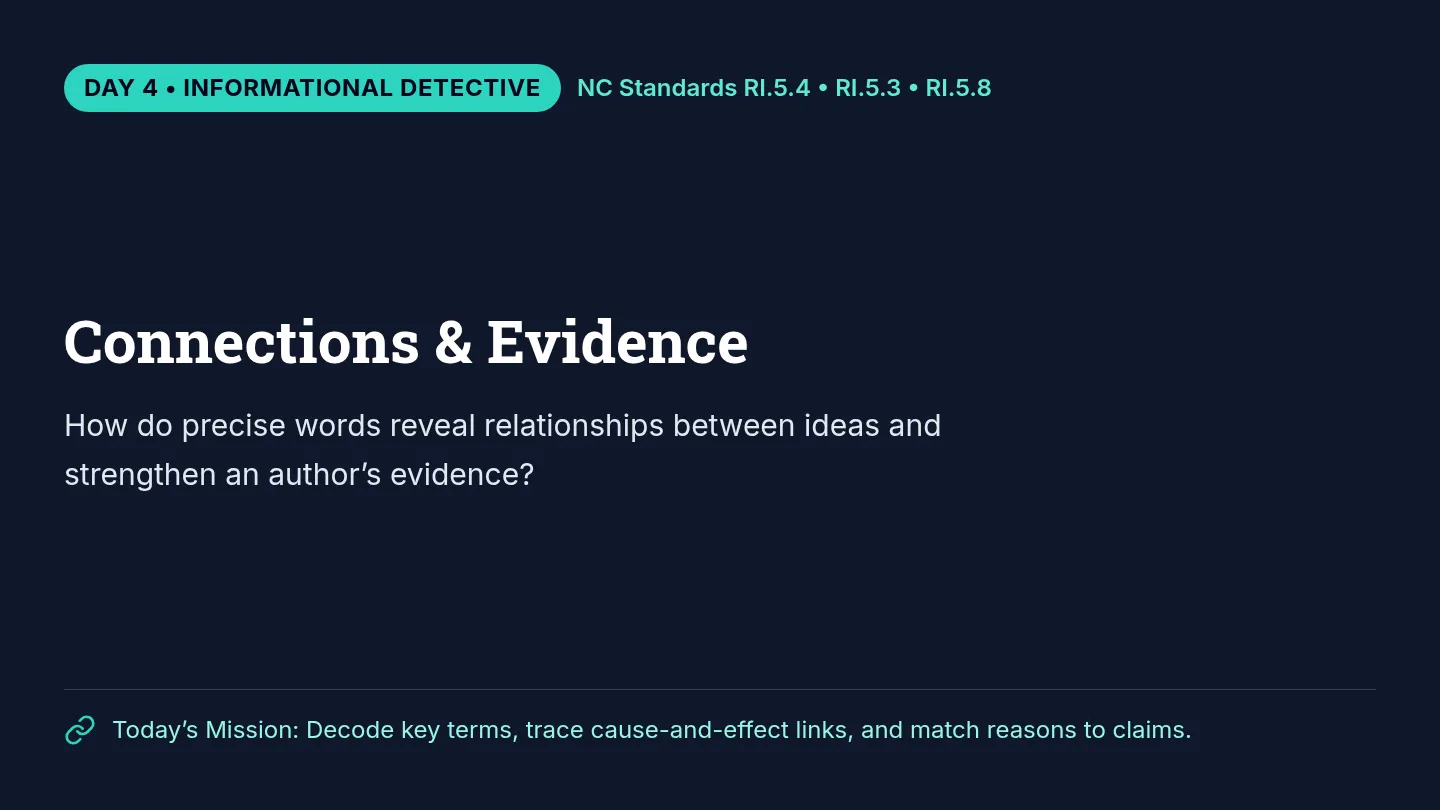
Connections Evidence Slides Day 4 • Informational Detective NC Standards RI.5.4 • RI.5.3 • RI.5.8
Connections & Evidence
How do precise words reveal relationships between ideas and strengthen an author’s evidence?
Today’s Mission: Decode key terms, trace cause-and-effect links, and match reasons to claims.
Day 4 Detective Targets
RI.5.4
Precise Terms
Use context and roots to determine academic and domain-specific meanings.
RI.5.3
Explain Links
Explain relationships or interactions between ideas, events, or concepts.
RI.5.8
Check Evidence
Identify which reasons and evidence support which specific author points.
Bridge Strategy • RI.5.4 + RI.5.3
Vocabulary Fuels Relationships
Problem Word
Fragmentation = breaking a habitat into isolated, disconnected pieces.
Solution Word
Corridor = a continuous strip of flowers linking habitats so pollinators travel safely.
Guided Model • RI.5.8
Match the Evidence to the Point
Author’s Point:
“Cities can boost local food crops by planting native wildflower strips.”
Supporting Evidence:
“In a two-year study, neighborhoods with wildflower corridors saw a 40% increase in native bees visiting nearby community tomato gardens.”
Turn & Talk
Why is a 40% increase in bee visits strong evidence for planting wildflower strips, rather than just an opinion?
Sentence Starter: “This evidence supports the author’s point because it gives measurable proof that ___.”
Pollinator Corridors Worksheet Day 4 • Classwork Case File
Highways for Honeybees
Name: _________________________
Date: ______________
RI.5.4 Vocabulary RI.5.3 Relationships RI.5.8 Reasons & Evidence
Directions: Read the article carefully. Choose the best answer for each multiple-choice question.
1 As cities expand, concrete roads and parking lots replace meadows and wildflowers. Ecologists call this habitat fragmentation —the breaking apart of natural spaces into small, separated patches. For pollinators like bumblebees and monarch butterflies, fragmentation creates a dangerous barrier. Because many native bees can fly only a few hundred yards without resting, wide stretches of bare pavement cut them off from the nectar and pollen they need to forage .
2 Fortunately, city planners have discovered a sustainable solution that works for both people and wildlife: urban pollinator corridors. A corridor is a connected pathway of native flowers planted along sidewalks, schoolyards, and power-line trails. Instead of facing miles of empty concrete, bees can hop from one blooming patch to the next like stepping-stones across a stream.
3 Research proves these green highways make a measurable difference. In a three-year study across twelve cities, neighborhoods that planted pollinator corridors recorded 35 percent more native bee species than neighborhoods with mowed grass lawns. Even better, community vegetable gardens near those corridors produced heavier harvests of squash and tomatoes, since more bees meant more reliable pollination.
1. (RI.5.4) Using context clues in paragraph 1, what does the word forage mean?
A. To build nests inside concrete walls
B. To search for and gather food
C. To sleep during cold winter months
D. To fly high above tall city buildings
Highways for Honeybees • Page 2 RI.5.4 • RI.5.3 • RI.5.8
2. (RI.5.3) Based on paragraphs 1–2, how do urban pollinator corridors solve the problem of habitat fragmentation?
A. They remove all sidewalks and roads from city neighborhoods.
B. They connect separated flower patches like stepping-stones so bees can travel safely.
C. They train native bees to fly miles without resting or eating nectar.
D. They replace vegetable gardens with mowed grass lawns.
3. (RI.5.8) Which evidence in paragraph 3 BEST supports the author’s point that “these green highways make a measurable difference”?
A. Neighborhoods with corridors had 35 percent more native bee species and heavier garden harvests.
B. Monarch butterflies and bumblebees are both types of insects.
C. City planners enjoy walking along power-line trails in the summer.
D. Concrete parking lots are larger than most backyard meadows.
Exit Ticket • Evidence & Word Check
4. (RI.5.4) What does the domain-specific term sustainable mean in paragraph 2 (“a sustainable solution that works for both people and wildlife”)?
A. Expensive to build and hard to maintain
B. Able to last and support living things over time
C. Temporary and meant for only one season
D. Harmful to insects that live near roads
Connections Evidence Teacher Guide Day 4 Teacher Guide • Voices and Clues
Connections and Evidence
Grade 5 ELA • 45 Minutes
Focus: RI.5.4 • Spiral: RI.5.3, RI.5.8
1. Launch (10 min)
Use Connections Evidence Slides 1–3 . Show how problem/solution vocabulary (fragmentation vs. corridor ) signals cause-and-effect links (RI.5.3).
2. Model (10 min)
Project Slide 4 . Distinguish an author’s claim/point from measurable evidence (study data, percentages) for RI.5.8.
3. Practice (25 min)
Slide 5 Turn & Talk, then students complete Pollinator Corridors Worksheet . Assign Connections Evidence Homework .
Differentiation & Support
Scaffold: Have students circle numbers/percentages in paragraph 3 before answering Q3 (RI.5.8).
Extend: Ask students to identify which distractor in Q3 is a true fact from the text that does not prove the specific point.
Answer Key • Pollinator Corridors Worksheet (Classwork)
1. B (RI.5.4) — To search for and gather food.
2. B (RI.5.3) — They connect separated flower patches like stepping-stones so bees can travel safely.
3. A (RI.5.8) — Neighborhoods with corridors had 35 percent more native bee species and heavier garden harvests.
4. B (RI.5.4) — Able to last and support living things over time.
Answer Key • Connections Evidence Homework
1. A (RI.5.4) — Completely change in form/appearance.
2. B (RI.5.4) — Tiny bits of soil and sand settled in water.
3. B (RI.5.3) — Dams slow water and soak soil for droughts.
4. B (RI.5.8) — Oregon study: 3x more young salmon.
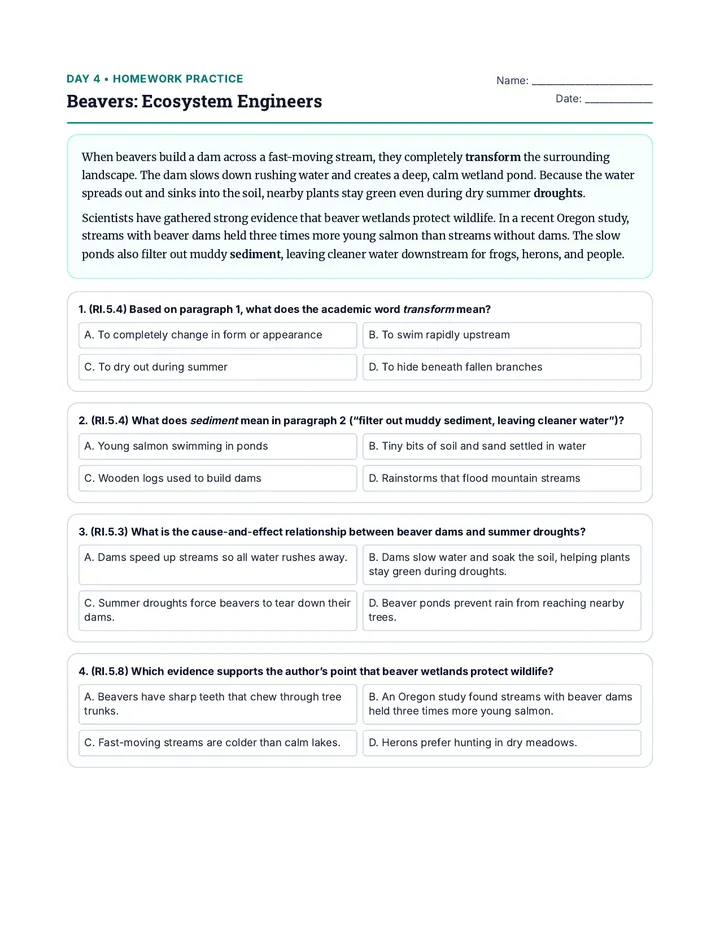
Connections Evidence Homework Day 4 • Homework Practice
Beavers: Ecosystem Engineers
Name: _________________________
Date: ______________
When beavers build a dam across a fast-moving stream, they completely transform the surrounding landscape. The dam slows down rushing water and creates a deep, calm wetland pond. Because the water spreads out and sinks into the soil, nearby plants stay green even during dry summer droughts .
Scientists have gathered strong evidence that beaver wetlands protect wildlife. In a recent Oregon study, streams with beaver dams held three times more young salmon than streams without dams. The slow ponds also filter out muddy sediment , leaving cleaner water downstream for frogs, herons, and people.
1. (RI.5.4) Based on paragraph 1, what does the academic word transform mean?
A. To completely change in form or appearance
B. To swim rapidly upstream
C. To dry out during summer
D. To hide beneath fallen branches
2. (RI.5.4) What does sediment mean in paragraph 2 (“filter out muddy sediment, leaving cleaner water”)?
A. Young salmon swimming in ponds
B. Tiny bits of soil and sand settled in water
C. Wooden logs used to build dams
D. Rainstorms that flood mountain streams
3. (RI.5.3) What is the cause-and-effect relationship between beaver dams and summer droughts?
A. Dams speed up streams so all water rushes away.
B. Dams slow water and soak the soil, helping plants stay green during droughts.
C. Summer droughts force beavers to tear down their dams.
D. Beaver ponds prevent rain from reaching nearby trees.
4. (RI.5.8) Which evidence supports the author’s point that beaver wetlands protect wildlife?
A. Beavers have sharp teeth that chew through tree trunks.
B. An Oregon study found streams with beaver dams held three times more young salmon.
C. Fast-moving streams are colder than calm lakes.
D. Herons prefer hunting in dry meadows.
Kitty Hawk Quiz Day 5 • Summative Quiz
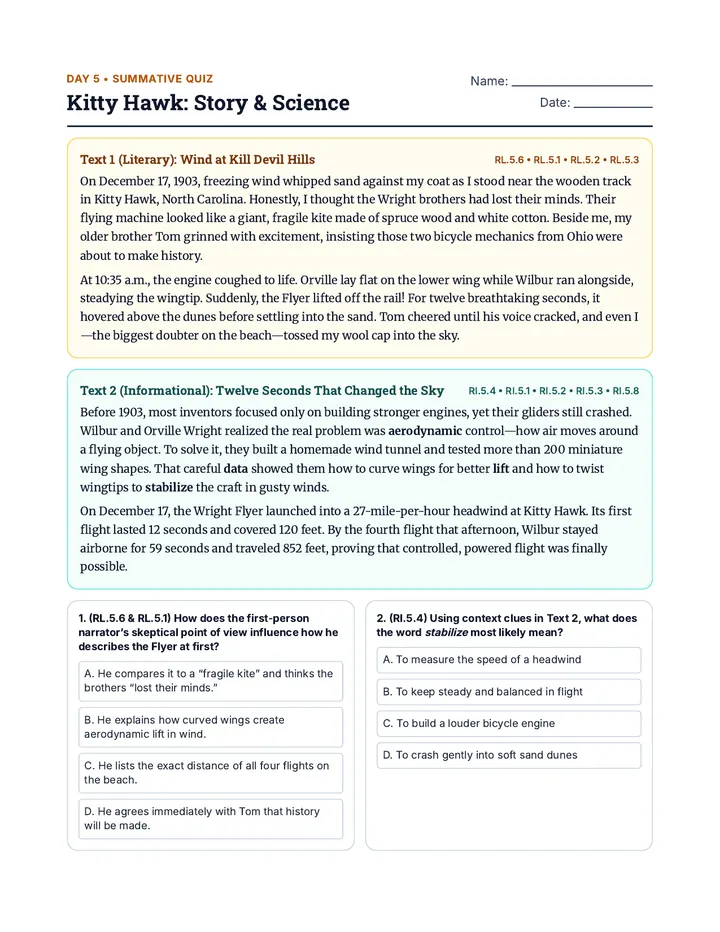
Kitty Hawk: Story & Science
Name: _________________________
Date: ______________
Text 1 (Literary): Wind at Kill Devil Hills
RL.5.6 • RL.5.1 • RL.5.2 • RL.5.3
On December 17, 1903, freezing wind whipped sand against my coat as I stood near the wooden track in Kitty Hawk, North Carolina. Honestly, I thought the Wright brothers had lost their minds. Their flying machine looked like a giant, fragile kite made of spruce wood and white cotton. Beside me, my older brother Tom grinned with excitement, insisting those two bicycle mechanics from Ohio were about to make history.
At 10:35 a.m., the engine coughed to life. Orville lay flat on the lower wing while Wilbur ran alongside, steadying the wingtip. Suddenly, the Flyer lifted off the rail! For twelve breathtaking seconds, it hovered above the dunes before settling into the sand. Tom cheered until his voice cracked, and even I—the biggest doubter on the beach—tossed my wool cap into the sky.
Text 2 (Informational): Twelve Seconds That Changed the Sky
RI.5.4 • RI.5.1 • RI.5.2 • RI.5.3 • RI.5.8
Before 1903, most inventors focused only on building stronger engines, yet their gliders still crashed. Wilbur and Orville Wright realized the real problem was aerodynamic control—how air moves around a flying object. To solve it, they built a homemade wind tunnel and tested more than 200 miniature wing shapes. That careful data showed them how to curve wings for better lift and how to twist wingtips to stabilize the craft in gusty winds.
On December 17, the Wright Flyer launched into a 27-mile-per-hour headwind at Kitty Hawk. Its first flight lasted 12 seconds and covered 120 feet. By the fourth flight that afternoon, Wilbur stayed airborne for 59 seconds and traveled 852 feet, proving that controlled, powered flight was finally possible.
1. (RL.5.6 & RL.5.1) How does the first-person narrator’s skeptical point of view influence how he describes the Flyer at first?
A. He compares it to a “fragile kite” and thinks the brothers “lost their minds.”
B. He explains how curved wings create aerodynamic lift in wind.
C. He lists the exact distance of all four flights on the beach.
D. He agrees immediately with Tom that history will be made.
2. (RI.5.4) Using context clues in Text 2, what does the word stabilize most likely mean?
A. To measure the speed of a headwind
B. To keep steady and balanced in flight
C. To build a louder bicycle engine
D. To crash gently into soft sand dunes
Kitty Hawk Quiz • Page 2 RL.5.1–3, RL.5.6 • RI.5.1–4, RI.5.8
3. (RL.5.3 & RL.5.2) How do the narrator’s and Tom’s perspectives contrast before the flight in Text 1, and what theme does the narrator’s change of heart suggest?
A. Tom doubts the Flyer while the narrator cheers; the theme is never trust mechanics.
B. The narrator doubts the Flyer while Tom grins with belief; seeing courage in action can turn doubt into wonder.
C. Both brothers refuse to watch the flight because the December wind is freezing.
D. Both brothers help Wilbur push the wingtip along the wooden track.
4. (RI.5.3 & RI.5.4) Based on Text 2, how did the Wright brothers’ wind-tunnel data affect their flight at Kitty Hawk?
A. The measurements showed them how to curve wings for lift and twist wingtips for control.
B. The wind tunnel proved that stronger engines were the only way to fly.
C. The data convinced them to cancel the December 17 test flight.
D. The tunnel damaged their miniature wings so they had to use cotton instead.
5. (RI.5.2 & RI.5.1) Which pair of statements BEST represents TWO main ideas of Text 2?
A. The Wright brothers solved flight by researching aerodynamic control, and their 1903 Kitty Hawk flights proved controlled, powered flight worked.
B. Ohio bicycle mechanics disliked coastal winds, and spruce wood is heavier than cotton.
C. Earlier inventors built wind tunnels, and Wilbur flew for 12 seconds on the fourth flight.
D. Headwinds always stop airplanes from launching, and 200 wings crashed in Ohio.
6. (RI.5.8) Which specific evidence in paragraph 2 of Text 2 supports the author’s claim that “controlled, powered flight was finally possible”?
A. Most inventors before 1903 focused on building stronger engines.
B. The first flight lasted 12 seconds (120 feet), and the fourth flight lasted 59 seconds (852 feet).
C. The brothers owned a bicycle shop in Ohio before visiting North Carolina.
D. Freezing wind whipped sand against coats at Kill Devil Hills.
Part 2: Unit Vocabulary Check • Page 3 Day 1 Vocabulary Mastery
7. Text 1 is told using I and my by a character watching on the beach. Which pair of vocabulary terms describes Text 1?
A. Third-person and glossary
B. First-person narrator
C. Index and suffix
D. Domain-specific speaker
8. In Text 2, the author writes “aerodynamic control—how air moves around a flying object.” Which type of context clue is used to clarify the word?
A. Definition / restatement
B. Opinion and feelings
C. Index entry
D. Third-person perspective
9. Which words from Text 2 are the BEST examples of domain-specific or technical vocabulary for flight?
A. Honestly and suddenly
B. Aerodynamic and lift
C. Afternoon and brother
D. Giant and white
10. Look at the word airborne or uncontrolled . What do a prefix and a suffix have in common?
A. Both are text features at the back of a book.
B. Both are word parts added to a root word to change its meaning.
C. Both are feelings that influence a speaker’s opinion.
D. Both mean making a logical inference from an example.
11. If you were reading a book about aviation and wanted to find the exact definition of lift , which text feature would help most?
A. The glossary
B. The narrator’s opinion
C. A first-person speaker
D. An index only
12. When a reader combines clues from Text 1 (“tossed my wool cap into the sky”) with what they already know to conclude the narrator feels amazed, what is the reader making?
A. A root word
B. An inference
C. A general academic index
D. A third-person restatement
Dual Text Teacher Guide Day 5 Quiz Guide • Voices and Clues
Dual Text Showdown Quiz
Grade 5 ELA • 40 Minutes
12-Item Multiple-Choice Quiz
1. Setup (5 min)
Distribute Kitty Hawk Quiz . Remind students to read both passages carefully and check evidence before selecting A–D.
2. Quiz (25 min)
Students complete Parts 1 & 2 (12 multiple-choice items) independently. Provide read-aloud accommodations per IEP/504 plans.
3. Review (10 min)
Collect or self-check, then review Q1 (RL.5.6), Q2 (RI.5.4), and key vocabulary items from Part 2 aloud.
NC Standards & Vocabulary Coverage
Primary: RL.5.6 (Q1, Q7), RI.5.4 (Q2, Q4, Q8–11) • Spiral: RL.5.1 (Q1, Q12), RL.5.2 (Q3), RL.5.3 (Q3), RI.5.1 (Q5), RI.5.2 (Q5), RI.5.3 (Q4), RI.5.8 (Q6).
Answer Key • Kitty Hawk Quiz (12 Questions)
1. A (RL.5.6 & RL.5.1) — Compares it to a “fragile kite” and thinks the brothers “lost their minds.”
2. B (RI.5.4) — To keep steady and balanced in flight.
3. B (RL.5.3 & RL.5.2) — Narrator doubts vs. Tom’s belief; seeing courage in action turns doubt into wonder.
4. A (RI.5.3 & RI.5.4) — Measurements showed how to curve wings for lift and twist wingtips for control.
5. A (RI.5.2 & RI.5.1) — Wright brothers researched aerodynamic control, and 1903 flights proved powered flight worked.
6. B (RI.5.8) — First flight: 12 seconds (120 feet); fourth flight: 59 seconds (852 feet).
7. B — First-person narrator
8. A — Definition / restatement
9. B — Aerodynamic and lift
10. B — Word parts added to a root word
11. A — The glossary
12. B — An inference