A student worksheet to record observations from the Mystery Box and Happiness Jar, and to apply the Wheelbarrow Test to nouns sorted during the relay.
A comprehensive answer key for the Hatchet Chapters 9-10 worksheet, providing suggested responses for recall, inference, and conflict analysis.
A student worksheet for Chapters 9 and 10 of Hatchet, featuring recall, inference, and conflict-based questions with a survival journal aesthetic.
A teacher's facilitation guide for the Spring Break Saga writing lesson, including objectives, hooks, and discussion prompts.
A creative narrative writing worksheet for 3rd graders featuring a mysterious suitcase prompt to spark spring break adventure stories.
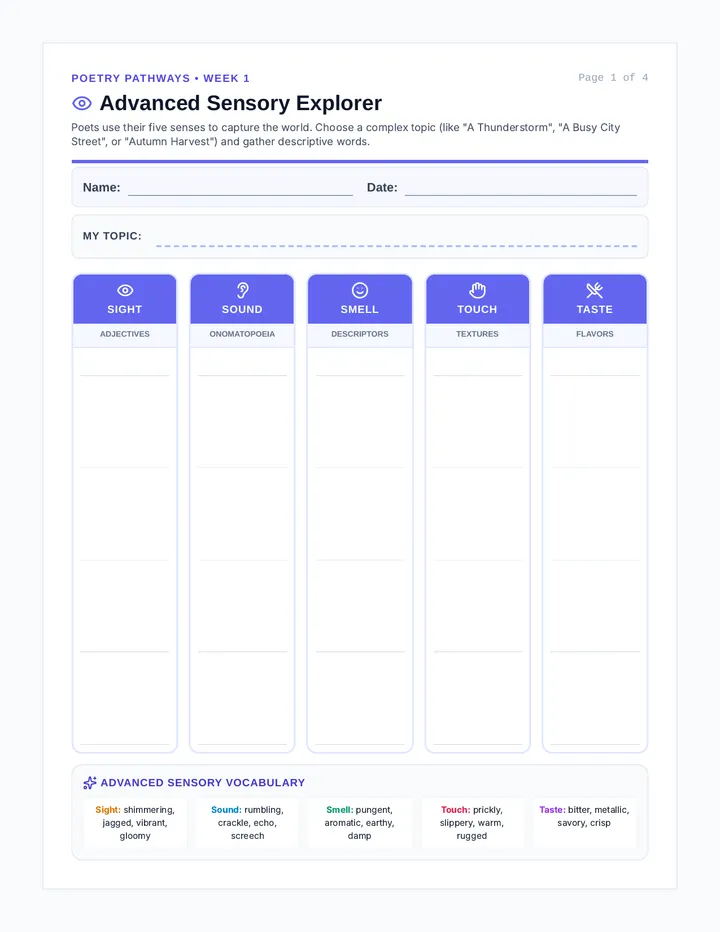
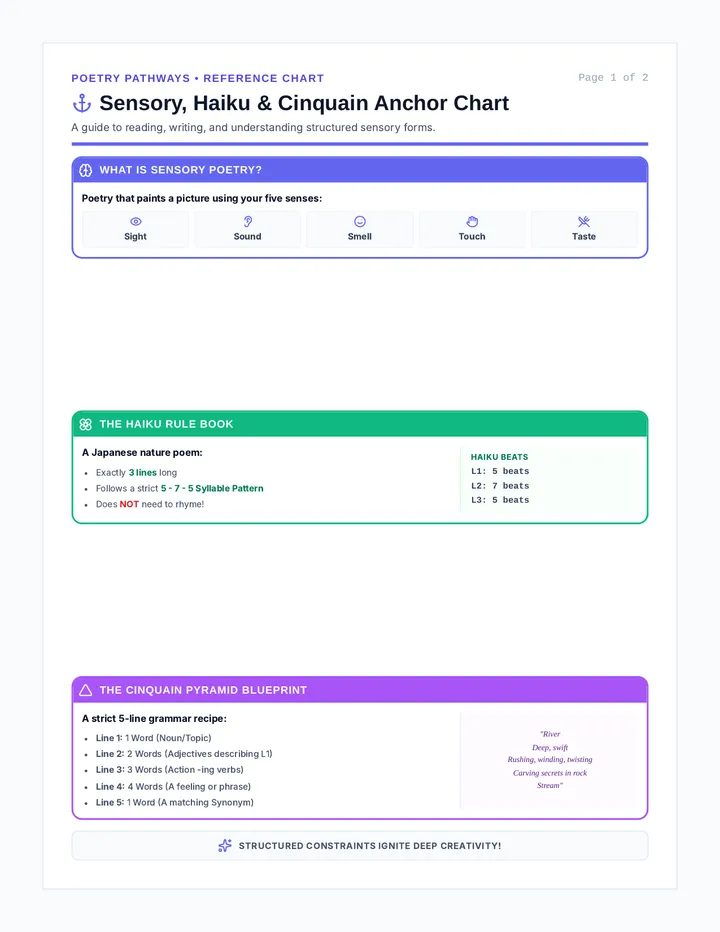
A two-page guided worksheet for students to brainstorm spring-themed grammar and figurative language, then craft a structured poem.
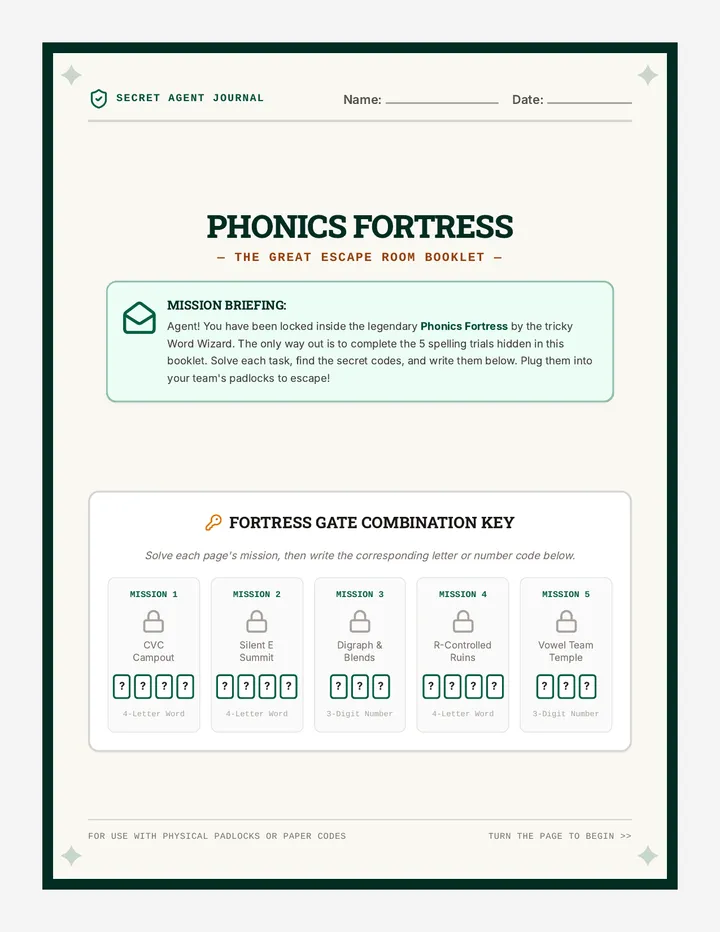
Student worksheet for vowel team practice featuring word completion, sorting, and sentence dictation with a secret agent theme.
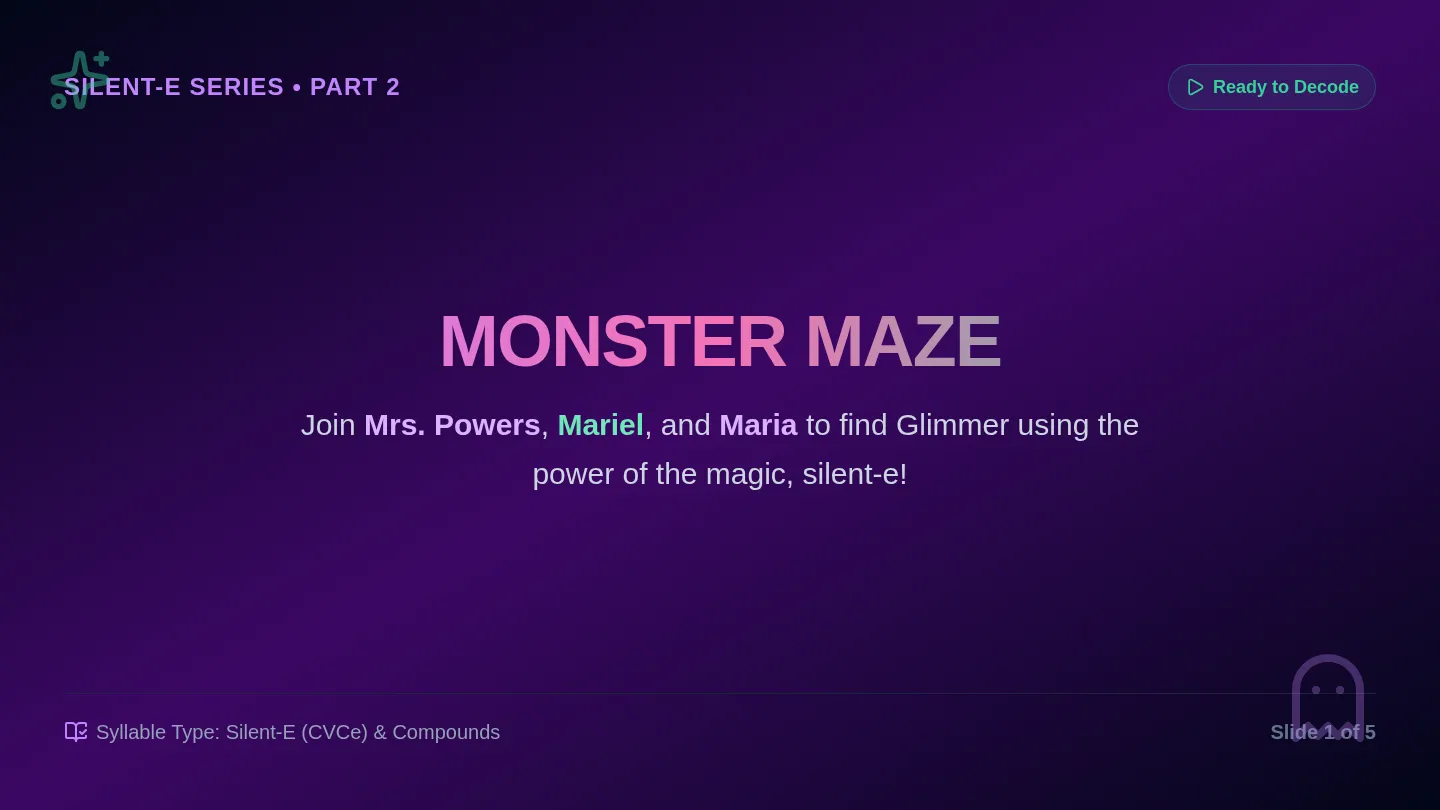
Visual presentation for introducing the Vowel Team secret rule (EE, EA, AI, AY) with a high-tech agent theme and interactive decoding practice.
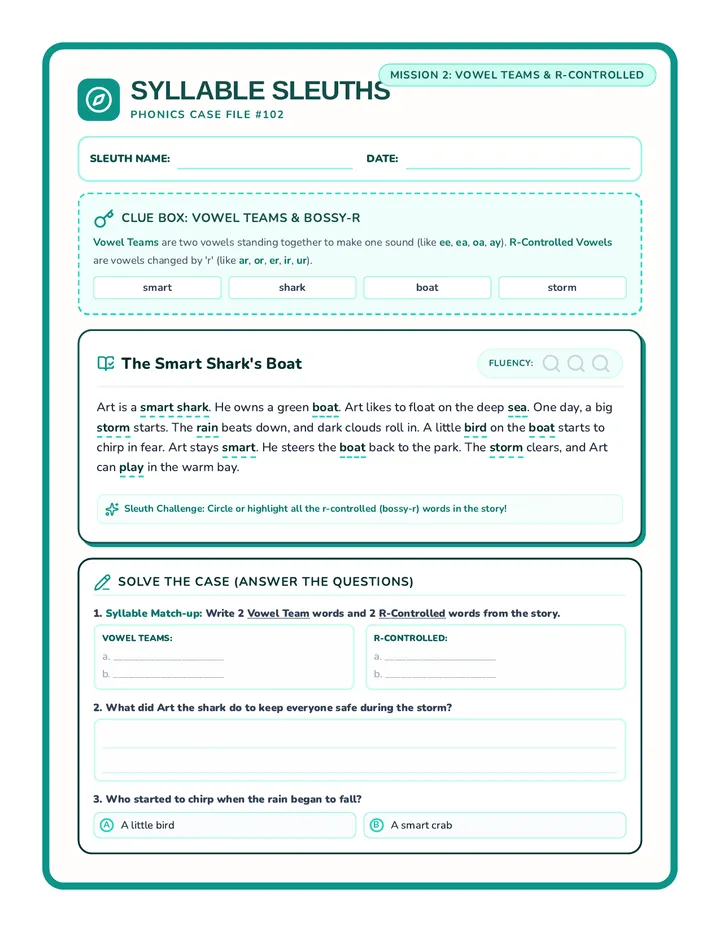
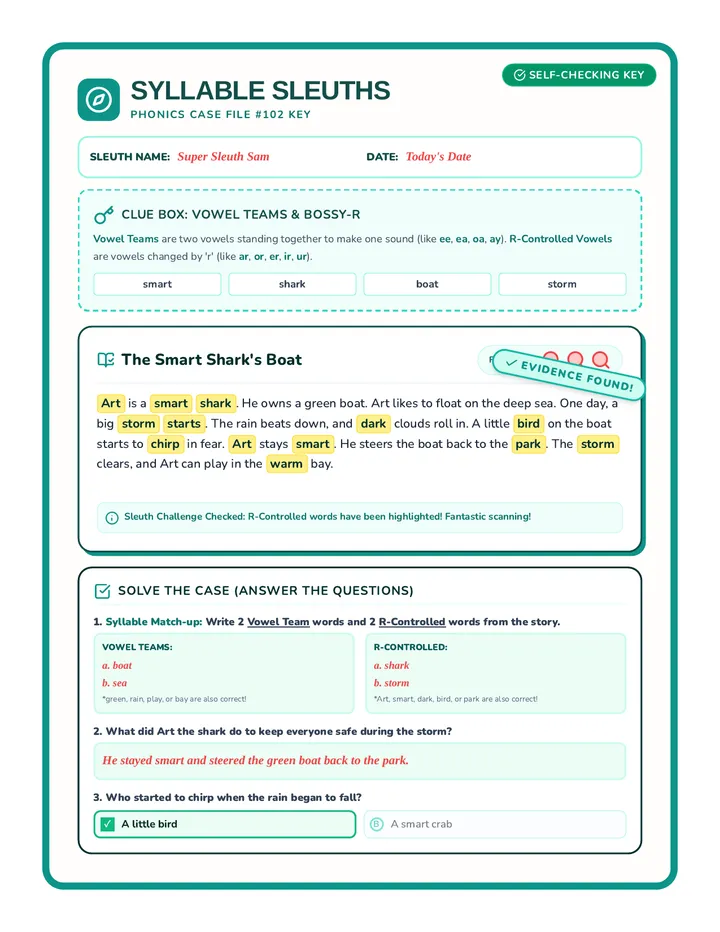
An introductory reading passage for students featuring vowel teams EE, EA, AI, and AY, styled as a confidential secret agent mission file.
A comprehensive teacher guide for introducing Level 2 vowel teams (EE, EA, AI, AY) featuring a secret agent theme, instructional script, word lists, and dictation sentences.
Facilitator script for Lesson 6 of the Thinking Readers Program. Aligned with Bloom's Taxonomy (Remember, Analyze, Evaluate, Create). Focuses on Synthesis (Thinking Evolution). Includes character shift modeling and explicit Bloom's checks. Revised for branding and layout.
Facilitator script for Lesson 5 of the Thinking Readers Program. Aligned with Bloom's Taxonomy (Understand, Analyze, Evaluate). Teaches the Curiosity Compass strategy for generated questioning. Revised for branding and layout.
Facilitator script for Lesson 4 of the Thinking Readers Program. Aligned with Bloom's Taxonomy (Remember, Apply, Create). Focuses on Visualization (The Sensory Cinema). Includes explicit strategy modeling for 4D sensory reading.
Facilitator script for Lesson 3 of the Thinking Readers Program. Aligned with Bloom's Taxonomy (Understand, Apply, Analyze, Evaluate). Teaches the 'Clue Equation' strategy for inferencing. Includes explicit Bloom's check for evaluation.
Facilitator script for Lesson 2 of the Thinking Readers Program. Aligned with Bloom's Taxonomy (Remember, Understand, Analyze, Create). Focuses on activating background knowledge (The Knowledge Vault). Revised for branding and taxonomy labels.
Facilitator script for Lesson 1 of the Thinking Readers Program. Explicitly aligned with Bloom's Taxonomy (Remember, Apply, Analyze, Evaluate). Includes the specific 'Brain Choice' prompt and modeling for metacognition.
Student workbook page for Lesson 6 of the Thinking Readers Program. Features a 'Thinking Evolution Log' to track shifts at 0%, 50%, and 100%. Revised for page fit, high-contrast writing areas, and larger response boxes. Added evolution clues for better guidance. Aligned with Bloom's Taxonomy.
Student workbook page for Lesson 5 of the Thinking Readers Program. Features a 'Quest Map' for Thick and Thin questions. Includes Strategy Clues for vocabulary help and a high-contrast integrated Brain Choice section. Revised for contrast and page fit. Added specific quest clues for distinguishing question types.
Student workbook page for Lesson 4 of the Thinking Readers Program. Features a storyboard frame for multi-sensory visualization. Includes Strategy Clues for vocabulary help and a print-friendly high-contrast layout. Revised for page fit and larger writing areas. Added specific director clues.
Student workbook page for Lesson 3 of the Thinking Readers Program. Centers on the 'Clue Equation' (Inference). Features Strategy Clues for vocabulary support and a print-friendly high-contrast Brain Choice section. Revised for alignment, writing space, and contrast. Added specific equation clues.
Student workbook page for Lesson 2 of the Thinking Readers Program. Focuses on Schema activation (The Knowledge Vault). Includes optimized writing areas for item sorting and a print-friendly Deductive Dilemma section. Revised for contrast, vocabulary support, and answer choice uniformity.
Student workbook page for Lesson 1 of the Thinking Readers Program. Features tally and writing areas with Strategy Clues for metacognition. Includes the updated Brain Choice Moment section with print-friendly high contrast and larger writing areas. Revised for contrast and label size.
Student workbook page for Lesson 6 of the Thinking Readers Program. Features a 'Thinking Evolution Log' to track shifts at 0%, 50%, and 100%. Revised for page fit, high-contrast writing areas, and larger response boxes.
Student workbook page for Lesson 5 of the Thinking Readers Program. Features a 'Quest Map' for Thick and Thin questions. Includes Strategy Clues for vocabulary help and a high-contrast integrated Brain Choice section. Revised for contrast and page fit.
Student workbook page for Lesson 4 of the Thinking Readers Program. Features a storyboard frame for multi-sensory visualization. Includes Strategy Clues for vocabulary help and a print-friendly high-contrast layout. Revised for page fit and larger writing areas.
Final capstone workbook page for Lesson 12 of the Thinking Readers Program. Includes an integrated mystery case. Revised for single-page fit, larger response areas, high-contrast belt labels, and branding. Added Master's clues for final challenge.
Facilitator script for Lesson 12 (Capstone) of the Thinking Readers Program. Students apply all strategies to solve a complex 'Maze'. Includes graduation speech. Revised for branding and layout.
Student workbook page for Lesson 11 of the Thinking Readers Program. Features a 'Selection Lab' for matching tools to text challenges. Revised for branding, page fit, contrast, and writing space. Added strategy clues for selection.
Facilitator script for Lesson 11 of the Thinking Readers Program. Teaches Strategy Selection (The Strategy Toolbox). Includes specific modeling for matching tools to text types. Revised for branding and layout.
Student workbook page for Lesson 10 of the Thinking Readers Program. Features a Click or Clunk monitoring log and fix-up report. Revised for single-page fit, larger writing areas, and uniform fix-up tool choices. Added monitoring clues.
Facilitator script for Lesson 10 of the Thinking Readers Program. Teaches Monitoring (The Click Clunk Check). Includes fix-up tool modeling and a mission checklist for self-monitoring mastery. Revised for branding and layout.
Student workbook page for Lesson 9 of the Thinking Readers Program. Features Structural Mapping for sequence and cause/effect. Revised for page fit, contrast, and branding. Includes larger writing spaces.
Facilitator script for Lesson 9 of the Thinking Readers Program. Teaches Text Structure (The Brain Blueprint). Includes signal word identification and pattern mapping prompts. Revised for branding and layout.
Student workbook page for Lesson 8 of the Thinking Readers Program. Features a logic puzzle for suspect elimination. Revised for answer choice uniformity, page fit, and contrast.
Facilitator script for Lesson 8 of the Thinking Readers Program. Teaches Deductive Reasoning (The Logic Lock). Includes suspect elimination modeling and evaluative prompts. Revised for branding and layout.
Student workbook page for Lesson 7 of the Thinking Readers Program. Features a Mission Script with clear line numbering and Evidence Hunter questions. Revised for page fit, high-contrast line numbers, and increased writing space. Added specific evidence clues.
Facilitator script for Lesson 7 of the Thinking Readers Program. Aligned with Bloom's Taxonomy (Remember, Apply, Analyze, Evaluate). Teaches Evidence Hunting (The Paper Trail). Includes explicit strategy modeling and evaluation checks. Revised for branding and layout.
Facilitator script for Lesson 6 of the Thinking Readers Program. Teaches Synthesis (The Thinking Evolution). Includes a character shift example and a three-stage mission checklist for tracking thinking shifts. Revised for branding and layout.
Facilitator script for Lesson 5 of the Thinking Readers Program. Introduces Questioning (The Curiosity Compass). Includes specific Thick and Thin question definitions and a mission checklist for inquiry mastery. Revised for branding and layout.
Facilitator script for Lesson 4 of the Thinking Readers Program. Teaches Visualization (The Sensory Cinema). Includes specific strategy lenses for all five senses and a Brain Choice prompt for active filming. Revised for branding and layout.
Student workbook page for Lesson 3 of the Thinking Readers Program. Centers on the 'Clue Equation' (Inference). Features Strategy Clues for vocabulary support and a print-friendly high-contrast Brain Choice section. Revised for alignment and writing space.
Facilitator script for Lesson 3 of the Thinking Readers Program. Teaches the 'Clue Equation' (Inference). Includes strategy vocabulary support and a mission checklist for during-reading mastery. Revised for branding and layout.
A simplified parent guide for the Thinking Readers Program. Features clear language, a white background for easy printing, and actionable at-home strategies. Revised for page fit and readability. Optimized for single-page printing. updated contrast and layout.
Official completion certificate for the Thinking Readers Program. Revised for single-page fit, updated program branding, and high-quality visual presentation. Replaced markdown artifacts with clean typography. updated fit for US Letter.
Facilitator script for Lesson 2 of the Thinking Readers Program. Focuses on Schema (The Knowledge Vault). Includes specific vocabulary support and a mission checklist for before-reading activation. Revised for branding and layout.
Facilitator script for Lesson 1 of the Thinking Readers Program. Introduces the 'Thinking Voice' concept. Includes a sample mission text 'The Mysterious Box' for modeling and guided practice. Revised for branding and layout consistency.
Student workbook page for Lesson 6 (The Synthesizing Secret). Features a "Thinking Evolution Log" to track changes in understanding at 0%, 50%, and 100% of the text. Includes a synthesis challenge. Revised for contrast, larger text, and single-page fit.