Main Idea Progression Assessment
Indiana Academic Standard 3.RC.5 • Tier 1 Check
Main Idea & Key Details: Below Standard
Name: Date:
Part 1: Reading Passage & Question 1
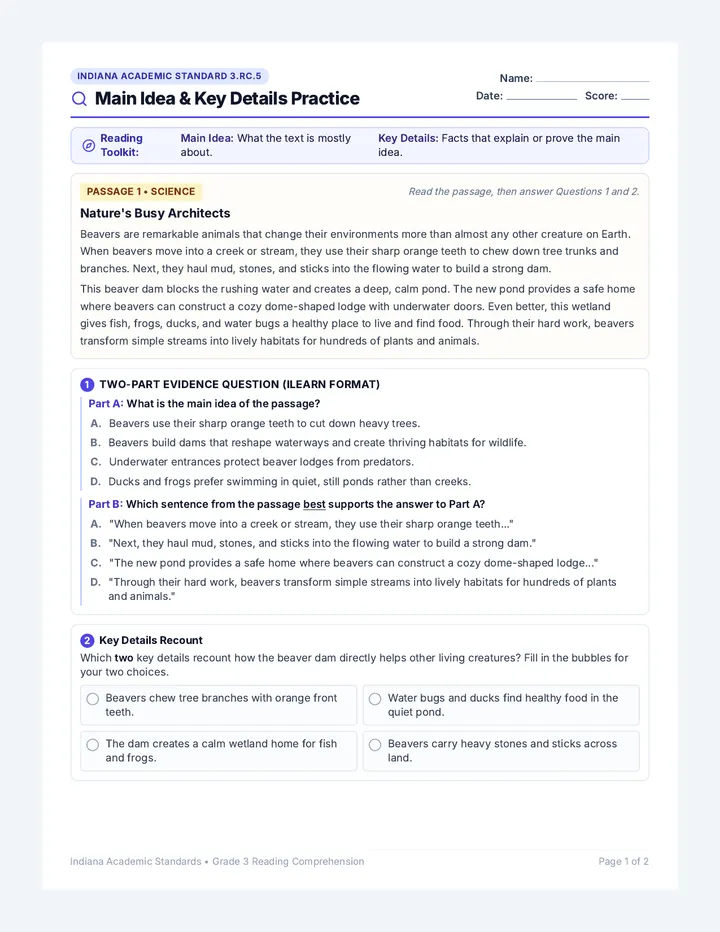
Architects of the Stream: Beaver Builders
Passage 1 • Lexile: 560L • Grade 3
Beavers are furry mammals that are specially built for living in the water. They have wide, paddle-shaped tails that act like boat rudders in rushing rivers. Their thick fur is waterproof to keep them warm in freezing streams, and their strong webbed back feet help them swim fast.
Beavers are also famous for being skilled builders. They use their sharp orange front teeth to cut down small trees and branches. Then, they pack the wood with heavy stones and river mud to build watertight dams. These strong dams block flowing water and create calm, deep ponds where beavers build safe dome-shaped homes called lodges.
The quiet ponds made by beaver dams help many other forest animals. Ducks and frogs swim and lay eggs in the still waters. Dragonflies zip through the reeds, and thirsty deer visit the pond edge for a cool drink. Beaver building makes the forest a better home for everyone.
1 Standard Requirement: Identify a clear main idea in a text.
Level: Below Standard
What is the clear main idea of this entire passage? Read all four options and choose the sentence that best tells what the whole text is about.
A Beavers have strong front teeth that are orange.
B Beavers are water mammals that build dams and create ponds that help forest wildlife.
C Ducks and frogs like to lay their eggs in cold mountain streams.
D Heavy stones and river mud can be found at the bottom of forest rivers.
Explain in your own words why your choice is the best main idea for the whole story:
Turn to the next page to complete Questions 2 and 3. Indiana 3.RC.5 • Level 1 (Page 1 of 2)
Level 1 • Below
Beaver Builders: Questions 2 & 3
Name:
2 Standard Requirement: Determine a key detail that supports a specific main idea.
Standard 3.RC.5
Specific Main Idea: "Beavers have bodies that are specially built for living in the water."
Which key detail from the passage best supports this specific main idea?
A They use sharp orange teeth to chop down birch and willow branches.
B They have paddle-shaped tails and waterproof fur to keep warm while swimming.
C Dragonflies zip through tall reeds around the edges of the water.
D Quiet ponds block flowing water and protect young kits from predators.
Write one sentence from the text explaining how this body feature helps the beaver:
3 Standard Requirement: Determine key details that support a specific main idea.
Standard 3.RC.5
Specific Main Idea: "The ponds built by beavers help many other forest animals."
Determine two key details from the passage that support this specific main idea. Write each detail on the lines below:
First Supporting Detail:
Second Supporting Detail:
Self-Check: Did you cite proof from the text for both details?
Indiana 3.RC.5 • Level 1 (Page 2 of 2)
Indiana Academic Standard 3.RC.5 • Tier 2 Check
Main Idea & Key Details: Approaching Standard
Name: Date:
Part 1: Reading Passage & Question 1
The Waggle Dance: How Honeybees Talk
Passage 2 • Lexile: 590L • Grade 3
Honeybees live together in large colonies with thousands of busy workers. For the hive to survive through winter, worker bees must gather sweet nectar and pollen from millions of blooming flowers. However, flowers are scattered across wide fields, so worker bees need a clever way to share the location of good food sources with their hive mates.
When a single scout bee discovers a rich flower patch, she flies back to the dark hive. Inside, she climbs onto the vertical honeycomb and performs an amazing movement called the "waggle dance." She rapidly shakes her abdomen back and forth while walking in a tight figure-eight pattern. Other bees crowd around her in the dark, touching her with their sensitive antennae to feel her rhythm.
This special dance communicates exact directions to the food. The angle of the bee's dance tells the other workers which direction to fly in relation to the sun. The length of time she waggles tells them how many miles away the flowers are. After watching and feeling the dance, dozens of worker bees fly straight out of the hive directly to the blossoms.
1 Approaching Indicator: Determine the main idea of a text.
Level: Approaching
In your own words, determine the main idea of this entire passage. What is the text mostly about? Write your response in complete sentences:
Turn to the next page to complete Questions 2 and 3. Indiana 3.RC.5 • Level 2 (Page 1 of 2)
Level 2 • Approaching
The Waggle Dance: Questions 2 & 3
Name:
2 Approaching Indicator: Identify main idea and provide a supporting detail.
Standard 3.RC.5
Look at Paragraph 2. Identify the main idea of this paragraph, and provide one key supporting detail from Paragraph 2 that proves it.
Paragraph 2 Main Idea:
Supporting Detail from Paragraph 2:
3 Approaching Indicator: Identify main idea and provide a supporting detail.
Standard 3.RC.5
The author shows that the waggle dance gives worker bees specific clues about food. Identify this main idea and provide one key supporting detail from Paragraph 3 that explains how the dance guides the bees:
Self-Check: Did you state the main idea in your own words and include clear details?
Indiana 3.RC.5 • Level 2 (Page 2 of 2)
Indiana Academic Standard 3.RC.5 • Tier 3 Check
Main Idea & Key Details: At Standard
Name: Date:
Part 1: Reading Passage & Question 1
Giants of the Coast: The Secret Network of Redwoods
Passage 3 • Lexile: 620L • Grade 3
[Section 1: Towers of the Pacific Fog] Coast redwoods are the tallest living trees on Earth, soaring more than three hundred feet into foggy skies. Surprisingly, these massive giants do not have deep taproots anchored hundreds of feet underground. Instead, their roots only extend five to ten feet deep into the soil, spreading outward up to one hundred feet in all directions.
[Section 2: The Living Underground Net] Because their roots are shallow, a single redwood standing alone would easily topple during severe coastal gales. Redwoods survive by growing in dense groves where their spreading roots tangle and fuse with the roots of neighboring trees. This underground mesh locks the entire forest together like a giant woven wooden mat that withstands fierce ocean winds.
[Section 3: Sharing Nutrients and Life] These root connections do far more than provide physical stability. Through this shared underground network, healthy mature trees pump moisture and sugary sap to younger saplings shaded under the dense canopy. If one redwood is damaged by insects or fire, neighboring trees send vital nutrients to keep it alive until it recovers.
1 At Standard Indicator: Synthesize multiple sections to determine the main idea.
Level: At Standard
Synthesize information from all three sections of the text. What is the overarching main idea of this entire passage? Combine the key ideas into a complete statement:
Turn to the next page to complete Questions 2 and 3. Indiana 3.RC.5 • Level 3 (Page 1 of 2)
Level 3 • At Standard
Coast Redwoods: Questions 2 & 3
Name:
2 At Standard Indicator: Provide and explain supporting details across multiple sections.
Standard 3.RC.5
Explain how key details from Section 2 (The Living Net) and Section 3 (Sharing Nutrients) work together to support the main idea that redwoods survive through community cooperation:
3 At Standard Indicator: Evaluate key details that support a specific main idea.
Standard 3.RC.5
Evaluate: Which key detail from the text provides the strongest evidence that redwoods actively support injured grove members? Explain why this detail is more convincing than other facts in the passage:
Self-Check: Did you synthesize across sections and justify your choice of strongest detail?
Indiana 3.RC.5 • Level 3 (Page 2 of 2)
Indiana Academic Standard 3.RC.5 • Tier 4 Check
Main Idea & Key Details: Above Standard
Name: Date:
Part 1: Reading Passage & Question 1
Fortress of the Sonoran Desert: The Saguaro's Secret
Passage 4 • Lexile: 640L • Grade 3
The scorching Sonoran Desert experiences months of blistering heat with virtually no rainfall, making survival nearly impossible for most living organisms. Standing tall against the rocky horizon, the giant saguaro cactus functions like a living water tower. Its pleated accordion-like skin expands outward during rare summer flash floods, allowing a single mature cactus to soak up and store more than two hundred gallons of pure water inside its spongy internal pulp.
This biological reservoir transforms the saguaro into an indispensable desert fortress. Thick waxy skin seals in moisture, preventing deadly evaporation under temperatures exceeding one hundred degrees. Sharp spines deflect hungry desert herbivores while casting tiny protective shadows over the plant's green skin, cooling its internal tissues during the hottest peak hours of daylight.
Because of this remarkable water-storing ability, the saguaro anchors an entire web of desert life. Gila woodpeckers chisel cool nesting cavities inside the moist cactus trunk, which later become homes for elf owls and purple martins. In early summer, nocturnal desert bats feed on sweet white saguaro blossoms, pollinating the flowers in exchange for life-saving nectar during the driest season of the year.
1 Above Standard Indicator: Analyze text to interpret the implied main idea.
Level: Above Standard
Analyze the text: What deeper, implied main idea does the author convey about why the saguaro cactus is called an "indispensable desert fortress"? Interpret the author's message beyond basic biological facts:
Turn to the next page to complete Questions 2 and 3. Indiana 3.RC.5 • Level 4 (Page 1 of 2)
Level 4 • Above Standard
Sonoran Saguaro: Questions 2 & 3
Name:
2 Above Standard Indicator: Provide and explain complex supporting details.
Standard 3.RC.5
Provide two specific key details from different paragraphs and explain how each detail demonstrates that the saguaro's physical survival adaptations directly enable desert animals to survive:
3 Above Standard Indicator: Analyze how details work together to develop the central idea.
Standard 3.RC.5
Analyze how the author uses cause-and-effect reasoning in Paragraphs 1 and 3. Explain how the cactus storing 200 gallons of floodwater directly causes life-saving effects for woodpeckers, owls, and bats:
Self-Check: Did you interpret the deeper meaning and explain cause-and-effect relationships?
Indiana 3.RC.5 • Level 4 (Page 2 of 2)
Teacher Guide & Master Rubric • Part 1
Indiana Standard 3.RC.5 Learning Progression
3.RC.5 Item Specification
Full IDOE Progression Matrix
Indiana Department of Education (IDOE) Standard 3.RC.5 Proficiency Levels Subdomain: Read and Understand Informational Text
Below Standard
- Identify a clear main idea in a text.
- Determine one or more key details that support a specific main idea.
Approaching
- Determine the main idea of a text.
- Identify the main idea of a text, and provide a supporting detail.
At Standard
- Synthesize multiple sections of a text to determine the main idea, and provide or explain supporting details.
- Evaluate key details that support a specific main idea.
Above Standard
- Analyze a text to interpret the main idea, and provide or explain one or more supporting details.
Level 1 (Below Standard) Key Beavers
Q1 Key: B
Beavers are water mammals that build dams and create ponds that help forest wildlife. (Summarizes entire passage, not isolated facts).
Q2 Key: B
They have paddle-shaped tails and waterproof fur to keep warm while swimming. (Directly matches body adaptations for water).
Q3 Exemplar:
Any two: (1) Ducks and frogs swim and lay eggs; (2) Dragonflies zip through reeds; (3) Thirsty deer visit for a drink.
Level 2 (Approaching) Key Honeybees
Q1 Exemplar (Determine Main Idea):
Honeybees use a special "waggle dance" inside the hive to communicate the exact direction and distance of flower patches to other worker bees.
Q2 Exemplar (Paragraph 2 Idea & Detail):
Idea: A scout bee performs a dance on the honeycomb to share food location. Detail: She shakes her abdomen in a figure-eight pattern while bees touch her antennae.
Q3 Exemplar (Provide Supporting Detail):
Either: (1) The angle tells the direction in relation to the sun; OR (2) The length of time she waggles tells how many miles away the flowers are.
Diagnostic Analysis: Evaluating Foundational Performance
• Placement at "Below": A student can identify a clear main idea when given multiple-choice options (Level 1, Q1) and locate a key detail matching a given idea (Q2 & Q3), but cannot independently state the main idea in their own words.
• Placement at "Approaching": A student successfully generates a written main idea statement independently (Level 2, Q1) and accurately provides a direct supporting detail from a specific paragraph (Level 2, Q2 & Q3).
Indiana Department of Education (IDOE) Standard 3.RC.5 Item Specification Rubric Master Progression Key • Page 1 of 2
Teacher Guide & Master Rubric • Part 2
At Standard & Above Standard Scoring
3.RC.5 Item Specification
Advanced Scoring & Intervention
Level 3 (At Standard) Key Redwoods
Q1 Exemplar (Synthesize Sections):
Coast redwoods survive despite shallow roots because their roots weave together underground into a shared network that withstands storms and shares food and water.
Q2 Exemplar (Multi-Section Evidence):
Section 2 shows physical protection (tangled roots prevent toppling in winds), while Section 3 shows nutritional protection (trees share sap and water with young or injured trees).
Q3 Exemplar (Evaluate Evidence):
Strongest detail: Neighboring trees send vital nutrients to damaged trees to keep them alive. This is strongest because it proves trees actively invest energy to rescue injured neighbors.
Level 4 (Above Standard) Key Saguaro
Q1 Exemplar (Interpret Implied Main Idea):
The saguaro is an "indispensable fortress" because its unique water-storing anatomy allows it to withstand extreme desert drought while acting as the protective foundation that sustains birds, bats, and other wildlife.
Q2 Exemplar (Complex Details):
(1) Pleated skin stores 200 gallons of floodwater, keeping plant tissues moist for woodpeckers to carve cool homes; (2) Early summer night blossoms provide nectar that sustains bats during the driest season.
Q3 Exemplar (Cause-and-Effect Analysis):
The cause of storing 200 gallons of floodwater produces the effect of a spongy, moist internal trunk that does not dry up, directly allowing woodpeckers to hollow out cool nests and flowers to produce liquid nectar.
Targeted Small-Group Differentiation Matrix Standard 3.RC.5 Next Steps
Scoring "Below": Immediate Scaffolding
Use color-coded highlighting: blue for the topic sentence (main idea) and yellow for proof sentences (key details). Have students practice matching pre-written detail cards to the correct main idea poster.
Scoring "Approaching": Bridge to "At"
Use multi-paragraph synthesis organizers. Teach students to summarize Paragraph 1 and Paragraph 2 in single bullet points, then combine them using the sentence frame: "This whole passage shows that [Idea] because [Detail 1] and [Detail 2]."
Scoring "At Standard": Deepening Evaluation
Present students with two accurate supporting details from the passage. Challenge them to debate: "Which of these two details is the most critical piece of evidence for the author's claim, and why?"
Scoring "Above Standard": Advanced Analysis
Have students analyze paired informational texts on similar ecosystems. Ask them to compare how different authors structure details to convey subtly different underlying themes or perspectives.
Indiana Department of Education (IDOE) Standard 3.RC.5 Item Specification Rubric Master Progression Key • Page 2 of 2