A comprehensive practice packet focusing on core spelling rules: doubling consonants, dropping final 'e', and the dge/ge distinction, integrated with vowel team mastery.
A hands-on outdoor poetry workshop for fourth graders to master imagery and figurative language by observing the Indiana spring environment. Students transition from sensory observation to creative poetic drafting.
A 4th-grade ELA lesson where students venture outdoors to observe the Indiana spring environment, using their five senses to gather imagery for descriptive poetry using figurative language.
A collection of high-interest reading passages and fluency packets about legendary athletes. Each resource includes word-work exercises, timed reading sections, and discussion prompts.
A guide for students to transform their research into a persuasive travel advertisement paragraph, focusing on structure, hooks, and descriptive language.
A reading comprehension lesson focused on identifying the main idea through a fictional narrative about discovering a magical forest.
A 4th-grade non-fiction reading lesson focused on the biology, social structure, and conservation of African elephants. Students will read a detailed passage and demonstrate comprehension through multiple-choice questions.
An interactive exploration of the 6 Traits of Effective Writing, designed to help students identify and apply key elements of strong prose through discussion and analysis.
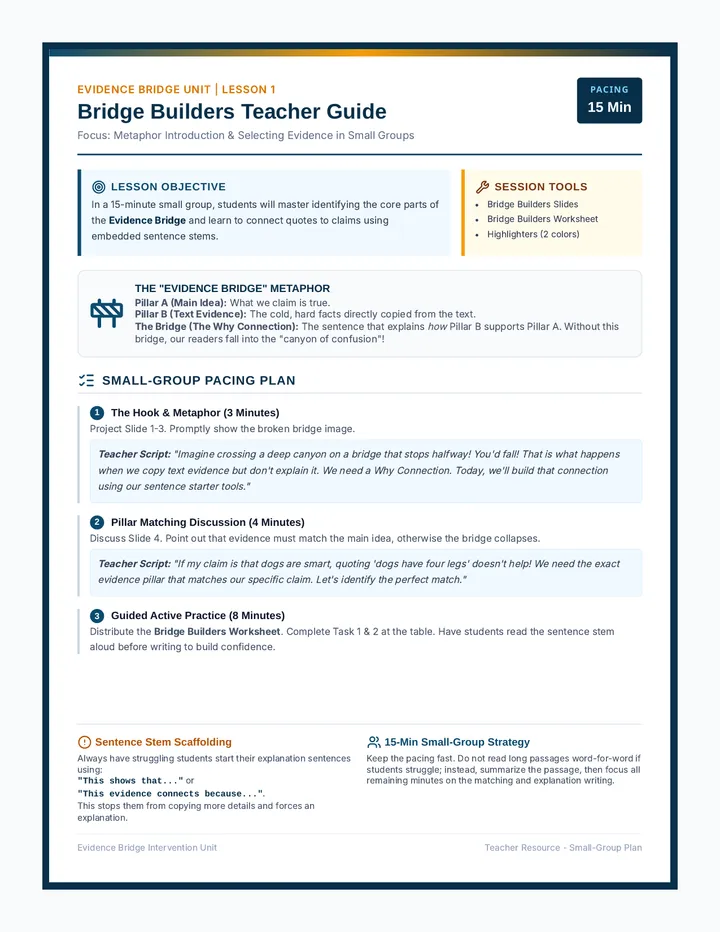
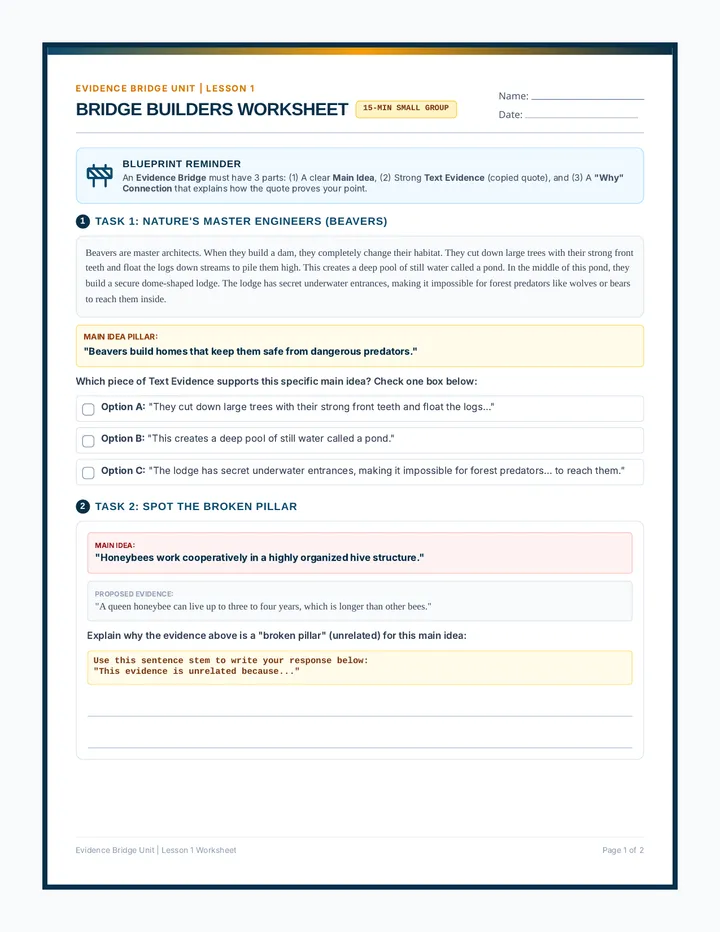
A high-level extension lesson for students who correctly identified the theme, focusing on the sophisticated skill of explaining how specific textual evidence supports a theme. Introduces the 'Evidence Bridge' framework to connect plot details to universal messages.
A comprehensive suite of 20 unique syllable assessment trackers for teachers to monitor student progress in phonological awareness. Each sheet features a randomized list of words ranging from 1 to 4 syllables.
A targeted reteach lesson for students who confuse universal themes with subjective opinions or social judgments about characters. Focuses on the "Filter Test" to separate opinions from evidence-based themes.
A reading comprehension lesson focused on making inferences from a social situation during recess, tailored for 3rd-grade readers at a 400L-500L Lexile level.
A reading comprehension lesson focused on making inferences based on a story about a rainy day indoor recess.
Explores overcurve strokes and 'hump' letters such as m, n, v, x, y, and z. Focuses on rhythmic movement and distinct peak heights.
Covers sharp, angled letters and undercurve strokes like i, u, w, t, r, s, p, and j. Emphasizes uniform slant and precise points.
Focuses on letters with upward loops and tall strokes, including l, e, b, h, k, and f. Students learn to maintain consistent height and loop width.
Introduction to the 'Magic C' stroke group, covering letters c, a, d, g, q, and o. Students practice the foundational counter-clockwise motion used in these related characters.
A focused lesson on using context clues to determine word meaning in both scientific texts and school-based narratives. Includes guided practice, independent work, and a hands-on task card activity.
A reflective end-of-year literacy project where students act as museum curators to showcase their academic growth and personal milestones through physical artifacts and descriptive writing.
A lesson for second graders to master sequencing fiction stories using the signal words first, next, and last. Includes a presentation, a short story worksheet, and a teaching guide.
A short, focused lesson on identifying themes in literature using short fictional passages. Students learn to distinguish between plot details and universal messages.
Students will investigate and identify the purpose of text features including diagrams, labels, bold print, maps, captions, and headings through an interactive presentation, a matching activity, and a hands-on scavenger hunt.
A creative storytelling lesson for K-3 students that uses found objects to develop oral narrative skills, sequencing, and descriptive language in a cozy campfire-themed setting.
A reading comprehension lesson focused on identifying text structures and author's purpose across multiple genres for elementary students.
A comprehensive assessment on fairy tale elements and plot structures for elementary students, featuring two differentiated levels to meet specific grade-level standards.
A final mastery assessment where students apply all three core skills to paired narrative and informational texts.
A mixed-skill review session applying opinion identification and structure analysis to complex informational texts.
Students compare two short texts on the same topic to identify points of agreement and disagreement.
Students analyze informational texts to identify the 'compare and contrast' organizational structure.
Students learn to identify an author's opinion within a narrative text using a 'fact vs. clue' detective approach.
A lesson focused on identifying and using similes and metaphors to enhance poetic imagery and descriptive writing.
A targeted lesson for intermediate English Learners to master identifying the main idea and supporting details using a passage about the Earth's water cycle.
A cumulative review where students synthesize traits, motivations, and POV to complete a final character analysis.
Distinguishing between the narrator and characters to identify point of view and how it shapes the story.
Connecting character actions to plot development, showing how individual choices influence the sequence of events in a story.
An exploration of why characters act the way they do by identifying their motivations and the text clues that reveal them.
Students learn to distinguish between external traits and internal feelings while gathering textual evidence to support their findings.
A comprehensive assessment for 3rd-4th grade students covering key fairy tale elements, sequencing, character analysis, and theme using classic tales.
A comprehensive system for tracking whole-class progress across foundational phonics skills, focusing on mastery dates and percentage scores.
A focused study on chapters 15 and 16 of Hatchet, covering the 'Great Day' of Brian's first meat and the devastating moose attack and tornado.
Students will learn to identify and use definition, restatement, synonym, and antonym context clues to determine the meaning of unfamiliar vocabulary in 6th-grade level texts.
A comprehensive unit assessment for 3rd-4th grade students covering fairy tale elements, sequencing, and literary analysis using classic stories like The Gingerbread Man, Puss in Boots, and Beauty and the Beast.
A lesson introducing common idioms and practicing their use in real-world scenarios through a detective-themed investigation.
A lesson centered on the historic 1952 Pendleton rescue off the coast of Chatham, Massachusetts, featuring a Lexile-leveled informational article and assessment.