Word Shades Quiz
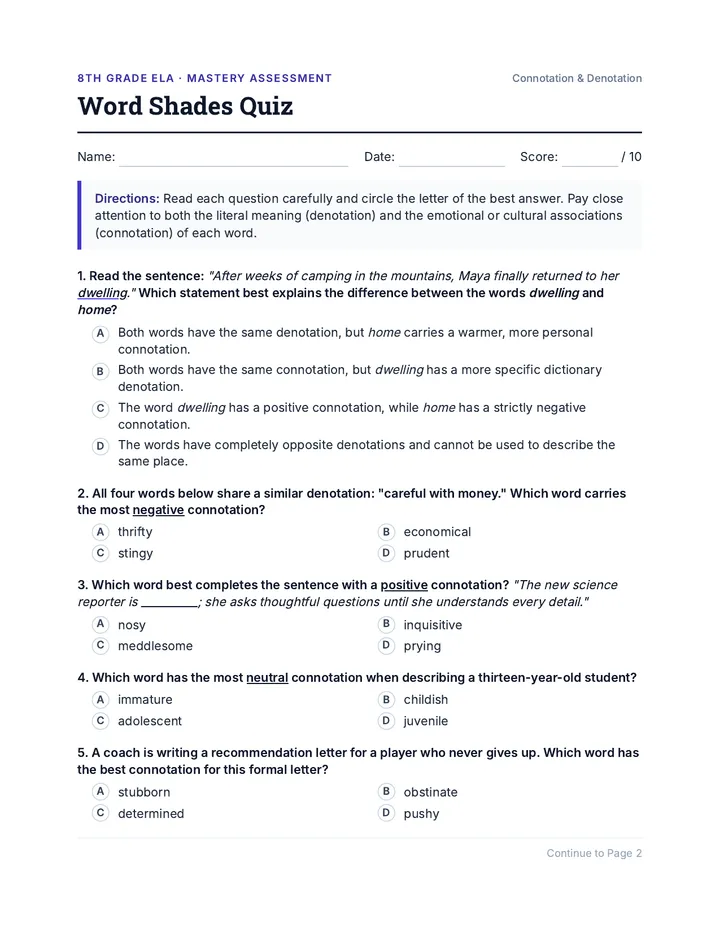
8th Grade ELA · Mastery Assessment Connotation & Denotation
Word Shades Quiz
Name:
Date:
Score: / 10
Directions: Read each question carefully and circle the letter of the best answer. Pay close attention to both the literal meaning (denotation) and the emotional or cultural associations (connotation) of each word.
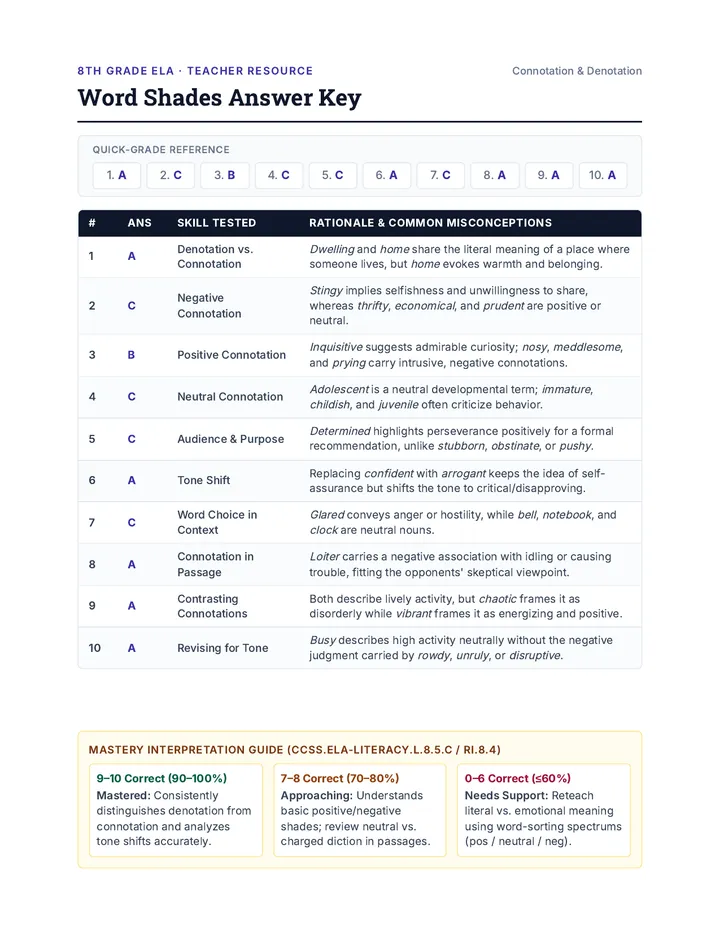
1. Read the sentence: "After weeks of camping in the mountains, Maya finally returned to her dwelling." Which statement best explains the difference between the words dwelling and home?
A Both words have the same denotation, but home carries a warmer, more personal connotation.
B Both words have the same connotation, but dwelling has a more specific dictionary denotation.
C The word dwelling has a positive connotation, while home has a strictly negative connotation.
D The words have completely opposite denotations and cannot be used to describe the same place.
2. All four words below share a similar denotation: "careful with money." Which word carries the most negative connotation?
A thrifty
B economical
C stingy
D prudent
3. Which word best completes the sentence with a positive connotation? "The new science reporter is __________; she asks thoughtful questions until she understands every detail."
A nosy
B inquisitive
C meddlesome
D prying
4. Which word has the most neutral connotation when describing a thirteen-year-old student?
A immature
B childish
C adolescent
D juvenile
5. A coach is writing a recommendation letter for a player who never gives up. Which word has the best connotation for this formal letter?
A stubborn
B obstinate
C determined
D pushy
Continue to Page 2
Word Shades Quiz Page 2 · Tone & Context
6. Read the sentence: "Marcus walked onto the stage with a confident smile." If the author replaced confident with arrogant, how would the sentence change?
A The denotation would stay the same, but the tone would become critical of Marcus's attitude.
B The tone would stay positive, but the reader would think Marcus was nervous.
C The sentence would become completely neutral and express no opinion about Marcus.
D The denotation would change so that Marcus is no longer smiling on stage.
7. Read the sentence: "When the bell rang, Elena slammed her notebook shut and glared at the clock." Which word in the sentence carries the strongest negative connotation?
A bell
B notebook
C glared
D clock
Read the Excerpt for Questions 8–10
Last Tuesday, the city council debated whether to build a new skatepark near Oak Street. Opponents argued that teenagers would simply loiter near the benches and create a chaotic atmosphere in the quiet neighborhood. However, supporters countered that the park would give local youth a safe, vibrant space to stay active after school.
8. Why did the author report that opponents used the word loiter instead of gather?
A Loiter has a negative connotation that suggests teenagers are hanging around without a good purpose.
B Loiter has a positive connotation that emphasizes friendship and community spirit.
C Gather is an informal slang term, whereas loiter is a purely neutral word.
D Loiter means to leave an area quickly, which fits the opponents' argument.
9. Compare the words chaotic and vibrant in the excerpt. How do their connotations reflect the two sides of the debate?
A Both words describe high energy, but chaotic suggests disorder while vibrant suggests lively, positive energy.
B Both words have negative connotations, showing that neither side wants the skatepark built.
C Chaotic has a neutral connotation, while vibrant has a negative connotation.
D The two words are exact synonyms in both denotation and connotation.
10. Suppose the writer wanted to make the opponents' view sound more neutral. Which word would best replace chaotic in the second sentence?
A busy
B rowdy
C unruly
D disruptive
End of Quiz