Word Shades Slides 6th Grade ELA Mini-Lesson
Word Shades
Same dictionary meaning. Totally different feeling.
Positive
Neutral
Negative
Denotation vs. Connotation
Mini-Lesson
Denotation
The literal, dictionary definition of a word.
Example: A building where people live.
Connotation
The feeling, vibe, or attitude a word carries.
Same meaning, different vibes:
The Connotation Spectrum
Mini-Lesson
All three words share the same denotation: "wanting to know more."
Positive
inquisitive
Sounds smart, eager, and respectful of learning.
Neutral
curious
Just states the fact—neither praise nor criticism.
Negative
nosy
Sounds annoying, intrusive, and impolite.
Guided Practice: Sort by Tone
Together
Place each word meaning "careful with money" on the spectrum:
cheap • thrifty • economical
Positive (+)
Smart & resourceful
Neutral (=)
Matter-of-fact
Negative (-)
Stingy or low quality
Guided Practice: Context & Revision
Together
1. Choose by Context
"My aunt has a ( unique / weird ) collection of hand-painted teacups from around the world."
Which word fits the admiring tone of the sentence? Why?
2. Revise for Effect
"The loud crowd cheered as the team walked onto the field."
Swap loud for a positive word (e.g., enthusiastic ) or a negative word (e.g., rowdy ).
Guided Practice: Compare Word Pairs
Turn & Talk
Pair A
bold vs. reckless
Both describe taking big risks. How does each word make the person sound?
Pair B
slim vs. scrawny
Both mean thin. Which one is a compliment, and which one is a criticism?
Next up: Complete your 4-part Word Shades Review Worksheet!
Word Shades Review Worksheet 6th Grade ELA Review
Word Shades: Connotation Practice
Name: _____________________ Date: ___________
Denotation: Literal dictionary meaning.
Connotation: Emotional feeling (+ Positive, = Neutral, - Negative).
PART 1
Sort by Tone
Sort all 12 words from the word bank into the chart below based on their connotation.
immature scent slender bossy youthful stench scrawny firm young fragrance thin assertive
Positive (+)
Neutral (=)
Negative (-)
PART 2
Choose by Context
Read each sentence carefully. Circle the word in parentheses that best fits the tone and situation.
During the awards assembly, the principal praised Maya for her ( confident / arrogant / boastful ) speech about teamwork.
After forgetting to clean out his gym locker for three weeks, Jordan noticed a terrible ( aroma / odor / perfume ) coming from his backpack.
Because our family is saving for a summer trip, we are trying to be ( cheap / stingy / thrifty ) at the grocery store.
The reporter asked ( nosy / inquisitive / meddling ) questions that helped the audience understand how the invention worked.
Word Shades: Connotation Practice Page 2
PART 3
Compare Word Pairs
Each pair of words below shares a similar denotation. Explain how the two words differ in feeling or tone.
1. determined vs. stubborn
2. vintage vs. outdated
3. relaxed vs. lazy
PART 4
Revise for Effect
Replace the underlined word in each sentence and rewrite the sentence to shift the tone as directed.
The old car sat in the driveway. → Shift to sound positive (admiring):
Marcus walked into the classroom after lunch. → Shift to sound negative (careless):
The group waited outside the auditorium. → Shift to sound negative (rowdy):
Word Shades Teacher Guide 6th Grade ELA • Teacher Resource
Word Shades: Teacher Guide & Key
40–45 Minute Lesson
Learning Objective
Students will distinguish among the connotations (positive, neutral, negative) of words with similar denotations and apply those distinctions when sorting, selecting, comparing, and revising words in context.
Pacing & Facilitation
Time
Segment
Teacher Moves & Prompts
10 min
Mini-Lesson
(Slides 1–3)
Contrast denotation (dictionary) vs. connotation (feeling). Walk through house / home / shack and inquisitive / curious / nosy . Emphasize that neutral words state facts without judgment.
10 min
Guided Practice
(Slides 4–6)
Sort thrifty (+), economical (=), cheap (-) as a class. Model checking sentence clues before picking unique vs. weird . Have partners turn-and-talk on bold vs. reckless and slim vs. scrawny .
15–20 min
Review Exercise
(Worksheet)
Students complete Parts 1–4 independently or in pairs. Circulate to check that Part 3 explanations name the specific feeling/attitude, not just "one is good and one is bad."
5 min
Debrief
Invite 2–3 students to share their Part 4 sentence revisions aloud and ask the class to identify the new tone.
Common Misconceptions
Confusing meaning with tone: Students may think synonyms are always interchangeable. Remind them that swapping aroma for odor changes the reader's reaction.Vague explanations: In Part 3, push students past "positive/negative" to describe the specific attitude (e.g., admiring effort vs. criticizing inflexibility ).
Differentiation Tips
Support: Group the 12 words in Part 1 into 4 trios before sorting, or provide a mini word bank (e.g., classic, stomped, mob ) for Part 4.Extension: Challenge fast finishers to write two sentences for the same event—one using positive connotations and one using negative connotations.
Word Shades: Teacher Guide & Key Answer Key
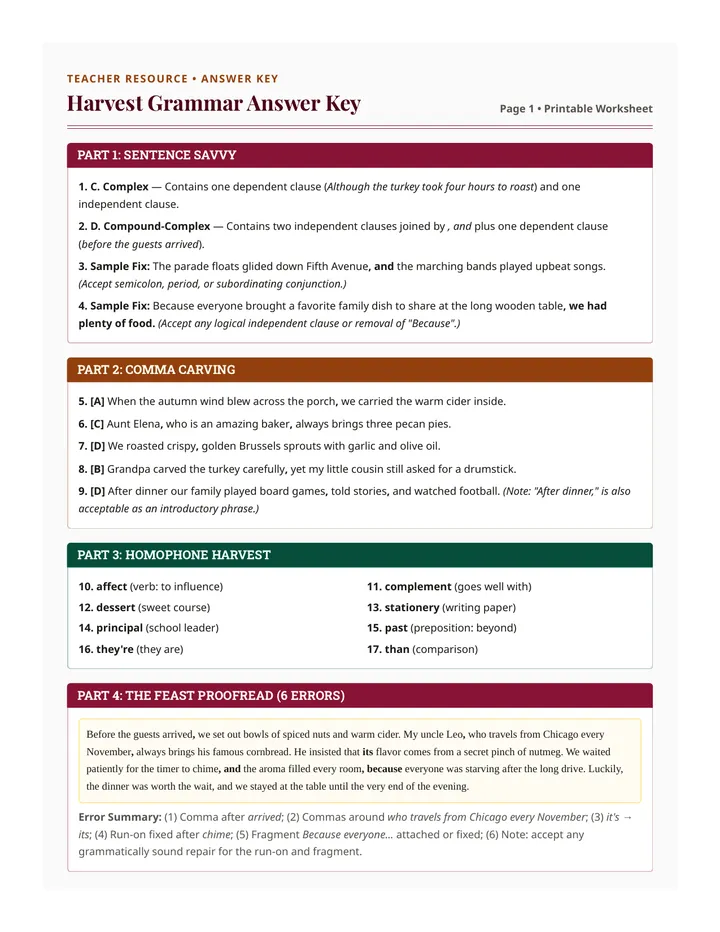
Part 1: Sort by Tone
Positive (+)
Neutral (=)
Negative (-)
youthful
young
immature
fragrance
scent
stench
slender
thin
scrawny
assertive
firm
bossy
Part 2: Choose by Context
confident (fits the admiring context of being praised at an assembly)odor (fits the unpleasant context of an uncleaned gym locker)thrifty (fits the positive goal of smartly saving for a family trip)inquisitive (fits the respectful context of helping an audience learn)
Part 3: Compare Word Pairs (Sample Responses)
1. determined vs. stubborn: Both mean refusing to give up. Determined has a positive tone that shows admirable persistence, while stubborn has a negative tone suggesting someone refuses to listen or compromise.
2. vintage vs. outdated: Both describe something from the past. Vintage feels stylish, classic, and valuable, while outdated feels old-fashioned, useless, or behind the times.
3. relaxed vs. lazy: Both describe not working hard at the moment. Relaxed feels calm, peaceful, and well-rested, while lazy criticizes someone for avoiding effort or responsibility.
Part 4: Revise for Effect (Sample Responses)
1. Positive revision: "The classic (or vintage / antique ) car sat in the driveway."
2. Negative revision: "Marcus stomped (or slouched / trudged ) into the classroom after lunch."
3. Negative revision: "The mob (or pack / unruly crowd ) waited outside the auditorium."