TSI Benchmark Practice Exam
TSIA2 Preparatory Battery Standard Time: 90 Minutes • 50 Items
Texas Success Initiative: English Language Arts & Reading
Section 1: Reading Comprehension
Candidate: ___________________________
Date: ___________________
Testing ID: _________________
DIRECTIONS: Read each passage carefully and choose the best answer for each question based on what is stated or implied. Fill in the corresponding letter on your score sheet.
Passage 1: Science & Marine Ecology Adapted from "The Living Light of the Abyssal Depths" (2024)
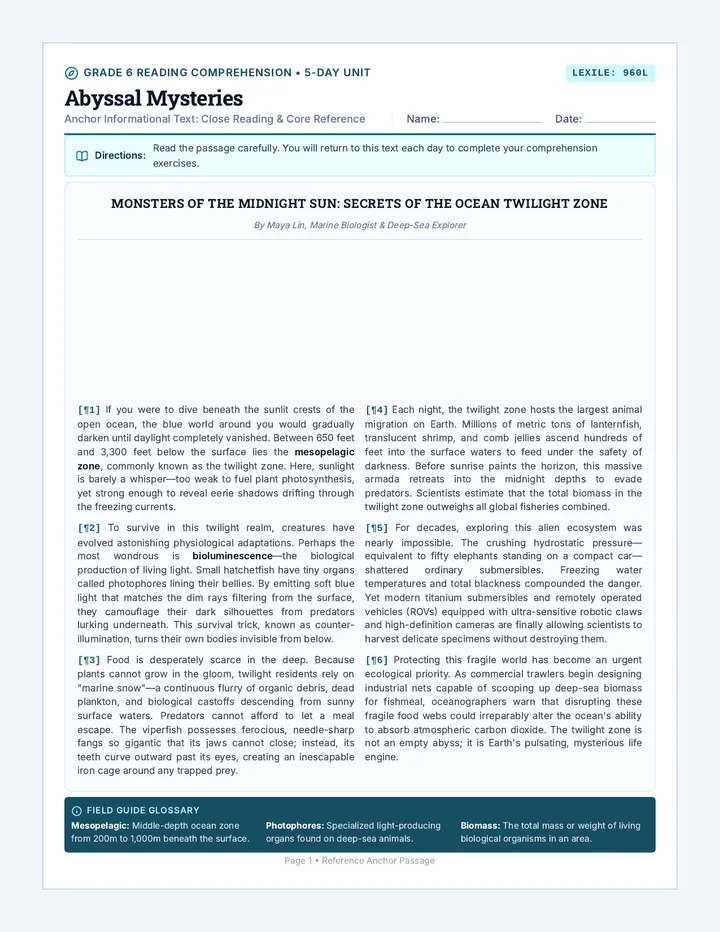
[1] Below 200 meters, sunlight attenuates rapidly until the ocean enters the aphotic zone, a vast expanse of perpetual obsidian gloom. Despite the crushing hydrostatic pressures and near-freezing temperatures, this realm is far from lifeless; instead, it is illuminated by living light. Bioluminescence—the biochemical emission of visible photons through the oxidation of the substrate luciferin catalyzed by the enzyme luciferase—is not an eccentric novelty here, but a near-universal adaptation.
[2] Marine organisms utilize this cold light for survival strategies as diverse as their morphologies. The anglerfish famously suspends a glowing esca above its cavernous jaws to lure unsuspecting prey within striking distance. Conversely, hatchetfish deploy counterillumination: photophores lining their ventral bellies emit blue-green hues calibrated precisely to match downwelling light, dissolving their silhouettes from the view of predators hunting from beneath. Far from a decorative biological curiosity, bioluminescence serves as communication, camouflage, and fatal weapon in Earth's largest frontier.
- Which statement best expresses the primary claim of Passage 1?
A. Ocean pressure prevents most aquatic life from surviving below 200 meters.
B. Bioluminescence represents an essential ecological adaptation rather than an anomaly.
C. Counterillumination is the sole defensive mechanism used by deep-sea organisms.
D. Sunlight can penetrate the aphotic zone under specific seasonal weather conditions.
- As used in paragraph 1, the word "attenuates" most nearly means:
A. diminishes in strength
B. refracts violently
C. intensifies gradually
D. multiplies rapidly
- According to paragraph 2, hatchetfish utilize counterillumination specifically to:
A. attract mates across vast underwater distances
B. generate heat against freezing oceanic currents
C. obscure their silhouettes from predators swimming below them
D. disorient schooling prey before striking
TSIA2 Diagnostic Battery • Form 1A Page 1 of 9 GO ON TO THE NEXT PAGE →
Section 1: Reading Comprehension Passage 1 (Cont.) & Passage 2
- Which rhetorical strategy does the author employ in the concluding sentence of paragraph 2?
A. An emotional appeal warning against deep-sea drilling
B. A synthesized summary highlighting multifunctional evolutionary purposes
C. A chronological recount of marine biology discoveries
D. An allegorical comparison between oceans and distant planets
- Based on the text, what can be reasonably inferred about deep-sea marine life?
A. Deep-sea organisms produce light without chemical reactions.
B. Bioluminescence has evolved independently to serve distinct ecological niches.
C. Predatory species rely exclusively on visual lures rather than physical pursuit.
D. Hydrostatic pressure impedes the biochemical synthesis of luciferase.
Passage 2: Historical Analysis Adapted from "The People's Archive: The Federal Writers' Project"
[1] Created in 1935 as a relief arm of the Works Progress Administration, the Federal Writers' Project (FWP) dispatched thousands of unemployed journalists, historians, and novelists into the American heartland. While the program’s official mandate was the publication of comprehensive state travel guidebooks, its most enduring cultural legacy was accidental: the radical democratization of American oral history.
[2] Rather than memorializing military generals or political chieftains, field researchers recorded the testimonies of sharecroppers, immigrant laborers, and over 2,300 formerly enslaved individuals whose narratives had been omitted from textbooks. Critics initially castigated the project as a frivolous boondoggle, deriding its compilations as unverified folkloric trivia. However, modern historians view the archive as a revolutionary historiographical shift that dismantled the elite monopoly on national memory.
- The primary purpose of Passage 2 is to:
A. criticize the fiscal mismanagement of Depression-era federal programs
B. evaluate the historiographical value of the Federal Writers' Project
C. compare the literary styles of renowned American novelists
D. demonstrate how tourism guidebooks preserved regional dialects
- As used in paragraph 2, "castigated" most nearly means:
A. praised enthusiastically
B. severely condemned
C. formally audited
D. temporarily postponed
- The author contrasts traditional histories with the FWP archive primarily by noting that the FWP:
A. centered the firsthand accounts of marginalized everyday citizens
B. focused strictly on statistical and census demographic models
C. corroborated every testimony with official courtroom documents
D. restricted research to major industrial urban centers
TSIA2 Diagnostic Battery • Form 1A Page 2 of 9 GO ON TO THE NEXT PAGE →
Section 1: Reading Comprehension Passage 2 (Cont.) & Passage 3
- Which phrase from Passage 2 best encapsulates the shift described by the author?
A. "mandate was the publication of comprehensive state travel guidebooks"
B. "dismantled the elite monopoly on national memory"
C. "dispatched thousands of unemployed journalists"
D. "deriding its compilations as unverified folkloric trivia"
- The author's tone toward the Federal Writers' Project can best be described as:
A. dismissive and skeptical
B. appreciative and vindicating
C. detached and indifferent
D. nostalgic and sentimental
Passage 3: Literary Nonfiction Excerpted from "The Cartographer's Paradox" (2023)
[1] To trace a river onto vellum is to commit a deliberate betrayal. When Julian unrolled the topographical survey across his cherry-wood desk, the contour lines pulsed under his brass magnifier like the ribcage of a breathing creature. For forty years, the municipal registry had tasked him with codifying boundary stones, property lines, and drainage basins. Yet every stroke of his ruling pen felt like an act of taxidermy—pinning down a living, fluid world into rigid, geometric silence.
[2] "A map that tells the whole truth," he would remind his apprentices, "would have to be as large as the territory itself, and twice as unruly." The real terrain resisted neat parceling. Rivers silted overnight, redrawing counties with a single spring freshet; footpaths wandered where cattle chose to graze, disregarding deed markers. Julian’s ink could record ownership, but it could never capture tenure—the lived reality of earth that belonged to no one save the rain.
- The comparison of mapmaking to "an act of taxidermy" in paragraph 1 suggests that maps:
A. preserve dead abstractions while extinguishing dynamic vitality
B. require surgical dexterity and anatomical precision
C. celebrate the triumph of human architecture over nature
D. suffer gradual deterioration when exposed to moisture
- What internal conflict does Julian experience throughout the passage?
A. Resentment toward his apprentices' lack of discipline
B. Ambivalence between technical duty and the unruly reality of nature
C. Financial anxiety caused by declining demand for hand-drawn maps
D. Fear of failing municipal inspection standards
- As used in paragraph 2, Julian contrasts "ownership" with "tenure" to emphasize that:
A. legal claims cannot dictate the wild and organic state of the land
B. rural tenants pay exorbitant rental fees to municipal landowners
C. accurate surveying requires formal university credentials
D. boundary disputes are resolved through legal arbitration
TSIA2 Diagnostic Battery • Form 1A Page 3 of 9 GO ON TO THE NEXT PAGE →
Section 1: Reading Comprehension Passage 3 (Cont.) & Paired Passages 4A/4B
- In paragraph 2, the example of a "spring freshet" serves to demonstrate:
A. the seasonal hazards faced by apprentice cartographers
B. the futility of trying to permanently freeze a mutable landscape
C. the superiority of modern digital instruments over brass tools
D. the economic devastation brought by flooding along riverbanks
- Which central theme is explored through Julian's craft?
A. Technological advancement always simplifies human labor.
B. Human systems of classification are inherently incomplete imitations of nature.
C. Devotion to civil bureaucracy produces artistic fulfillment.
D. Historical cartography is too unreliable to settle legal claims.
Passages 4A & 4B: Debating Urban Rewilding
Passage 4A: The Case for Rewilding
Urban rewilding offers an antidote to sterile municipal concrete. By replacing manicured, pesticide-soaked turf with native flora, bioswales, and micro-forests, cities can sequester carbon, mitigate urban heat islands, and restore depleted pollinator networks. Crucially, access to spontaneously regenerating green spaces reduces chronic cortisol levels and enhances community well-being. Leaving nature unmanaged is not civic neglect; it is ecological restorative justice.
Passage 4B: The Pragmatic Critique
While romantic in rhetoric, total urban rewilding overlooks dense municipal realities. Unmanaged vegetation along pedestrian corridors fosters public safety hazards, invites invasive vector species like deer ticks and rodents, and clogs subterranean drainage infrastructure during storm events. Genuine urban sustainability demands deliberate design, active arboricultural maintenance, and controlled horticulture—not the abdication of municipal stewardship under an eco-utopian banner.
- The author of Passage 4A characterizes traditional municipal turf grass primarily as:
A. an efficient sponge for heavy precipitation
B. an artificially maintained and ecologically barren space
C. a vital recreational hub for underserved neighborhoods
D. an affordable landscaping alternative for city budgets
- As used in Passage 4B, the phrase "abdication of municipal stewardship" most nearly refers to:
A. privatizing public city parks to corporations
B. failing to uphold civic responsibilities to manage public spaces
C. decreasing the budget allocations for public transit
D. replacing trained city arborists with automated machinery
- Which concern raised in Passage 4B directly challenges the environmental claims made in Passage 4A?
A. Native vegetation is visually displeasing to suburban commuters.
B. Unregulated growth can obstruct stormwater drainage infrastructure.
C. Public recreation spaces should be converted into commercial retail.
D. Native plantings cost significantly more than synthetic turf.
TSIA2 Diagnostic Battery • Form 1A Page 4 of 9 GO ON TO THE NEXT PAGE →
Section 1 (Wrap-Up) • Section 2: Writing & Revision Questions 19–23
- How would the author of Passage 4B most likely respond to Passage 4A's claim that unmanaged green space represents "restorative justice"?
A. By agreeing that all lawn mowing should be outlawed nationwide
B. By asserting that untamed urban greenery risks public safety and infrastructure
C. By denying that climate change impacts urban temperature dynamics
D. By recommending that cities remove all parklands entirely
- Both authors would most likely agree with which foundational premise?
A. Urban green spaces significantly influence the quality of city life.
B. Native plant species invariably harm subterranean pipes and wiring.
C. Completely unmanaged wilderness is the only viable model for parks.
D. City governments should eliminate chemical pesticide regulations.
Section 2: Writing & Text Revision Questions 21–35
Draft: The Microgrid Revolution Read the draft and answer the revision questions.
[1] (1) Centralized electrical grids, originally engineered over a century ago, are increasingly vulnerable to severe weather anomalies and cascading blackouts. (2) In response, municipal planners are pioneering decentralized community microgrids. (3) These modular energy systems combine local solar arrays and lithium battery storage to function independently from the main grid during emergencies. (4) Coal plants take hours to fire up after an unexpected shutdown.
[2] (5) When Hurricane Ian disabled regional transmission lines in 2022, the Babcock Ranch solar microgrid sustained power without a single flicker. (6) Furthermore, microgrids democratize energy ownership by allowing neighborhoods to trade surplus power peer-to-peer. (7) Therefore, transitioning to localized renewable networks fortifies community resilience and accelerates decarbonization.
- Which sentence would provide the most engaging and relevant hook if added before sentence 1?
A. Thomas Edison and Nikola Tesla feuded vigorously over AC versus DC currents in the late 1880s.
B. As extreme climate disruptions strain aging infrastructure, relying on a single distant power plant is becoming perilous.
C. Electricity bills represent a substantial portion of the average suburban homeowner’s monthly budget.
D. Modern lithium batteries have undergone extensive chemical revisions in consumer smartphones.
- Which sentence in paragraph 1 contains extraneous information that disrupts the focus and should be deleted?
A. Sentence 1
B. Sentence 2
C. Sentence 3
D. Sentence 4
- Which word or phrase would best replace the transition "Therefore" in sentence 7 to summarize the paragraph's two core advantages?
A. By combining reliability with local economic autonomy,
B. In spite of the massive financial burdens imposed on citizens,
C. In contrast to earlier historical attempts at rural electrification,
D. Meanwhile, in regions with predominantly fossil-fuel economies,
TSIA2 Diagnostic Battery • Form 1A Page 5 of 9 GO ON TO THE NEXT PAGE →
Section 2: Writing & Text Revision Questions 24–28
- Where would the following sentence best be placed in the draft?
"This ability to detach seamlessly from damaged trunk lines is termed 'islanding.'"
A. Immediately after sentence 1
B. Immediately after sentence 3
C. Immediately after sentence 5
D. Immediately after sentence 7
- The writer wants to add data to strengthen the claim in sentence 5. Which choice most effectively accomplishes this?
A. while over 2.6 million neighboring utility customers suffered days in total darkness
B. although many residents felt that hurricane season was unusually lengthy that year
C. which proved that solar energy is universally beloved by coastal residents
D. because hurricane winds blow much faster across flat peninsulas
Draft: Preserving Natural Soundscapes Read the student essay draft and answer questions 26–28.
[1] (1) When park visitors envision wilderness preservation, they typically imagine majestic peaks, crystal alpine lakes, and sprawling pine forests. (2) However, biologists argue that an equally precious resource is disappearing. (3) That resource is the acoustic environment. (4) Anthropogenic noise from commercial aviation, highway corridors, and motorized recreation has doubled background sound levels in more than half of America's protected wilderness areas.
[2] (5) Noise pollution is not merely an inconvenience for hikers. (6) It disrupts vital acoustic niches. (7) Predatory owls cannot hear the rustle of small rodents beneath snow. (8) Songbirds must alter the pitch of their mating calls, expending metabolic energy and reducing reproductive success.
- Which is the most effective way to combine sentences 2 and 3 into a single, cohesive sentence?
A. However, biologists argue that an equally precious resource is disappearing, which is the acoustic environment.
B. However, biologists argue that an equally precious resource—the natural acoustic environment—is rapidly disappearing.
C. In contrast, biologists argue it is disappearing, and that precious resource is acoustic environment.
D. Furthermore, acoustic environment is an equally precious resource disappearing according to biologists.
- The writer wants to revise sentence 6 to provide a smoother transition between sentence 5 and sentences 7–8. Which revision best achieves this?
A. Rather, pervasive noise severely undermines wildlife survival and evolutionary fitness.
B. Some hikers bring headphones to listen to podcasts while exploring trails.
C. Noise levels can be measured with sophisticated decibel meters.
D. In addition, animals make noises when they communicate with each other.
- In sentence 4, the writer wants to replace the phrase "doubled background sound levels" with more precise scientific terminology. Which choice is best?
A. made things way louder than they used to be
B. increased ambient sound energy by a factor of two
C. produced loud disturbances that ruin the nice silence
D. multiplied audible commotion exponentially everywhere
TSIA2 Diagnostic Battery • Form 1A Page 6 of 9 GO ON TO THE NEXT PAGE →
Section 2: Writing & Text Revision Questions 29–35
- The writer wishes to conclude the essay with a call to action regarding park policies. Which choice best fulfills this goal?
A. National park gift shops ought to sell high-grade earplugs to all visitors.
B. Conserving wilderness requires enforcing acoustic buffer zones and restricting air corridors above vulnerable habitats.
C. In conclusion, animals have ears just like humans do and prefer peaceful environments.
D. Modern jet aircraft engines are significantly quieter than the earliest turbojets of the 1960s.
- Which title best captures the central argument and tone of the draft in Passage 2?
A. Why Campers Should Wear Headsets
B. Vanishing Silence: Protecting the Ecological Soundscape
C. Commercial Air Traffic in the United States
D. Owls and Songbirds: A Guide to Forest Predators
Questions 31–35: Discrete Rhetorical Revision Scenarios
- Which sentence combination best emphasizes that high soil salinity causes agricultural yield reductions?
A. Soil salinity is rising in arid regions, and crop yields are falling across many continents.
B. Because elevated soil salinity inhibits root water absorption, crop yields have plummeted across arid agricultural basins.
C. Crop yields have plummeted across arid basins while soil salinity is elevated and roots cannot absorb water.
D. Roots cannot absorb water, so soil salinity is rising, which means yields fall.
- Choose the transitional word that creates the most logical concession in the sentence below:
"[______] the prototype showed promise in laboratory simulations, field tests revealed severe thermal throttling under sustained loads."
A. Because
B. Although
C. Inasmuch as
D. Consequently
- A writer wants to support the claim that bilingual education provides cognitive benefits beyond language acquisition. Which piece of evidence is most relevant?
A. Neuroimaging studies showing that bilingual individuals exhibit enhanced executive function and task-switching agility
B. Demographic surveys indicating Spanish and Mandarin are the most sought-after commercial languages
C. Testimonials from travelers who find ordering food in foreign restaurants more enjoyable
D. Statistics reflecting that English is the dominant language in international aviation communication
- Which choice eliminates wordiness and unnecessary redundancy without altering meaning?
"The committee reached a unanimous consensus where every single member agreed in complete unity of mind."
A. The committee reached a consensus in complete unified agreement together.
B. The committee reached a unanimous consensus.
C. Every single member of the whole entire committee was in agreement.
D. The committee reached a consensus with nobody disagreeing at all.
- Which is the most logical order of the following sentences to construct a coherent paragraph?
[1] These spores can remain dormant in arid topsoil for decades.
[2] Once rain arrives, however, the organisms germinate in a matter of hours.
[3] Cryptobiotic crusts survive desert droughts by producing specialized metabolic spores.
A. [1] → [2] → [3]
B. [3] → [1] → [2]
C. [2] → [3] → [1]
D. [3] → [2] → [1]
TSIA2 Diagnostic Battery • Form 1A Page 7 of 9 GO ON TO THE NEXT PAGE →
Section 3: Writing & Conventions (Editing) Questions 36–50 • Part A: Discrete Convention Items
DIRECTIONS: Choose the option that corrects grammatical, mechanical, or syntactical errors according to standard written English. If the original sentence is correct, choose "NO CHANGE."
- The deep-sea submersible lost telemetry with the research vessel, the backup acoustic transponder immediately activated.
A. NO CHANGE
B. vessel; however, the backup
C. vessel, but, the backup
D. vessel, and because the backup
- Although the archaeological team excavated the subterranean limestone tomb for three continuous months.
A. NO CHANGE
B. While the archaeological team excavated
C. The archaeological team excavated
D. Despite the fact that the team excavated
- The proliferation of invasive lionfish along Atlantic coral reefs have threatened native marine biodiversity.
A. NO CHANGE
B. has threatened
C. are threatening
D. were threatening
- By the time the restoration crew arrived at the historic library, the burst pipe flooded the archive room.
A. NO CHANGE
B. has flooded
C. had flooded
D. will flood
- Each of the doctoral candidates must submit their dissertation abstract before the institutional deadline.
A. NO CHANGE
B. his or her
C. they're
D. its'
- The aerospace internship requires analyzing flight telemetry, writing technical briefs, and to collaborate with propulsion engineers.
A. NO CHANGE
B. collaborating
C. collaboration
D. having collaborated
- Having polished the telescope mirrors until dawn, the distant nebula was clearly photographed by the astronomer.
A. NO CHANGE
B. the astronomer clearly photographed the distant nebula
C. clear photographs of the distant nebula were taken
D. the camera captured the distant nebula clearly
- The geneticist identified three key factors influencing cellular longevity; telomere length, oxidative stress, and mitochondrial integrity.
A. NO CHANGE
B. influencing cellular longevity:
C. influencing cellular longevity, they are
D. influencing cellular longevity
TSIA2 Diagnostic Battery • Form 1A Page 8 of 9 GO ON TO THE NEXT PAGE →
Section 3: Writing & Conventions (Editing) Questions 44–50 • Part B: Editing in Context
Passage: The Evolution of Agritech Drones Read and identify standard grammatical conventions.
Modern agriculture is experiencing a rapid technological transformation. Unmanned aerial vehicles, equipped with multispectral sensors, now monitor [44] crops health across thousands of contiguous acres. These autonomous aircraft collect real-time data [45] which allows agronomists to isolate nitrogen deficiencies before they [46] adverse affect crop yields. Furthermore, multispectral imaging is significantly [47] more superior than conventional ground inspections. Neither excessive soil compaction nor sporadic cloud shadows [48] prevent the drone's thermal sensors from capturing spectral signatures. [49] Because precise targeted irrigation reduces water waste, farm cooperatives have adopted the technology rapidly [50] it has become an indispensable staple of precision farming worldwide.
- Choice for underline [44]:
A. NO CHANGE
B. crop's health
C. crops' health
D. crops health's
- Choice for underline [45]:
A. NO CHANGE
B. that allows agronomists
C. , which allow agronomists
D. what allows agronomists
- Choice for underline [46]:
A. NO CHANGE
B. adversely affect
C. adverse effect
D. adversely effect
- Choice for underline [47]:
A. NO CHANGE
B. superior to
C. more superior than that of
D. most superior over
- Choice for underline [48]:
A. NO CHANGE
B. prevents
C. has prevented
D. preventing
- Choice for underline [49]:
A. NO CHANGE
B. Because precise targeted irrigation reduces water waste;
C. Because, precise targeted irrigation reduces water waste
D. Precise targeted irrigation reduces water waste,
- Choice for underline [50]:
A. NO CHANGE
B. ; consequently, it has become an indispensable staple
C. , it has become an indispensable staple
D. where it has become an indispensable staple
• STOP •
This concludes the TSIA2 English Language Arts and Reading Diagnostic Battery. Please verify that all 50 questions have been answered on your response grid.
TSIA2 Diagnostic Battery • Form 1A Page 9 of 9 END OF EXAMINATION