Pearl Classroom Poster Set
Literary Guide
THEME
The Heartbeat of the Story
What is a Theme?
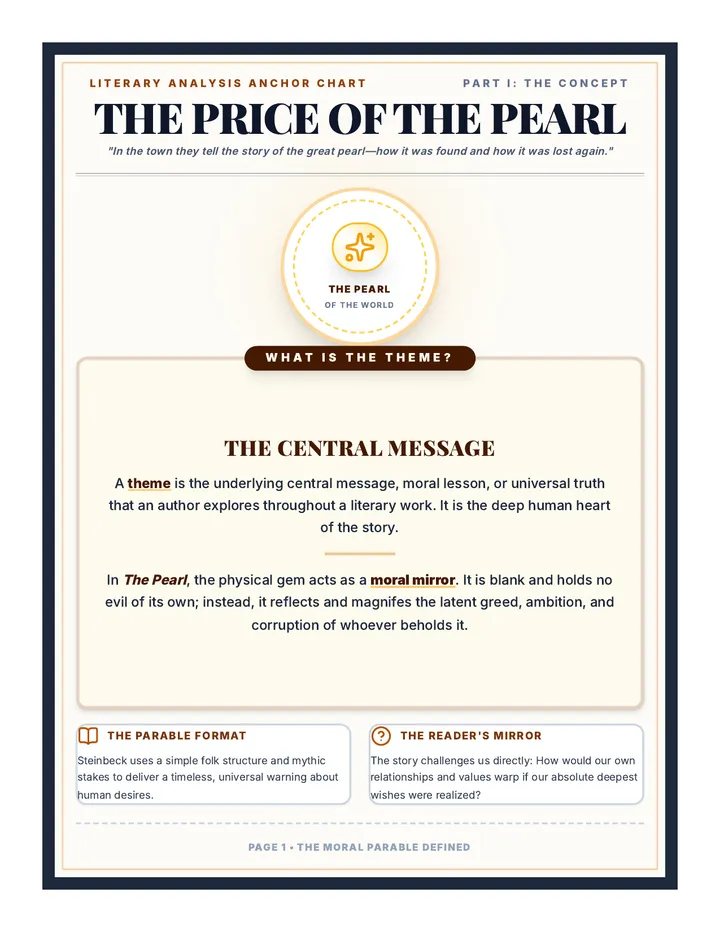
A theme is the central, universal message, lesson, or truth about life that an author explores throughout a literary work. It is not just what the story is about (the plot); it is the deeper statement the author makes about human nature or society.
PLOT THEME
The Theme Iceberg Metaphor
The Plot is what floats above the surface—the action, characters, and events. The Theme is the massive truth resting below the surface—the deeper message holding the entire story together.
How to Discover a Theme
1
Analyze the Conflict
Who struggles, and why? What causes the central tension in the plot?
2
Track Character Growth
Do the main characters change, succeed, or fall? What do they learn from their mistakes?
3
Spot Recurring Motifs
Pay attention to symbols, imagery, repeated words, and parallel storylines.
Golden Rule of Themes
"A theme is never just one word. It is a full statement. 'Greed' is a topic; 'Unchecked greed blinds a person to what truly matters' is a theme."
The Pearl Classroom Posters • Poster 1
John Steinbeck's Novella
MAIN THEMES
Deep Truths in The Pearl
Theme I
The Corruption of Greed
The discovery of the pearl begins as a promise of health, education, and social equality for Kino’s family. However, the greed of the townspeople—and eventually Kino's own obsession with retaining the pearl—leads to paranoia, violence, the destruction of his home, and the tragic loss of his son, showing how material desires can corrupt natural human values.
Theme II
Social Oppression & Colonialism
The narrative highlights the stark division between the impoverished native villagers and the European-descended town elites (represented by the Doctor and the Pearl Buyers). Kino's attempt to obtain a fair price for the pearl is treated as a threat to the established social hierarchy, emphasizing how the powerful systematically exploit and oppress the marginalized.
Theme III
Illusion vs. Reality
Things are rarely what they appear to be. The pearl is physically radiant, flawless, and dubbed "The Pearl of the World," representing divine fortune. Yet in reality, it behaves like a malignant magnet, attracting theft, tracking parties, and ruin. Steinbeck cautions that beautiful illusions can blind individuals to the harsh realities and threats they introduce.
The Pearl Classroom Posters • Poster 2
Literary Devices
SYMBOLS & STYLE
Deeper Meaning & Literary Craft
The Pearl
Originally a symbol of divine blessing, hope, and social status. As Kino holds onto it, it darkens into a symbol of evil, human greed, and the destruction of innocence.
The Canoe
Represents Kino's ancestral heritage, culture, and economic survival. Passed down from his grandfather, the canoe's destruction represents the systematic crushing of his cultural identity.
The Scorpion
Represents the arbitrary, natural evil that strikes without warning. The bite acts as the inciting incident, initiating a series of events that puncture the family's simple, peaceful world.
The Dark Gulf
Represents the immense power, indifference, and mystery of nature. It acts as both a maternal provider and a dangerous, unfathomable void reflecting human fates.
Motif & Auditory Metaphor: The Songs
Steinbeck builds a powerful auditory motif by writing about the "songs" Kino hears in his head. These songs represent Kino's internal emotional landscape and ancestral instincts:
Song of the Family
The rhythmic warmth, safety, peace, and wholeness of his brush house, wife, and son.
Song of Evil / Enemy
A harsh, threatening undertone signaling danger, colonial forces, or malicious greed.
A Visual Symphony
In the novella, objects are never just passive items. Steinbeck blends them with the lyrical "Songs" to transform physical reality into an emotionally-charged allegory.
The Pearl Classroom Posters • Poster 3
Novella Setting
THE SETTING
La Paz, Mexico (Baja California)
BRUSH HOUSE THE GULF STONE TOWN
The Coast of the Gulf
The story unfolds along the arid coastline of Baja California in the town of La Paz. The physical setting of dry desert plains transitioning directly into the turquoise Gulf waters dictates the lifestyle, livelihoods, and historical survival of the native communities.
A Divided World
The Brush Houses
Constructed of organic, natural brush materials along the sandy coast. They are humble, open to the sea breeze, and integrated with the community. They symbolize simple indigenous family structures, ancient tradition, and vulnerability to external forces.
The Stone Town
A cold city of thick plaster-walled stone houses, gated gardens, and clinical interiors. The home of the European-descended elite (the Doctor, the Buyers, the Priest). It represents colonial oppression, division, exclusion, and heavy social authority.
Nature's Indifference
The natural landscape (the blazing sun, the deep water, the dry mountains where Kino runs) remains completely neutral to the characters' human misery, emphasizing the harsh struggle for survival in a vast, uncaring universe.
The Pearl Classroom Posters • Poster 4