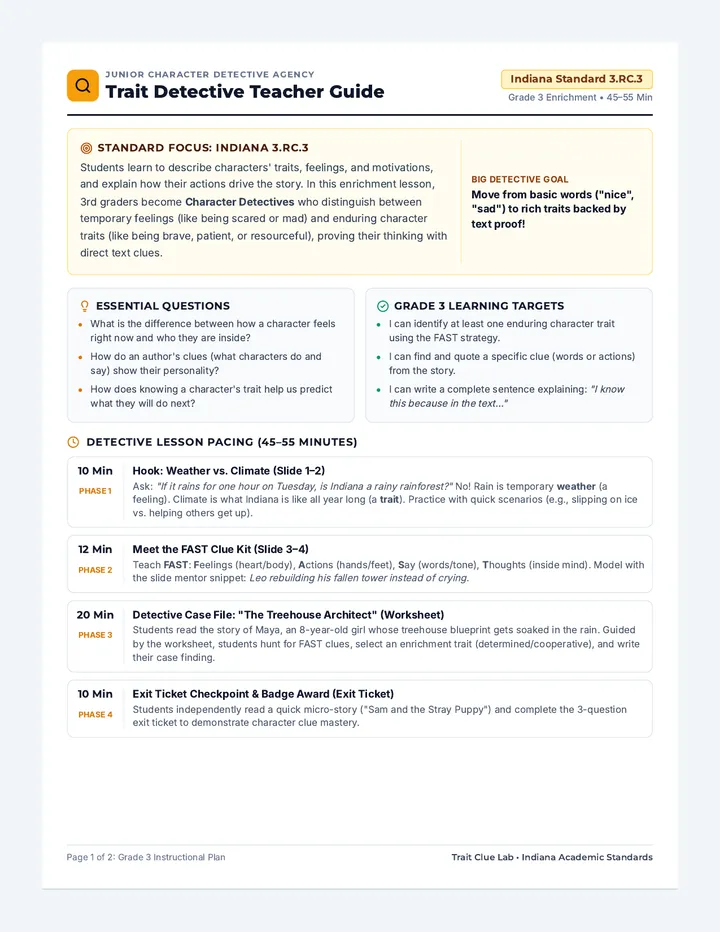
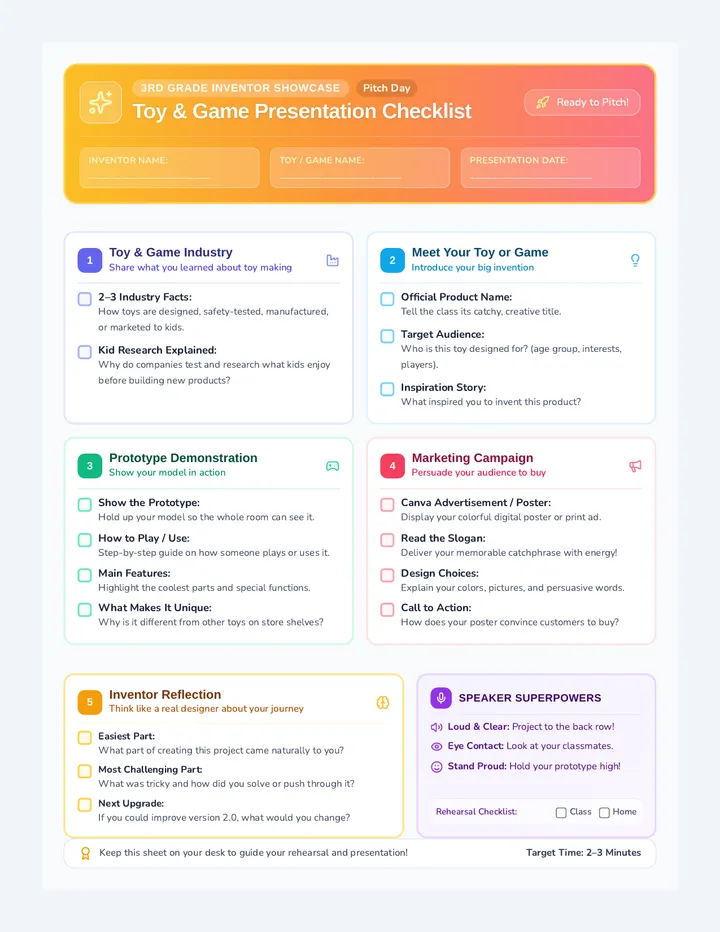
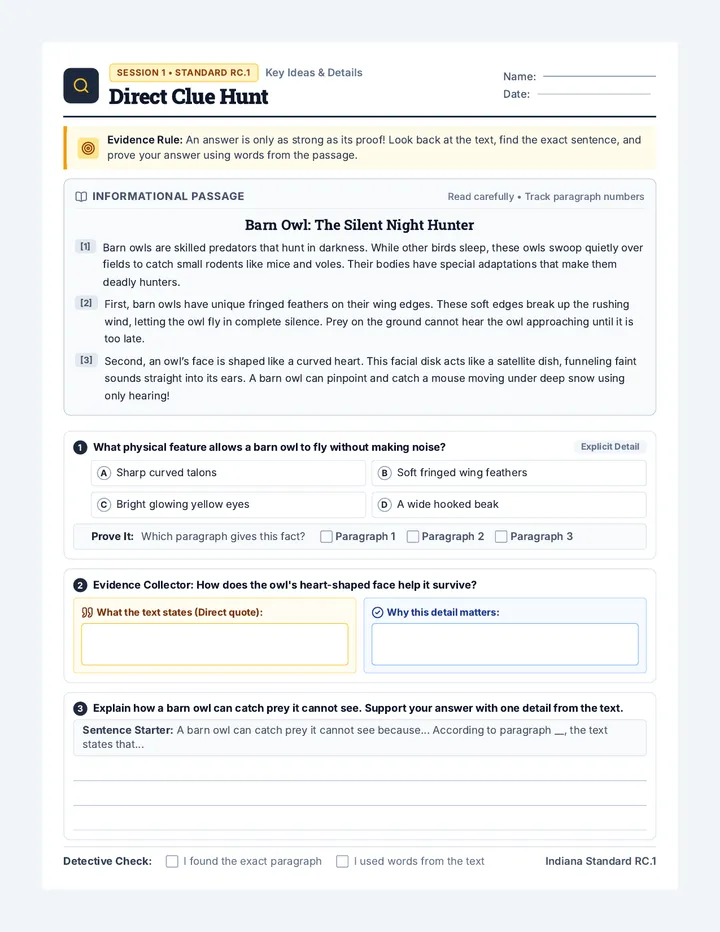
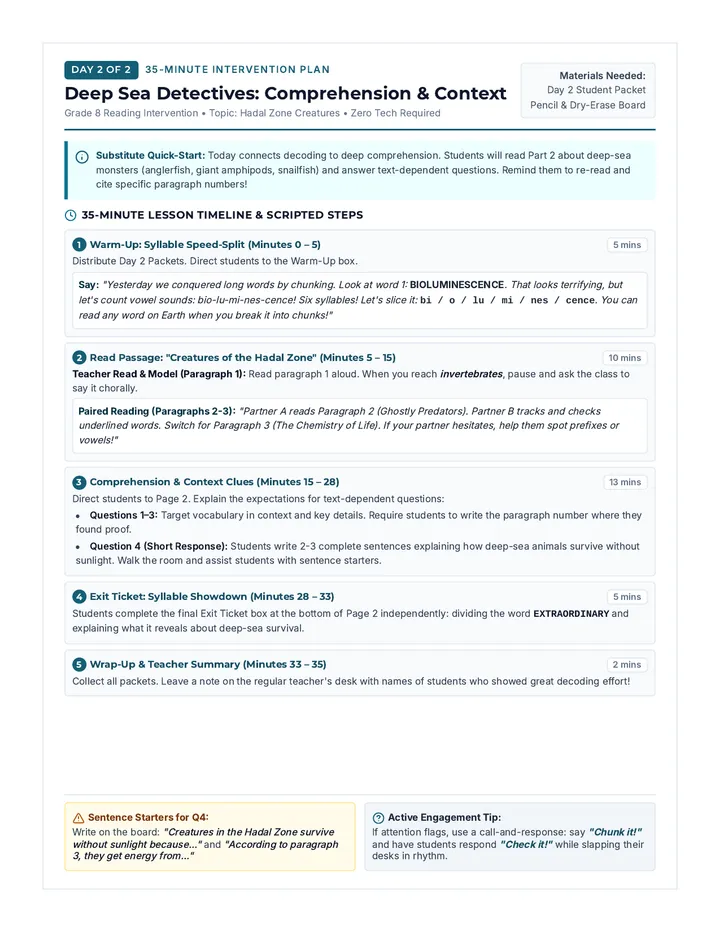
Reading Evidence Objectives Guide
Grade 3 • ELA Standards Priority / Essential (E)
Text Evidence & Main Idea Objectives
Instructional Planning Guide • Learning Targets, "I Can" Statements & Question Stems
Standard 3.RC.1 Textual Evidence & Comprehension
"Ask and answer questions to demonstrate comprehension of a text, referring explicitly to the text as the basis for the answers."
DOK 2–3
Objective 1: Citing Explicit Text Evidence (Answering) Bloom: Comprehend / Apply
SWBAT: Answer text-dependent factual and inferential questions about a grade-level passage by directly citing at least one specific sentence or phrase from the text as explicit evidence.
I Can: I can answer questions about a story or article and point directly to the exact words that prove my answer.
Objective 2: Generating Text-Based Inquiries (Asking) Bloom: Analyze / Inquire
SWBAT: Formulate at least two clarifying or analytical questions before, during, and after reading, then locate specific textual details to construct evidence-based answers.
I Can: I can ask deep questions about what I read and find clues in the text to help solve them.
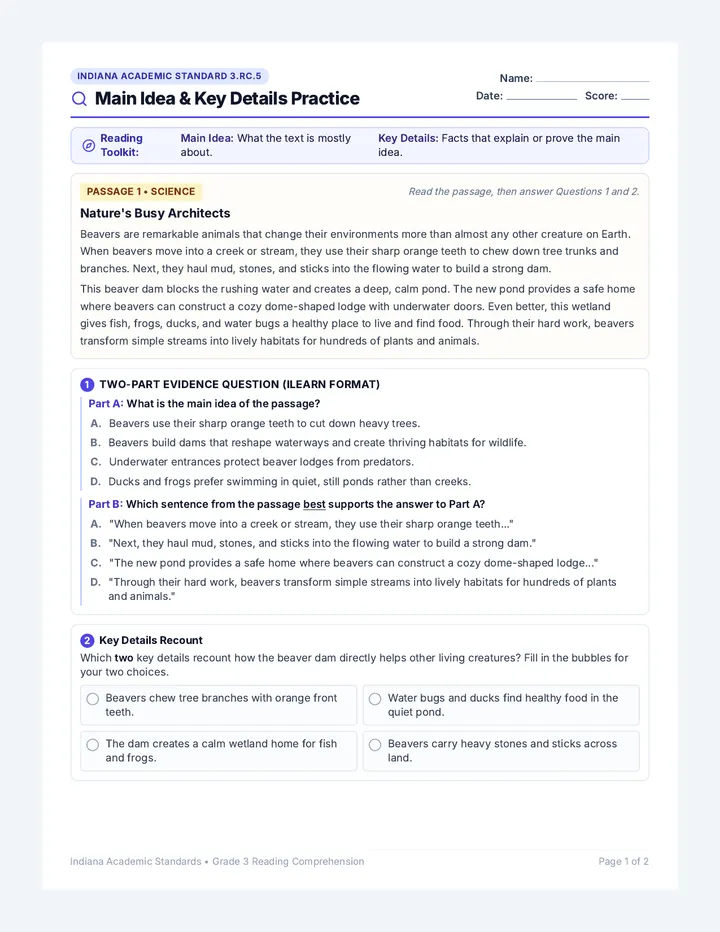
Standard 3.RC.5 Main Idea & Key Details
"Determine the main idea of a text; recount the key details and explain how they support the main idea."
DOK 2–3
Objective 1: Identifying the Central Main Idea Bloom: Determine / Summarize
SWBAT: State the central main idea of an informational or narrative passage in one concise sentence, distinguishing the overarching message from isolated facts.
I Can: I can tell what the text is mostly about in my own words.
Objective 2: Recounting & Connecting Supporting Details Bloom: Analyze / Explain
SWBAT: Identify 2 to 3 key supporting details from a passage and explain orally or in writing how each detail acts as evidence to reinforce the main idea.
I Can: I can pick out 2–3 key details and explain how they help prove or hold up the main idea.
Integrated Target (3.RC.1 + 3.RC.5)
SWBAT: Synthesize comprehension by stating the main idea of a text and justifying it with two explicitly cited quotes or key details from the passage.
"I can prove the big idea of a text using exact quotes from the author."
Formative Question Stems
- "Which sentence from paragraph [X] proves that...?"
- "What is this text mostly about in 10 words or less?"
- "How does the detail about [topic] support the main idea?"
- "What question can you ask the text to clarify...?"
Text Detectives Anchor Chart
3rd Grade Reading Text Detectives
I Can Be a Text Detective!
My Reading Targets
Standards 3.RC.1 & 3.RC.5
1
Hunting for Proof & Asking Questions
Standard 3.RC.1
Answering with Clues
"I can answer questions and point right to the exact words in the text that prove it!"
I don't just guess—I highlight the sentence that shows I'm right.
🗣️ Say: "I know this because paragraph 2 says..."
Asking Wonder Questions
"I can ask smart questions while I read and find clues to answer them!"
I ask Who, What, Where, When, Why, and How to understand the story deeper.
❓ Ask: "Why did this happen? What clue tells me?"
2
Finding the Big Idea & Key Details
Standard 3.RC.5
The Big Picture
"I can tell what the text is mostly about in one clear sentence!"
The main idea is the big umbrella that covers the whole text.
💡 Say: "The big point the author wants me to know is..."
Table Leg Details
"I can find 2 or 3 important details that hold up the main idea!"
Details act like table legs—they support the main idea and make it strong.
🪵 Say: "One key detail that supports this big idea is..."
Detective Evidence Sentence Starters
Use these in your speaking & writing!
"According to paragraph __,..."
"The author explicitly states..."
"On page __, the text proves..."
"This detail supports the idea because..."
Detective Self-Check
Can you check off all three before handing in your work?
Found exact quote
Named main idea
Connected 2+ details