Street Smart Practice Packet
Vocabulary Builder Series
Street Smart Words
Mastering words for school, friendships, and daily life.
Practice Packet
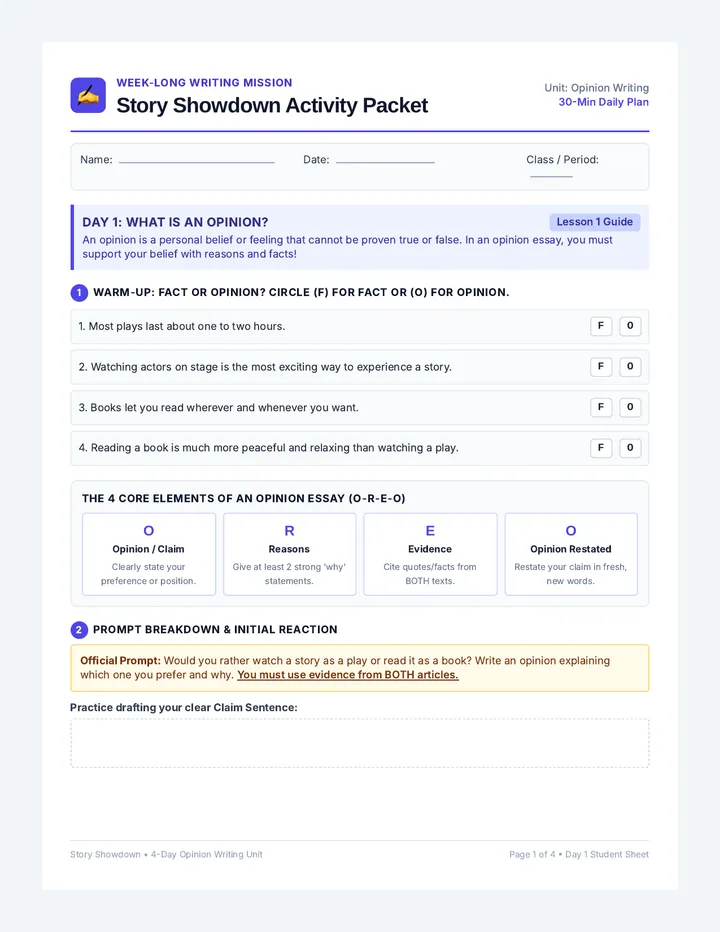
Student Name
Date
Class Period
The Daily 15 Word Bank
accustom
alert
assign
budge
burly
companion
compatible
concept
distract
jostle
obedient
obstacle
patient
pedestrian
retire
A Part 1: Definition Matching Challenge
Match each vocabulary word with its correct daily-life definition. Write the letter of the matching definition on the line next to each word.
1. accustom
2. alert
3. assign
4. budge
5. burly
6. companion
7. compatible
8. concept
9. distract
10. jostle
11. obedient
12. obstacle
13. patient
14. pedestrian
15. retire
A.
To give out as a task, homework, or duty.
B.
A friend, partner, or pet who spends time with you.
C.
To get used to a routine or environment over time.
D.
Wide awake, highly watchful, and ready for action.
E.
Getting along beautifully together; matching well.
F.
To move or shift even a tiny bit; to change mind.
G.
A general idea or understanding of how something works.
H.
Large, husky, and strongly built (like a lumberjack).
I.
Willing to obey school rules and follow adult orders.
J.
Something that blocks your way or makes progress hard.
K.
To draw focus away from what someone is doing.
L.
A person who is walking, particularly along a busy road.
M.
To push, elbow, or bump rudely in a crowded hallway.
N.
Able to stay calm and wait without getting annoyed or mad.
O.
To leave active work or step away for rest/sleep.
Street Smart Words • Unit 1 Vocabulary Practice Page 1
Vocabulary Builder Series
Street Smart Words
Mastering words for school, friendships, and daily life.
Sentence Fill
B Part 2: Sentence Completion
Complete each relatable scenario below using the correct vocabulary word from the Word Bank. Each word is used exactly once.
alert
assign
budge
companion
compatible
distract
obedient
obstacle
patient
pedestrian
Leo’s loyal golden retriever, Barnaby, is a wonderful companion who follows him everywhere around the neighborhood. (Example)
Because she was incredibly , Maya waited in the long lunch line for twenty minutes without complaining once.
Mrs. Vance had to a brand-new group project, splitting us into pairs for the history poster.
A safe should always look both ways before stepping off the curb at the school crosswalk.
Try not to let your phone’s vibrating notifications you while you are studying for tomorrow's big math test!
We tried with all our might to push the heavy old study desk across the classroom, but it wouldn't an inch.
The soccer field had a giant puddle right in the center, which was a huge that slowed down our team's passing.
Our science teacher, Mr. Brooks, explained that our laptop chargers and wall outlets are not because they use different plug shapes.
The school crossing guard is extremely , watching out for speeding cars during the busy morning drop-off hours.
The puppy was highly , immediately sitting down as soon as Clara held up a treat and said the word.
Street Smart Words • Unit 1 Vocabulary Practice Page 2
Vocabulary Builder Series
Street Smart Words
Mastering words for school, friendships, and daily life.
Context Detective
C Part 3: Context Detective Scenarios
Read each scenario. Figure out which vocabulary word fits best and write it. Then state your supporting clue words.
accustom
burly
concept
jostle
retire
Scenario 1: Hallway Chaos
Word:
"The final bell rang, and hundreds of kids flooded the narrow corridor. Everyone was pushing, bumping shoulders, and accidentally elbowing each other as they rushed to reach their school buses on time."
How do you know? (Write your clue words here):
Scenario 2: The Moving Crew
Word:
"To move the heavy gymnasium piano, the coach called over three large, muscular high-school football players. Their thick, broad shoulders made short work of lifting and pushing the giant wood frame."
How do you know? (Write your clue words here):
Scenario 3: Getting Used to Middle School
Word:
"During his first week, Toby felt lost. But by week three, he was waking up at 6:30 AM easily, remembered his locker combination instantly, and didn't mind the loud cafeteria noise anymore."
How do you know? (Write your clue words here):
Scenario 4: Big Ideas
"In science, we studied 'ecosystems'. It took me a few days to understand the grand idea that animals, plants, and weather are all linked in one massive system."
Clues:
Scenario 5: Calling it a Day
"After working for forty-five years as a devoted high school math teacher, grandfather packed up his chalkboard rulers, said goodbye to his students, and prepared to spend his days gardening."
Clues:
Street Smart Words • Unit 1 Vocabulary Practice Page 3
Street Smart Organizers
Vocabulary Builder Series
Street Smart Words
Deep-dive word exploration and graphic organizers.
Word Study
Student Name:
Date:
1 Part 1: The Frayer Model Deep Dive
Select two vocabulary words from our list of fifteen. Write your chosen word in the blank central oval, then complete each box to map out your understanding.
1. Definition in Your Own Words
2. Synonyms & Characteristics
3. Real-World Examples / Sentences
4. Non-Examples / Antonyms
1. Definition in Your Own Words
2. Synonyms & Characteristics
3. Real-World Examples / Sentences
4. Non-Examples / Antonyms
Street Smart Words • Word Study Organizers Page 1
Vocabulary Builder Series
Street Smart Words
Tracking progress, building confidence, and setting learning goals.
Self-Evaluation
Student Name:
Date:
2 Part 2: Student Self-Assessment Tracker
Be honest with yourself! Rate your confidence for each of the fifteen vocabulary words using the rating scale below.
Level 1 I have never seen or heard this word.
Level 2 I've heard it, but don't know what it means.
Level 3 I can define it and use it in a sentence.
Level 4 I can easily teach this word to others.
Vocabulary Word
Level 1
Level 2
Level 3
Level 4
1. accustom
2. alert
3. assign
4. budge
5. burly
6. companion
7. compatible
8. concept
9. distract
10. jostle
11. obedient
12. obstacle
13. patient
14. pedestrian
15. retire
My Vocabulary Goal
Look at the words you rated as Level 1 or 2. Choose one specific word you want to master this week. Write a sentence describing how you will practice using it in your daily conversations or writing:
Street Smart Words • Word Study Organizers Page 2