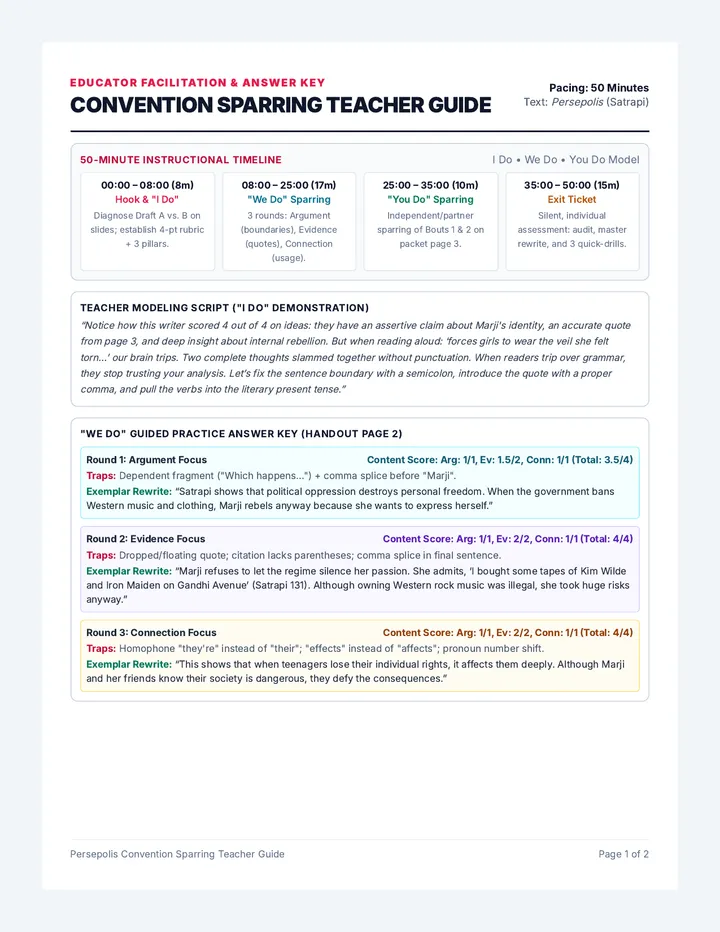
An 8th grade ELA lesson focusing on writing conventions (sentence boundaries, comma/quotation mechanics, and grammar/usage) through sample paragraph sparring using Marjane Satrapi's Persepolis, complete with analytical scoring (1 pt argument, 2 pts evidence, 1 pt analysis) and targeted revisions.
“Satrapi shows that political oppression destroys personal freedom. Which happens when the government bans Western music and clothing, Marji rebels anyway because she wants to express herself.”
Traps: Fragment (“Which happens...”) & comma splice before “Marji rebels”
Goal: Combine into one grammatically sound, assertive argument.
“Marji refuses to let the regime silence her passion. ‘I bought some tapes of Kim Wilde and Iron Maiden on Gandhi Avenue’ Satrapi page 131. It was illegal to own Western rock music, she took huge risks anyway.”
“This shows that when teenagers lose they’re individual rights, it effects them deeply. Marji and her friends knew their society was dangerous but she didn’t care about the consequences.”
“In the novel Satrapi demonstrates that Iranian citizens lived a divided double life to survive religious tyranny. At school Marji must wear her veil and mourn martyrs but at home her family parties and drinks homemade wine. For instance Satrapi notes ‘we had to pretend to be someone we weren’t outside’ (Satrapi 102). Proving that public conformity did not equal private belief, its a psychological coping mechanism.”
Identify & Circle 4 Traps: □ Missing introductory commas | □ Comma splice / run-on | □ Fragment ("Proving that...") | □ Its vs. It's
Pristine Academic Rewrite:
Bout 2: The Golden Key (Prompt: How does Satrapi expose social class injustice?)
“Through the tragic character of Mrs. Nasrine, Satrapi exposes how the regime manipulated poor boys into dying on the front lines. The government gave poor kids painted plastic keys promising them paradise, wealthy boys went to private school and stayed safe. Mrs. Nasrine cries ‘they told him that in paradise there would be plenty of food and women’ (Satrapi 99). This quote showed that the government exploited poor families poverty.”
Traps: Missing comma after introductory phrases; fragment "Proving that..."; homophone "its" vs "it's".
Model: “In the novel, Satrapi demonstrates that Iranian citizens live a divided double life to survive religious tyranny. At school, Marji must wear her veil and mourn martyrs, but at home, her family parties and drinks homemade wine. For instance, Satrapi notes, ‘we had to pretend to be someone we weren’t outside’ (Satrapi 102). This proves that public conformity does not equal private belief; it is a psychological coping mechanism.”
Bout 2: The Golden Key
Score: Arg 1/1, Ev 2/2, Conn 1/1 (Total: 4/4)
Traps: Comma splice between "paradise" and "wealthy"; missing comma after "cries"; missing apostrophe in "families' poverty"; tense shift "showed".
Model: “Through the tragic character of Mrs. Nasrine, Satrapi exposes how the regime manipulates poor boys into dying on the front lines. While the government gave poor kids painted plastic keys promising them paradise, wealthy boys went to private school and stayed safe. Mrs. Nasrine cries, ‘they told him that in paradise there would be plenty of food and women’ (Satrapi 99). This quote shows that the government exploited poor families’ poverty.”
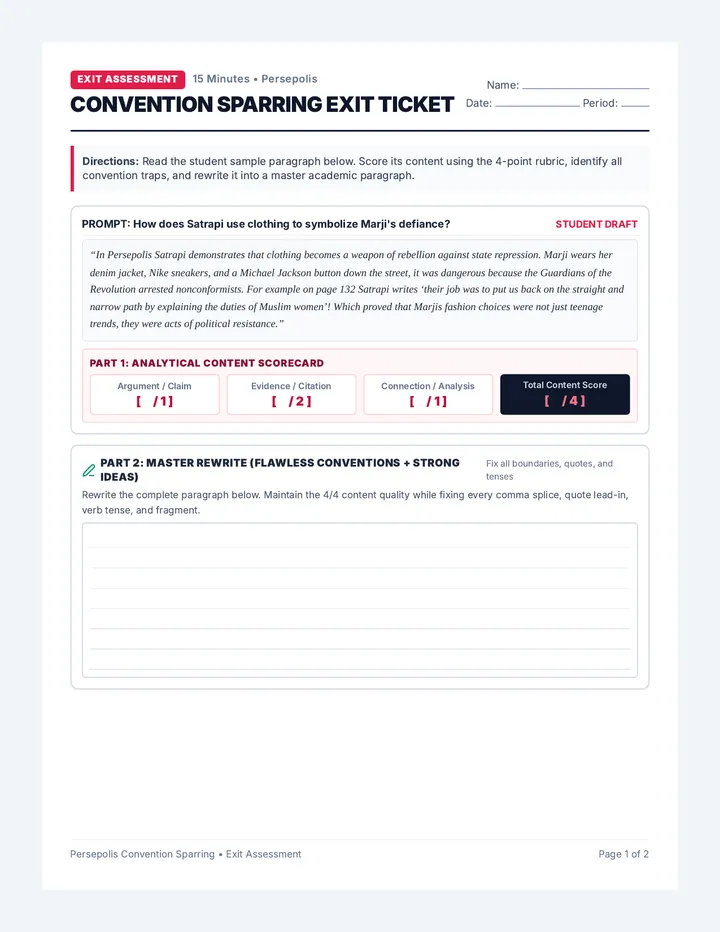
Identified Traps: (1) Missing comma after title Persepolis; (2) Comma splice joining "down the street, it was dangerous"; (3) Missing comma after "writes"; (4) Misplaced exclamation point; (5) Fragment beginning "Which proved that"; (6) Missing apostrophe in "Marjis fashion"; (7) Comma splice joining "not just teenage trends, they were acts".
Part 2 Exemplar Master Rewrite: “In Persepolis, Satrapi demonstrates that clothing becomes a weapon of rebellion against state repression. Marji wears her denim jacket, Nike sneakers, and a Michael Jackson button down the street; this was dangerous because the Guardians of the Revolution arrested nonconformists. For example, on page 132, Satrapi writes, ‘Their job was to put us back on the straight and narrow path by explaining the duties of Muslim women.’ This proves that Marji’s fashion choices are not just teenage trends; rather, they are courageous acts of political resistance.”