STAAR Vocab Decoder
7th Grade RLA Reference Guide
STAAR VOCAB DECODER
Master the language of the test. Keep this reference in your binder!
A-D
NAME:
DATE:
CLASS:
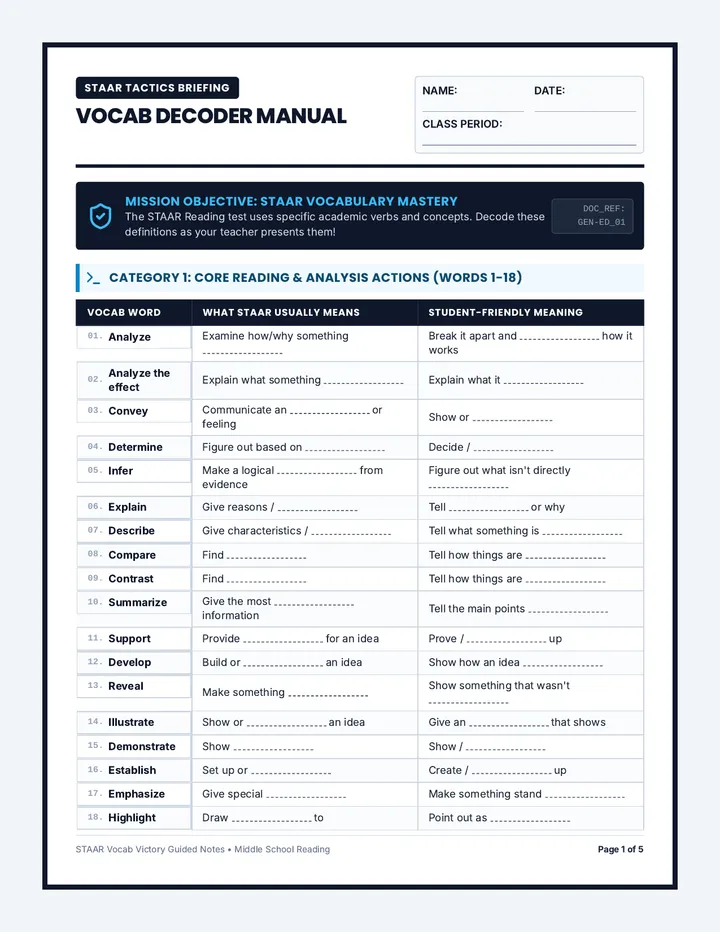
The STAAR Reading Language Arts (RLA) test uses highly specific academic vocabulary in its questions. Use this glossary to decode the question stems and confidently select the correct answer evidence.
1. Author's Purpose
Reading Concept
Definition: The primary reason an author writes a text (e.g., to persuade, inform, entertain, or express/reflect).
STAAR Stem:
"The author wrote this selection most likely to convince readers that urban parks benefit wildlife populations."
2. Characterization
Literary Text
Definition: The techniques an author uses to develop and reveal a character's personality, thoughts, actions, and speech.
STAAR Stem:
"In paragraph 4, the author uses indirect characterization to highlight Sarah’s internal determination."
3. Conflict
Literary Text
Definition: The primary struggle or obstacle between opposing forces (Internal: character vs. self; External: character vs. character/nature/society).
STAAR Stem:
"How does the main conflict in the story influence the protagonist’s decision in the resolution?"
4. Context Clues
Vocabulary
Definition: Words, phrases, or sentences surrounding an unfamiliar word that help a reader determine its meaning.
STAAR Stem:
"Which word from paragraph 12 helps the reader understand the meaning of the word 'resilient'?"
5. Drama & Stage Directions
Drama
Definition: A script written for actors. Stage directions (usually italicized in brackets) instruct actors on movement, emotion, and tone.
STAAR Stem:
"The stage directions in lines 14 through 18 are intended to convey the tense mood between the brothers."
STAAR RLA Notebook Tool Page 1 of 3
7th Grade RLA Reference Guide
STAAR VOCAB DECODER
Read for key ideas, author's craft, and structural clues.
F-O
Pro-Tip: Pay attention to the verbs in questions like "infer," "summarize," or "portray." They tell you exactly what cognitive tool to retrieve!
6. Figurative Language
Literary Devices
Definition: Words or expressions used non-literally for creative emphasis (e.g., similes, metaphors, personification, hyperbole).
STAAR Stem:
"The author uses personification in paragraph 3 to emphasize the harshness of the winter weather."
7. Imagery
Literary Devices
Definition: Descriptive language that appeals to the five physical senses (sight, sound, smell, taste, touch) to build vivid mental pictures.
STAAR Stem:
"The imagery in paragraph 9 is used to evoke a sense of peaceful isolation."
8. Inference
Reading Concept
Definition: A logical conclusion drawn by combining explicit text evidence with your personal background knowledge (schema).
STAAR Stem:
"Based on the details in the final section, the reader can infer that the guide is highly respected."
9. Key Ideas
Informational
Definition: The primary points or supporting claims that develop the central theme or main idea of an informational text.
STAAR Stem:
"Which statement best describes the key idea developed in paragraphs 6 through 8?"
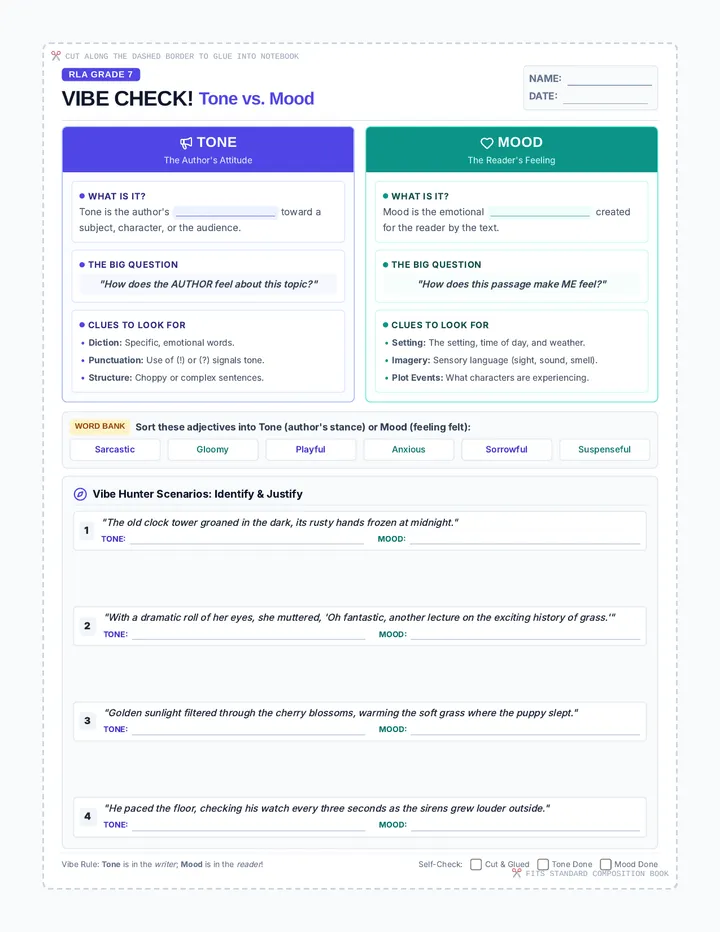
10. Mood
Literary Text
Definition: The emotional response or atmosphere that the writer designs to evoke within the reader's mind.
STAAR Stem:
"The descriptions of the deserted schoolhouse create a mood of mystery and longing."
11. Organizational Patterns
Informational
Definition: How informational text is organized (e.g., Cause/Effect, Compare/Contrast, Chronological, Problem/Solution).
STAAR Stem:
"The author organizes paragraph 5 primarily by explaining the causes of erosion and its eventual outcome."
STAAR RLA Notebook Tool Page 2 of 3
7th Grade RLA Reference Guide
STAAR VOCAB DECODER
Identify point of view, argument structures, and poetry craft.
P-Z
12. Plot Elements
Literary Text
Definition: The structured sequence of events (Exposition, Rising Action, Climax, Falling Action, Resolution) that builds a story.
STAAR Stem:
"How does the rising action in the forest scene contribute directly to the story's climax?"
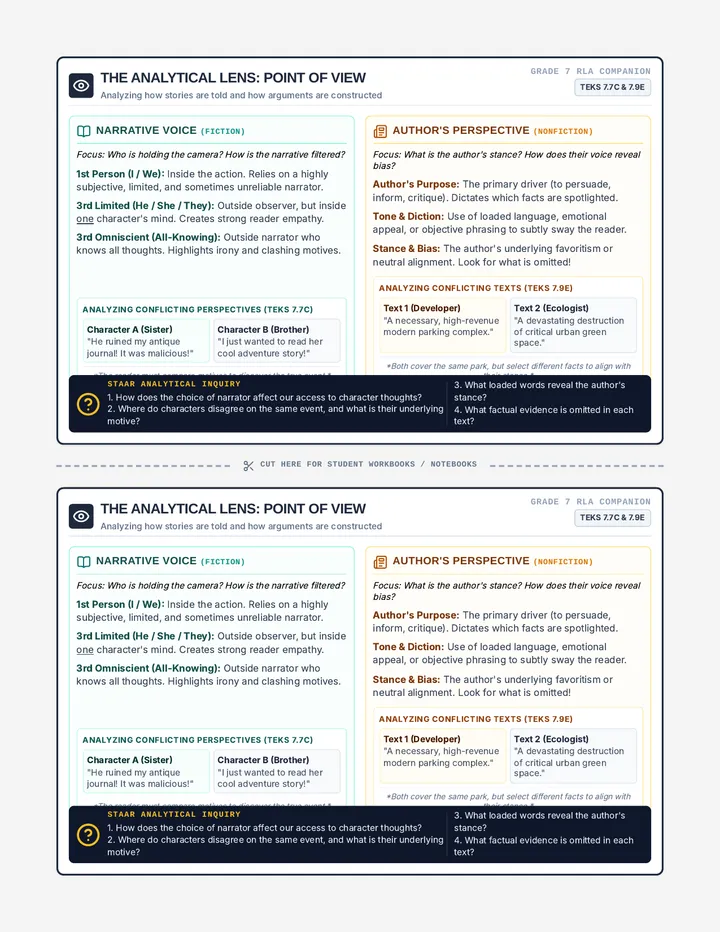
13. Point of View
Literary Text
Definition: The perspective from which a narrative is told (First-Person, Third-Person Limited, Third-Person Omniscient).
STAAR Stem:
"The use of third-person limited point of view allows the author to reveal only Arthur's private thoughts."
14. Rhetorical & Argument Devices
Persuasive
Definition: Writing techniques used to build an argument, including a central claim, logical evidence, and a counterargument.
STAAR Stem:
"How does the author address a potential counterargument to support their overall claim?"
15. Stanza
Poetry
Definition: A group of lines forming a recurring structural block in a poem (similar to a paragraph in prose writing).
STAAR Stem:
"In stanza 3, the poet shifts focus from the quiet meadow to the bustling town."
16. Summary
Reading Concept
Definition: A concise, objective restatement of the major ideas, actions, and resolution of a text, leaving out minor details.
STAAR Stem:
"Which statement offers the most complete and accurate objective summary of the selection?"
17. Theme & Tone
Literary Devices
Definition: Theme is the deeper life lesson or moral. Tone is the author's overall attitude toward the topic or characters.
STAAR Stem:
"What theme is revealed through the dialogue, and what tone does the author use?"
STAAR TEST-DAY DECODING STRATEGY:
When you read a question stem, underline the academic term first. Think: "What is the author's purpose here?" or "What is the conflict?" before looking at answer choices. This shields you from falling for deceptive answer traps.
STAAR RLA Notebook Tool Page 3 of 3
Vocab Blueprint Frayer Templates
STAAR Vocabulary Workspace
FRAYER MODEL EXEMPLAR
Guided Model: Use this anchor page to guide your vocabulary study.
MODEL
NAME:
DATE:
CLASS:
A Frayer Model is a powerful four-quadrant organizer that helps you deeply analyze STAAR terms. By defining, listing synonyms, identifying non-examples, and sketching a visual cue, you lock the word into your long-term memory.
STAAR Priority Word Analysis
TERM: INFERENCE (Noun)
INFERENCE
1. My Definition
A logical guess or conclusion that a reader makes by combining clues found inside the text with their own background knowledge (schema).
"It's reading between the lines."
2. STAAR Clues & Synonyms
- "Deduction" / "Educated Guess"
- "Most likely suggests..."
- "The reader can conclude..."
- "What is implied by..."
3. Visual Memory Cue
Text Clues
My Schema
=
Inference
4. Non-Examples & Antonyms
- Stating exactly what is written (literal facts).
- Making a wild guess without any evidence.
- Ignoring clues and making things up.
- Directly quoted text statements.
How to Fill Out Your Blank Templates:
On the next page, you will find two blank templates. Choose priority vocabulary terms from the STAAR Vocab Decoder glossary. Focus on drafting a clear personal definition and a memory graphic that actually helps you connect with the term!
STAAR RLA Notebook Tool Page 1 of 2
STAAR Vocabulary Workspace
VOCABULARY BLUEPRINT
Active Workspace: Select two terms to map out and master.
STUDENT
NAME:
DATE:
CLASS:
TERM:
My Definition
Examples / Synonyms
Visual Memory Cue
Non-Examples / Antonyms
TERM:
My Definition
Examples / Synonyms
Visual Memory Cue
Non-Examples / Antonyms
STAAR RLA Notebook Tool Page 2 of 2