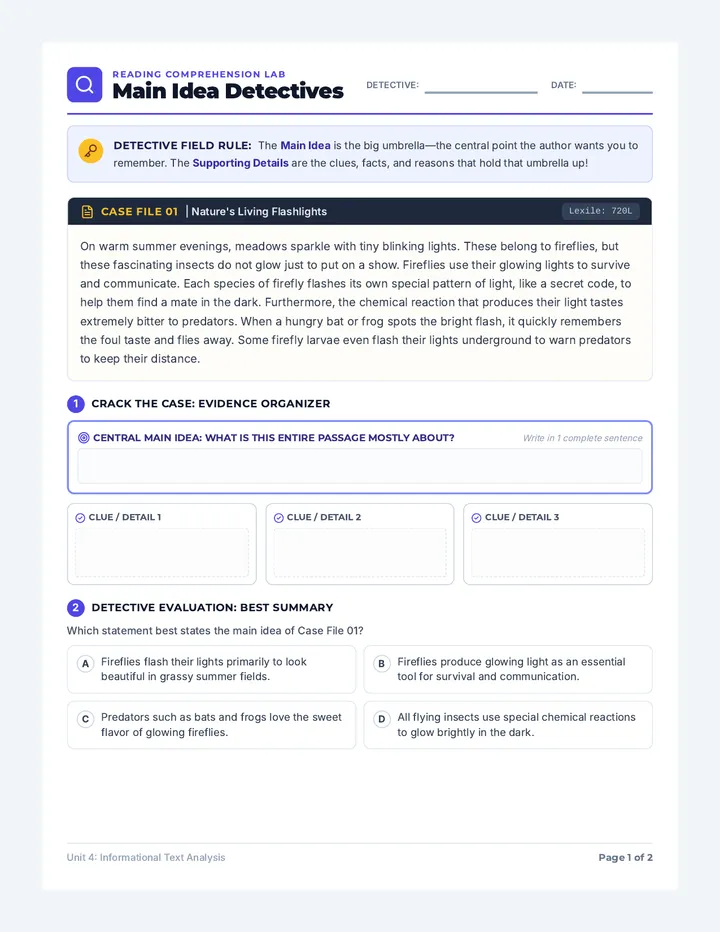
Forest Whisperers Reading Prompt
Grade 5 Informational Reading Skill Focus: Main Idea, Key Details & 5 W's
Name: Date:
Science & Ecology Article
The Forest's Secret Internet
How underground fungal threads allow ancient trees to communicate and share survival resources.
Reading Level
Lexile: 840L • Grade 5
Reading Mission: Track who discovered this system, what it does, where it is, when alerts happen, and why trees share resources.
Evidence-Based
A Silent World Beneath the Moss
When you walk through an evergreen forest in the Pacific Northwest, everything appears still and quiet. Towering Douglas firs and western hemlocks reach toward the sky, while thick moss covers the damp ground. For over a century, scientists believed that these massive trees were fierce rivals, competing against one another for every ray of sunlight, drop of rain, and nutrient in the soil.
The 1997 Breakthrough
That competitive view changed in 1997 when Canadian forest ecologist Dr. Suzanne Simard published groundbreaking research. While studying woodlands in British Columbia, Canada, Dr. Simard discovered that trees are not isolated individuals. Instead, they are connected by a vast underground system known as a mycorrhizal network.
Threads of Connection
This subterranean network is made of millions of microscopic fungal threads called hyphae. These threads wrap around tree root tips, linking neighboring trees together like a biological web. A single teaspoon of healthy forest soil can contain miles of these invisible fungal wires!
Trading Food and Sending Warnings
Trees and fungi form an essential partnership. Fungi cannot make their own food through photosynthesis, so trees send surplus sugary carbon down to nourish the fungi. In return, the fungal network gathers water, nitrogen, and minerals from deep underground and delivers them directly to tree roots.
Remarkably, trees also use this network to send urgent warnings. When bark beetles attack a pine tree in early summer, the injured tree pulses chemical distress signals across the fungal grid. Neighboring healthy trees receive the warning hours in advance and quickly produce bitter chemicals to repel the incoming insects.
The Power of Mother Trees
At the center of this web stand the oldest, tallest trees, nicknamed "Mother Trees." These ancient giants have deep roots and large crowns that capture abundant sunlight. Experiments prove that Mother Trees deliberately pump extra sugars and water to small, struggling saplings growing in deep shade.
By sharing resources rather than fighting, the forest functions as a single resilient community, protecting the whole woodland against storms and drought.
Key Term: Mycorrhizae
An underground network of microscopic fungal threads that connects plant roots together.
Key Term: Mother Tree
A large, mature hub tree that nurtures and feeds younger seedlings through the fungal web.
Active Reader Check
Identified scientist & location Marked how trees help each other
Adapted from scientific research by Dr. Suzanne Simard (University of British Columbia) Page 1 of 2 • Turn to Page 2 for Comprehension Questions
Comprehension & Text Evidence Assessment
Name: Score: / 20
Comprehension Check: The Forest's Secret Internet
Answer using complete sentences and specific text details.
1
Main Idea & Central Concept
Part A & B • 6 Points
A. Which statement best expresses the main idea of the entire informational passage?
A Fungi are harmful forest parasites that steal energy from healthy root systems.
B Trees communicate and cooperate through an underground fungal web to share food and warning signals.
C Bark beetles attack evergreen pines in the Pacific Northwest during the summer months.
D Forest trees always compete fiercely with their neighbors for rain and sunlight.
B. In your own words, write one complete sentence explaining how Dr. Simard's discovery changed what scientists believed:
2
The 5 W's Comprehension Detective Grid
Identify Key Details • 10 Points
WHO
Who discovered this underground network, and who does a Mother Tree nurture?
WHERE
Where did the scientist conduct her research, and where is the network located?
WHEN
When was this study published, and when do trees send chemical alarm signals?
WHAT
What is the network made of, and what items do trees and fungi trade?
WHY Explain the scientific benefit to the entire woodland
Why do older trees share nutrients with saplings and neighbors instead of keeping resources only for themselves?
3
Key Details & Text Evidence
Constructed Response • 4 Points
According to the text, what specific danger triggers trees to send chemical warnings, and how do neighboring trees prepare themselves before they are attacked? Cite two specific details from the passage.
Student Checklist: Restated question Answered all 5 W's Quoted/cited evidence
Aligned to CCSS.ELA-LITERACY.RI.5.1, RI.5.2, RI.5.3
Forest Whisperers Answer Key
Teacher Answer Key & Scoring Guide Grade 5 ELA • RI.5.1, RI.5.2, RI.5.3
Total Available: 20 Points
Answer Key: The Forest's Secret Internet
Evaluation criteria, point allocations, and exemplar student answers.
1
Section 1: Main Idea & Central Concept (6 Points Total)
RI.5.2 Focus
Part A: Multiple Choice 2 Pts
B Correct Answer
"Trees communicate and cooperate through an underground fungal web to share food and warning signals."
Distractor Note: A and D describe outdated misconceptions; C is merely a supporting detail.
Part B: Student Summary 4 Pts
Exemplar Response:
"Scientists used to think trees only competed against each other for resources, but Dr. Simard showed that trees actually cooperate and share nutrients like a community."
Rubric (4 pts): Award 2 pts for contrasting competition with cooperation; 2 pts for complete sentence mechanics.
2
Section 2: The 5 W's Detective Grid (10 Points • 2 Pts Each)
RI.5.1 & RI.5.3 Focus
WHO 2 Points
Answer: Dr. Suzanne Simard (Canadian forest ecologist) discovered the network. Mother Trees nurture struggling young saplings and neighboring trees.
Scoring: 1 pt for Dr. Simard; 1 pt for saplings/seedlings.
WHERE 2 Points
Answer: Research took place in British Columbia, Canada. The network is underground/beneath the forest floor, wrapping around root tips.
Scoring: 1 pt for British Columbia/Canada; 1 pt for root tips/underground.
WHEN 2 Points
Answer: Published in 1997. Trees send chemical alarm signals when under attack by pests (such as bark beetles in early summer).
Scoring: 1 pt for 1997; 1 pt for pest/beetle attack timing.
WHAT 2 Points
Answer: Made of microscopic fungal threads (hyphae). Trees trade sugary carbon for fungal water, nitrogen, and minerals (plus chemical alerts).
Scoring: 1 pt for fungal threads; 1 pt for shared resources named.
WHY 2 Points
Answer: Older trees share resources because cooperation keeps the entire woodland healthy. When trees support each other, the canopy remains moist, resilient, and better protected against harsh storms and droughts.