Reading Lesson Framework Guide
Instructional Design Manual
Guide for Creating Evidence-Based Reading and Vocabulary Lesson Plans
This guide provides a structured framework for designing high-quality reading lessons that incorporate evidence-based practices for vocabulary development, reading comprehension, active engagement, and systematic scaffolding. Each instructional component includes the ABC Learning Objective Framework alongside scholarly support formatted with APA 7th edition in-text citations.
Foundational Framework: The ABCs of Learning Objectives
Before developing individual lesson components, establish a measurable learning objective using the ABC format. Well-written objectives set clear expectations and improve both instructional planning and assessment (Mager, 1997).
| Component |
Definition |
Guiding Question |
Examples |
| A — Audience |
The specific group of learners targeted by the instruction. |
Who will perform the behavior? |
Students, 4th-grade readers, small-group intervention learners |
| B — Behavior |
The observable, measurable action learners will demonstrate. |
What action will students perform? |
Identify, compare, explain, summarize, define, analyze |
| C — Condition |
The tools, texts, or contexts under which the action occurs. |
Under what circumstances will it occur? |
After reading a text, using a graphic organizer, during partner discussion |
Model Objective
After reading an informational text about ecosystems (Condition), students (Audience) will identify three ways organisms adapt to their environment (Behavior) with 80% accuracy.
Core Instructional Components Overview
1
Advance Organizer
2
Vocabulary Instruction
3
Comprehension Organizer
4
Structured Discussion
5
Systematic Scaffolding
1
Advance Organizer
Definition: An advance organizer is a pre-instructional activity that bridges prior knowledge to new learning and prepares students for the lesson's objective. Advance organizers improve reading comprehension by activating relevant background knowledge prior to engaging with text (Ausubel, 1960).
Lesson Plan Standards
An effective advance organizer must:
- Explicitly activate students' prior knowledge.
- Preview the lesson objective.
- Introduce key concepts students will encounter in the text.
- Require active student participation.
Model Implementation — Topic: Ecosystems
ABC Learning Objective: After reading an informational text about ecosystems (Condition), students (Audience) will explain two relationships between organisms and their habitats (Behavior).
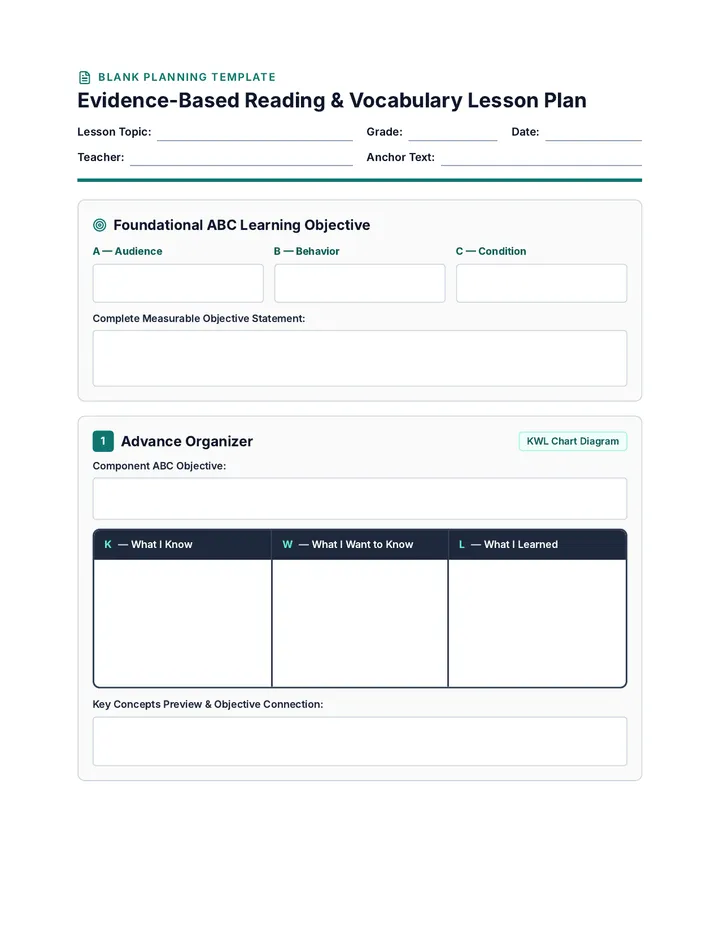
Classroom Activity: Before reading, students complete a KWL Chart. In the Know column, students list facts they already know about habitats. In the Want to Know column, students generate at least two questions about how animals survive in different environments. The teacher then introduces the lesson objective and explains that students will read to answer their questions and examine ecosystem relationships.
Scholarly Rationale: This strategy supports meaningful learning by helping students anchor new information to existing cognitive structures (Ausubel, 1960).
2
Evidence-Based Vocabulary Instruction
Recommended Method: Frayer Model
Definition: Vocabulary instruction must be explicit, systematic, and provide multiple opportunities to interact with target words. Direct teaching of word meanings significantly improves reading comprehension and overall academic achievement (Beck et al., 2013).
Lesson Plan Standards
An effective vocabulary routine must include:
- A student-friendly definition.
- Concrete examples.
- Clear non-examples.
- Structured opportunities for oral discussion and contextual application.
Model Implementation — Target Word: Adaptation
ABC Learning Objective: Given a Frayer Model (Condition), students (Audience) will define and apply the word adaptation (Behavior) by identifying its characteristics, examples, and non-examples.
Classroom Activity: Before reading, students complete a Frayer Model for adaptation by:
- Writing a student-friendly definition.
- Identifying key characteristics of adaptations.
- Generating examples (camouflage, migration).
- Generating non-examples (sleeping, eating lunch).
- Explaining how an adaptation helps an organism survive.
- Using the target word orally in a sentence connected to the upcoming passage.
Scholarly Rationale: Explicit vocabulary routines deepen word knowledge and build students' capacity to apply academic terms in meaningful contexts (Beck et al., 2013).
3
Graphic Organizer for Reading Comprehension
Recommended Method: Main Idea and Details Chart
Definition: Graphic organizers help learners visually structure information and support comprehension by making relationships between concepts explicit (Kim et al., 2004).
Lesson Plan Standards
An effective comprehension organizer must:
- Align directly with the organizational structure of the text.
- Require active completion during reading.
- Support the identification of central ideas and key evidence.
- Serve as a foundation for post-reading discussion and writing.
Model Implementation
ABC Learning Objective: While reading an informational text about ecosystems (Condition), students (Audience) will identify the main idea and three supporting details (Behavior) using a graphic organizer.
Classroom Activity: Students populate the chart below while reading the passage, then use their notes to summarize the text orally and in writing.
Model Graphic Organizer: Main Idea & Supporting Details
| Main Idea |
Supporting Detail 1 |
Supporting Detail 2 |
Supporting Detail 3 |
| Ecosystems contain interacting living and nonliving components. |
Plants provide food for consumers. |
Animals depend on specific habitats. |
Weather patterns affect organism survival. |
Scholarly Rationale: Graphic organizers improve comprehension by helping students visually organize, synthesize, and connect critical information from texts (Kim et al., 2004).
4
Active Engagement and Structured Discussion
Definition: Students acquire vocabulary and comprehension skills more effectively when they actively use academic language through discussion, practice, and collaboration rather than passive listening. Structured peer interaction drives language development and social knowledge construction (Vygotsky, 1978).
Lesson Plan Standards
During the lesson, students must:
- Articulate definitions and uses of new vocabulary aloud.
- Discuss text meaning with peers.
- Justify answers using direct textual evidence.
- Participate across multiple checkpoints throughout the lesson.
Model Implementation
ABC Learning Objective: After learning target vocabulary (Condition), students (Audience) will accurately use the vocabulary words in structured oral discussion (Behavior).
Classroom Activity: Following explicit vocabulary instruction, students engage in a structured Think-Pair-Share:
- Each student explains one target vocabulary term to a partner.
- Students use the term in an original sentence connected to the reading topic.
- Partners provide peer feedback and ask clarifying questions.
- Selected pairs share their responses with the whole class.
- During reading, the teacher pauses at planned intervals for students to discuss comprehension prompts using text evidence.
Scholarly Rationale: Collaborative dialogue creates authentic opportunities for meaningful language use and strengthens reading comprehension (Vygotsky, 1978).
5
Systematic Scaffolding and Error Correction
Definition: Effective instruction relies on immediate corrective feedback and graduated support whenever students encounter difficulty. Systematic scaffolding guides learners smoothly from teacher-led modeling to independent mastery (Archer & Hughes, 2011).
Lesson Plan Standards
Teachers must apply a consistent, predetermined corrective sequence whenever student errors occur.
Model Implementation
ABC Learning Objective: Given an informational text and teacher prompts (Condition), students (Audience) will determine the meaning of unfamiliar vocabulary and answer comprehension questions (Behavior).
7-Step Error-Correction Procedure
1
Stop the Error Immediately: Interrupt incorrect responses right away so misconceptions are not reinforced.
2
Revisit the Text: Direct students back to the specific sentence, paragraph, graphic organizer, or vocabulary example containing the evidence.
3
Model the Thinking Process: Deliver a brief think-aloud: "The sentence says the animal changes color to hide from predators. That tells me this is an adaptation because it helps the animal survive."
4
Provide Guided Practice: Ask scaffolded questions to rebuild understanding ("What does the animal do? Why does it do that? How does that help it survive?").
5
Check for Understanding: Prompt the student to answer the original question with guided support.
6
Verify Independent Response: Ask a parallel question for the student to answer independently.
7
Conduct Distributed Review: Revisit the concept later in the lesson and in subsequent sessions to solidify long-term retention.
Scholarly Rationale: Explicit instruction paired with immediate corrective feedback improves learning outcomes and prevents the repetition of errors (Archer & Hughes, 2011).
Lesson Plan Quality Assurance Checklist
Use the checklist below to verify that every lesson plan meets all instructional standards before delivery:
ABC Learning Objective: Clearly specifies the Audience, observable Behavior, and Condition.
Advance Organizer: Activates prior knowledge, previews objectives, and requires active student input.
Vocabulary Routine: Uses an evidence-based method featuring student-friendly definitions, examples, non-examples, and discussion.
Comprehension Graphic Organizer: Matches the text structure and is completed actively during reading.
Structured Engagement: Provides multiple opportunities for students to speak, collaborate, and cite text evidence.
Scaffolding & Error Correction: Outlines a clear, step-by-step corrective feedback loop.
Scholarly Alignment: Includes accurate APA 7th edition in-text citations supporting instructional choices.
Independent Application: Culminates in opportunities for students to demonstrate mastery independently.
References
Archer, A. L., & Hughes, C. A. (2011). Explicit instruction: Effective and efficient teaching. Guilford Press.
Ausubel, D. P. (1960). The use of advance organizers in the learning and retention of meaningful verbal material. Journal of Educational Psychology, 51(5), 267–272. https://doi.org/10.1037/h0046669
Beck, I. L., McKeown, M. G., & Kucan, L. (2013). Bringing words to life: Robust vocabulary instruction (2nd ed.). Guilford Press.
Kim, A. H., Vaughn, S., Wanzek, J., & Wei, S. (2004). Graphic organizers and their effects on the reading comprehension of students with learning disabilities: A synthesis of research. Journal of Learning Disabilities, 37(2), 105–118. https://doi.org/10.1177/00222194040370020201
Mager, R. F. (1997). Preparing instructional objectives (3rd ed.). Center for Effective Performance.
Vygotsky, L. S. (1978). Mind in society: The development of higher psychological processes. Harvard University Press.
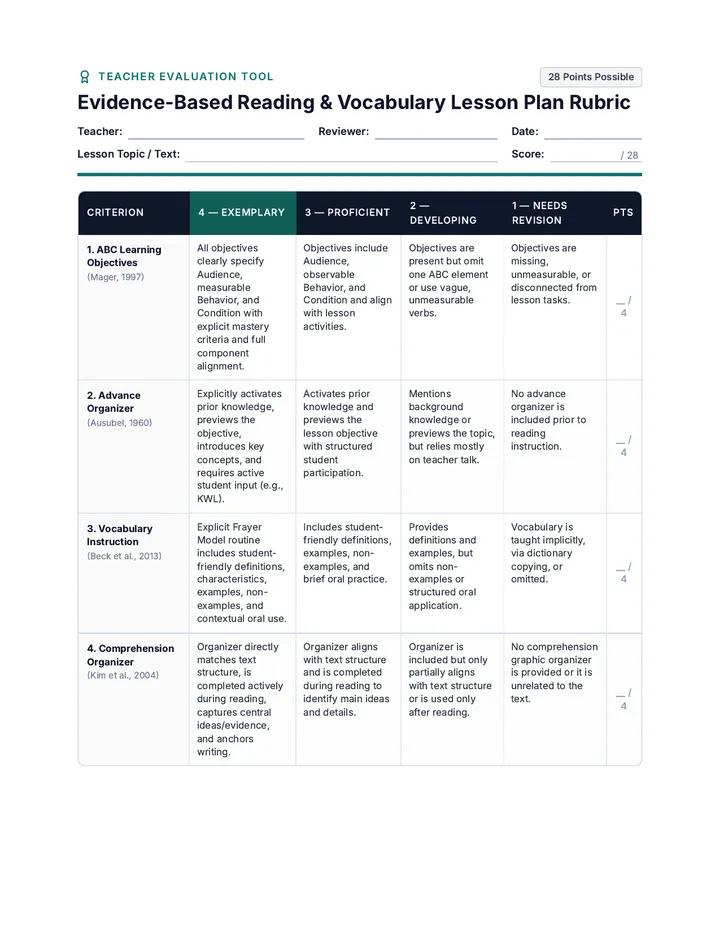
Reading Lesson Evaluation Rubric
Teacher Evaluation Tool
28 Points Possible
Evidence-Based Reading & Vocabulary Lesson Plan Rubric
Teacher:
Reviewer:
Date:
Lesson Topic / Text:
Score:
/ 28
| Criterion |
4 — Exemplary |
3 — Proficient |
2 — Developing |
1 — Needs Revision |
Pts |
|
|
|
|
|
|
| 1. ABC Learning Objectives |
|
|
|
|
|
(Mager, 1997)
| All objectives clearly specify Audience, measurable Behavior, and Condition with explicit mastery criteria and full component alignment. | Objectives include Audience, observable Behavior, and Condition and align with lesson activities. | Objectives are present but omit one ABC element or use vague, unmeasurable verbs. | Objectives are missing, unmeasurable, or disconnected from lesson tasks. | __ / 4 |
|
2. Advance Organizer
(Ausubel, 1960)
| Explicitly activates prior knowledge, previews the objective, introduces key concepts, and requires active student input (e.g., KWL). | Activates prior knowledge and previews the lesson objective with structured student participation. | Mentions background knowledge or previews the topic, but relies mostly on teacher talk. | No advance organizer is included prior to reading instruction. | __ / 4 |
|
3. Vocabulary Instruction
(Beck et al., 2013)
| Explicit Frayer Model routine includes student-friendly definitions, characteristics, examples, non-examples, and contextual oral use. | Includes student-friendly definitions, examples, non-examples, and brief oral practice. | Provides definitions and examples, but omits non-examples or structured oral application. | Vocabulary is taught implicitly, via dictionary copying, or omitted. | __ / 4 |
|
4. Comprehension Organizer
(Kim et al., 2004)
| Organizer directly matches text structure, is completed actively during reading, captures central ideas/evidence, and anchors writing. | Organizer aligns with text structure and is completed during reading to identify main ideas and details. | Organizer is included but only partially aligns with text structure or is used only after reading. | No comprehension graphic organizer is provided or it is unrelated to the text. | __ / 4 |
| Criterion |
4 — Exemplary |
3 — Proficient |
2 — Developing |
1 — Needs Revision |
Pts |
|
|
|
|
|
|
| 5. Active Engagement & Discussion |
|
|
|
|
|
(Vygotsky, 1978)
| Multiple structured checkpoints (e.g., Think-Pair-Share) require students to use target vocabulary aloud and justify claims with text evidence. | Includes peer discussion checkpoints where students use vocabulary and reference the text. | Includes brief partner talk, but lacks structured prompts or text-evidence expectations. | Lesson is passive and teacher-centered with no structured peer discussion. | __ / 4 |
|
6. Scaffolding & Error Correction
(Archer & Hughes, 2011)
| Outlines the complete 7-step corrective sequence (stop error, revisit text, think-aloud, guided practice, check, verify, distributed review). | Includes immediate corrective feedback, text revisiting, teacher modeling, and guided practice. | Mentions general teacher support or hints, but lacks a systematic corrective sequence. | No error-correction or scaffolding plan is included in the lesson. | __ / 4 |
|
7. Scholarly Alignment & Mastery
APA 7th & Transfer
| Accurate APA 7th edition in-text citations justify instructional choices, and the lesson culminates in clear independent mastery tasks. | Includes accurate APA 7th citations and an independent application task aligned to the objective. | Citations are incomplete/inconsistent or independent mastery task is loosely aligned. | Lacks scholarly citations and provides no opportunity for independent mastery. | __ / 4 |
Overall Lesson Plan Rating Scale
25–28 Points
Ready for Delivery (Exemplary)
20–24 Points
Meets Standards (Proficient)
14–19 Points
Needs Targeted Revisions
7–13 Points
Requires Redesign
Reviewer Feedback & Actionable Next Steps
Key Strengths Observed:
Priority Revisions Before Delivery: