Rat Year Quiz
鼠
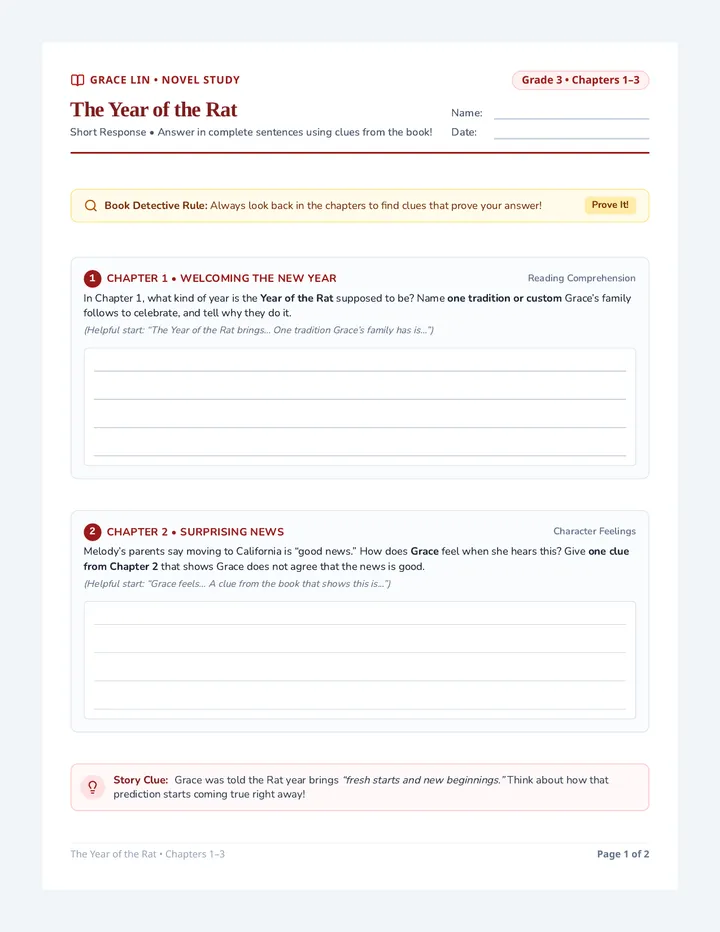
The Year of the Rat
Chapters 1–3 Comprehension Quiz • Grace Lin
Name:
Date:
Class:
Score:
Directions: Read each question carefully. Select and circle the letter of the single best answer.
8 Points Total
Part 1: The Great Zodiac Race, New Year Symbolism & Melody's Big News Questions 1–4
1
According to the Chinese zodiac legend in Chapter 1, how did the clever Rat win first place in the Great Race across the river?
A He built a swift wooden raft to sail past the other animals.
B He rode on the Ox's head across the river and leapt off at the finish line.
C He trained every morning to swim faster than all the competitors.
D He convinced the Dragon to fly him directly to the Emperor's palace.
2
What does Pacy's mother explain that the Year of the Rat represents?
A A quiet year for resting and avoiding difficult choices.
B A time of fresh starts, making changes, and planting future seeds.
C A year focused strictly on traveling abroad and learning languages.
D A solemn year dedicated only to looking back at past mistakes.
3
How does Pacy initially feel about entering the Year of the Rat after hearing her mother's explanation?
A Nervous and reluctant, because she likes her life just as it is.
B Thrilled, because she hopes her family moves into a bigger house.
C Uninterested, because she thinks Chinese zodiac signs are silly.
D Excited, because the rat is her personal favorite animal.
4
In Chapter 2, what shocking announcement does Pacy's best friend Melody share with her?
A Melody is leaving art club to join the competitive gymnastics team.
B Melody's family will host an exchange student from Taipei for the year.
C Melody's family is moving across the country to California for her dad's job.
D Melody is skipping fifth grade and going straight to middle school.
The Year of the Rat • Chapters 1–3 Assessment Continue to Page 2 →
The Year of the Rat • Comprehension Quiz Page 2 of 2
Part 2: Friendship Bond, New Year Dumplings & Family Traditions Questions 5–8
5
Why is Melody's upcoming move especially hard for Pacy compared to losing an ordinary classmate?
A Melody is the only other Asian-American girl in her grade who shares her background.
B Melody walks Pacy to school every day because Pacy gets lost easily.
C Pacy borrowed Melody's favorite sketchbook and hasn't returned it yet.
D Their mothers are business partners who run a bakery together.
6
In Chapter 3, what is the cultural significance of the shape of the New Year dumplings (jiaozi) Pacy's family wraps?
A They resemble ancient silver and gold ingots, symbolizing wealth and good fortune.
B They look like dragon claws to scare away bad luck and cold winter weather.
C They are shaped like river stones to honor the animals in the Great Race.
D They mimic flower petals to celebrate the upcoming spring harvest.
7
Why does Pacy's mother insist that all sweeping and house cleaning must be finished before New Year's Day?
A Guests will grade how tidy the house is when they visit for dinner.
B Sweeping on New Year's Day would accidentally sweep out all the incoming good luck.
C Brooms are traditionally burned in the fireplace at midnight on New Year's Eve.
D The trash trucks do not run on holidays in their neighborhood.
8
At the end of Chapter 3, what bittersweet realization does Pacy have regarding her mother's words about the Year of the Rat?
A She realizes that big, unexpected changes are already happening, even though she doesn't want them.
B She realizes that she would rather celebrate American holidays instead of Chinese New Year.
C She decides that she will run away and move to California with Melody's family.
D She discovers that her mother has hidden a real coin inside her dumpling.
Bonus Reflection (Optional • +2 Points)
Pacy's mother explains that the Year of the Rat brings both hard changes and new beginnings. Based on Chapters 1–3, what is one creative way Pacy and Melody could keep their friendship strong across the distance?
The Year of the Rat • Chapters 1–3 Quiz End of Assessment
Rat Year Answer Key
The Year of the Rat • Teacher Answer Key
Chapters 1–3 Reading Assessment Guide & Text Evidence • Grace Lin
Teacher Reference
8 MC Points + 2 Bonus
Quick Grading Matrix
RL.4.1, RL.4.2, RL.4.3
| # |
Ans |
Chapter |
Target Skill / Objective |
Points |
| 1 |
B |
Ch. 1 |
Key Detail • Legend of the Zodiac Great Race |
1 pt |
| 2 |
B |
Ch. 1 |
Cultural Symbolism • Theme of fresh beginnings & changes |
1 pt |
| 3 |
A |
Ch. 1 |
Character Perspective • Pacy's reluctance to embrace change |
1 pt |
| 4 |
C |
Ch. 2 |
Plot Turning Point • Melody's relocation announcement |
1 pt |
| 5 |
A |
Ch. 2 |
Character Relationship • Cultural identity & shared heritage |
1 pt |
| 6 |
A |
Ch. 3 |
Cultural Context • Jiaozi dumplings as symbols of wealth |
1 pt |
| 7 |
B |
Ch. 3 |
Cultural Traditions • New Year sweeping superstition |
1 pt |
| 8 |
A |
Ch. 3 |
Theme Synthesis • Connecting holiday symbolism to real life |
1 pt |
Detailed Answer Explanations & Text Evidence (Questions 1–4)
Question 1: Legend of the Rat & Great Race Correct: B
Text Evidence (Ch. 1): Lin recounts the folk story of the Jade Emperor's race. Because the Rat could not swim across the rushing river alone, he tricked the kind Ox into carrying him on his head. As soon as the Ox stepped onto shore, the Rat hopped down across the finish line first.
Distractor Notes: (A) rafts and (D) flying dragons are modern inventions or confusions with other myths. (C) contradicts the Rat's physical inability to swim without help.
Question 2: Meaning of the Year of the Rat Correct: B
Text Evidence (Ch. 1): Pacy's mother explains that because the Rat is the very first animal of the 12-year zodiac cycle, this year signifies fresh beginnings, major transitions, and tough decisions that set the direction for years to come.
Distractor Notes: (A) describes a resting year (often associated with the Boar/Pig). (C) and (D) are overly narrow or contrary to the Rat's active, ambitious symbolism.
Question 3: Pacy's Emotional Reaction Correct: A
Text Evidence (Ch. 1): Unlike her family members who welcome the prospect of renewal, Pacy admits to herself that she likes her life comfortable and steady. She had a wonderful Year of the Dog and Year of the Pig, and she worries that "change" means things will get worse.
Distractor Notes: (B) and (D) mischaracterize Pacy as eager for disruption. (C) fails because Pacy deeply treasures her family's traditions and stories.
Question 4: Melody's Big Announcement Correct: C
Text Evidence (Ch. 2): When Pacy and Melody meet up, Melody confesses the secret her parents announced: her dad got a promising new job opportunity in California, meaning their entire family must move away soon.
Distractor Notes: (A), (B), and (D) are plausible childhood plotlines but do not occur in the novel. Melody's cross-country move acts as the primary inciting conflict of the book.
The Year of the Rat • Teacher Answer Key Continue to Explanations & Rubric (Page 2) →
The Year of the Rat • Answer Key & Explanatory Guide Page 2 of 2
Detailed Answer Explanations & Text Evidence (Questions 5–8)
Question 5: Pacy and Melody's Special Bond Correct: A
Text Evidence (Ch. 2): Lin emphasizes that in their predominantly non-Asian community, Melody and Pacy share a rare cultural camaraderie. Melody understands the nuances of Taiwanese-American family expectations, holiday customs, and feeling "different" at school without needing explanations.
Distractor Notes: (B), (C), and (D) are trivial or fabricated details that ignore the core thematic focus on heritage and belonging.
Question 6: Cultural Meaning of Jiaozi (Dumplings) Correct: A
Text Evidence (Ch. 3): As Pacy's family pleats the dumpling dough, Mom reminds them that the crescent shape mimics traditional gold and silver sycee ingots used as currency in ancient China. Eating them represents welcoming wealth and abundance.
Distractor Notes: While dragons and the Great Race are central motifs in Chinese folklore, dumplings specifically represent financial luck and prosperous fortune.
Question 7: The Superstition of New Year Cleaning Correct: B
Text Evidence (Ch. 3): In Taiwanese and Chinese tradition, families thoroughly clean their homes before midnight on New Year's Eve to sweep away the old year's bad luck. On New Year's Day, brooms are tucked away because sweeping would figuratively sweep out incoming good fortune.
Distractor Notes: (A), (C), and (D) are fictitious distractors designed to catch students who read casually rather than recalling specific cultural traditions.
Question 8: Connecting Zodiac Themes to Real Life Correct: A
Text Evidence (Ch. 3): Pacy realizes with a heavy heart that her mother was right: the Year of the Rat truly is a time of sudden, unpredictable change. The devastating news about Melody's move proves that the year's "fresh start" is already happening, even if she desperately wants time to stand still.
Distractor Notes: (B) and (C) contradict Pacy's deep loyalty to her family and cultural pride. (D) is a minor surface detail about the coin tradition.
Bonus Reflection Scoring Rubric & Sample Student Responses
0–2 Points
Full Credit (2 pts)
Provides a thoughtful, text-aligned suggestion (e.g., mailing hand-drawn comics, keeping a shared journal, phone calls on weekends) showing understanding of both girls' artistic bond and distance.
Partial Credit (1 pt)
Offers a general friendship idea (e.g., "they can text" or "visit each other") without acknowledging the physical distance or their specific shared interests.
No Credit (0 pts)
Response is off-topic, unfeasible (e.g., "tell her dad to quit his job"), or left blank.
Recommended Discussion Prompts (Post-Quiz Debrief)
- Symbolism of the Rat: Why do you think Chinese folklore views the Rat as clever rather than sneaky? How does this contrast with Western views of rodents?
- Coping with Change: Pacy fears that changes will ruin her happy life. Have you ever experienced an unwanted change that turned into an unexpected opportunity?
- Cultural Identity: Why is having someone who shares your cultural background at school so empowering for kids like Pacy and Melody?
The Year of the Rat • Teacher Answer Key Grace Lin Literature Study