Deep Sea Starter Sheet Unit 2 • Into the Deep
Talk & Write Starter Sheet
Sentence starters, word banks, and frames for Session 1 activities
Name:
Date:
1
Notice & Wonder Sentence Frames
Session 1 • Page 4
Use these frames when studying deep-sea photos, videos, or the concept web.
I Notice... (What you see)
I notice that the ocean floor looks ________.
In the picture, I see ________ in the deep water.
Looking closely, I observe ________ around the ________.
I Wonder... (Questions you have)
I wonder how animals survive without ________.
Why does the deep sea look so ________?
I wonder what would happen if a diver ________.
Word Bank for "The Ocean" Concept Web: Pick words to add to your web
pitch-black freezing high pressure submarine glowing creatures trench shipwreck unexplored
2
Vocabulary in Action: Discover vs. Explore
Session 1 • Page 5
dis•cov•er (verb) to find or uncover
Use when talking about finding something for the first time.
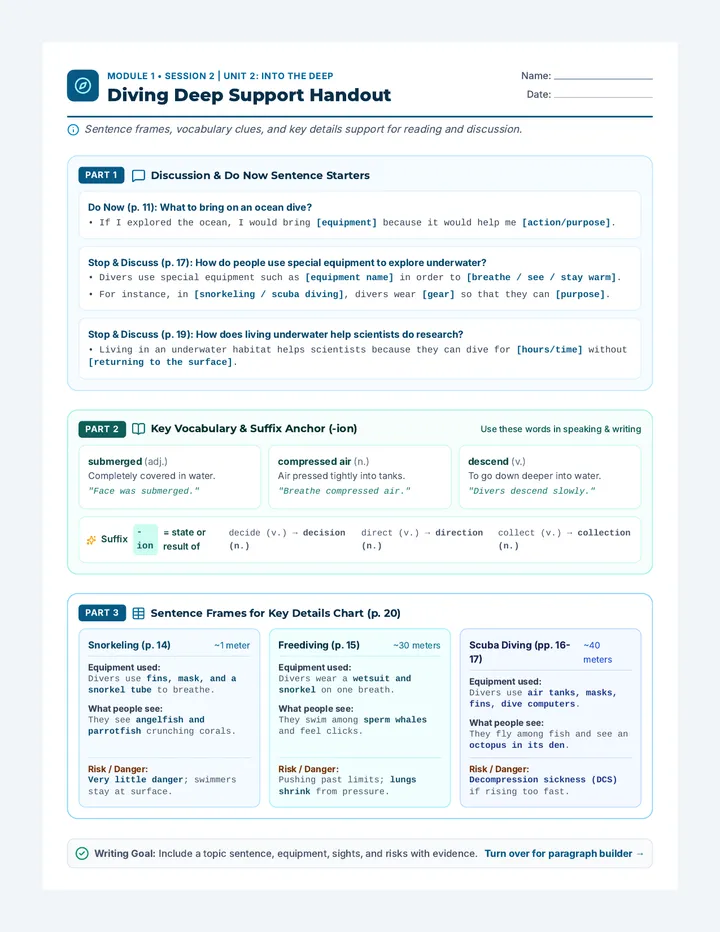
Frame A: In the coral reef, divers can discover ________.
Frame B: Scientists were excited to discover ________ hidden in the rocks.
ex•plore (verb) to search or hunt
Use when talking about traveling or searching an unknown place.
Frame A: The deep-sea diver swam down to explore ________.
Frame B: A submarine is built to explore ________ because ________.
Your Turn: Write one complete sentence using either discover or explore:
Unit 2: Into the Deep • Module 1, Session 1 Page 1 of 2
Text Reactions & Reflection
Deep Sea Talk & Reflect Frames
Supports for Anchor Text annotation, Unit Texts preview, and the Essential Question
Name:
Date:
3
Reacting to Anchor Text: Deep, Deep Down
Session 1 • Page 6
Choose one frame to share what surprised you or made you curious:
! Notice Surprising Details
When I read about the Mariana Trench, I noticed that ________.
It surprised me that creature like the (vampire squid / anglerfish / goblin shark) can ________.
? Wonder Curious Questions
The author asks if the trench is desolate, which makes me wonder if ________.
I wonder how scientists can explore the bottom when it is ________.
4
Partner Talk: Connecting Unit Texts
Session 1 • Page 7
Partner A Starter:
"I think the text [Text Title] will help me answer questions about ________."
Partner B Response:
"I agree, and these texts will help us understand the anchor text better because ________."
5
Essential Question Reflection Scaffold
Session 1 • Page 9
Essential Question: Why do people explore the deep sea?
Tier 1 • Starters People explore the deep sea because they want to find / learn ________.
Tier 2 • Expanding One important reason scientists explore the ocean depths is to ________ so they can ________.
Your Reflection (1-2 sentences): Capital letter & period
Oral Rehearsal Tip: Say your sentence out loud to your partner before writing it down! Partner Approved
Unit 2: Into the Deep • Module 1, Session 1 Page 2 of 2
Ocean Opinion Essay Packet Unit 2 Writing Project
Deep Sea Opinion Essay Packet
Step 1: Visual Planning & Stance Selector
Name:
Date:
The Writing Prompt
Write a four-paragraph opinion essay about why humans should or should not explore the deep sea. Support your reasons with evidence from Deep, Deep Down and at least one other unit text.
1
Choose Your Stance (Check One)
OPTION A: Humans SHOULD explore
Belief: Exploration helps science, medicine, and understanding.
Ideas for your reasons:
• Discover new species with unique survival traits
• Learn how the Earth and sea vents work
• Find resources and scientific breakthroughs
OPTION B: Humans SHOULD NOT explore
Belief: Exploration is too dangerous, costly, and harms sea life.
Ideas for your reasons:
• Extreme deep-sea pressure is deadly to humans
• Submersibles and machines can disturb fragile habitats
• Billions of dollars could be spent on land or space
2
The 4-Paragraph Roadmap
Paragraph 1 Introduction Hook + Topic + Your Claim
Paragraph 2 Reason 1 Evidence from Deep, Deep Down
Paragraph 3 Reason 2 Evidence from 2nd Unit Text
Paragraph 4 Conclusion Restate Claim + Big Thought
3
My Essay Plan (Jot Notes or Key Words)
My Claim Statement: In my opinion, humans (should / should not) explore the deep sea because ________________________________________.
Reason 1 (Text: Deep, Deep Down):
Reason 2 (2nd Text: ___________________):
Oral Rehearsal Option: State your claim and two reasons out loud to a partner before drafting! Ready to Draft →
Unit 2: Into the Deep • Opinion Essay Packet Page 1 of 3
Guided Drafting
Paragraph-by-Paragraph Frames
Step 2: Drafting Paragraph 1 (Introduction) and Paragraph 2 (Body 1)
Name:
Date:
Paragraph 1
Introduction: Hook, Background & Claim
3-4 sentences total
Word Bank:
mysterious pitch-black Mariana Trench ocean depths firmly believe
Sentence 1 (The Hook):
Did you know that the deepest part of the ocean is __________________________________________________?
Sentence 2 (Background Information):
Deep beneath the surface, the ocean is a place of extreme ________________________ and ________________________.
Sentence 3 (Your Opinion Claim):
In my opinion, humans (should / should not) explore the deep sea because ______________________________________________________________________________________.
Paragraph 2
Body Paragraph 1: Reason 1 & Evidence from Deep, Deep Down
3-4 sentences total
Transition Starters:
First of all, To begin with, One major reason is According to the author,
Sentence 1 (Topic Sentence - Reason 1):
First of all, one reason humans (should / should not) explore is that ______________________________________________________________________________________.
Sentence 2 (Text Evidence from Anchor Text):
In the text Deep, Deep Down by Lydia Lukidis, the author explains that ______________________________________________________________________________________.
Sentence 3 (Explanation / Elaboration):
This proves my point because ______________________________________________________________________________________.
Extra Support Tip: Circle the option in parentheses that matches your stance, then fill in the blank lines. Continue to Page 3 →
Unit 2: Into the Deep • Opinion Essay Packet Page 2 of 3
Guided Drafting & Review
Body 2, Conclusion & Checklist
Step 3: Drafting Paragraph 3 (Body 2), Paragraph 4 (Conclusion) and Editing
Name:
Date:
Paragraph 3
Body Paragraph 2: Reason 2 & Evidence from 2nd Text
3-4 sentences
Choose your 2nd text: Diving Deep • Secrets of the Sea Vents • Aliens of the Deep • Explorers
Sentence 1 (Topic Sentence - Reason 2):
In addition, another key reason is that ______________________________________________________________________________________.
Sentence 2 (Evidence from Second Text):
In the text ________________________, the reader learns that ______________________________________________________________________________________.
Sentence 3 (Explanation):
This evidence clearly demonstrates that ______________________________________________________________________________________.
Paragraph 4
Conclusion: Restate Claim & Final Thought
2-3 sentences
Sentence 1 (Restate Claim in New Words):
In conclusion, it is clear that humans (should / should not) explore the deep sea because ______________________________________________________________________________________.
Sentence 2 (Final Thought / Call to Action):
As we look to the future of our oceans, people must remember that ______________________________________________________________________________________.
Self-Monitoring & Peer Check Checklist
Check off each item before publishing
I clearly stated my opinion claim in Paragraph 1.
Paragraph 2 includes evidence from Deep, Deep Down .
Paragraph 3 includes evidence from a second unit text.
I used transition words (First of all, In addition, In conclusion ).
Every sentence starts with a capital and ends with punctuation.
I read my essay out loud to verify it makes sense.
Accommodated Submission Options: Completed frames may be typed, handwritten on lined paper, or dictated orally with teacher check. Classroom Ready
Unit 2: Into the Deep • Opinion Essay Packet Page 3 of 3
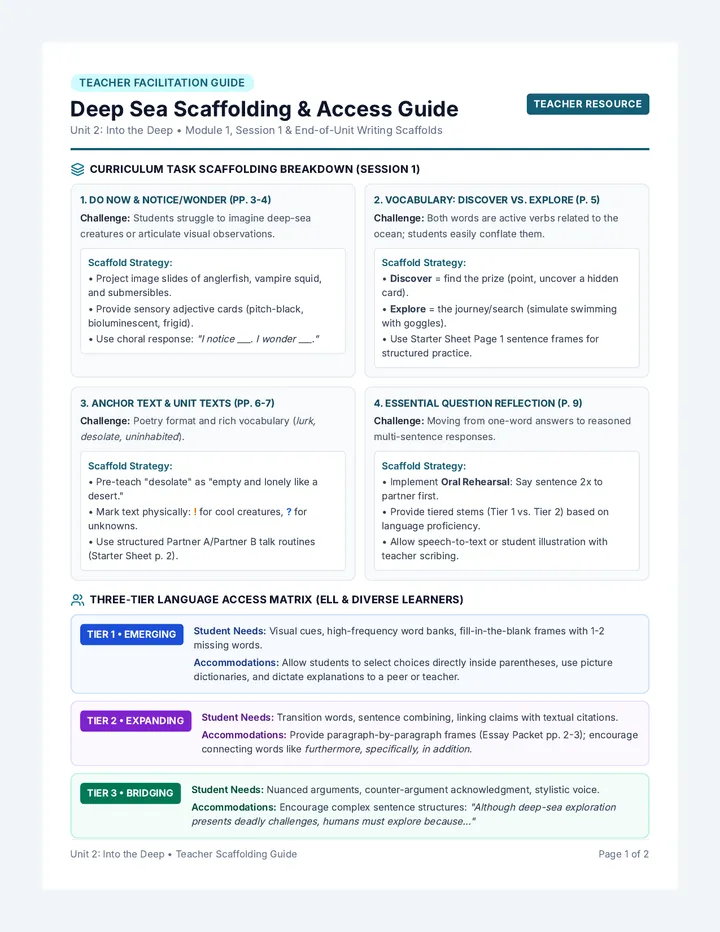
Deep Sea Scaffolding Teacher Guide Teacher Facilitation Guide
Deep Sea Scaffolding & Access Guide
Unit 2: Into the Deep • Module 1, Session 1 & End-of-Unit Writing Scaffolds
Teacher Resource
Curriculum Task Scaffolding Breakdown (Session 1)
1. Do Now & Notice/Wonder (pp. 3-4)
Challenge: Students struggle to imagine deep-sea creatures or articulate visual observations.
Scaffold Strategy:
• Project image slides of anglerfish, vampire squid, and submersibles.
• Provide sensory adjective cards (pitch-black, bioluminescent, frigid).
• Use choral response: "I notice ___. I wonder ___."
2. Vocabulary: Discover vs. Explore (p. 5)
Challenge: Both words are active verbs related to the ocean; students easily conflate them.
Scaffold Strategy:
• Discover = find the prize (point, uncover a hidden card).
• Explore = the journey/search (simulate swimming with goggles).
• Use Starter Sheet Page 1 sentence frames for structured practice.
3. Anchor Text & Unit Texts (pp. 6-7)
Challenge: Poetry format and rich vocabulary (lurk, desolate, uninhabited ).
Scaffold Strategy:
• Pre-teach "desolate" as "empty and lonely like a desert."
• Mark text physically: ! for cool creatures, ? for unknowns.
• Use structured Partner A/Partner B talk routines (Starter Sheet p. 2).
4. Essential Question Reflection (p. 9)
Challenge: Moving from one-word answers to reasoned multi-sentence responses.
Scaffold Strategy:
• Implement Oral Rehearsal : Say sentence 2x to partner first.
• Provide tiered stems (Tier 1 vs. Tier 2) based on language proficiency.
• Allow speech-to-text or student illustration with teacher scribing.
Three-Tier Language Access Matrix (ELL & Diverse Learners)
Tier 1 • Emerging
Student Needs: Visual cues, high-frequency word banks, fill-in-the-blank frames with 1-2 missing words.
Accommodations: Allow students to select choices directly inside parentheses, use picture dictionaries, and dictate explanations to a peer or teacher.
Tier 2 • Expanding
Student Needs: Transition words, sentence combining, linking claims with textual citations.
Accommodations: Provide paragraph-by-paragraph frames (Essay Packet pp. 2-3); encourage connecting words like furthermore, specifically, in addition .
Tier 3 • Bridging
Student Needs: Nuanced arguments, counter-argument acknowledgment, stylistic voice.
Accommodations: Encourage complex sentence structures: "Although deep-sea exploration presents deadly challenges, humans must explore because..."
Unit 2: Into the Deep • Teacher Scaffolding Guide Page 1 of 2
Essay Scaffolding
Annotated Model Essay & Protocols
Exemplar response demonstrating the four-paragraph opinion structure and citations
Teacher Resource
Annotated 4-Paragraph Model Opinion Essay
Target Stance: Humans SHOULD explore
Paragraph 1: Introduction (Hook + Claim) Intro
Did you know that humans know more about the surface of the moon than the bottom of our own oceans? Deep beneath the waves, the Mariana Trench is pitch-black and freezing cold. In my opinion, humans should explore the deep sea because scientists can discover amazing new species and uncover scientific secrets that protect our planet.
Paragraph 2: Body 1 (Anchor Text Evidence) Reason 1
First of all, exploring the depths allows scientists to discover rare and fascinating creatures. In the text Deep, Deep Down by Lydia Lukidis, the author describes creatures like vampire squid, seadevil anglerfish, and goblin sharks that thrive in the deep trench. This evidence proves that the deep sea is teeming with life rather than being desolate, and studying these animals teaches humans about extreme survival.
Paragraph 3: Body 2 (Second Text Evidence) Reason 2
In addition, deep-sea exploration helps humans understand Earth's geology and energy systems. In the unit text Secrets of the Sea Vents , the reader learns that hydrothermal vents release superheated minerals and support life without sunlight. This demonstrates that deep exploration provides vital clues about how life began on Earth.
Paragraph 4: Conclusion (Restate Claim + Call to Action) Conclusion
In conclusion, it is clear that humans must continue to explore the deep ocean. By building advanced submersibles, explorers can uncover new medicines, observe strange creatures, and protect fragile ecosystems. Our oceans hold the keys to Earth's greatest mysteries.
IEP / 504 / Extra Access Implementation Protocol
Reduced Copying
Students complete their final drafts directly on the guided packet pages (pp. 2-3) rather than recopying onto separate lined paper.
Oral Scribing
Students who have fine-motor fatigue may orally rehearse each frame and use voice dictation software or teacher/aide scribing.
Chunked Pacing
Assign one paragraph per session (Day 1: Intro; Day 2: Body 1; Day 3: Body 2; Day 4: Conclusion & Peer Checklist).
Unit 2: Into the Deep • Teacher Scaffolding Guide Page 2 of 2