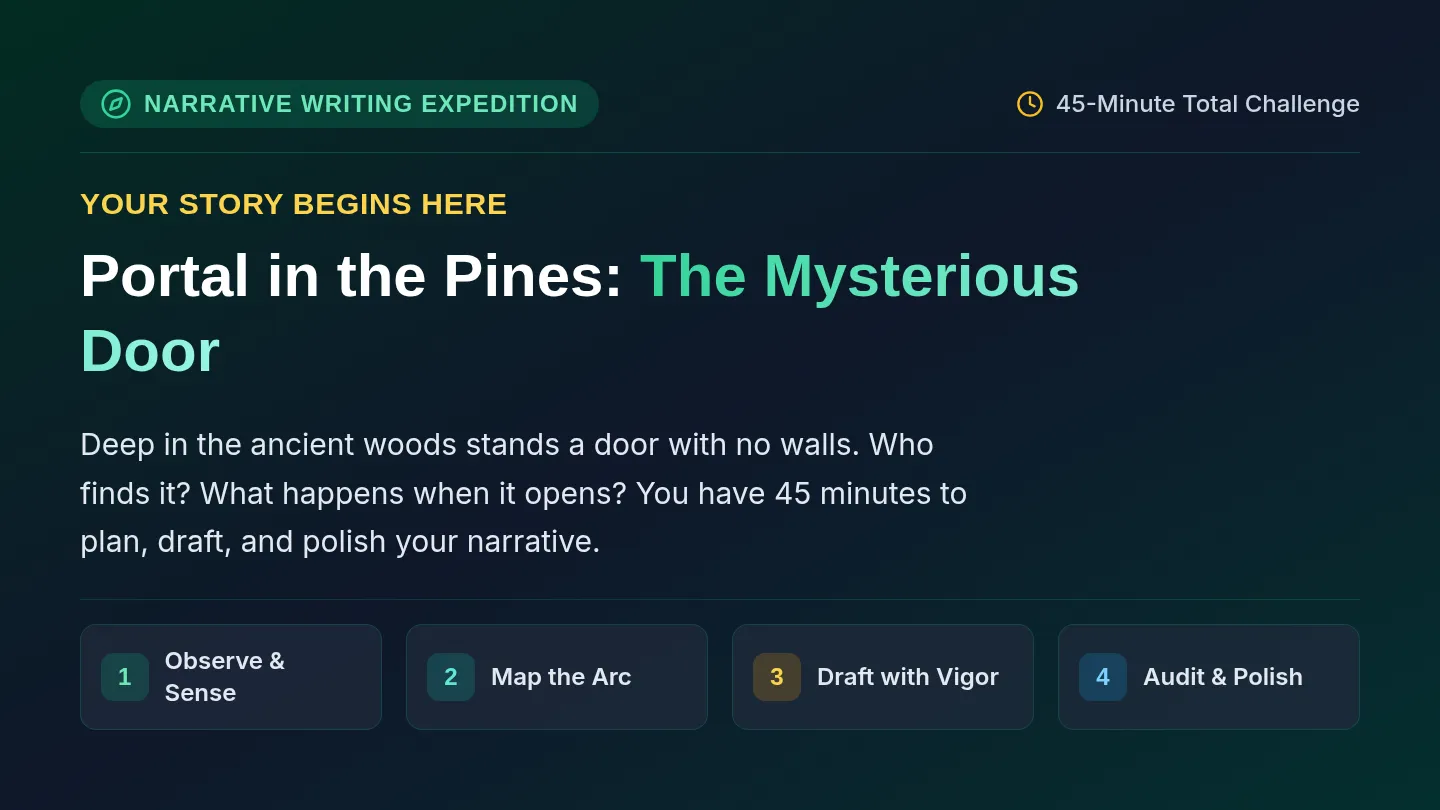
Portal in the Pines Slides Narrative Writing Expedition
45-Minute Total Challenge
Your Story Begins Here
Portal in the Pines: The Mysterious Door
Deep in the ancient woods stands a door with no walls. Who finds it? What happens when it opens? You have 45 minutes to plan, draft, and polish your narrative.
1
Observe & Sense
2
Map the Arc
3
Draft with Vigor
4
Audit & Polish
Checkpoint 1: Sensory Observation
5 Minutes
The Forest Door Sunbeams, silent canopy, ancient wood
"A freestanding doorway wrapped in moss and light..."
Turn & Talk: The Sensory Scan
Partner A describes what you hear and smell . Partner B describes what you touch and see .
👂 Sound
Creaking hinges? Muffled hum? Dead silence?
🌲 Scent
Damp pine needles, ozone, ancient stone?
✋ Touch
Cold iron latch, pulsating heat, rough bark?
👁️ Sight
Golden dust motes, strange symbols on frame?
✏️ Action Item: Record at least 3 vivid sensory details in your packet Part 1. Target: 3+ Senses
Checkpoint 2: Character Anchor
5 Minutes
Who Discovers the Door — and Why Are They There?
Great stories do not start with a stranger walking aimlessly. Give your character an urgent reason to be in this forest.
The Searcher
Searching for a lost heirloom, missing family member, or secret medicinal herb to save someone.
Core Urgency: Love or Duty
The Runaway
Fleeing an overwhelming danger, a broken promise, or a sudden crisis in their town.
Core Urgency: Survival or Escape
The Curious Rebel
Breaking the elder's strict rule: "Never cross the boundary stones at dusk."
Core Urgency: Defiance & Truth
Quick Choice: Pick your character's urgent motive now.
Write in Packet Page 1
Checkpoint 3: Mapping the Arc
5 Minutes
The 5 Stages of Your Story
Keep notes short in your planner table! A plan is a roadmap, not the full journey.
Stage 1
Exposition
Who is the character? Where are they when the story opens?
Hint: Establish the quiet woods before the shock.
Stage 2
Rising Action
What draws them toward the door? What tension builds?
Hint: Footsteps slow; a whisper or glow emanates.
Stage 3
Climax
The turning point! Highest tension moment.
Hint: The latch turns; the decision to step through!
Stage 4
Falling Action
What happens right after the choice? The immediate consequence.
Hint: A rush of wind, an altered sky, or a secret revealed.
Stage 5
Resolution
How does it end? What has permanently changed?
Hint: The character can never view the woods the same way.
📋 Fill out the 5 rows in your planner table (Page 2). 1-2 sentences per box
Writer's Secret: Show, Don't Tell
Descriptive Mastery
Reveal Character Through Reactions and Choices
Do not announce traits ("Marcus was brave"). Show their body, breath, and decisions!
Telling (Flat & Vague)
"Elena was terrified of the old door. It was very creepy, and she felt scared."
Why it misses: The reader feels nothing because no physical senses or internal thoughts are shared.
Showing (Vivid & Immersive)
"Elena pressed her spine against the damp cedar trunk, knuckles white around her flashlight. Through the keyhole drifted the scent of scorched cinnamon."
Why it works: Senses (touch, sight, smell) reveal fear and curiosity simultaneously!
💡 Quick Practice: Replace "He was shocked" with one physical reaction. Turn & Tell Your Partner
Checkpoint 4: The Drafting Sprint
25 Minutes
Pencils Moving: Bring the Door to Life
Write your descriptive narrative in Part 2 of your packet.
Continuous Writing
First 5 Minutes
Establish Setting
Hook the reader with sensory details. Describe the beams of sunlight, the damp air, and the surreal sight of the standalone door.
Next 15 Minutes
Build to the Turn
Move toward the door. Build tension step by step. What sounds or sensations intensify? Reach your breathtaking climax!
Final 5 Minutes
Consequence & Close
Resolve the immediate action. Don't end with "It was all a dream!" Give a real, lasting change for your character.
Silence & focus in the room. If stuck, describe what your character smells or touches! Sprint in Progress
Checkpoint 5: Audit & Polish
5 Minutes
The 6-Point Narrative Audit
Read your story with a detective's eye. Check off every item that is true of your draft in Part 3.
1
Clear Opening
Did you set the scene and immediately introduce your character?
2
Three Senses
Can you underline sight, sound, smell, touch, or taste?
3
Character Voice
Personality shown through thoughts, choices, and reactions?
4
Climax & Resolution
Does the story build to a peak and resolve satisfyingly?
5
Vivid Word Choice
Replaced vague words ("went", "nice", "big") with precise verbs?
6
Proofreading Pass
Capital letters, end punctuation, and complete sentences checked?
✨ Fix at least two weak words or missing punctuation marks now! Check All 6 Boxes
Narrative Debrief
Mission Accomplished
Share Your Golden Line
Select your single most descriptive sentence — the line that paints the clearest sensory picture of the door or your character's reaction.
Partner Reflection Protocol
1
Read your Golden Line aloud with dramatic pacing and expression.
2
Your partner identifies which sense was triggered most powerfully.
3
Swap roles and celebrate each other's vivid imagination!
Portal in the Pines Narrative Expedition Great writers plan, draft, and polish!
Mystic Door Narrative Packet Narrative Writing Task • 45-Minute Challenge
Portal in the Pines: Descriptive Narrative
Time Limit: 45 Minutes
Genre: Descriptive Narrative
Name:
Date:
Period:
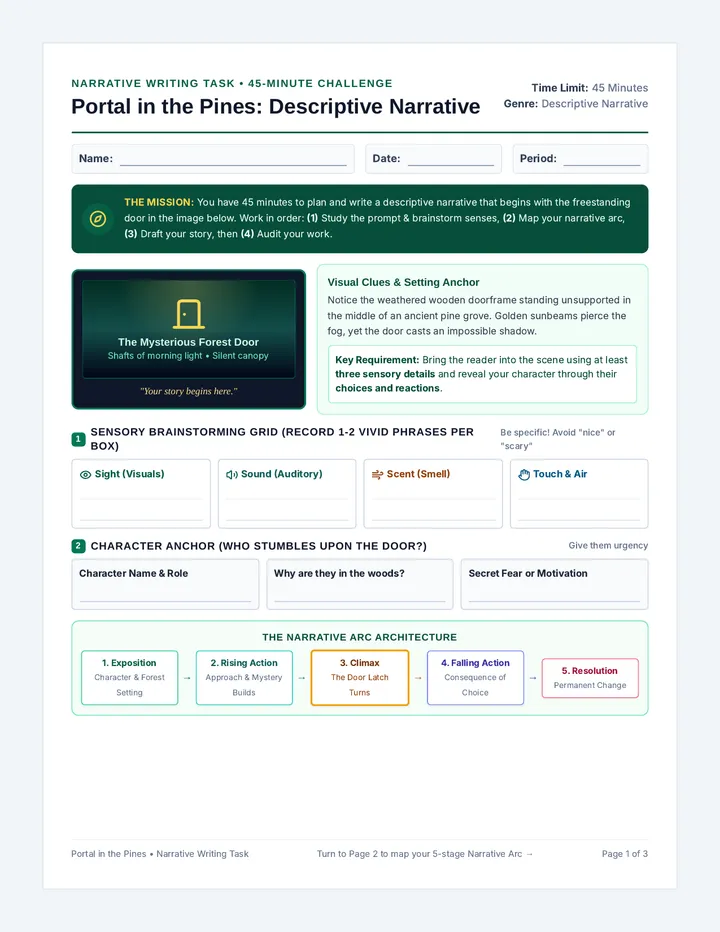
The Mission: You have 45 minutes to plan and write a descriptive narrative that begins with the freestanding door in the image below. Work in order: (1) Study the prompt & brainstorm senses, (2) Map your narrative arc, (3) Draft your story, then (4) Audit your work.
The Mysterious Forest Door Shafts of morning light • Silent canopy
"Your story begins here."
Visual Clues & Setting Anchor
Notice the weathered wooden doorframe standing unsupported in the middle of an ancient pine grove. Golden sunbeams pierce the fog, yet the door casts an impossible shadow.
Key Requirement: Bring the reader into the scene using at least three sensory details and reveal your character through their choices and reactions .
1 Sensory Brainstorming Grid (Record 1-2 vivid phrases per box)
Be specific! Avoid "nice" or "scary"
Sight (Visuals)
Sound (Auditory)
Scent (Smell)
Touch & Air
2 Character Anchor (Who stumbles upon the door?)
Give them urgency
Character Name & Role
Why are they in the woods?
Secret Fear or Motivation
The Narrative Arc Architecture
1. Exposition Character & Forest Setting
→
2. Rising Action Approach & Mystery Builds
→
3. Climax The Door Latch Turns
→
4. Falling Action Consequence of Choice
→
5. Resolution Permanent Change
Portal in the Pines • Narrative Writing Task Turn to Page 2 to map your 5-stage Narrative Arc → Page 1 of 3
Part 1: Plan Your Story
The 5-Stage Narrative Arc Matrix
Suggested Pacing: 8-10 Mins
Before you write, sketch out the shape of your story. Fill in each stage below with a few quick notes — who your character is, what happens, and how it ends. Keep your notes short; this is a plan, not the story itself.
Stage & Guiding Questions
Your Plan (1-2 quick bullet points or sentences)
1. Exposition
Who is your character, and where are they when the story opens? What mood is set?
2. Rising Action
What draws your character toward the door? What problem, mystery, or tension builds?
3. Climax
What is the turning point, the moment of highest tension? The door opens or a critical choice occurs!
4. Falling Action
What happens right after the turning point? What are the immediate consequences?
5. Resolution
How does the story end? What has permanently changed for your character or the forest?
Writer's Tip: Instead of telling the reader "He felt scared," show physical reactions: "His throat tightened, and he instinctively held his breath." Use your plan above to pace your draft!
Portal in the Pines • Narrative Writing Task Turn to Page 3 to draft your narrative → Page 2 of 3
Part 2: Write Your Narrative
Drafting Space
Suggested Pacing: 25 Mins
Write a descriptive narrative that begins with the door in the image. Bring your reader into the scene: what does your character see, hear, smell, and feel? Show who your character is through their thoughts, choices, and reactions.
Part 3: Check Your Work (5 Minutes)
Read back through your draft and check each box
Setting & Opening: My opening sets the scene clearly and introduces my character.
Sensory Details: I used at least three senses (sight, sound, smell, touch, taste) to describe the scene.
Show, Don't Tell: I showed my character's personality through thoughts, choices, or reactions.
Story Structure: My story builds to a clear climax and resolves it with a lasting change.
Vivid Vocabulary: I used precise, vivid word choices instead of vague ones.
Editing & Conventions: I proofread for spelling, punctuation, and complete sentences.
Portal in the Pines • Narrative Writing Task Completed & Audited Draft Page 3 of 3
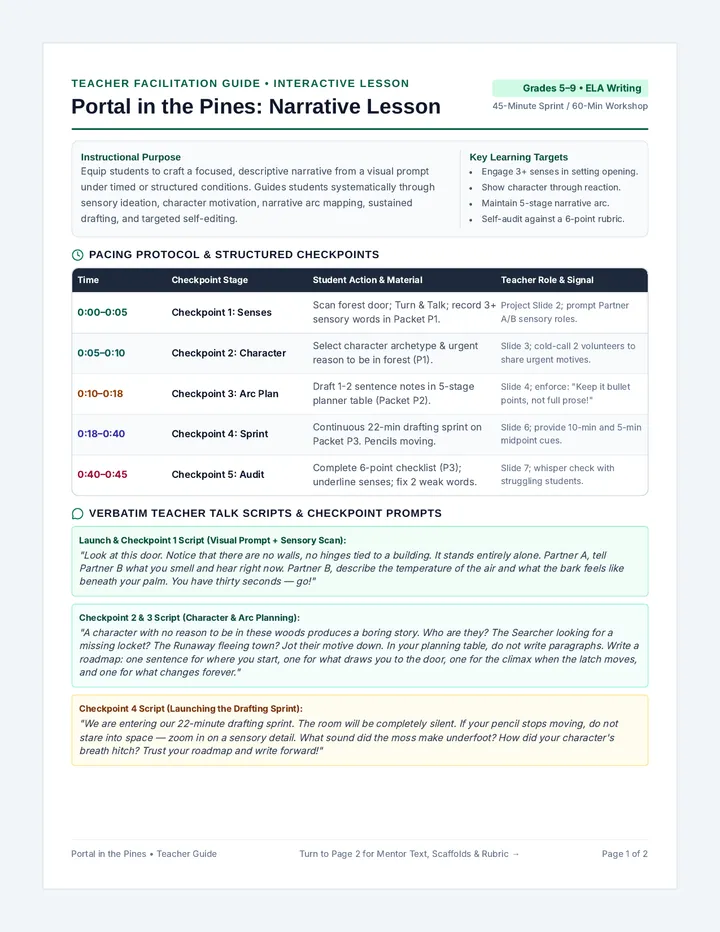
Doorway Quest Teacher Guide Teacher Facilitation Guide • Interactive Lesson
Portal in the Pines: Narrative Lesson
Grades 5–9 • ELA Writing 45-Minute Sprint / 60-Min Workshop
Instructional Purpose
Equip students to craft a focused, descriptive narrative from a visual prompt under timed or structured conditions. Guides students systematically through sensory ideation, character motivation, narrative arc mapping, sustained drafting, and targeted self-editing.
Key Learning Targets
Engage 3+ senses in setting opening.
Show character through reaction.
Maintain 5-stage narrative arc.
Self-audit against a 6-point rubric.
Pacing Protocol & Structured Checkpoints
Time
Checkpoint Stage
Student Action & Material
Teacher Role & Signal
0:00–0:05
Checkpoint 1: Senses
Scan forest door; Turn & Talk; record 3+ sensory words in Packet P1.
Project Slide 2; prompt Partner A/B sensory roles.
0:05–0:10
Checkpoint 2: Character
Select character archetype & urgent reason to be in forest (P1).
Slide 3; cold-call 2 volunteers to share urgent motives.
0:10–0:18
Checkpoint 3: Arc Plan
Draft 1-2 sentence notes in 5-stage planner table (Packet P2).
Slide 4; enforce: "Keep it bullet points, not full prose!"
0:18–0:40
Checkpoint 4: Sprint
Continuous 22-min drafting sprint on Packet P3. Pencils moving.
Slide 6; provide 10-min and 5-min midpoint cues.
0:40–0:45
Checkpoint 5: Audit
Complete 6-point checklist (P3); underline senses; fix 2 weak words.
Slide 7; whisper check with struggling students.
Verbatim Teacher Talk Scripts & Checkpoint Prompts
Launch & Checkpoint 1 Script (Visual Prompt + Sensory Scan):
"Look at this door. Notice that there are no walls, no hinges tied to a building. It stands entirely alone. Partner A, tell Partner B what you smell and hear right now. Partner B, describe the temperature of the air and what the bark feels like beneath your palm. You have thirty seconds — go!"
Checkpoint 2 & 3 Script (Character & Arc Planning):
"A character with no reason to be in these woods produces a boring story. Who are they? The Searcher looking for a missing locket? The Runaway fleeing town? Jot their motive down. In your planning table, do not write paragraphs. Write a roadmap: one sentence for where you start, one for what draws you to the door, one for the climax when the latch moves, and one for what changes forever."
Checkpoint 4 Script (Launching the Drafting Sprint):
"We are entering our 22-minute drafting sprint. The room will be completely silent. If your pencil stops moving, do not stare into space — zoom in on a sensory detail. What sound did the moss make underfoot? How did your character's breath hitch? Trust your roadmap and write forward!"
Portal in the Pines • Teacher Guide Turn to Page 2 for Mentor Text, Scaffolds & Rubric → Page 1 of 2
Part 2: Instructional Support
Mentor Model, Interventions & Rubric
Scaffolds & Grading
Mentor Text Model: Opening & Climax Transition Demonstrates 3+ Senses & Show Don't Tell
"The morning mist clung to Jarek’s eyelashes like cold cobwebs. He stepped over rotting pine logs, the scent of damp earth and crushed needles sharp in his throat. Then he saw it: an oak door upright in the fern grove, its iron latch glistening with dew. A faint amber pulse bled through the keyhole. Jarek's throat constricted. His fingers trembled as they reached for the cold iron ring..."
Common Pitfalls & In-the-Moment Coaching
Pitfall 1: "It was all a dream"
Students panic at the resolution and make the character wake up in bed.
Fix: Require physical proof (e.g., golden moss remains in their pocket).
Pitfall 2: Over-telling emotion
Writing "She was terrified" repeatedly without physical reactions.
Fix: Coach: "What did her hands do? What did her chest feel like?"
Pitfall 3: Mid-Sprint Writer's Block
Student freezes after reaching the door and doesn't know what's behind it.
Fix: Prompt: "What sound comes through the keyhole? Answer that first."
Tiered Differentiation Strategies
Emergent / ELL Scaffolds
Provide sensory word bank (creaking, pine, damp, glowing, frozen).
Provide sentence starters for each arc stage.
Allow 3-stage arc (Beginning, Turning Point, End).
On-Grade Writers
Complete all 5 stages of the narrative arc matrix.
Incorporate at least 3 distinct senses in the opening.
Ensure clear internal monologue or choice at climax.
Advanced / Extensions
Use dramatic irony or symbolism in the door's carvings.
Experiment with second-person or dual perspective.
Craft a circular ending echoing the opening imagery.
Narrative Assessment Rubric (1–4 Scale)
Criterion
Level 4: Exemplary
Level 3: Proficient
Level 2–1: Developing
Setting & Senses
3+ senses woven seamlessly; atmosphere grips the reader.
3 senses included; setting is clear and recognizable.
1-2 senses; setting is generic or minimally described.
Character & Showing
Personality revealed richly through physical reactions & choice.
Clear actions and thoughts; mostly shows rather than tells.
Mainly tells emotions ("he was scared"); flat characterization.
Narrative Structure
Flawless 5-stage arc with gripping climax and permanent change.
Follows beginning, build-up, turning point, and resolution.
Lacks clear climax or cuts off abruptly ("it was a dream").
Word Choice & Conventions
Vivid verbs, varied syntax; exceptionally clean mechanics.
Precise vocabulary; minor errors do not impede reading.
Repetitive vague words; frequent run-ons or fragments.
Portal in the Pines • Teacher Guide Classroom-Ready Facilitation Page 2 of 2