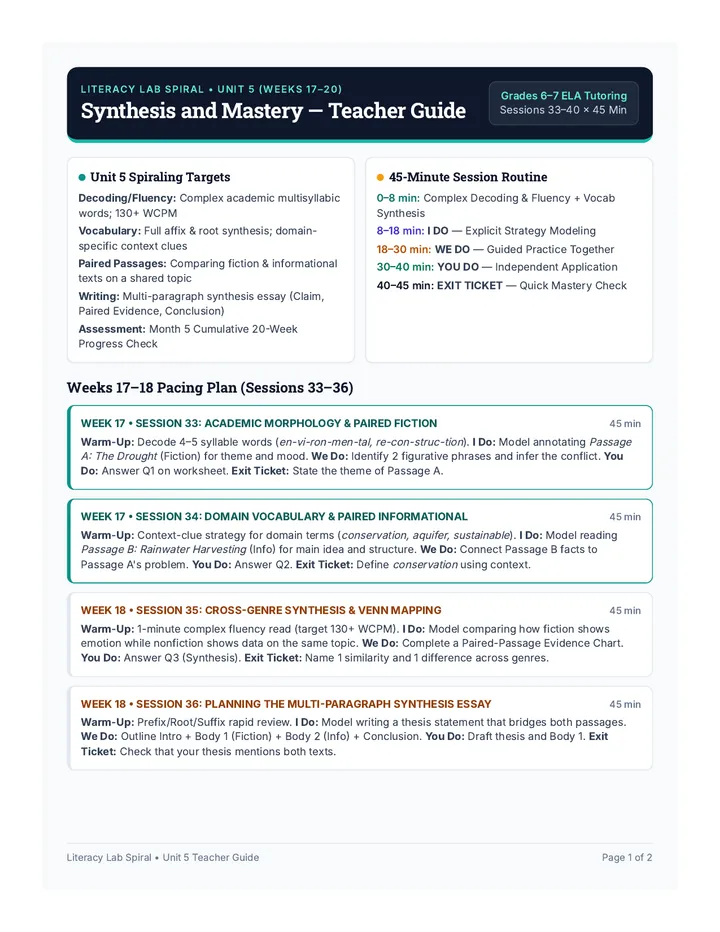
Name That Noun Teacher Guide 7th Grade ELA • 40-Minute Lesson
Name That Noun: Teacher Guide
Focus Skill: Common & Proper Nouns
Level: Accessible / Below Grade Level
NYS Next Generation ELA Standards
Grades 6–8 Anchor Standard L1 & L2 (Conventions of Academic English): Demonstrate command of the conventions of academic English grammar, usage, and capitalization when writing or speaking. Lesson Focus: Distinguish between common and proper nouns and apply correct capitalization to proper nouns.
“I Can” Statement
“I can tell the difference between a common noun and a proper noun, and I can capitalize proper nouns in my writing.”
Academic Vocabulary
Term
Student-Friendly Definition
Examples
Noun
A word that names a person, place, or thing.
girl, park, shoe
Common Noun
A general name for any person, place, or thing. Starts with a lowercase letter.
teacher, city, dog
Proper Noun
The exact, special name of a person, place, or thing. Always starts with a capital letter.
Mr. Diaz, Albany, Rex
Capitalize
To write the first letter of a word as a big (uppercase) letter.
tuesday → T uesday
General / Specific
General means any one in a group. Specific means one exact one.store vs. Target
40-Minute Pacing & Lesson Flow
0–5 min
Do Now (Warm-Up): Students read 3 short sentences on their worksheet and circle the nouns that name a specific person, place, or thing. Review answers quickly as a class.
5–15 min
Mini-Lesson (“I Do” — Slides 2–5): Introduce the “I Can” statement and academic vocabulary. Show side-by-side examples of common (general) vs. proper (specific) nouns. Emphasize the Golden Rule: Proper nouns always get a capital letter!
15–25 min
Guided Practice (“We Do” — Slides 6–7 & Worksheet Part 1): Display words on the board; students show thumbs-up for proper nouns and thumbs-down for common nouns. Complete Worksheet Part 1 together.
25–35 min
Independent Practice (“You Do” — Worksheet Parts 2 & 3): Students match common nouns to proper nouns and fix lowercase proper nouns in 4 short sentences. Circulate to support IEP/ENL/low learners.
35–40 min
Exit Ticket: Collect worksheets and hand out the 4-question Exit Ticket. Students work silently to show mastery of identifying and capitalizing proper nouns.
Differentiation & Answer Key
Name That Noun • 7th Grade ELA
Targeted Differentiations
High Students (Extension)
Write 3 original sentences that each contain one common noun and one proper noun , and label both.
Challenge question: Explain why “my mom” is lowercase, but “Mom” as a name is capitalized.
Low Students (Scaffolding)
Give a quick “Capitalize It!” Checklist : People’s names, Cities/States, Days/Months, Brand names.
Have students highlight proper nouns in yellow before rewriting sentences. Complete odd items only if needed.
ENL Students (Language Support)
Use visual icons and cognates (common / común , specific / específico ).
Provide sentence frame: “______ is a proper noun because it names a specific ______.”
Allow bilingual word-to-word dictionaries for unfamiliar nouns.
Students with IEPs
Chunk the worksheet: fold paper so only one part is visible at a time.
Read all directions aloud and check for understanding before independent work.
Allow verbal answers or circling/correcting directly on the sentence instead of full rewrites.
Complete Answer Key
Worksheet — Do Now (Circle the specific nouns):
1. Maya | 2. Brooklyn | 3. Friday
Worksheet — Part 1: Common (C) or Proper (P)?
1. school (C ) | 2. Nike (P ) | 3. October (P ) | 4. city (C ) | 5. Dr. Patel (P ) | 6. pizza (C )
Worksheet — Part 2: Match Common to Proper Noun:
1. state → New York | 2. singer → Taylor Swift | 3. restaurant → McDonald’s | 4. month → July
Worksheet — Part 3: Fix the Sentences (Capitalize Proper Nouns):
My friend Carlos lives in Queens .
We have a math test on Monday .
I bought new Jordan sneakers at the mall.
Ms. Green took our class to Central Park .
Exit Ticket:
1. B (Buffalo) | 2. Common (teacher is general) | 3. Fix: On Saturday , Leo ate Doritos . | 4. Any valid proper noun (e.g., Target, Nike, Bronx, Ms. Lee ) starting with a capital letter.
Name That Noun Slides 7th Grade ELA • 40-Minute Lesson
Name That Noun
Common Nouns vs. Proper Nouns
Do Now • 5 Minutes
Spot the Special Name!
On your worksheet, circle the exact, special name in each sentence:
1. My friend Maya walked to the store.
2. That big city is called Brooklyn .
3. Our favorite day of the week is Friday .
Today’s Goal
“I can tell the difference between a common noun and a proper noun, and I can capitalize proper nouns in my writing.”
Noun
A person, place, or thing.
Common
Any general noun (lowercase).
Proper
One specific noun (CAPITAL).
Common vs. Proper Nouns
Common Noun
General name • lowercase
• teacher
• city
• sneakers
• day
Proper Noun
Exact name • CAPITALIZED
• M s. G reen
• B rooklyn
• N ike
• F riday
The Golden Rule
If it names ONE exact person, place, or thing, CAPITALIZE it!
People’s Names
Carlos, Dr. Patel, Taylor Swift
Places
New York, Central Park, Queens
Days & Months
Monday, Saturday, October, July
Brands & Stores
Nike, Target, McDonald’s, Doritos
We Do • Guided Practice
Thumbs Up or Thumbs Down?
👍 Thumbs Up = Proper Noun | 👎 Thumbs Down = Common Noun
1. school
2. October
3. Dr. Patel
4. pizza
You Do • 10 Minutes
Independent Practice
Step 1: Finish Part 2 (Match common nouns to proper nouns).
Step 2: Finish Part 3 (Fix the 4 sentences by capitalizing proper nouns).
Next: 5-Minute Exit Ticket to show what you learned!
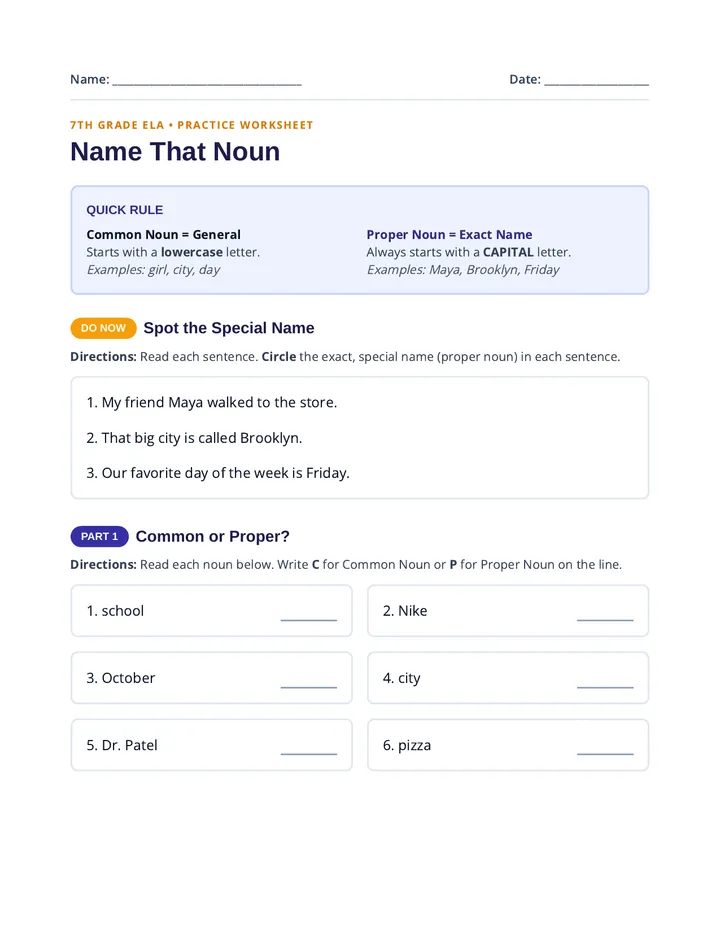
Name That Noun Worksheet Name: ____________________________________
Date: ____________________
7th Grade ELA • Practice Worksheet
Name That Noun
Quick Rule
Common Noun = General
Starts with a lowercase letter.
Examples: girl, city, day
Proper Noun = Exact Name
Always starts with a CAPITAL letter.
Examples: Maya, Brooklyn, Friday
Do Now
Spot the Special Name
Directions: Read each sentence. Circle the exact, special name (proper noun) in each sentence.
1. My friend Maya walked to the store.
2. That big city is called Brooklyn.
3. Our favorite day of the week is Friday.
Part 1
Common or Proper?
Directions: Read each noun below. Write C for Common Noun or P for Proper Noun on the line.
1. school
2. Nike
3. October
4. city
5. Dr. Patel
6. pizza
Part 2
Match the Nouns
Directions: Draw a line to match each Common Noun on the left to its Proper Noun on the right.
1. state
2. singer
3. restaurant
4. month
Taylor Swift
July
New York
McDonald’s
Part 3
Fix the Sentences
Directions: Each sentence has proper nouns that need a capital letter . Rewrite each sentence correctly on the line below.
1. My friend carlos lives in queens.
2. We have a math test on monday.
3. I bought new jordan sneakers at the mall.
4. ms. green took our class to central park.
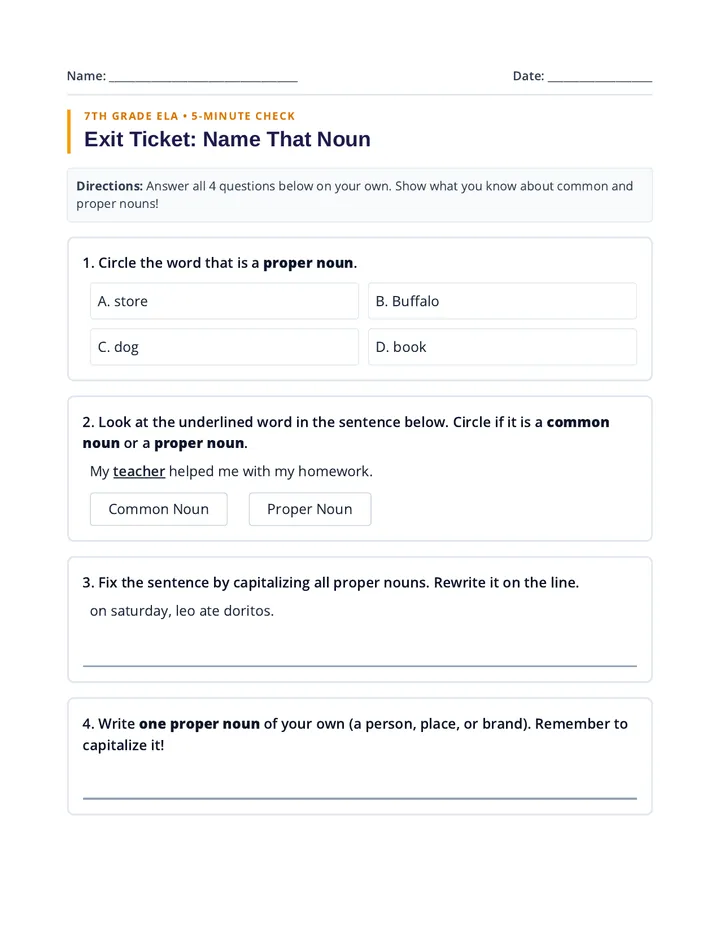
Name That Noun Exit Ticket Name: ____________________________________
Date: ____________________
7th Grade ELA • 5-Minute Check
Exit Ticket: Name That Noun
Directions: Answer all 4 questions below on your own. Show what you know about common and proper nouns!
1. Circle the word that is a proper noun .
A. store
B. Buffalo
C. dog
D. book
2. Look at the underlined word in the sentence below. Circle if it is a common noun or a proper noun .
My teacher helped me with my homework.
Common Noun
Proper Noun
3. Fix the sentence by capitalizing all proper nouns. Rewrite it on the line.
on saturday, leo ate doritos.
4. Write one proper noun of your own (a person, place, or brand). Remember to capitalize it!