Main Idea Marvels Lesson Plan Main Idea Marvels
Instructional Facilitation Guide
Duration
30 Minutes
Audience
3rd Grade
Level
Tier 1 Classroom
Why This Matters
Understanding the main idea helps students grasp the most important information in a text, which is a fundamental skill for reading comprehension and academic success. It teaches them to filter out less important information and focus on the core message.
Learning Objective
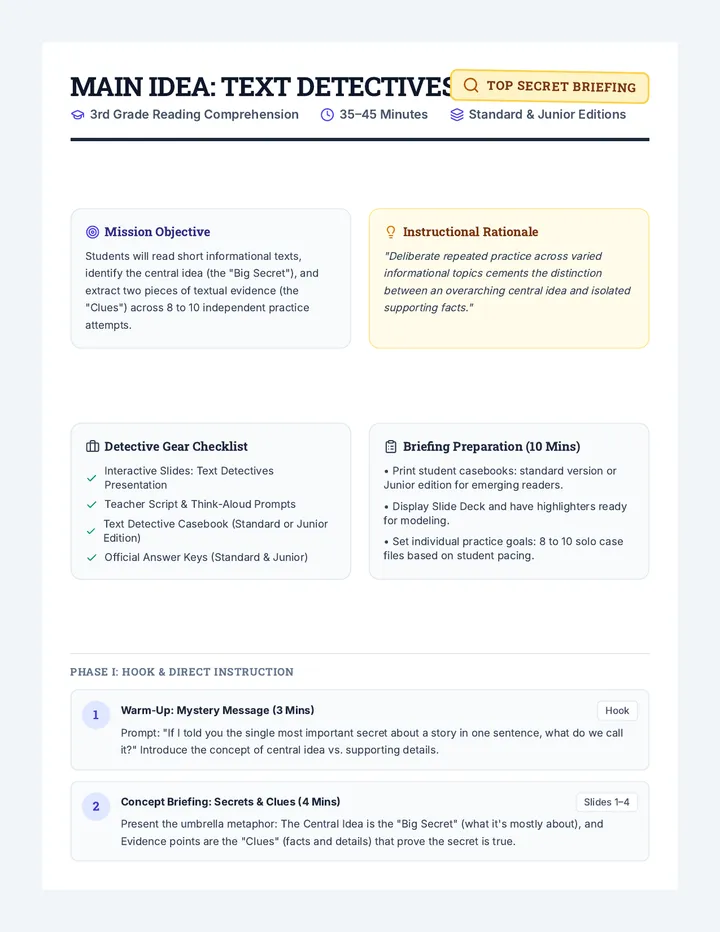
Students will be able to identify the main idea and at least two supporting details in a short informational text.
Materials Needed
Main Idea Marvels Slide Deck
Text Detectives Worksheet
Warm-Up & Cool-Down Slips
Whiteboard/Projector & Pencils
Preparation (15 Minutes)
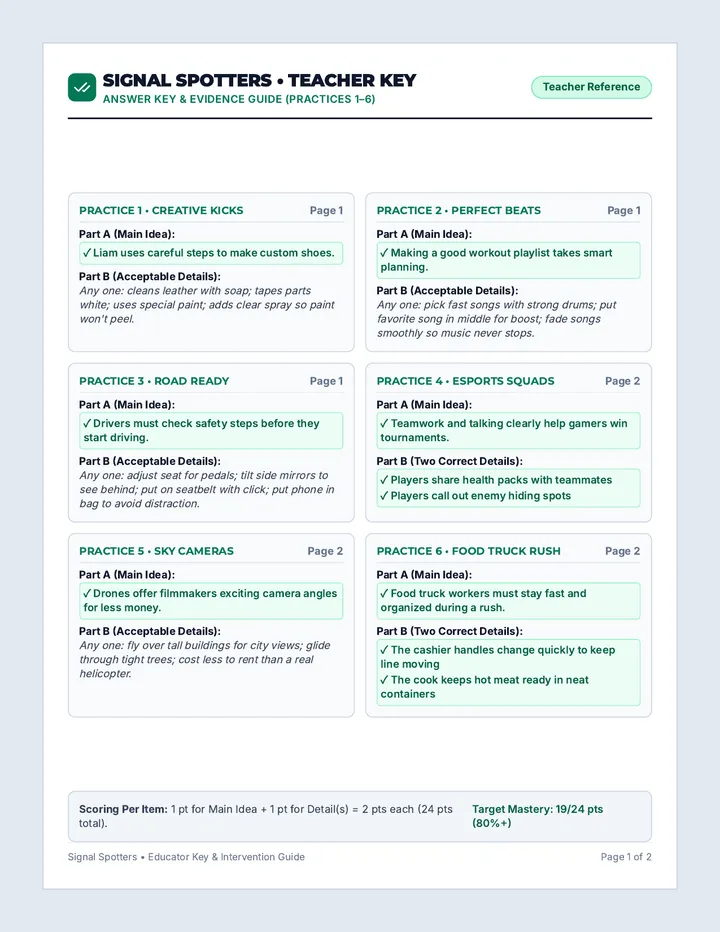
Review the lesson plan, slide deck, script, and answer key.
Set up the projector for the Main Idea Marvels Slide Deck .
Print copies of the Main Idea Worksheet: Text Detectives for each student.
Have pencils and exit ticket slips ready.
Lesson Procedure
Time Phase Instructional Steps 3 mins Warm-Up Picture This! Use Warm-Up: What's the Big Idea?
Project the playground image.
Ask: "What is the 'big idea' or main point of this picture?"
Quick discussion on grasping ideas from visuals.
|
| 4 mins | Intro | What's the Point?
Use Slides 1-3
Introduce title: "Unlocking Text Secrets!"
Discuss: "Why is it important to find the main idea?"
State the learning objective clearly.
|
| 8 mins | Instruction | Main Idea & Details Explained
Use Slides 4-6 & Hand Analogy
Define Main Idea: The "palm" or the heart of the text.
Define Details: The "fingers" that support the palm.
Model identifying both using the 'Dogs' example passage.
|
| 10 mins | Practice | Text Detectives
Use Worksheet & Slide 7
Distribute Text Detectives worksheet.
Students work independently/pairs on Passage 1 and 2.
Circulate for support (check-in with ADHD student).
Quick class check of Passage 1 results.
|
| 5 mins | Cool-Down | One Big Thing
Use Cool-Down Slip
Students write one thing they learned on their exit ticket.
Informal assessment of today's objective.
|
ADHD Support (Tier 1)
Pacing & Structure:
Keep instructions brief. Use the visual hand analogy to anchor abstract concepts. Provide a clear visual timer for independent work.
Focus Checks:
Use physical proximity during independent work. Ask student to repeat instructions to verify processing.
Main Idea Marvels Slide Deck Classroom Mission
Main Idea
Marvels!
Unlocking Text Secrets
Teacher Note:
Welcome students, get their attention, and set a positive tone for learning.
Why is it important?
Have you ever read something and wondered: "What is the author trying to tell me?"
Today, we become detectives to find the "big idea"!
Teacher Note:
Ask students why finding the main point is useful in everyday life.
Our Mission Today:
"By the end of this lesson, you will be able to find the Main Idea and Important Details in a short story or paragraph!"
Teacher Note:
Clearly state the learning goal for the lesson.
What's the Main Idea?
The most important point or message the author wants you to understand.
What the text is mostly about.
"Think of your hand! The palm is the Main Idea – the biggest part."
THE PALM
Teacher Note:
Introduce the main idea. Emphasize it's the 'heart' of the text. Use hand analogy.
What are
Supporting Details?
Facts, examples, or descriptions that explain or prove the main idea.
They give more information about the main idea.
"Your fingers are the supporting details – they extend from the palm!"
THE FINGERS
Teacher Note:
Explain details and how they connect to the main idea. Continue hand analogy.
Let's Practice Together!
Passage:
"Dogs make great pets. They are loyal and often protect their owners. Dogs can also be very playful and keep you active, enjoying walks and games of fetch."
Main Idea (Palm)
Dogs make great pets.
Supporting Details (Fingers)
1. Loyal and protect owners.
2. Playful and keep you active.
Teacher Note:
Provide a simple, quick example and walk students through identifying both parts.
Your Turn:
Text Detectives!
I will give you a worksheet with short passages. Your job is to find the Main Idea and the Supporting Details for each one!
Teacher Note:
Introduce the activity. Remind them to be 'text detectives'.
You Did It,
Main Idea Marvels Script Teaching Script
Main Idea Marvels: Unlocking Text Secrets
3rd Grade Reading
01
Warm-Up: Picture This! (3 Minutes)
Use "Warm-Up: What's the Big Idea?" slip or slide
"Good morning, everyone! Let's start with a quick warm-up. Look at the image on the board. Without saying anything yet, what do you think is the main idea of this picture? What is the most important thing happening, or what is it mostly about?"
"Okay, now turn to a partner and share your thoughts. What's the main idea of this picture?" (Allow 1 minute for discussion).
"Alright, let's hear a few ideas! [Call on 2-3 students]. Excellent! You all did a great job figuring out the main point just from looking at an image. Today, we're going to do something similar, but with words!"
02
Introduction: What's the Point? (4 Minutes)
Display Slide 1: Main Idea Marvels!
"Look at our exciting title for today: 'Main Idea Marvels: Unlocking Text Secrets!' Doesn't that sound like an adventure?"
Display Slide 2: Why is it important?
"Now, think about this: Why do you think it's important to be able to find the main idea when you read? Why does it matter what the author is trying to tell us? [Pause for student responses, affirm answers like 'to understand,' 'to learn']."
"Exactly! Finding the main idea helps us truly understand what we're reading. It's like finding the treasure map that tells us where the most valuable information is."
Display Slide 3: Our Mission Today
"Our mission today, our learning objective, is to be able to find the main idea and at least two important details in a short informational text. We're going to become 'Text Detectives'!"
03
Direct Instruction: Explained (8 Minutes)
Display Slide 4: What's the Main Idea?
"So, what is the main idea? The main idea is the most important point the author wants you to know about a topic. It's what the whole story or paragraph is mostly about. Think of it as the 'big picture' or the 'heart' of the text."
Hand Analogy: "Here's a trick: imagine your hand. Your palm is like the main idea – it's the biggest, central part. Everything else connects to it."
Display Slide 5: What are Supporting Details?
"Now, what about those 'supporting details'? Supporting details are the facts, examples, or descriptions that explain or prove the main idea. They give us more information."
Hand Analogy: "If your palm is the main idea, what do you think your fingers are? [Wait for responses]. Yes! Your fingers are like the supporting details – they come off the main part. They support the main idea, just like your fingers support your hand."
Main Idea Worksheet: Text Detectives Text Detectives
Case File: Main Idea
Agent Name:
Mission Date:
MISSION INSTRUCTIONS: Read each passage carefully. Identify the "Palm" (Main Idea) and two "Fingers" (Supporting Details) for each case!
1
Case: Busy Bees
"Bees are very important insects. They fly from flower to flower, collecting nectar. While they do this, pollen sticks to their fuzzy bodies and they carry it to other flowers. This process, called pollination, helps plants grow fruits and vegetables for us to eat."
Main Idea (The Palm)
Supporting Details (The Fingers)
Detail 1:
Detail 2:
2
Case: The Mighty Ocean
"The ocean is a fascinating place full of life. Many different kinds of fish, from tiny clownfish to giant sharks, live in its waters. Whales, dolphins, and sea turtles also call the ocean home. Even plants, like kelp and seaweed, grow in the ocean's depths, providing food and shelter for many creatures."
Main Idea (The Palm)
Supporting Details (The Fingers)
Detail 1:
Detail 2:
Main Idea Worksheet Answer Key Answer Key
Main Idea Marvels: Text Detectives
Teacher Resource
Case 1: Busy Bees
Main Idea (Palm):
Bees are very important insects. (Accept variations like "Bees are important for pollination.")
Supporting Details (Fingers):
1. They fly flower to flower collecting nectar.
2. They carry pollen to other flowers (pollination).
3. This helps plants grow food for us.
Thought Process & Guidance
The whole paragraph talks about what bees do and how that makes them important. The first sentence directly states their importance, and the rest explains why .
Red Flag: If a student writes "Bees collect nectar" as the main idea, ask: "Is that the ONLY thing the paragraph is about, or is that just one reason why they are important?"
Case 2: The Mighty Ocean
Main Idea (Palm):
The ocean is a fascinating place full of life. (Accept variations like "Many living things call the ocean home.")
Supporting Details (Fingers):
1. Many fish like clownfish and sharks live there.
2. Whales, dolphins, and turtles also live there.
3. Plants like kelp provide food and shelter.
Thought Process & Guidance
The paragraph introduces the ocean as "full of life." The rest of the sentences list specific examples of that life (fish, mammals, plants).
Guidance: Remind students that supporting details are like "evidence" that the main idea is true. If the ocean is full of life, what is the evidence? (The list of animals).
Main Idea Warm-Up Slips Warm-Up: What's the Big Idea?
Quick Detective Mission
Look at this scene:
Busy Playground Scene
What is the most important thing happening here? What is the 'big idea' of this image?
Main Idea Marvels Detective ID: _________
Warm-Up: What's the Big Idea?
Quick Detective Mission
Look at this scene:
Busy Playground Scene
What is the most important thing happening here? What is the 'big idea' of this image?
Main Idea Marvels Detective ID: _________
Main Idea Cool-Down Slips Cool-Down: One Big Thing
Case Closed: Final Report
What is one important thing you learned today about finding the main idea in a text?
Agent:
Cool-Down: One Big Thing
Case Closed: Final Report
What is one important thing you learned today about finding the main idea in a text?
Agent:
ADHD Accommodations: 3rd Grade Focus ADHD Support Guide
3rd Grade • Tier 1 Instruction
Context
These accommodations are designed to support a 9-year-old student with ADHD (Primarily Inattentive type) within a general education 3rd-grade classroom. These strategies focus on enhancing attention, organization, and task completion without requiring physical movement, making them ideal for Tier 1 instruction.
Environment & Routine
Preferential Seating: Seat near the teacher or a positive role model, away from windows/doors.Clear Workspace: Minimize visual clutter on the desk. Assist with folder organization.Visual Schedule: Provide a clear, visible daily routine to reduce transition anxiety.
Assignment Habits
Extended Time: Allow extra time for processing and writing tasks.Reduced Workload: Focus on quality over quantity (e.g., complete 1 passage perfectly instead of 3).Alternative Response: Allow verbal or drawn responses if writing becomes a barrier to showing knowledge.
Instructional Strategies
Chunking: Divide the lesson into the distinct 3-8 minute phases provided in this plan.Concise Directions: Give directions verbally AND visually. Ask student to repeat them back.Frequent Check-ins: Use non-verbal cues (thumbs up, proximity) to check focus during independent work.Visual Timers: Use an on-screen or physical timer to help with "time blindness."Graphic Organizers: The hand analogy in this lesson serves as a primary cognitive anchor.
Teacher Focus
"The goal is to reduce the cognitive load of 'organizing' the information, so the student can focus entirely on 'identifying' the main idea."
Empowering Every Learner • Main Idea Marvels