Forensic Lab Teacher Guide Classified Dossier
LITERARY FORENSIC LAB
SUBJECT: 7TH GRADE AUTHOR'S PURPOSE ANALYSIS
LAB ID: LFL-RI76
EST. Pacing: 80 MINS
Mission Objectives
Students will act as literary forensic scientists to decode why an author wrote a text (Author's Purpose) by gathering and examining structural, tonal, and lexical evidence.
Target CCSS
CCSS.ELA-LITERACY.RI.7.6
Determine author's point of view or purpose and analyze how the author distinguishes their position.
Materials & Lab Preparation
Slide Presentation: Forensic Lab SlideshowCase Files Worksheet: One printed per studentStation Task Cards: 4 stations set up in classroomCase Report Organizers: Print 1-2 per group
Phase 1: Interactive Briefing (30 Mins)
STAGE 1: The Briefing & Hook (10 Mins) Slide 1-3
Welcome students to the "Literary Forensic Lab." Explain that in this classroom, we are no longer passive readers; we are literary forensic scientists. Show the initial mystery slide. Present a short, 1-paragraph text about vaping risks or electric cars and ask: "Why was this written? What are the clues?" Guide them away from simple "PIE" (Persuade, Inform, Entertain) to deeper nuances (e.g., to advocate, to expose, to instruct).
Key Dialogue Hook: "Authors never write without a motive. Every adjective, every sentence length, and every sub-heading is a fingerprint left behind. Today, we learn how to lift those prints."
STAGE 2: Forensic Tools Mini-Lesson (20 Mins) Slide 4-8
Introduce the Forensic Evidence Framework . Model how to examine the three pillars of author purpose using a short mentor text:
Word Choice
Identify heavily loaded, emotional words (connotations). Strong verbs or technical terminology reveal motive.
Tone
The author's attitude. Is it objective, satirical, urgent, nostalgic? Tone maps directly to their true objective.
Text Structure
Compare-contrast, problem-solution, cause-effect. The architecture of a text guides readers to a specific conclusion.
MISSION CODE: RI.7.6 / FORENSICS PAGE 1 OF 2
PART II: ACTIVE ANALYSIS & ROTATIONS
LAB INSTRUCTIONS & FACILITATION
CONFIDENTIAL
STAGE 3: Guided Field Training (15 Mins)
Using Slide 9-10 , analyze a mock text as a whole class. Display the "Case File 00: The Microbe Threat." Model annotation strategies: circle emotional words (Word Choice), highlight cause-effect structure (Text Structure), and deduce the voice (Tone). Demonstrate how to write a justification statement that links findings to the author's target purpose.
STAGE 4: Station Rotation - Crime Scene Investigation (25 Mins)
Divide students into 4 small groups. Each group begins at a designated station containing a distinct Case File Task Card (Task Cards 1–4). Groups must complete their analysis on their shared Case Report Organizer .
Station Tasks Overview
Station 1 (The Tech Dilemma): Analyze persuasive text structure & rhetorical questions.Station 2 (The Historic Artifact): Analyze biased descriptors and historical lens.Station 3 (The Eco-Warning): Focus on highly emotional words & scientific data structures.Station 4 (The Consumer Trap): Deconstruct advertising copy and call-to-actions.
Teacher Facilitation Tips
Circulate the room with a colored "Evidence Approved" marker or stamp. Check each group's findings for text evidence. If the group successfully connects at least 2 categories of evidence (e.g., word choice and structure) to the final purpose, stamp their Case Report.
STAGE 5: Debrief & Individual Assessment (10 Mins)
Bring students back to their main desks. Direct them to complete the Case Files Worksheet individually. This acts as an independent check for understanding and is highly structured to assess progress.
Intervention & Extension Protocols
Scaffolding (Intervention)
Provide students with a **Word Bank of Tone Words** and sentence stems (e.g., "The author uses the word ____ to make the reader feel ____"). Allow them to focus on just 1 area of evidence (either Word Choice OR Structure) rather than all three.
Expansion (Extension)
Challenge students to rewrite one of the station texts to serve a completely different purpose (e.g., turn an objective informative paragraph into a satirical, persuasive text using the same basic topic/facts).
MISSION CODE: RI.7.6 / FORENSICS PAGE 2 OF 2
Forensic Lab Slides [ Classified Briefing ]
SESSION: RI.7.6
MISSION INTRO
Literary Forensic Lab
Lifting fingerprints and analyzing evidence to decode Author's Purpose.
FORENSIC AGENT IN TRAINING SLIDE 1 OF 6
Throw Away the "PIE"
[ Case Background ]
Elementary vs. Forensic
In elementary school, author's purpose is simple P.I.E.: Persuade, Inform, Entertain.
But real texts are complex! 7th graders analyze the precise motive:
To expose inequality
To alert of danger
To critique a standard
To advocate for change
MODULE 1: THE MOTIVE SLIDE 2 OF 6
Three Elements of Evidence
[ Investigative Kit ]
1. Word Choice
Look for strong, emotional, or technical words that betray feelings or target specific audiences.
2. Tone
The author's attitude. Is it cynical? Playful? Alarmist? Objective?
3. Text Structure
Is it cause-effect, problem-solution, or sequence? The layout directs the argument.
MODULE 2: TOOLS OF ANALYSIS SLIDE 3 OF 6
Crime Scene File 01
[ Live Analysis ]
EVIDENCE ITEM #1
"The chemical run-off from the factory did not just pollute the local creek; it choked and poisoned the fragile local trout population. Year after year, state officials stayed blind to this tragedy while corporate executives grew richer."
Let's Lift the Prints:
Word Choice: "Choked," "poisoned," "stayed blind." (Loaded verbs and idioms).
Tone: Hostile, urgent, accusatory.
True Motive: To spark public anger and demand corporate accountability.
MODULE 3: MODELING EVIDENCE SLIDE 4 OF 6
Crime Scene File 02
[ Identifying Structure ]
EVIDENCE ITEM #2
"While paper bags decay within weeks, plastic grocery bags persist for up to 500 years. To combat this ecological logjam, we must implement a community-wide bag tax, which studies show cuts plastic waste by 80%."
Structure Clues:
Structure: Compare-contrast ("Weeks vs. 500 years") leading to Problem-Solution.
Tone: Rational, objective, and solution-oriented.
True Motive: To present a practical legislative fix for an environmental problem.
MODULE 3: MODELING EVIDENCE SLIDE 5 OF 6
Case Files Worksheet Official Investigation Form
Literary Forensic Lab
CASE RECORD: INDEPENDENT ANALYSIS
Special Agent Name: _________________________________
Date of Inquiry: ___________
Class Period: _______
Mission Protocol: Read the evidence exhibit below. Lift linguistic clues to determine the author's precise intent. Do not just write "to persuade" or "to inform"—define their exact motive using the evidence.
Exhibit Echo-45: The Virtual Cage
CONFIDENTIAL TEXT
"The modern smartphone screen is not merely a tool; it is a meticulously engineered digital trap. Every bright red notification circle and infinite-scroll feed is intentionally calibrated by behavioral psychologists to trigger bursts of dopamine, keeping our children locked in an endless cycle of virtual consumption. We can no longer stand idly by as multi-billion-dollar tech giants siphon away our children's attention spans and real-world childhoods. We must demand immediate, strict age restrictions on social media registration."
Section 2: Forensic Evidence Gathering
Word Choice Clues
Identify 3 highly emotional or biased words/phrases used in Exhibit Echo-45.
Clue 1:
Clue 2:
Clue 3:
What feelings do these spark?
Tone Diagnosis
Describe the author's attitude. Cite one short sentence that proves this tone.
Tone Word:
Evidence:
Is it objective or subjective?
Structural Blueprint
What major text structure is used (e.g., Cause-Effect, Problem-Solution)? Explain.
Text Structure:
How it is used:
How does structure aid the goal?
Section 3: Final Case Report & Purpose Verdict
A. THE VERDICT (Identify the author's precise purpose beyond PIE):
B. EVIDENCE SUMMARY (Write a cohesive paragraph justifying your verdict using at least 2 pieces of evidence gathered above):
METADATA: CASE_05_SCREENLOCK SCORE: ________ / 10 AGENT LEVEL
Station Task Cards Active Investigation Cards
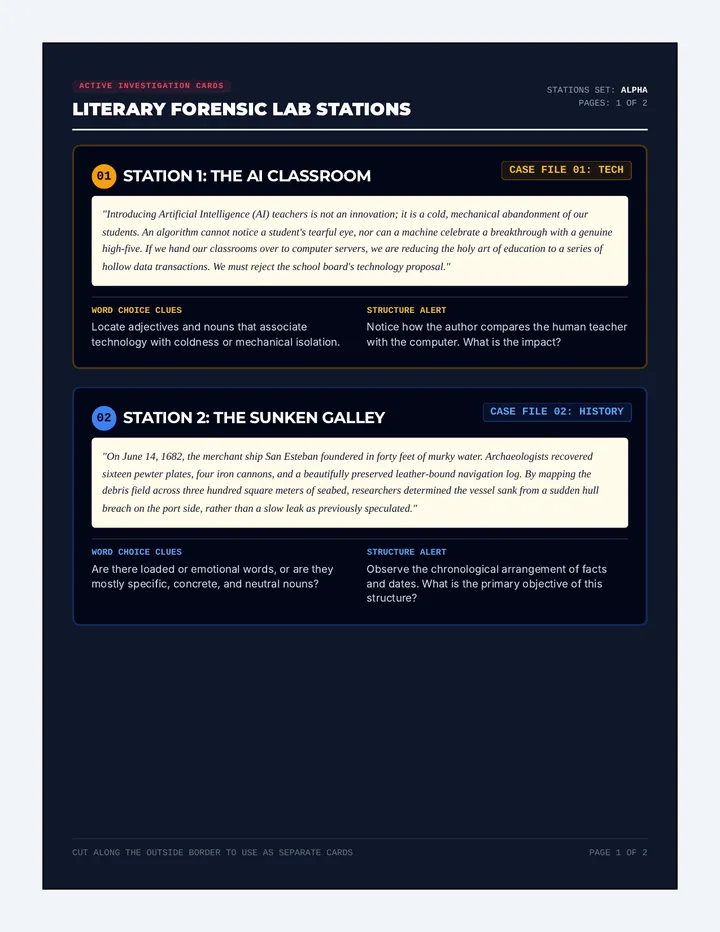
LITERARY FORENSIC LAB STATIONS
STATIONS SET: ALPHA
PAGES: 1 OF 2
Case File 01: Tech
01
STATION 1: The AI Classroom
"Introducing Artificial Intelligence (AI) teachers is not an innovation; it is a cold, mechanical abandonment of our students. An algorithm cannot notice a student's tearful eye, nor can a machine celebrate a breakthrough with a genuine high-five. If we hand our classrooms over to computer servers, we are reducing the holy art of education to a series of hollow data transactions. We must reject the school board's technology proposal."
Word Choice Clues
Locate adjectives and nouns that associate technology with coldness or mechanical isolation.
Structure Alert
Notice how the author compares the human teacher with the computer. What is the impact?
Case File 02: History
02
STATION 2: The Sunken Galley
"On June 14, 1682, the merchant ship San Esteban foundered in forty feet of murky water. Archaeologists recovered sixteen pewter plates, four iron cannons, and a beautifully preserved leather-bound navigation log. By mapping the debris field across three hundred square meters of seabed, researchers determined the vessel sank from a sudden hull breach on the port side, rather than a slow leak as previously speculated."
Word Choice Clues
Are there loaded or emotional words, or are they mostly specific, concrete, and neutral nouns?
Structure Alert
Observe the chronological arrangement of facts and dates. What is the primary objective of this structure?
CUT ALONG THE OUTSIDE BORDER TO USE AS SEPARATE CARDS PAGE 1 OF 2
Active Investigation Cards
LITERARY FORENSIC LAB STATIONS
STATIONS SET: ALPHA
PAGES: 2 OF 2
Case File 03: Nature
03
STATION 3: Bleaching Reefs
"As ocean temperatures climb merely one degree Celsius, thousands of acres of brilliant coral reefs transform into ghost-white skeleton colonies. Marine biologists warn that if carbon emissions continue unchecked, the entire Great Barrier Reef will collapse within thirty years, wiping out twenty-five percent of marine life. This is not a future problem—it is a current, catastrophic ecological emergency."
Word Choice Clues
Look for words like "ghost-white," "collapse," and "catastrophic." What tone do these set?
Structure Alert
The passage is built on a Cause-Effect blueprint. Why did the author select this structure?
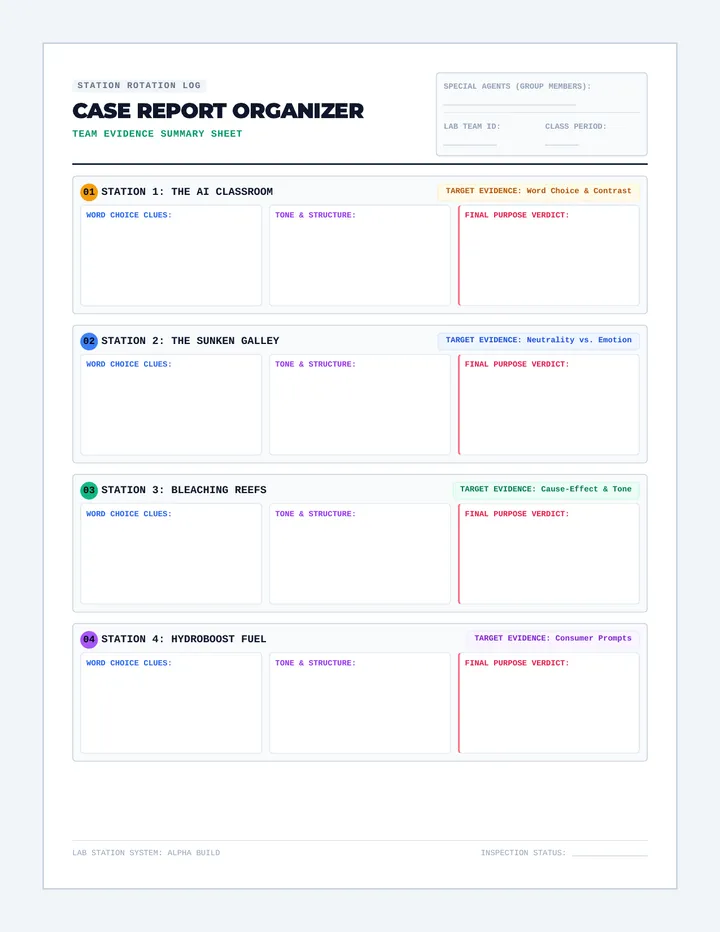
Case Report Organizer Station Rotation log
CASE REPORT ORGANIZER
TEAM EVIDENCE SUMMARY SHEET
Special Agents (Group Members): _________________________________
Lab Team ID: ___________
Class Period: _______
01 STATION 1: THE AI CLASSROOM TARGET EVIDENCE: Word Choice & Contrast
Word Choice Clues:
Tone & Structure:
Final Purpose Verdict:
02 STATION 2: THE SUNKEN GALLEY TARGET EVIDENCE: Neutrality vs. Emotion
Word Choice Clues:
Tone & Structure:
Final Purpose Verdict:
03 STATION 3: BLEACHING REEFS TARGET EVIDENCE: Cause-Effect & Tone
Word Choice Clues:
Tone & Structure:
Final Purpose Verdict:
04 STATION 4: HYDROBOOST FUEL TARGET EVIDENCE: Consumer Prompts
Word Choice Clues:
Tone & Structure:
Final Purpose Verdict:
LAB STATION SYSTEM: ALPHA BUILD INSPECTION STATUS: ________________