Iron Horse Teacher Guide
Railway Dispatch • Teacher Read-Aloud
Iron Horse Teacher Guide
Interest: Grade 4
Academic Level: Grade 2
Before You Read Aloud
- Read at a clear, steady pace. Do not show students the passage text.
- Pause for 2–3 seconds between paragraphs so students can picture each train.
- Optionally read the passage a second time if students need help recalling details.
Oral Passage: Trains on the Move
2 Paragraphs
Not all trains look the same, and they do very different jobs! Giant freight trains are the heavy lifters of the tracks. Their powerful engines can pull more than one hundred train cars at a time. Those cars carry heavy loads like coal, lumber, new cars, and even fresh food across the country. Other trains are built for speed instead of heavy loads. In places like Japan and Europe, sleek bullet trains zoom along smooth tracks at over two hundred miles per hour. Their pointed noses cut right through the air so passengers can travel between big cities in just a couple of hours.
While some trains race across open land, subway trains travel right under busy city streets. They zip through dark underground tunnels so people can get to work or school without getting stuck in car traffic above. Subway trains make quick stops at bright stations, pick up riders, and head back into the tunnel. Whether a train is hauling heavy goods, flying down high-speed rails, or zooming underground, every train helps keep our world moving.
Quick Word Support (If Students Ask)
Freight
Heavy goods or supplies carried from place to place.
Sleek
Smooth and shaped to move fast through the air.
Tunnel
A long path dug underground for trains or cars.
Question Guide & Sample Answers
4 Concrete 3 Inferential
1. What are two things that freight trains carry across the country? Concrete
Sample Answer: Freight trains carry coal, lumber, new cars, or fresh food (any two).
2. Where do subway trains travel to help people avoid city traffic? Concrete
Sample Answer: They travel through dark underground tunnels beneath busy city streets.
3. How fast can bullet trains travel, and where are some of them used? Concrete
Sample Answer: They can travel over 200 miles per hour, and they are used in places like Japan and Europe.
4. How many cars can a giant freight train engine pull at one time? Concrete
Sample Answer: A freight train engine can pull more than one hundred train cars at a time.
5. Why do freight trains need giant engines while bullet trains are sleek and pointed? Inferential
Sample Answer: Freight trains need strong power to pull very heavy loads, while bullet trains need a smooth, pointed shape to cut through the air and go fast.
6. How might a big city be different if it did not have subway trains? Inferential
Sample Answer: There would be much more car traffic on the streets, and it would take longer for people to get to work or school.
7. If you needed to send 1,000 boxes of apples to another state, which train would you pick and why? Inferential
Sample Answer: A freight train, because freight trains carry heavy loads and fresh food across the country.
Iron Horse Listening Worksheet
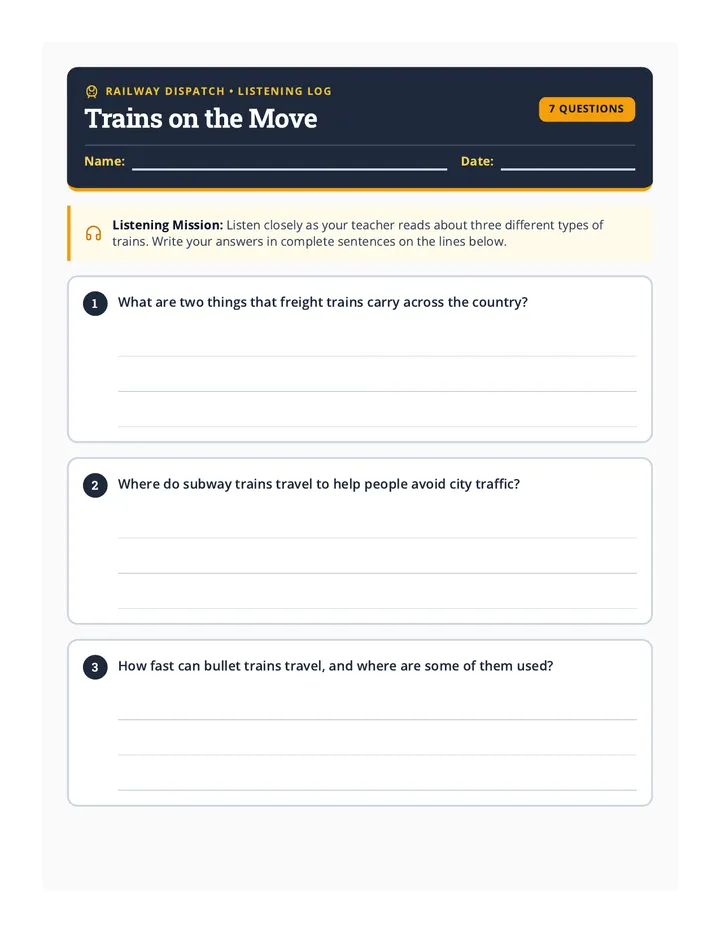
Railway Dispatch • Listening Log
Trains on the Move
7 Questions
Name:
Date:
Listening Mission: Listen closely as your teacher reads about three different types of trains. Write your answers in complete sentences on the lines below.
1
What are two things that freight trains carry across the country?
2
Where do subway trains travel to help people avoid city traffic?
3
How fast can bullet trains travel, and where are some of them used?
Trains on the Move — Listening Log
Questions 4–7
4
How many cars can a giant freight train engine pull at one time?
5
Why do freight trains need giant engines while bullet trains are sleek and pointed?
6
How might a big city be different if it did not have subway trains?
7
If you needed to send 1,000 boxes of apples to another state, which train would you pick and why?