IREAD Reading Comprehension Practice
IREAD Practice Passage 1 • Fiction
Name: Date:
Maya's Garden Mystery
Read the passage. Then answer questions 1 through 4.
[1] Maya loved helping her grandfather tend his backyard vegetable garden. Every afternoon after school, she carried a green watering can to sprinkle the neat rows of soil. In early spring, tiny green leaves sprouted from the earth, promising sweet carrots and crisp lettuce. But on a sunny Thursday morning, Maya noticed that half of her baby lettuce plants had jagged, chewed edges. Something was snacking on her hard work!
[2] Grandfather brought his magnifying glass outside so they could examine the damp ground. Near the wooden fence post, Maya discovered two tiny paw prints pressed into the soft mud. "Look at the long back feet," Grandfather whispered with a knowing smile. "A cottontail rabbit must have crept through the loose wire during the night." Maya worried that the visitor would eat the rest of the vegetables before they could grow.
[3] Instead of chasing the rabbit away, Grandfather helped Maya build a soft wire mesh border around the garden bed. Then, Maya planted a small patch of wild clover and dandelion greens outside the fence. Later that evening, she watched from her bedroom window as a fluffy brown bunny happily munched on the clover, leaving the lettuce completely safe.
- What is this passage mostly about?
A How a girl and her grandfather solved a garden problem peacefully
B Why wild rabbits only eat lettuce plants during early spring
C The steps needed to plant carrot seeds in damp soil
- In paragraph 1, what does the word sprouted mean?
A Turned brown and dry
B Began to grow out of the ground
C Washed away in heavy rain
- According to paragraph 2, what clue helped Maya and Grandfather identify the garden visitor?
A They found brown fur caught on the fence post.
B They saw tiny paw prints in the soft mud.
C They heard a rabbit chewing near the watering can.
- Which sentence from paragraph 3 shows that Maya cared about the rabbit's needs?
A "Grandfather helped Maya build a soft wire mesh border around the garden bed."
B "Then, Maya planted a small patch of wild clover and dandelion greens outside the fence."
C "Later that evening, she watched from her bedroom window..."
Grade 2 Reading Comprehension • IREAD Standards Page 1 of 5
IREAD Practice Passage 2 • Nonfiction
Name: Date:
Gliders of the Night
Read the passage. Then answer questions 1 through 4.
[1] Many people assume that flying squirrels flap wings like birds or bats, but these forest animals actually glide. A special fold of furry skin stretches along both sides of their bodies, connecting their front wrists to their back ankles. When a flying squirrel leaps from a high pine branch, it spreads its legs wide like a tiny parachute. The trapped air catches the skin flap, allowing the animal to sail smoothly through the forest canopy for over one hundred feet.
[2] Flying squirrels are nocturnal, meaning they sleep during the bright daytime and wake up when the sun goes down. Their enormous, dark eyes take in every bit of moonlight so they can spot tree trunks and predators in the dark. They also use their broad, flat tails as rudders. By tilting its tail from side to side, a squirrel can steer around branches or make sharp mid-air turns.
[3] High above the ground, these creatures search for nuts, berries, mushrooms, and tree seeds. Living high in the treetops protects them from ground hunters like foxes and coyotes. During freezing winter months, several flying squirrels often huddle together inside hollow tree cavities to share body warmth and stay safe.
- What is the main idea of paragraph 1?
A Flying squirrels fly through the air by flapping feathered wings.
B Flying squirrels use furry skin flaps to glide from tree to tree.
C Flying squirrels prefer to live in hollow pine branches on the ground.
- Based on paragraph 2, what does the word nocturnal mean?
A Active during the night
B Able to swim in water
C Afraid of cold weather
- According to paragraph 2, how does a flying squirrel steer while sailing through the air?
A By closing its eyes tightly
B By tilting its broad, flat tail
C By making a loud whistling sound
- Why did the author most likely write this passage?
A To persuade readers to keep flying squirrels as indoor pets
B To tell a funny story about a squirrel that got lost in the dark
C To inform readers about how flying squirrels live and travel
Grade 2 Reading Comprehension • IREAD Standards Page 2 of 5
IREAD Practice Passage 3 • Fable
Name: Date:
The Heron and the Wise Turtle
Read the passage. Then answer questions 1 through 4.
[1] Young Heron was proud of his slender gray feathers, long yellow legs, and sharp, spear-like beak. Every morning, he strutted along the riverbank boasting about his hunting skills. "Watch how quickly I can catch my breakfast!" he bragged to the other creatures. Heron rushed into the shallow water, splashing his feet noisily and darting his head back and forth. However, the ripples he created warned the fish, and they immediately darted away into the deep weeds. Heron's stomach rumbled with hunger.
[2] Old Turtle sat nearby on a mossy log, warming his green shell in the morning sunlight. "Splashing and rushing will never fill your belly, young friend," Turtle said calmly. "The river rewards those who are patient. If you want the fish to come near, you must learn to stand still like the tall reeds." Heron frowned, but because he was exhausted and hungry, he decided to test Turtle's advice.
[3] Heron stepped slowly into the quiet pond, tucked his chin close to his chest, and froze. He did not flutter a single feather or stir the clear water. Soon, schools of shiny minnows swam right past his motionless yellow legs. With one swift, silent strike, Heron caught a silver fish. He bowed his head toward the log, grateful for the turtle's quiet wisdom.
- In paragraph 1, why was Heron unable to catch any fish?
A The river water was too muddy for him to see.
B His noisy splashing created ripples that scared the fish away.
C Turtle had already eaten all the minnows in the stream.
- In paragraph 2, what does the word patient mean?
A Willing to wait calmly without rushing
B Loud and full of excitement
C Strong enough to swim upstream
- What happened right after Heron stood completely motionless in the pond?
A Turtle splashed water onto Heron's feathers.
B Shiny minnows swam right past his legs.
C Heron flew away to search for frogs in the meadow.
- What lesson does Heron learn by the end of the story?
A Hunting is easiest when you work with a large flock of birds.
B Taking your time and being calm can lead to greater success.
C Old animals are always faster hunters than young animals.
Grade 2 Reading Comprehension • IREAD Standards Page 3 of 5
IREAD Practice Passage 4 • Nonfiction
Name: Date:
The Lighthouse Keepers
Read the passage. Then answer questions 1 through 4.
[1] Long before GPS satellites and electric lights guided ships, rocky coastlines were dangerous places for sailors. During dark nights and blinding fog, wooden trading ships could easily crash into hidden underwater boulders. To prevent these terrible wrecks, countries built tall stone towers called lighthouses on rocky points and lonely islands. Inside each tower lived dedicated workers known as lighthouse keepers.
[2] A lighthouse keeper's job required steady discipline and hard labor. Every evening, the keeper climbed hundreds of winding iron steps to reach the lantern room at the top of the tower. They trimmed the cotton wicks of oil lamps and carefully polished the giant curved glass lenses so the beam shone brightly for miles out to sea. In thick fog, keepers also rang heavy brass bells or operated loud foghorns to warn captains away from shallow reefs.
[3] Even during fierce winter gales with howling winds and freezing ocean spray, keepers never let the light go out. Whole families often shared the duties, taking turns staying awake through the long night. Today, modern computers and solar-powered bulbs operate most lighthouses automatically, but these historic towers still remind us of the courageous people who saved countless lives at sea.
- What was the main purpose of a coastal lighthouse?
A To catch fish for trading ships during the night
B To warn sailors about dangerous rocks and prevent shipwrecks
C To help families build stone houses on lonely islands
- According to paragraph 2, why did keepers polish the giant glass lenses?
A So the light beam would shine brightly for miles out to sea
B To prevent sea birds from nesting on the iron stairs
C To keep the lantern room warm during winter months
- In paragraph 3, what does the word fierce tell the reader about the storms?
A The storms were short and gentle.
B The storms were wild, powerful, and dangerous.
C The storms brought warm sunshine to the coast.
- How are modern lighthouses different from historic lighthouses?
A Modern lighthouses use computers and work automatically without a keeper.
B Modern lighthouses require larger families to live inside the tower.
C Modern lighthouses only operate during sunny afternoons.
Grade 2 Reading Comprehension • IREAD Standards Page 4 of 5
IREAD Practice Passage 5 • Fiction
Name: Date:
The Lost Trail Map
Read the passage. Then answer questions 1 through 4.
[1] Leo zipped his backpack and tied his hiking boots tightly. He and his older sister Sam were exploring the Pine Ridge Trail at Turkey Run State Park. They wanted to hike to Lookout Point to see the rushing creek below. Leo held the folded paper trail map carefully in his hands. But as they crossed a narrow wooden footbridge, a sudden gust of mountain wind snatched the map right from his fingers, tumbling it down into thick, thorny briars where they could not reach it.
[2] "Don't panic," Sam said calmly, placing a reassuring hand on Leo's trembling shoulder. "Remember what the park ranger explained this morning? Safe hikers never wander into the brush. Instead, we follow the blue trail blazes painted on the tree trunks." Leo took a deep breath and scanned the forest path ahead. Sure enough, a bright blue rectangle was neatly painted at eye level on a tall white birch tree.
[3] The brother and sister walked steadily from one marked tree to the next, keeping the well-worn dirt path under their feet. Within twenty minutes, the trees opened up to reveal the sunlit wooden deck of Lookout Point. Ranger Diaz was standing near the railing with binoculars. When Sam explained how they used the painted blazes instead of guessing, the ranger smiled proudly and handed both children shiny Junior Ranger badges.
- What problem do Leo and Sam face in paragraph 1?
A A sudden rainstorm makes the wooden footbridge slippery.
B A gust of wind blows their paper map into thorny briars.
C Leo forgets to pack his hiking boots and water bottle.
- In paragraph 2, why does Sam tell Leo to look for painted tree trunks?
A The painted blue blazes mark the safe hiking trail.
B The paint shows where birds have built hidden nests.
C The marks warn hikers about dangerous wild animals nearby.
- In paragraph 2, what does the word reassuring mean?
A Giving comfort and helping someone feel less afraid
B Moving very quickly to escape danger
C Cold and freezing to the touch
- Why did Ranger Diaz award badges to Leo and Sam?
A They found a lost dog near the creek.
B They stayed calm, followed trail rules, and solved their problem safely.
C They ran faster than any other hikers in the park.
Grade 2 Reading Comprehension • IREAD Standards Page 5 of 5
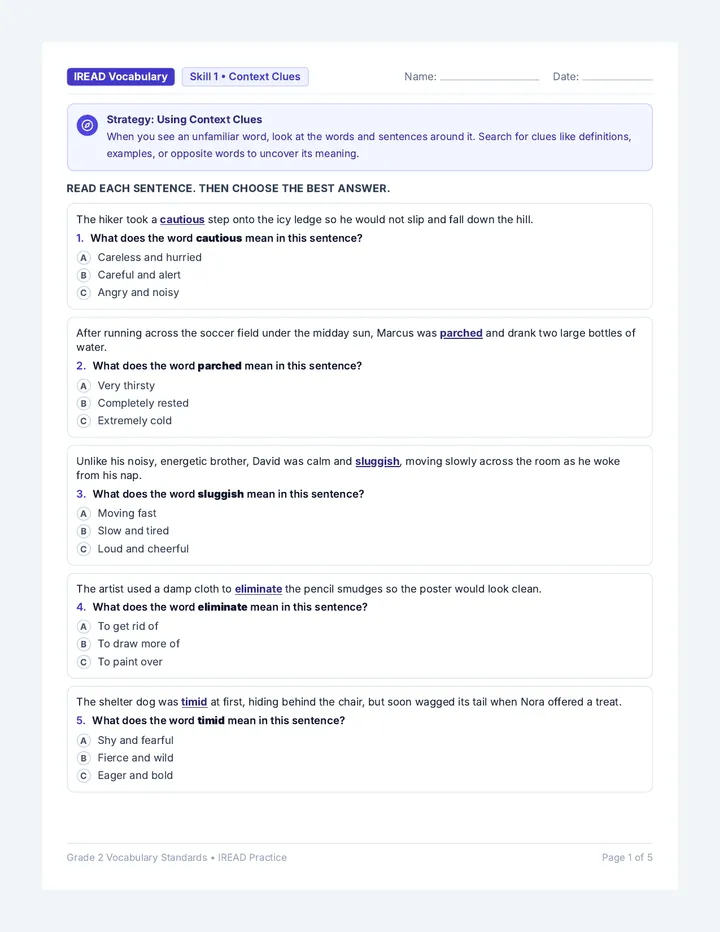
IREAD Vocabulary Skills Practice
IREAD Vocabulary Skill 1 • Context Clues
Name: Date:
Strategy: Using Context Clues
When you see an unfamiliar word, look at the words and sentences around it. Search for clues like definitions, examples, or opposite words to uncover its meaning.
Read each sentence. Then choose the best answer.
The hiker took a cautious step onto the icy ledge so he would not slip and fall down the hill.
- What does the word cautious mean in this sentence?
A Careless and hurried
B Careful and alert
C Angry and noisy
After running across the soccer field under the midday sun, Marcus was parched and drank two large bottles of water.
- What does the word parched mean in this sentence?
A Very thirsty
B Completely rested
C Extremely cold
Unlike his noisy, energetic brother, David was calm and sluggish, moving slowly across the room as he woke from his nap.
- What does the word sluggish mean in this sentence?
A Moving fast
B Slow and tired
C Loud and cheerful
The artist used a damp cloth to eliminate the pencil smudges so the poster would look clean.
- What does the word eliminate mean in this sentence?
A To get rid of
B To draw more of
C To paint over
The shelter dog was timid at first, hiding behind the chair, but soon wagged its tail when Nora offered a treat.
- What does the word timid mean in this sentence?
A Shy and fearful
B Fierce and wild
C Eager and bold
Grade 2 Vocabulary Standards • IREAD Practice Page 1 of 5
IREAD Vocabulary Skill 2 • Prefixes & Suffixes
Name: Date:
Strategy: Word Parts (Affixes & Base Words)
A prefix (un-, re-, pre-, dis-) sits at the start of a base word. A suffix (-ful, -less, -ly) sits at the end. Breaking words into parts reveals their new meanings!
Read each question. Then choose the best answer.
Read the word: unlock
- What does the prefix un- mean in the word unlock?
A Lock again
B Reverse or open the lock
C Lock before
- Which word means "to heat before baking"?
A reheat
B preheat
C unheat
The rescue firefighter was fearless as she climbed the tall ladder into the building.
- What does the word fearless mean in this sentence?
A Full of fear
B Without fear
C Causing fear
After the thunderstorm knocked down the garden fence, Dad had to rebuild the wooden posts.
- What does the word rebuild mean in this sentence?
A Build again
B Never build
C Build before
- Which word means "in a quiet way"?
A quietness
B quietly
C quietful
Grade 2 Vocabulary Standards • IREAD Practice Page 2 of 5
IREAD Vocabulary Skill 3 • Multiple-Meaning Words
Name: Date:
Strategy: Homographs (Words with Multiple Meanings)
Some words look and sound identical, but mean completely different things. Read the whole sentence carefully to see how the word is being used!
Read each question. Then choose the correct answer.
Read the definition: scale (noun) - a tool used to measure how heavy something is.
- In which sentence does scale have this meaning?
A The shiny trout had a silver scale on its belly.
B The doctor asked Maya to step onto the scale.
C The hikers began to scale the rocky mountain path.
Read the sentence: The friendly puppy began to bark whenever the mail carrier came up the walkway.
- In which sentence does bark have the SAME meaning as in the sentence above?
A The rough bark on the old oak tree protected it from insects.
B We heard the watchdog bark loudly across the yard.
C A brown beetle crawled under the thick tree bark.
Read the sentence: Grandma planted a straight row of sweet corn along the garden border.
- In which sentence does row have the SAME meaning as in the sentence above?
A The students arranged their chairs in a neat row.
B Can you help me row the canoe across the pond?
C Dad used two wooden oars to row toward the shore.
Read the definition: spring (noun) - the season between winter and summer when flowers bloom.
- In which sentence does spring have this meaning?
A The metal spring inside the clock stopped bouncing.
B In early spring, bright tulips begin to peek out of the dirt.
C Cool water bubbled up from a hidden underground spring.
Read the sentence: Lucas placed a gold ring on his finger before walking onto the stage.
- In which sentence does ring mean a circular band of jewelry?
A Did you hear the school bell ring at three o'clock?
B Aunt Clara wears a shiny silver ring with a blue sapphire.
C The children held hands in a wide ring on the grass.
Grade 2 Vocabulary Standards • IREAD Practice Page 3 of 5
IREAD Vocabulary Skill 4 • Synonyms & Antonyms
Name: Date:
Strategy: Synonyms (Same) vs. Antonyms (Opposites)
Synonyms are words with the same or nearly the same meaning (gleeful / happy). Antonyms are words with opposite meanings (cautious / reckless).
Read each question carefully. Then choose the best answer.
Read the sentence: The afternoon sun was radiant in the clear summer sky.
- Which word is a SYNONYM for radiant?
A Bright and shining
B Dark and stormy
C Cold and freezing
Read the sentence: The math puzzle was simple for Eva to solve on her own.
- Which word means the OPPOSITE of simple?
A easy
B difficult
C short
- Which pair of words are SYNONYMS?
A whisper / scream
B gigantic / tiny
C courageous / brave
Read the sentence: The abandoned kitten was feeble after being lost and could barely stand.
- Which word means the OPPOSITE of feeble?
A weak
B strong
C tired
Read the sentence: The cafeteria was so clamorous that students could not hear the teacher speak.
- Which word is a SYNONYM for clamorous?
A noisy
B silent
C empty
Grade 2 Vocabulary Standards • IREAD Practice Page 4 of 5
IREAD Vocabulary Skill 5 • Compounds & Relationships
Name: Date:
Strategy: Compound Words & Word Categories
A compound word combines two distinct words to create a new meaning (rain + coat = raincoat). Notice how words connect in categories and analogies!
Read each question. Then choose the best answer.
Read the word: backpack
- Which two smaller words make up the compound word backpack?
A back + pack
B ba + ckpack
C bake + pack
Mia placed a bookmark inside her mystery novel so she would remember where she stopped reading.
- Based on its word parts, what is a bookmark?
A A pen used to scribble on library pages
B An item placed between pages to save your place
C A building where people check out books
- Which of the following is a compound word?
A sunflower
B floating
C carefully
Complete the analogy: Bird is to nest as bee is to __________.
- Which word correctly completes this relationship?
A flower
B hive
C honey
Look at this word group: apple, banana, strawberry
- Which word belongs in the same category?
A carrot
B blueberry
C potato
Grade 2 Vocabulary Standards • IREAD Practice Page 5 of 5