Beaver Builders Reading Worksheet
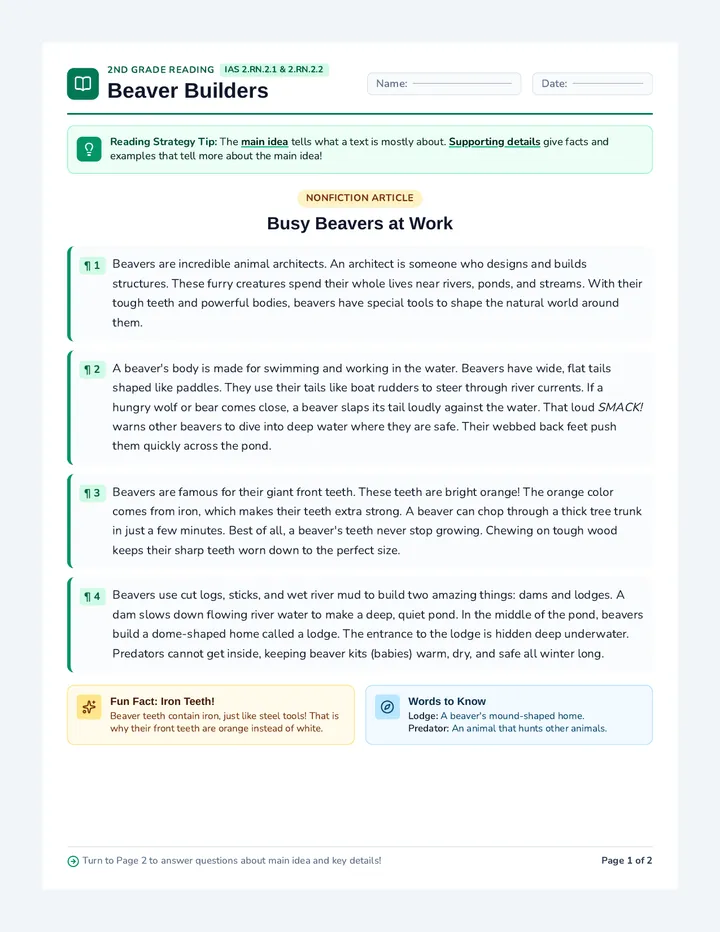
2nd Grade Reading IAS 2.RN.2.1 & 2.RN.2.2
Beaver Builders
Name:
Date:
Reading Strategy Tip: The main idea tells what a text is mostly about. Supporting details give facts and examples that tell more about the main idea!
Nonfiction Article
Busy Beavers at Work
¶ 1
Beavers are incredible animal architects. An architect is someone who designs and builds structures. These furry creatures spend their whole lives near rivers, ponds, and streams. With their tough teeth and powerful bodies, beavers have special tools to shape the natural world around them.
¶ 2
A beaver's body is made for swimming and working in the water. Beavers have wide, flat tails shaped like paddles. They use their tails like boat rudders to steer through river currents. If a hungry wolf or bear comes close, a beaver slaps its tail loudly against the water. That loud SMACK! warns other beavers to dive into deep water where they are safe. Their webbed back feet push them quickly across the pond.
¶ 3
Beavers are famous for their giant front teeth. These teeth are bright orange! The orange color comes from iron, which makes their teeth extra strong. A beaver can chop through a thick tree trunk in just a few minutes. Best of all, a beaver's teeth never stop growing. Chewing on tough wood keeps their sharp teeth worn down to the perfect size.
¶ 4
Beavers use cut logs, sticks, and wet river mud to build two amazing things: dams and lodges. A dam slows down flowing river water to make a deep, quiet pond. In the middle of the pond, beavers build a dome-shaped home called a lodge. The entrance to the lodge is hidden deep underwater. Predators cannot get inside, keeping beaver kits (babies) warm, dry, and safe all winter long.
Fun Fact: Iron Teeth!
Beaver teeth contain iron, just like steel tools! That is why their front teeth are orange instead of white.
Words to Know
Lodge: A beaver's mound-shaped home.
Predator: An animal that hunts other animals.
Turn to Page 2 to answer questions about main idea and key details! Page 1 of 2
Comprehension Check Standards: 2.RN.2.1 • 2.RN.2.2
Main Idea & Key Details
Score: ____ / 5
Directions: Fill in the bubble next to the correct answer for questions 1–4. Write your response for question 5.
1
What is the main idea of the entire article?
A) Beavers have bright orange teeth that never stop growing. B) Beavers have special body parts that help them swim and build in water. C) Wolves and bears like to live in quiet forest streams. D) Baby beavers are called kits and sleep all winter.
2
According to paragraph 2, why does a beaver slap its tail against the water?
A) To push heavy tree branches across the flowing river. B) To clean off wet mud from its paddle-shaped tail. C) To warn other beavers that danger is near. D) To splash cool water onto its warm fur coat.
3
What is the main idea of Paragraph 3?
A) Beavers have powerful, growing teeth made for cutting wood. B) Iron is a mineral that makes steel pots and pans strong. C) Thick tree trunks take hours to cut down in the forest. D) Beavers like eating tree leaves during the chilly winter.
4
Which detail from the text shows how beaver kits stay safe from predators?
A) The entrance to the lodge is hidden deep underwater. B) Beavers build their homes high up in pine trees. C) Beavers swim in deep river water to find food. D) River dams are made with green leaves and stones.
5
Detail Detective: Text Evidence
The author states that beavers are built for swimming. Write ONE detail from paragraph 2 that proves beavers have bodies made for the water.
Double-check your work before turning in! Page 2 of 2
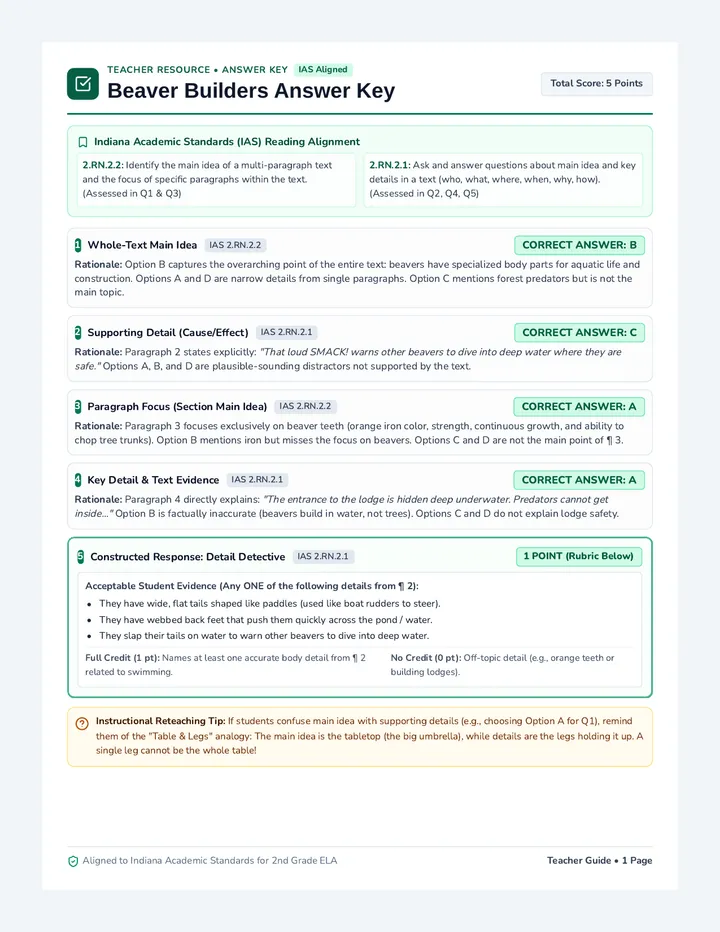
Beaver Builders Answer Key
Teacher Resource • Answer Key IAS Aligned
Beaver Builders Answer Key
Total Score: 5 Points
Indiana Academic Standards (IAS) Reading Alignment
2.RN.2.2: Identify the main idea of a multi-paragraph text and the focus of specific paragraphs within the text. (Assessed in Q1 & Q3)
2.RN.2.1: Ask and answer questions about main idea and key details in a text (who, what, where, when, why, how). (Assessed in Q2, Q4, Q5)
1 Whole-Text Main Idea IAS 2.RN.2.2
CORRECT ANSWER: B
Rationale: Option B captures the overarching point of the entire text: beavers have specialized body parts for aquatic life and construction. Options A and D are narrow details from single paragraphs. Option C mentions forest predators but is not the main topic.
2 Supporting Detail (Cause/Effect) IAS 2.RN.2.1
CORRECT ANSWER: C
Rationale: Paragraph 2 states explicitly: "That loud SMACK! warns other beavers to dive into deep water where they are safe." Options A, B, and D are plausible-sounding distractors not supported by the text.
3 Paragraph Focus (Section Main Idea) IAS 2.RN.2.2
CORRECT ANSWER: A
Rationale: Paragraph 3 focuses exclusively on beaver teeth (orange iron color, strength, continuous growth, and ability to chop tree trunks). Option B mentions iron but misses the focus on beavers. Options C and D are not the main point of ¶ 3.
4 Key Detail & Text Evidence IAS 2.RN.2.1
CORRECT ANSWER: A
Rationale: Paragraph 4 directly explains: "The entrance to the lodge is hidden deep underwater. Predators cannot get inside..." Option B is factually inaccurate (beavers build in water, not trees). Options C and D do not explain lodge safety.
5 Constructed Response: Detail Detective IAS 2.RN.2.1
1 POINT (Rubric Below)
Acceptable Student Evidence (Any ONE of the following details from ¶ 2):
- They have wide, flat tails shaped like paddles (used like boat rudders to steer).
- They have webbed back feet that push them quickly across the pond / water.
- They slap their tails on water to warn other beavers to dive into deep water.
Full Credit (1 pt): Names at least one accurate body detail from ¶ 2 related to swimming. No Credit (0 pt): Off-topic detail (e.g., orange teeth or building lodges).
Instructional Reteaching Tip: If students confuse main idea with supporting details (e.g., choosing Option A for Q1), remind them of the "Table & Legs" analogy: The main idea is the tabletop (the big umbrella), while details are the legs holding it up. A single leg cannot be the whole table!
Aligned to Indiana Academic Standards for 2nd Grade ELA Teacher Guide • 1 Page