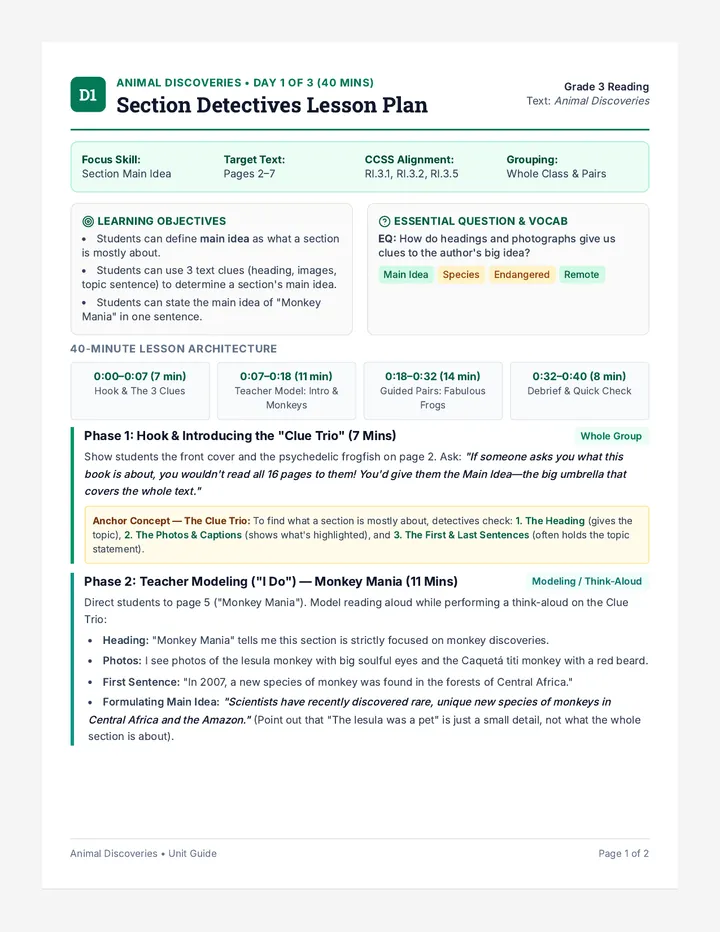
History Chain Detectives Lesson Plan Master Lesson Plan • Grade 2 ELA
History Chain Detectives
Standard: CCSS RI.2.3
Duration: 45–55 Minutes
Learning Objective
Students will describe how historical events in a text connect through time order (chronology) and cause and effect using transition signal words.
Essential Question
How do past events link together like links in a chain to shape the world we live in today?
Detective Signal Words (Connection Clues)
Time Order Links (When): First, Long ago, Next, In 1923, Then, Later, Today
Cause & Effect Links (Why): Because, So, As a result, Led to, That made
Step 1: Mystery Hook (7 Min) Whole Group Discussion
Display slide with a tangled street from 1920: horse wagons, early cars, and people colliding. Ask: "What happens if there are no traffic lights in a busy city?" Reveal that every invention begins with a real historical problem that triggered a chain of events.
Step 2: Explicit Modeling / "I Do" (12 Min) Teacher Think-Aloud
Project Paragraph 1 of the historical text on Garrett Morgan. Read aloud and model tracing the link:
“Listen closely to this sentence: 'Because the streets were chaotic, Garrett Morgan witnessed a dangerous crash.' Watch how I spot the clue word 'Because' .”
“The first event is crowded, confusing streets. That caused event two: a crash! The events do not just sit beside each other; event one pushed event two to happen! Let's link our chain!”
History Chain Detectives • Lesson Plan Guide Page 1 of 2
Instructional Workflow & Scaffolding
Classroom Implementation Steps
Step 3: Guided Practice / "We Do" (12 Min) Partner Collaboration
Read Paragraph 2 together. Have student partners turn and talk using the sentence frame:
“First, Garrett Morgan saw the crash. As a result, he designed a safety signal with three positions so drivers knew when to stop.”
Step 4: Independent Practice / "You Do" (15 Min) Student Worksheet
Students read the complete Traffic Signal Story passage independently or in pairs. They complete the 3-link Event Chain Graphic Organizer, identifying what happened, the connecting signal word, and why each event occurred.
Step 5: Assessment & Wrap-Up (6 Min) Formative Evaluation
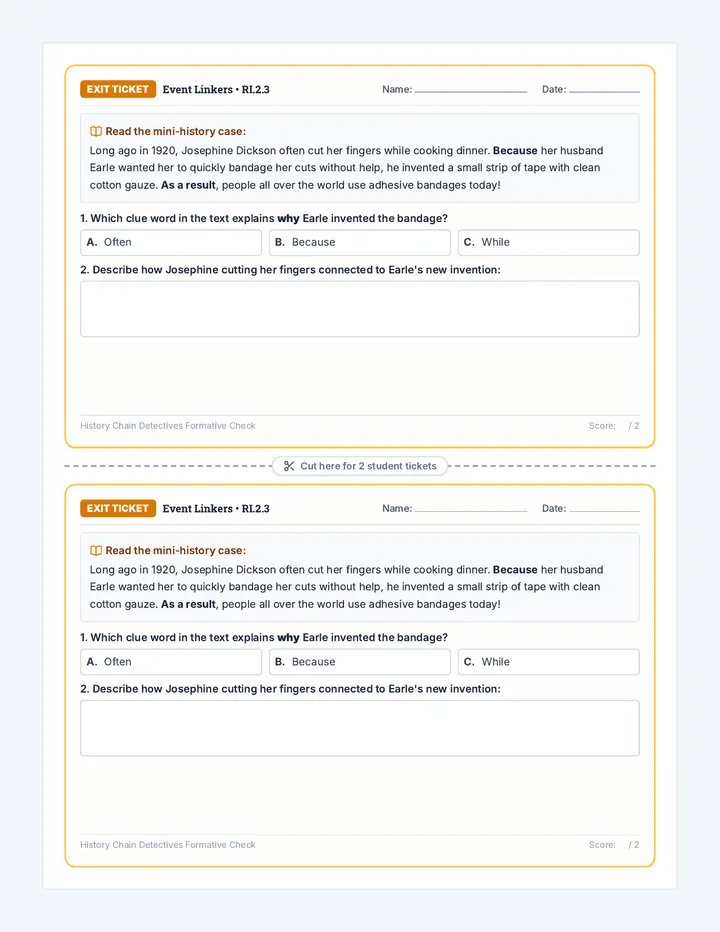
Administer the quick Event Linkers Exit Ticket . Students read a short two-event scenario about the telephone and explain how the first event led to the second event.
Differentiation & Scaffolding Matrix
Striving Readers
Pre-highlight transition clue words (First, Because, Next) in the passage text. Provide pre-cut event strips to arrange physically before writing.
Multilingual Learners
Pair with visual cause-and-effect arrow icons (→). Use primary language support for anchor signal words like porque (because) and luego (then).
Advanced / Extension
Ask: "What if Garrett Morgan had not seen the crash?" Students hypothesize alternative historical timelines and write a 2-sentence prediction.
Common Second-Grade Misconception
Students often treat historical events as isolated, random facts (“First he lived in Ohio. Then he wore a hat.”). Remind students that historical events are connected by purpose and cause : ask them “How did Event 1 cause Event 2?”
History Chain Detectives • Lesson Plan Guide Page 2 of 2
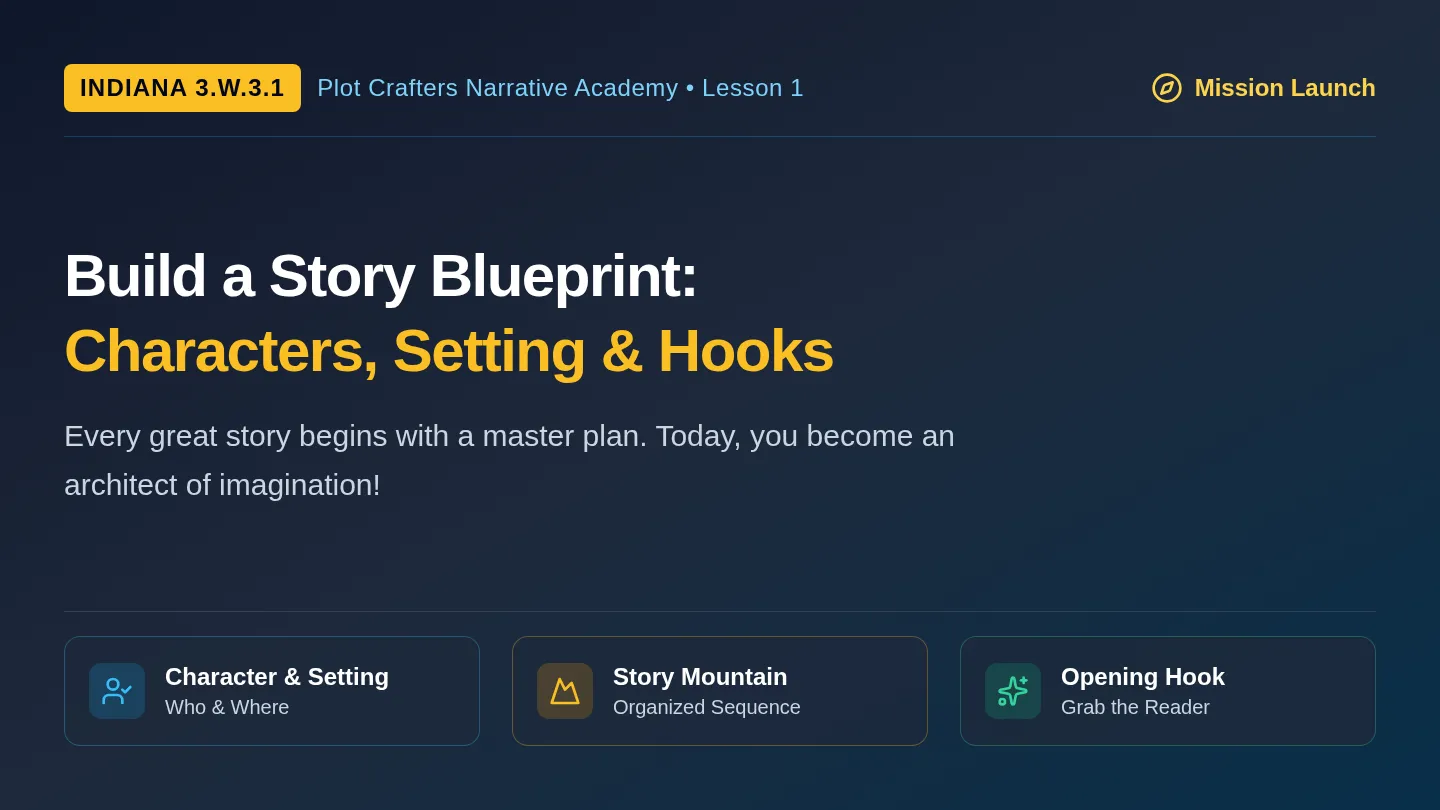
Event Linkers Slide Deck Grade 2 Reading • RI.2.3
Connecting Historical Events
History Chain Detectives
Discover how past events link together like chains to build the world we live in today!
Our Mission: Find the clues that show HOW and WHY history happened!
What is a Historical Connection?
Events Don't Stand Alone!
1. Time Order (When)
Tells us the order in which historical events happened across time.
Clue Words:
First • Long ago • Next • Then • Today
2. Cause & Effect (Why)
Shows how one historical event made the next event happen!
Clue Words:
Because • So • As a result • Led to
💡 Detective Rule: Ask yourself, "Did Event 1 cause Event 2?"
Our Case: The Streets of 1920
Investigating the Past
Read Like a Detective:
“Long ago, city streets were filled with horse buggies, walkers, and new automobiles. Because there were no traffic signals, streets were chaotic, and dangerous crashes happened every day.”
What caused the dangerous crashes?
Look for the clue word that explains WHY it happened!
Clue Word Spotted: BECAUSE Connection: Problem → Dangerous Result
The 3-Link Event Chain
How One Event Led to Another
EVENT 1
A Bad Problem
Streets were crowded with horses and cars, leading to serious collisions.
⚠️ Historical Problem
EVENT 2
Garrett's Idea
Garrett Morgan saw a terrible crash and invented a 3-way safety signal in 1923.
💡 Creative Solution
EVENT 3
Safer Cities
Cities installed the signal, and traffic accidents dropped dramatically!
🌟 Lasting Impact
Event 1 caused Event 2 ••• WHICH CAUSED ••• Event 2 caused Event 3!
Partner Detective Talk
Turn & Talk (2 Minutes)
Share with your partner:
Complete this connection sentence:
“First, street crashes were happening. Because of that, Garrett Morgan invented a traffic signal!”
Ready to investigate on your own? Open Your Case File Worksheet! →
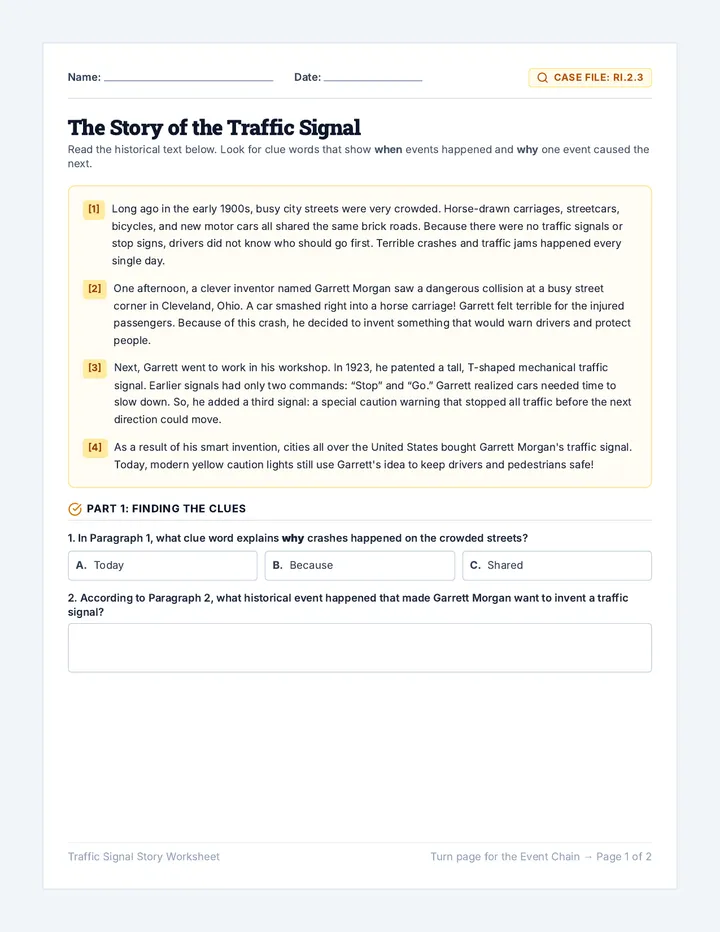
Traffic Signal Story Worksheet Name: Date:
Case File: RI.2.3
The Story of the Traffic Signal
Read the historical text below. Look for clue words that show when events happened and why one event caused the next.
[1]
Long ago in the early 1900s, busy city streets were very crowded. Horse-drawn carriages, streetcars, bicycles, and new motor cars all shared the same brick roads. Because there were no traffic signals or stop signs, drivers did not know who should go first. Terrible crashes and traffic jams happened every single day.
[2]
One afternoon, a clever inventor named Garrett Morgan saw a dangerous collision at a busy street corner in Cleveland, Ohio. A car smashed right into a horse carriage! Garrett felt terrible for the injured passengers. Because of this crash, he decided to invent something that would warn drivers and protect people.
[3]
Next, Garrett went to work in his workshop. In 1923, he patented a tall, T-shaped mechanical traffic signal. Earlier signals had only two commands: “Stop” and “Go.” Garrett realized cars needed time to slow down. So, he added a third signal: a special caution warning that stopped all traffic before the next direction could move.
[4]
As a result of his smart invention, cities all over the United States bought Garrett Morgan's traffic signal. Today, modern yellow caution lights still use Garrett's idea to keep drivers and pedestrians safe!
Part 1: Finding the Clues
1. In Paragraph 1, what clue word explains why crashes happened on the crowded streets?
A. Today
B. Because
C. Shared
2. According to Paragraph 2, what historical event happened that made Garrett Morgan want to invent a traffic signal?
Traffic Signal Story Worksheet Turn page for the Event Chain → Page 1 of 2
Part 2: The Historical Event Chain Name:
Complete the chain below to show how one historical event led directly to the next event in Garrett Morgan's life.
Event 1: The Problem Early 1900s
What was happening on city streets before traffic lights were invented?
Connection Clue: BECAUSE of this problem, Garrett Morgan saw a crash...
Event 2: The Solution In 1923
What did Garrett Morgan do to fix the problem?
Connection Clue: AS A RESULT of his new invention...
Event 3: The Result Today
How did his invention change streets for everyone?
Part 3: Connect the Events in Writing
Use the connection word because or so to write one complete sentence explaining how Event 1 caused Event 2.
Event Linkers Exit Ticket EXIT TICKET Event Linkers • RI.2.3
Name: Date:
Read the mini-history case:
Long ago in 1920, Josephine Dickson often cut her fingers while cooking dinner. Because her husband Earle wanted her to quickly bandage her cuts without help, he invented a small strip of tape with clean cotton gauze. As a result , people all over the world use adhesive bandages today!
1. Which clue word in the text explains why Earle invented the bandage?
A. Often
B. Because
C. While
2. Describe how Josephine cutting her fingers connected to Earle's new invention:
History Chain Detectives Formative Check Score: / 2
Cut here for 2 student tickets
EXIT TICKET Event Linkers • RI.2.3
Name: Date:
Read the mini-history case:
Long ago in 1920, Josephine Dickson often cut her fingers while cooking dinner. Because her husband Earle wanted her to quickly bandage her cuts without help, he invented a small strip of tape with clean cotton gauze. As a result , people all over the world use adhesive bandages today!
1. Which clue word in the text explains why Earle invented the bandage?
A. Often
B. Because
C. While
2. Describe how Josephine cutting her fingers connected to Earle's new invention:
History Chain Detectives Formative Check Score: / 2
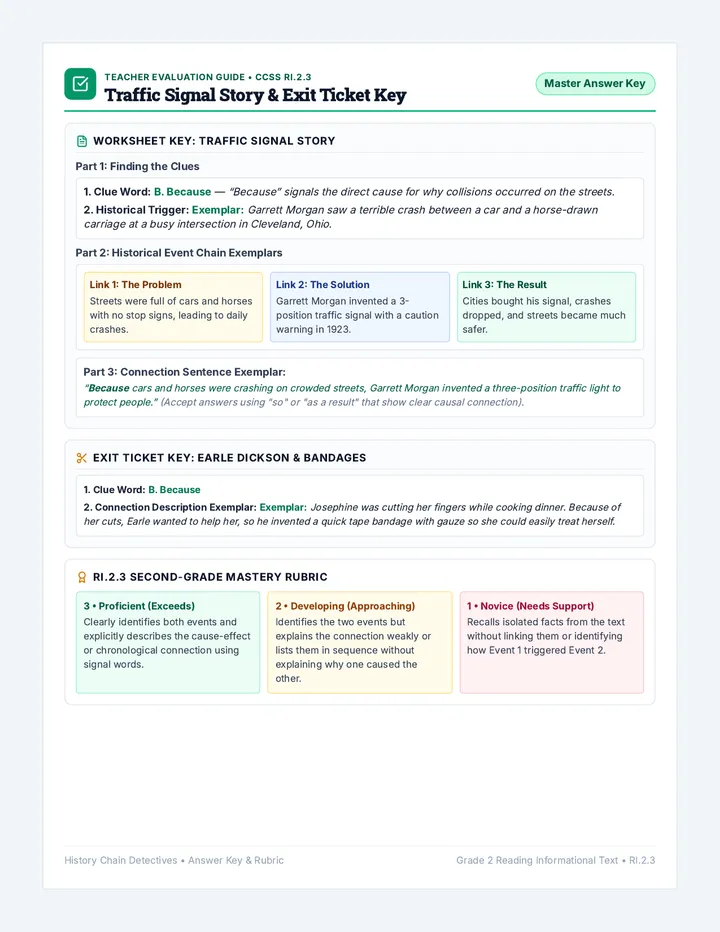
Traffic Signal Story Answer Key Teacher Evaluation Guide • CCSS RI.2.3
Traffic Signal Story & Exit Ticket Key
Master Answer Key
Worksheet Key: Traffic Signal Story
Part 1: Finding the Clues
1. Clue Word: B. Because — “Because” signals the direct cause for why collisions occurred on the streets.
2. Historical Trigger: Exemplar: Garrett Morgan saw a terrible crash between a car and a horse-drawn carriage at a busy intersection in Cleveland, Ohio.
Part 2: Historical Event Chain Exemplars
Link 1: The Problem
Streets were full of cars and horses with no stop signs, leading to daily crashes.
Link 2: The Solution
Garrett Morgan invented a 3-position traffic signal with a caution warning in 1923.
Link 3: The Result
Cities bought his signal, crashes dropped, and streets became much safer.
Part 3: Connection Sentence Exemplar:
“Because cars and horses were crashing on crowded streets, Garrett Morgan invented a three-position traffic light to protect people.” (Accept answers using "so" or "as a result" that show clear causal connection).
Exit Ticket Key: Earle Dickson & Bandages
1. Clue Word: B. Because
2. Connection Description Exemplar: Exemplar: Josephine was cutting her fingers while cooking dinner. Because of her cuts, Earle wanted to help her, so he invented a quick tape bandage with gauze so she could easily treat herself.
RI.2.3 Second-Grade Mastery Rubric
3 • Proficient (Exceeds)
Clearly identifies both events and explicitly describes the cause-effect or chronological connection using signal words.
2 • Developing (Approaching)
Identifies the two events but explains the connection weakly or lists them in sequence without explaining why one caused the other.
1 • Novice (Needs Support)
Recalls isolated facts from the text without linking them or identifying how Event 1 triggered Event 2.
History Chain Detectives • Answer Key & Rubric Grade 2 Reading Informational Text • RI.2.3