Ghost Ship Sub Plan
Ghost Ship Mystery — Sub Plan
No Tech Needed
Grade 8 Reading Intervention 35 Minutes Print Only
Materials Ready for You
- • Ghost Ship Reading Worksheet (1 per student)
- • Ghost Ship Answer Key (for your reference)
- • Pencils or highlighters (students' own)
Today's Learning Goal
Students will read an informational mystery about the 1872 ship Mary Celeste, use context clues, and cite text evidence to evaluate competing theories.
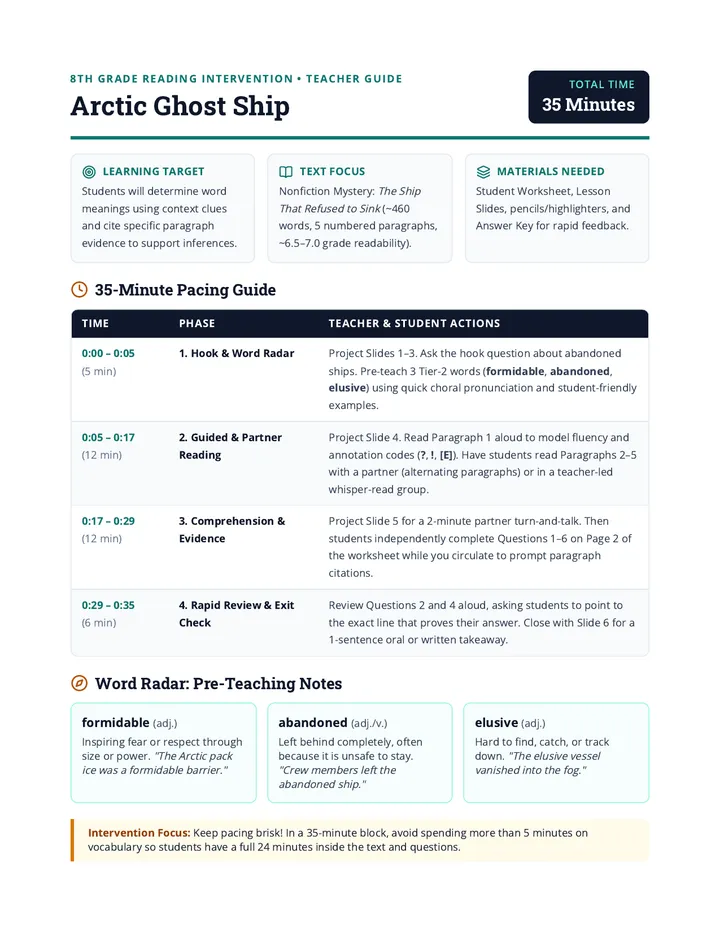
35-Minute Pacing Guide
0:00 – 0:05 5 Minutes
1. Hook & Worksheet Handout
Pass out worksheets. Say aloud: "Imagine finding a ship floating in the ocean—food is still on the table, the cargo is untouched, and every person is gone. Today you'll investigate a real 1872 mystery." Point out the annotation directions.
0:05 – 0:15 10 Minutes
2. Read & Mark Clues
Students read "The Mystery of the Mary Celeste" silently (or in quiet pairs). Remind them to underline clues about what happened to the crew and circle unfamiliar words as they read.
0:15 – 0:28 13 Minutes
3. Independent Comprehension Questions
Students flip to Page 2 and answer Questions 1–6 independently. Circulate to keep students on task, remind them to check the paragraph numbers listed in each question, and require complete sentences on #5–6.
0:28 – 0:35 7 Minutes
4. Quick Debrief & Collect
Use the Answer Key to review Questions 1–4 aloud together. Ask 2–3 volunteers to share their answer to Question 6 ("Which theory is most convincing?"). Collect all worksheets before dismissal.
Reading Support Tip
If students struggle to start, read Paragraphs 1–2 aloud while they follow along, then release them to finish Paragraphs 3–5 independently.
Early Finisher Prompt
Have early finishers flip to the back of Page 2 and write 3 interview questions they would ask the Mary Celeste captain if he were found.
Ghost Ship Reading Worksheet
Ghost Ship Mystery
Reading Passage
Name:
Date:
Directions: Read the passage carefully. Underline clues about what happened to the crew, and circle unfamiliar words.
The Mystery of the Mary Celeste
[1]On December 4, 1872, sailors aboard the British ship Dei Gratia spotted another vessel drifting about 400 miles east of the Azores islands in the Atlantic Ocean. Through his spyglass, the captain recognized the Mary Celeste, an American merchant ship that had left New York nearly a month earlier. Something was terribly wrong: the ship was moving erratically, as if no one were steering it.
[2]When sailors rowed over and climbed aboard, they found the ship completely deserted. A few sails were torn and some water sat in the bottom of the hull, but the Mary Celeste was still seaworthy. Stranger still, the cargo of 1,701 barrels of industrial alcohol was mostly intact. Six months' worth of food and fresh water sat untouched in the galley, and the crew's boots, pipes, and clothing remained neatly in their cabins. However, the ship's single lifeboat was gone, the last pages of the captain's logbook were missing, and all ten people aboard had vanished.
[3]Back on land, investigators struggled to explain how ten experienced sailors and passengers could disappear from a sturdy ship. At first, people suspected pirates. Yet pirates would have stolen the valuable cargo, the crew's money, and the captain's navigation tools—none of which were missing. Others blamed a violent storm, but the dry cabins and upright dishes on the dining table proved the ship had not been tossed by giant waves.
[4]Over the next century, wild theories multiplied, from underwater earthquakes to sea monsters. Modern scientists, however, point to a practical explanation: an alcohol-vapor explosion. If even a few wooden barrels leaked, invisible fumes could have filled the cargo hold. A single spark could have triggered a sudden flash fire—loud enough to blow open the hatches, yet too brief to char the wooden deck. Panicked by the blast, the captain may have ordered everyone into the lifeboat, only for the tow rope to snap and leave them adrift in the open sea.
[5]Because no wreckage of the lifeboat or trace of the ten people was ever found, we may never know for certain what drove the crew off the Mary Celeste. More than 150 years later, the empty ship remains one of ocean history's greatest puzzles.
Turn to Page 2 to answer the comprehension questions. Page 1 of 2
Comprehension Questions
Name:
1. In paragraph 2, what does the word intact most likely mean?
A. Damaged or broken apart
B. Complete and undamaged
C. Hidden below the deck
D. Sold at a nearby port
2. Which detail from paragraph 2 best shows that the crew did NOT leave because they ran out of supplies?
A. A few sails were torn and there was water in the hull.
B. The ship's single lifeboat was missing from its spot.
C. Six months' worth of food and fresh water sat untouched in the galley.
D. The last pages of the captain's logbook could not be found.
3. According to paragraph 3, why did investigators reject the theory that pirates attacked the Mary Celeste?
A. Pirates were not active in the Atlantic Ocean in 1872.
B. Valuable cargo, money, and navigation tools were left behind.
C. The crew's logbook stated that the weather had been calm.
D. The Dei Gratia chased the pirates away before boarding.
4. What is the main purpose of paragraph 4?
A. To describe how the Dei Gratia towed the empty ship to port
B. To prove that underwater earthquakes caused the crew to vanish
C. To explain a scientific theory for why the crew abandoned a seaworthy ship
D. To list the names of all ten people who disappeared aboard the vessel
5. Why could an alcohol-vapor explosion explain the mystery without leaving burn marks on the ship? Cite one detail from paragraph 4 in your answer.
6. Which explanation for the Mary Celeste mystery do you find most convincing, and why? Write 2–3 sentences using evidence from the passage.
Check your work: Did you use complete sentences for #5 and #6? Page 2 of 2
Ghost Ship Answer Key
Ghost Ship Mystery — Answer Key
Teacher & Substitute Reference • Grade 8 Reading Intervention
Answer Key
Multiple Choice (Questions 1–4)
Q1 B
Complete and undamaged (Vocabulary in Context • Paragraph 2)
Context clues show the ship was "seaworthy" and food and belongings were "untouched," contrasting with the few torn sails.
Q2 C
Six months' worth of food and fresh water sat untouched in the galley. (Text Evidence • Paragraph 2)
Having plenty of food and water left behind proves the crew did not abandon ship due to starvation or thirst.
Q3 B
Valuable cargo, money, and navigation tools were left behind. (Inference • Paragraph 3)
Paragraph 3 notes that pirates would have stolen those valuable items, which were all still aboard.
Q4 C
To explain a scientific theory for why the crew abandoned a seaworthy ship (Main Purpose • Paragraph 4)
While paragraph 4 mentions earthquakes and sea monsters, its main focus is the alcohol-vapor explosion theory.
Written Responses (Questions 5–6)
Question 5 — Sample Full-Credit Response
2 Points
"An alcohol-vapor explosion could explain the mystery because the flash fire was too brief to char the wooden deck. Even without burn marks, the loud blast would have blown open the hatches and scared the crew into the lifeboat."
Look for: Mentions that the flash fire was too brief to char/burn the wood (from Paragraph 4).
Question 6 — Sample Full-Credit Response
2 Points
"I find the alcohol-vapor explosion theory most convincing because it fits all the clues on the ship. The crew left behind their belongings and six months of food, showing they left in a sudden panic. If the tow rope snapped after they got into the lifeboat, that explains why the ship was left empty."
Look for: States a clear opinion in 2–3 sentences AND supports it with at least one specific detail from the passage (answers will vary).
Debrief Tip: Ask 2–3 students to share their #6 response before dismissal. Ghost Ship Mystery