Arctic Ghost Ship Lesson Plan 8th Grade Reading Intervention • Teacher Guide
Arctic Ghost Ship
Total Time
35 Minutes
Learning Target
Students will determine word meanings using context clues and cite specific paragraph evidence to support inferences.
Text Focus
Nonfiction Mystery: The Ship That Refused to Sink (~460 words, 5 numbered paragraphs, ~6.5–7.0 grade readability).
Materials Needed
Student Worksheet, Lesson Slides, pencils/highlighters, and Answer Key for rapid feedback.
35-Minute Pacing Guide
Time
Phase
Teacher & Student Actions
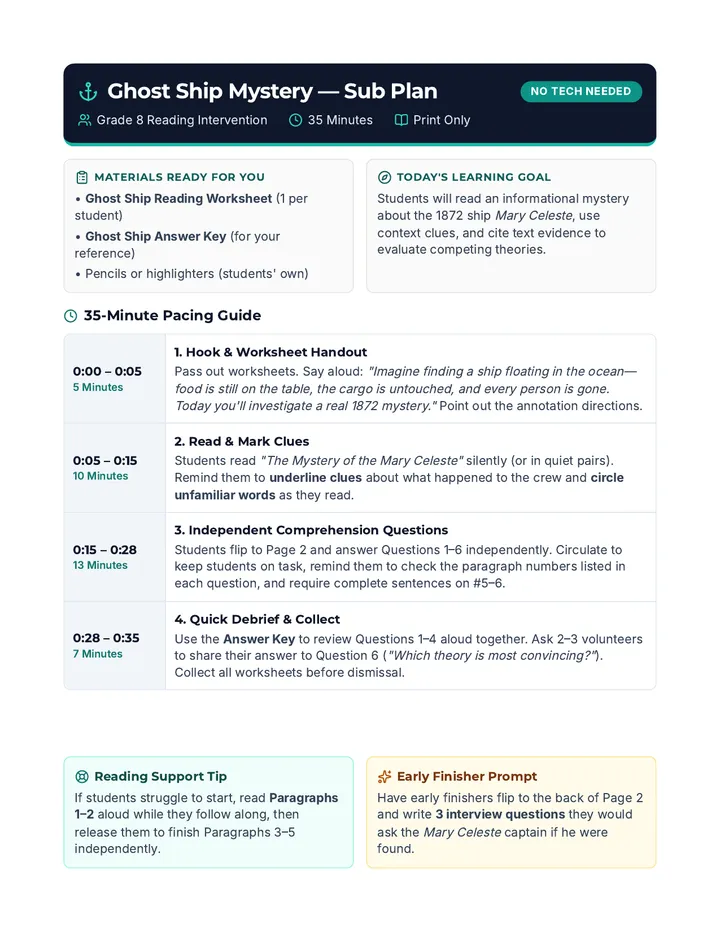
0:00 – 0:05
(5 min)
1. Hook & Word Radar
Project Slides 1–3. Ask the hook question about abandoned ships. Pre-teach 3 Tier-2 words (formidable , abandoned , elusive ) using quick choral pronunciation and student-friendly examples.
0:05 – 0:17
(12 min)
2. Guided & Partner Reading
Project Slide 4. Read Paragraph 1 aloud to model fluency and annotation codes (? , ! , [E] ). Have students read Paragraphs 2–5 with a partner (alternating paragraphs) or in a teacher-led whisper-read group.
0:17 – 0:29
(12 min)
3. Comprehension & Evidence
Project Slide 5 for a 2-minute partner turn-and-talk. Then students independently complete Questions 1–6 on Page 2 of the worksheet while you circulate to prompt paragraph citations.
0:29 – 0:35
(6 min)
4. Rapid Review & Exit Check
Review Questions 2 and 4 aloud, asking students to point to the exact line that proves their answer. Close with Slide 6 for a 1-sentence oral or written takeaway.
Word Radar: Pre-Teaching Notes
formidable (adj.)
Inspiring fear or respect through size or power. "The Arctic pack ice was a formidable barrier."
abandoned (adj./v.)
Left behind completely, often because it is unsafe to stay. "Crew members left the abandoned ship."
elusive (adj.)
Hard to find, catch, or track down. "The elusive vessel vanished into the fog."
Intervention Focus: Keep pacing brisk! In a 35-minute block, avoid spending more than 5 minutes on vocabulary so students have a full 24 minutes inside the text and questions.
Facilitation & Scaffolds
Page 2 • Teacher Notes
Think-Aloud Model (Paragraph 1 — Minutes 5–8)
Read Aloud: Read Paragraph 1 smoothly while students track with a finger or pencil.
Think Aloud: "Notice the year—October 1931—and the place: the coast of Alaska. When I read that the ship 'stopped dead in its tracks,' I'm marking an ! because a massive steel ship getting frozen solid sounds dangerous. I'll also underline 'pack ice' as a clue about the setting."
Check for Understanding: Ask: "Based on Paragraph 1, why couldn't the crew simply sail away?" (Call on 1–2 students before releasing pairs to read Paragraphs 2–5.)
Targeted Intervention Scaffolds
Decoding & Fluency Support
Pull 3–4 students who need decoding support into a quick echo-read table for Paragraphs 2–3 while other pairs read independently.
Pre-chunk multi-syllable names: Bay-chi-mo (BAY-chee-moh), Hud-son's Bay , bar-ri-er .
Writing & Evidence Support
Offer a sentence starter on the board for Questions 5–6: "In Paragraph ___, the author states that..."
Allow students who struggle with writing stamina to highlight the proof sentence first, then summarize it in one crisp sentence.
Watch-Fors & Common Misconceptions
1. "Ghost ship" literalism
Some students may assume the passage is fictional or supernatural. Reinforce during the hook that ghost ship is a real maritime term for an unmanned vessel still afloat.
2. Guessing without returning to the paragraph
Intervention readers often rely on memory for MCQs. Require students to write the paragraph number next to every multiple-choice answer (e.g., "P3" ) before moving on.
Fast Finishers (If 2–3 Min Remain)
Ask early finishers to write one question they would ask the 1969 Inuit hunters who last spotted the Baychimo .
Arctic Ghost Ship Slides 8th Grade Reading Intervention
Arctic Ghost Ship
In 1931, a massive steel steamship got trapped in the Alaskan ice. Its crew abandoned it—yet it kept sailing for 38 years.
Quick Hook: If you spotted an empty ship drifting through thick fog, would you board it? Why or why not?
Today's 35-Minute Mission
Our Plan & Target
Learning Target
I can use context clues to unlock unfamiliar words and cite exact paragraph evidence to support my inferences.
35-Min Pacing
5 min: Hook & Word Radar12 min: Read & Track Evidence12 min: Partner Talk & Questions6 min: Rapid Review & Exit Check
Tip: Keep your pencil moving while you read!
Before We Read • 5 Minutes
Word Radar: 3 Key Terms
formidable
Inspiring fear or respect because of size, strength, or difficulty.
"Arctic ice is a formidable barrier."
abandoned
Left behind completely, usually because it is unsafe to stay.
"The crew left the abandoned ship."
elusive
Hard to find, catch, or pin down.
"The elusive vessel vanished in fog."
Watch for these three words as we read The Ship That Refused to Sink .
During Reading • 12 Minutes
Annotation Strategy: Track & Prove
?
Question
Mark a ? next to anything confusing or a word you need to figure out.
!
Surprising Fact
Mark an ! next to a twist, danger, or detail that surprised you.
[E]
Key Evidence
Bracket [E] around clues that explain how the ship survived so long.
Paragraph 1 together → Paragraphs 2–5 with your partner.
Before Questions • 2 Minutes
Partner Turn-and-Talk
Why did people keep failing to rescue or sink the SS Baychimo ?
Point to one specific paragraph (P1–P5) to back up your answer before you start Questions 1–6.
Sentence starter: "In Paragraph ___, the text explains that..."
Final 6 Minutes • Exit Check
One-Sentence Verdict
In your own words, what made the SS Baychimo 's 38-year voyage possible—luck, ship design, or Arctic weather?
Be ready to name the paragraph number that proves your claim!
Arctic Ghost Ship Worksheet Name:
Date:
8th Grade Reading Intervention • Nonfiction
The Ship That Refused to Sink
The True Mystery of the SS Baychimo
Annotation Key (Mark as You Read)
? = Confusing part | ! = Surprising fact | [E] = Evidence of survival
Word Radar
formidable (powerful/scary) • abandoned (left behind) • elusive (hard to catch)
[1]In October 1931, the SS Baychimo was supposed to be on a routine cargo run. Built in Sweden with a thick steel hull, the 230-foot steamship hauled furs along the frozen coast of Alaska. Suddenly, early winter winds shoved massive sheets of sea ice together, creating a formidable wall that stopped the ship dead in its tracks. Trapped near the town of Barrow, the captain ordered his crew onto the ice to shelter in a nearby village until the freeze eased.
[2]Two days later, a blinding blizzard struck. When the storm finally cleared, the crew hiked back to their vessel—and stared in disbelief. The Baychimo had vanished. Assuming the crushing ice had dragged the steamship to the ocean floor, the Hudson's Bay Company officially listed it as lost. Most sailors went home, convinced they would never see the ship again.
[3]Yet one week later, an Inuit seal hunter spotted the Baychimo drifting forty-five miles away, completely intact. Fifteen crew members raced out and managed to climb aboard, hoping to rescue the valuable cargo of furs. However, the weather turned violent once more, and the men decided the ship was too dangerous to sail. They grabbed what furs they could carry and left the abandoned steamship to the mercy of the Arctic Ocean.
[4]Instead of sinking, the empty vessel began a strange, decades-long voyage. Over the next thirty-eight years, sailors, pilots, and trappers reported dozens of sightings of the "Ghost Ship of the Arctic." Built to withstand brutal polar waters, the steel hull rode high above the waves whenever the ice thawed. Several crews tried to board and tow the elusive ship to port, but sudden storms, shifting ice floes, or thick fog always forced them back empty-handed.
[5]The final confirmed sighting occurred in March 1969, when a group of Inuit hunters found the Baychimo locked in pack ice off the coast of Alaska—silent, rusted, and still upright. By the time a rescue team could organize, the ice broke apart and the ship drifted out of sight forever. In 2006, the Alaskan government launched a project to locate the wreck, yet no trace has ever been found.
Directions: Finish your annotations, then turn to Page 2 for Questions 1–6. Page 1 of 2
Comprehension Check: SS Baychimo
Page 2 of 2
Part A: Circle the best answer. Write the paragraph number where you found proof.
1. In Paragraph 4, what does the word elusive most likely mean?
A. Damaged beyond repair
B. Difficult to catch or hold onto
C. Carrying expensive cargo
D. Covered in heavy rust
2. Why did the crew originally leave the Baychimo in Paragraph 1?
A. The ship ran out of fuel near a Swedish port.
B. A seal hunter warned them that a blizzard was coming.
C. Thick sea ice trapped the ship, so they walked to a nearby village for shelter.
D. They wanted to sell the furs in Barrow before winter began.
3. Based on Paragraphs 3 and 4, why were later crews unable to rescue the ship?
A. The ship's steel hull was too heavy for tugboats to pull.
B. Harsh, unpredictable Arctic weather and shifting ice repeatedly drove rescuers away.
C. The Hudson's Bay Company forbade anyone from boarding the vessel.
D. The ship sank beneath the waves shortly after 1931.
4. Which sentence best states the central idea of the passage?
A. Fur trading in Alaska was the most dangerous job in the 1930s.
B. An abandoned steel steamship survived Arctic conditions and drifted mysteriously for nearly forty years.
C. Modern search teams used advanced technology to recover the Baychimo in 2006.
D. Swedish shipbuilders created the strongest vessels in maritime history.
Part B: Short Response — Cite specific paragraph evidence in your answers.
5. How was the SS Baychimo able to survive for 38 years without a crew? Cite at least one detail from the text.
6. In Paragraph 5, what happened after the 1969 sighting, and why does the Baychimo remain a mystery today?
Check your work: Did you cite paragraph numbers in Part B? Arctic Ghost Ship
Arctic Ghost Ship Answer Key 8th Grade Reading Intervention • Answer Key
Arctic Ghost Ship
Teacher Copy
Part A: Multiple Choice (Questions 1–4)
Q#
Answer
Proof
Rationale & Skill
1
B
Para. 4
Context Clues: Crews tried to board and tow the ship, but storms, ice, and fog always forced them back empty-handed, showing it was difficult to catch or hold onto.
2
C
Para. 1
Key Detail: Thick sea ice stopped the ship near Barrow, so the captain ordered the crew onto the ice to shelter in a nearby village.
3
B
Para. 3–4
Inference: Both the 1931 salvage attempt (violent weather) and later attempts (sudden storms, shifting ice floes, thick fog) were stopped by Arctic conditions.
4
B
Whole Text
Central Idea: Summarizes the full arc—the 1931 abandonment, the ship's tough steel build, and its 38-year unmanned drift.
Part B: Short Constructed Response (Questions 5–6)
5. How was the SS Baychimo able to survive for 38 years without a crew?
Model Response: The Baychimo survived because it was built with a thick steel hull designed for polar waters. In Paragraph 4, the author explains that the steel hull "rode high above the waves whenever the ice thawed," which kept it from sinking even during brutal Arctic storms. (Also accept reference to Paragraph 1's description of its thick steel hull.)
6. What happened after the 1969 sighting, and why does the Baychimo remain a mystery today?
Model Response: In Paragraph 5, Inuit hunters spotted the ship locked in pack ice in March 1969, but before a rescue team could arrive, the ice broke apart and the ship drifted out of sight forever. It remains a mystery because even when the Alaskan government searched for the wreck in 2006, no trace of it was ever found.
Quick 0–2 Point Evidence Rubric (Part B)
2 Points: Accurate answer + specific detail or quote cited from the text.
1 Point: Mostly accurate answer, but missing a specific text detail or paragraph reference.
0 Points: Inaccurate, off-topic, or blank response.