Fluency Student Passages Handout Oral Reading Passage
Beginning 3rd Grade • Narrative Fable
Form A-1
The Feathered Flute
Once in a green forest, a little brown bird named Pip wanted to sing like the great swans. Every morning, Pip would stand on a high branch and try to blow a beautiful, loud song. But only a tiny squeak came out. The other birds laughed at him. "You are too small," they chirped. "Your beak is not made for grand music." Pip felt sad, but he did not stop trying. One afternoon, Pip found a hollow reed by the river. He blew into it, and a sweet, golden sound filled the woods. All the animals stopped to listen. Pip had discovered that you do not need to be big to make beautiful music. You only need to find your own special voice.
Please read this out loud to your teacher. Page 1
Oral Reading Passage
Beginning 3rd Grade • Narrative Fable
Form A-2
The Silver Shell
Deep in a sandy bay, a little hermit crab named Shelby found a beautiful, shiny silver shell. It was twice as big as his old shell, and it glistened in the sun. Shelby felt proud and refused to share his sandy pool with the other creatures. "I am the king of the beach now!" he declared. But soon, a strong, high wave swept into the bay. The heavy silver shell was too large and clumsy for Shelby to swim away. He began to sink. His friends, the tiny sand crabs, worked together to pull him to a safe rock. Shelby realized that having a fancy shell was not as important as having helpful friends. He gladly swapped it for a simpler shell and shared his pool.
Please read this out loud to your teacher. Page 2
Oral Reading Passage
Mid-Year 3rd Grade • Science Nonfiction
Form B-1
Secrets of the Soil
Did you know that the ground beneath your feet is full of life? Soil is much more than just dirt. It is a busy home for millions of tiny living things. Plants need healthy soil to grow tall and strong. Inside the dark ground, earthworms crawl through small tunnels. As they wiggle, they make space for fresh air and water to reach plant roots. Soil also holds nutrients, which are like vitamins for plants. Tiny microbes break down dead leaves and turn them into rich food for the earth. Without these small workers, forests and farms could not survive. The next time you walk outside, remember that the quiet soil is working hard to keep our planet green and healthy.
Please read this out loud to your teacher. Page 3
Oral Reading Passage
Mid-Year 3rd Grade • Science Nonfiction
Form B-2
The Fire of Fireflies
Have you ever seen small, flashing lights in your backyard on a warm summer night? These magical lights come from beetles called fireflies. Fireflies use a special trick to glow in the dark. Inside their bodies, they mix a chemical called luciferin with oxygen from the air. This mixture creates a cool, gentle light with no heat. Fireflies use their lights to talk to each other. Each species has its own pattern of flashes, like a secret code. Male fireflies flash while flying, while females flash back from the ground. This helps them find mates in the dark. Scientists study these glowing insects to understand how to make energy-efficient lighting. So, these tiny glow-worms are helping humans, too!
Please read this out loud to your teacher. Page 4
Fable Running Record Teacher Sheet Teacher Assessment Tool
Fluency Running Record: Level A
Narrative Fable
Student Name
Date
Assessor
Target Rate (Fall)
70 - 90 WCPM
Passage: The Feathered Flute
Directions: Mark errors above words (slash / for sub, circle for omission, caret ^ for insertion, T for teacher assist, SC for self-correct).
Once in a green forest, a little brown bird named Pip wanted [12]
to sing like the great swans. Every morning, Pip would stand [23]
on a high branch and try to blow a beautiful, loud song. [35]
But only a tiny squeak came out. The other birds laughed [46]
at him. "You are too small," they chirped. "Your beak is [57]
not made for grand music." Pip felt sad, but he did not [69]
stop trying. One afternoon, Pip found a hollow reed by [79]
the river. He blew into it, and a sweet, golden sound [90]
filled the woods. All the animals stopped to listen. Pip [100]
had discovered that you do not need to be big to make [112]
beautiful music. You only need to find your own special voice. [123]
Miscue Key & Marking Guide
Sub: Write word above / bird/duck
SC: Write SC no error
Omission: Circle word / little
Insertion: Caret ^ + write word
Teacher Assist (T): Write T [E]
Repetition (R): Arrow above ➔
1. Fluency Calculator
Total Read
Errors (E)
WCPM Score
Accuracy %
WCPM: Words - Errors Acc: (Correct/Total)*100
Ind: 97%+ Inst: 90-96% Frust: <90%
2. Retell Checklist
Score: ___ / 4
Prompt: "Tell me about the story you just read."
Characters (Names Pip / swans / birds)
Setting (Forest, trees, or near river)
Problem (Pip wants to sing, can't / laughed at)
Resolution (Finds reed, makes sweet music / own voice)
3. Comprehension
Score: ___ / 3
Q1: Why did Pip feel sad at first? [0 / 1]
Ans: Other birds laughed / his song was only a squeak.
Q2: What did Pip find that changed things? [0 / 1]
Ans: A hollow reed by the river; blowing into it made sweet sound.
Q3: What is the moral of this story? [0 / 1]
Ans: Don't need to be big to make beautiful things / find your voice.
Observations & Qualities
Finger-point
Nonfiction Running Record Teacher Sheet Teacher Assessment Tool
Fluency Running Record: Level B
Science Nonfiction
Student Name
Date
Assessor
Target Rate (Mid-Year)
90 - 110 WCPM
Passage: Secrets of the Soil
Directions: Mark errors above words (slash / for sub, circle for omission, caret ^ for insertion, T for teacher assist, SC for self-correct).
Did you know that the ground beneath your feet is full of [12]
life? Soil is much more than just dirt. It is a busy [24]
home for millions of tiny living things. Plants need healthy [34]
soil to grow tall and strong. Inside the dark ground, [44]
earthworms crawl through small tunnels. As they wiggle, they [53]
make space for fresh air and water to reach plant roots. [64]
Soil also holds nutrients, which are like vitamins for plants. [74]
Tiny microbes break down dead leaves and turn them into [84]
rich food for the earth. Without these small workers, forests [94]
and farms could not survive. The next time you walk outside, [105]
remember that the quiet soil is working hard to keep our planet green and healthy. [120]
Miscue Key & Marking Guide
Sub: Write word above / dirt/mud
SC: Write SC no error
Omission: Circle word / healthy
Insertion: Caret ^ + write word
Teacher Assist (T): Write T [E]
Repetition (R): Arrow above ➔
1. Fluency Calculator
Total Read
Errors (E)
WCPM Score
Accuracy %
WCPM: Words - Errors Acc: (Correct/Total)*100
Ind: 97%+ Inst: 90-96% Frust: <90%
2. Retell Checklist
Score: ___ / 4
Prompt: "Tell me what you learned in this passage."
Main Topic (Soil is alive / busy home / not just dirt)
Detail: Worms (Make tunnels for air and water)
Detail: Microbes (Break down dead leaves into food/nutrients)
Importance (Without workers, forests/farms cannot survive)
3. Comprehension
Score: ___ / 3
Q1: Why are earthworms helpful to plants? [0 / 1]
Ans: They crawl and wiggle to make tunnels for fresh air and water.
Q2: What do tiny microbes do in the soil? [0 / 1]
Ans: Break down dead leaves and turn them into rich food / nutrients.
Q3: What would happen without soil workers? [0 / 1]
Ans: Forests and farms could not survive / plants couldn't grow healthy.
Fluency Tracker Binder Overview Small Group Progress Tracker
Fluency Launchpad: Binder Overview
Grade 3 Tier 2 / Small Group
Group/Class Name
Focus Goal WCPM
Assessment Cycle
Target Window
Fall / Winter / Spring
Student Weekly Fluency Tracker
| Student Name | Baseline
| / | / | / | / | / |
|
|
|
| / | / | / | / | / |
|
|
|
| / | / | / | / | / |
|
|
|
| / | / | / | / | / |
|
|
|
| / | / | / | / | / |
|
|
|
| / | / | / | / | / |
|
Group Progress Monitoring Chart
Plot weekly group average or highlight individual growth trajectories:
120+
100
80
60
0
Baseline
Week 1
Week 2
Week 3
Week 4
Week 5
Instructional Interventions
Choral Reading
Echo Reading
Reader's Theater
Phrase-Cued Reading
Partner Reading
Duet Reading
Fluency Strategy Focus: Select 1-2 targeted practices weekly for students not meeting progress trajectory.
Group Notes & Action Steps
Copyright © 2026 Fluency Launchpad Toolkit Small Group Progress Tracker Binder Master • Form G-1
Comprehension Retell Prompt Cards Teacher Tool • Small Group Kit
Comprehension & Retell Quick Cards
Cut along dashed lines & laminate
Card 1 • Narrative
Narrative Retell
For Fables, Stories & Legends
Prompt: "Tell me about the story you just read from the beginning."
• Characters: Who was the story about? What traits did they show?
• Setting: Where and when did this story happen? How do you know?
• Problem: What challenge or conflict did the characters face?
• Resolution: How did they fix the problem? What was the outcome?
• Theme/Moral: What did Pip or the characters learn?
Fluency Launchpad Tool Narrative
Card 2 • Story Depth
Narrative Comprehend
Deepen Narrative Meaning
Use these stems to check for deeper comprehension:
• Why do you think Pip made that decision? What does it tell us about him?
• How did the character feel when the others laughed? How do you know?
• If you were the main character, how would you have solved the problem?
• What did the author mean by [vocabulary word] in the passage?
Fluency Launchpad Tool Narrative
Card 3 • Nonfiction
Nonfiction Retell
For Informational & Science Texts
Prompt: "Tell me what you learned in this passage."
• Main Topic: What is the main idea or topic of the whole passage?
• Key Detail 1: What did you learn about the earthworms and soil?
• Key Detail 2: What do the tiny microbes do inside the ground?
• Connection: Why do plants need healthy, rich soil to grow?
• Vocabulary: What is a nutrient? Why is it like a vitamin?
Fluency Launchpad Tool Nonfiction
Card 4 • Fact Depth
Nonfiction Comprehend
Deepen Fact Connection
Use these stems to check for deeper comprehension:
• Why would farms and forests fail without these tiny soil workers?
• How does the wiggling of earthworms help plant roots get what they need?
• What is the difference between healthy soil and just plain dirt?
• What new question do you have about soil after reading this text?
Fable Running Record Teacher Sheet Two Teacher Assessment Tool
Fluency Running Record: Level A
Narrative Fable
Student Name
Date
Assessor
Target Rate (Fall)
70 - 90 WCPM
Passage: The Silver Shell
Directions: Mark errors above words (slash / for sub, circle for omission, caret ^ for insertion, T for teacher assist, SC for self-correct).
Deep in a sandy bay, a little hermit crab named Shelby found [12]
a beautiful, shiny silver shell. It was twice as big as [24]
his old shell, and it glistened in the sun. Shelby felt [35]
proud and refused to share his sandy pool with the other [46]
creatures. "I am the king of the beach now!" he [57]
declared. But soon, a strong, high wave swept into the [67]
bay. The heavy silver shell was too large and clumsy [77]
for Shelby to swim away. He began to sink. His [87]
friends, the tiny sand crabs, worked together to pull him [97]
to a safe rock. Shelby realized that having a fancy [107]
shell was not as important as having helpful friends. He [117]
gladly swapped it for a simpler shell and shared his pool. [126]
Miscue Key & Marking Guide
Sub: Write word above / crab/shrimp
SC: Write SC no error
Omission: Circle word / shiny
Insertion: Caret ^ + write word
Teacher Assist (T): Write T [E]
Repetition (R): Arrow above ➔
1. Fluency Calculator
Total Read
Errors (E)
WCPM Score
Accuracy %
WCPM: Words - Errors Acc: (Correct/Total)*100
Ind: 97%+ Inst: 90-96% Frust: <90%
2. Retell Checklist
Score: ___ / 4
Prompt: "Tell me about the story you just read."
Characters (Names Shelby / sand crabs)
Setting (Sandy bay, beach, ocean pool)
Problem (Shelby won't share fancy shell, wave sweeps in, sinks)
Resolution (Friends save him; swaps shell, shares pool)
3. Comprehension
Score: ___ / 3
Q1: Why did Shelby refuse to share his pool? [0 / 1]
Ans: He felt proud of his beautiful silver shell / declared himself king.
Q2: What happened when the big wave came? [0 / 1]
Ans: Heavy shell made him sink / couldn't swim away.
Q3: What lesson did Shelby learn in the end? [0 / 1]
Ans: Having helpful friends is more important than a fancy shell.
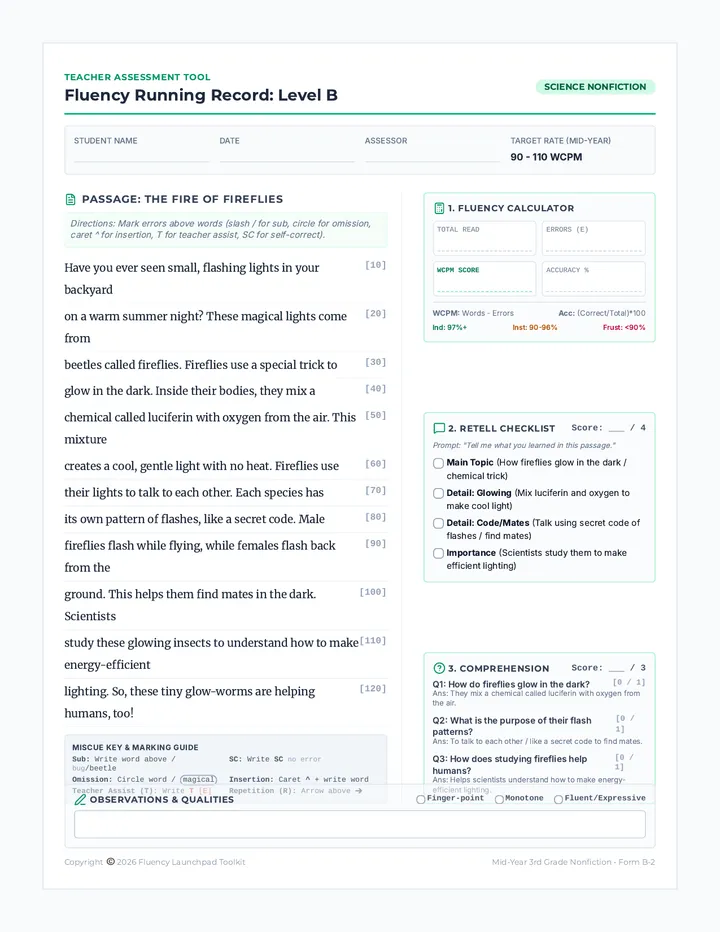
Nonfiction Running Record Teacher Sheet Two Teacher Assessment Tool
Fluency Running Record: Level B
Science Nonfiction
Student Name
Date
Assessor
Target Rate (Mid-Year)
90 - 110 WCPM
Passage: The Fire of Fireflies
Directions: Mark errors above words (slash / for sub, circle for omission, caret ^ for insertion, T for teacher assist, SC for self-correct).
Have you ever seen small, flashing lights in your backyard [10]
on a warm summer night? These magical lights come from [20]
beetles called fireflies. Fireflies use a special trick to [30]
glow in the dark. Inside their bodies, they mix a [40]
chemical called luciferin with oxygen from the air. This mixture [50]
creates a cool, gentle light with no heat. Fireflies use [60]
their lights to talk to each other. Each species has [70]
its own pattern of flashes, like a secret code. Male [80]
fireflies flash while flying, while females flash back from the [90]
ground. This helps them find mates in the dark. Scientists [100]
study these glowing insects to understand how to make energy-efficient [110]
lighting. So, these tiny glow-worms are helping humans, too! [120]
Miscue Key & Marking Guide
Sub: Write word above / bug/beetle
SC: Write SC no error
Omission: Circle word / magical
Insertion: Caret ^ + write word
Teacher Assist (T): Write T [E]
Repetition (R): Arrow above ➔
1. Fluency Calculator
Total Read
Errors (E)
WCPM Score
Accuracy %
WCPM: Words - Errors Acc: (Correct/Total)*100
Ind: 97%+ Inst: 90-96% Frust: <90%
2. Retell Checklist
Score: ___ / 4
Prompt: "Tell me what you learned in this passage."
Main Topic (How fireflies glow in the dark / chemical trick)
Detail: Glowing (Mix luciferin and oxygen to make cool light)
Detail: Code/Mates (Talk using secret code of flashes / find mates)
Importance (Scientists study them to make efficient lighting)
3. Comprehension
Score: ___ / 3
Q1: How do fireflies glow in the dark? [0 / 1]
Ans: They mix a chemical called luciferin with oxygen from the air.
Q2: What is the purpose of their flash patterns? [0 / 1]
Ans: To talk to each other / like a secret code to find mates.