A high-engagement 5th-grade grammar lesson on punctuating dialogue. Includes clean, bold, and colorful slides, student cloze notes, a practice worksheet, desk anchor charts, and center-ready task cards.
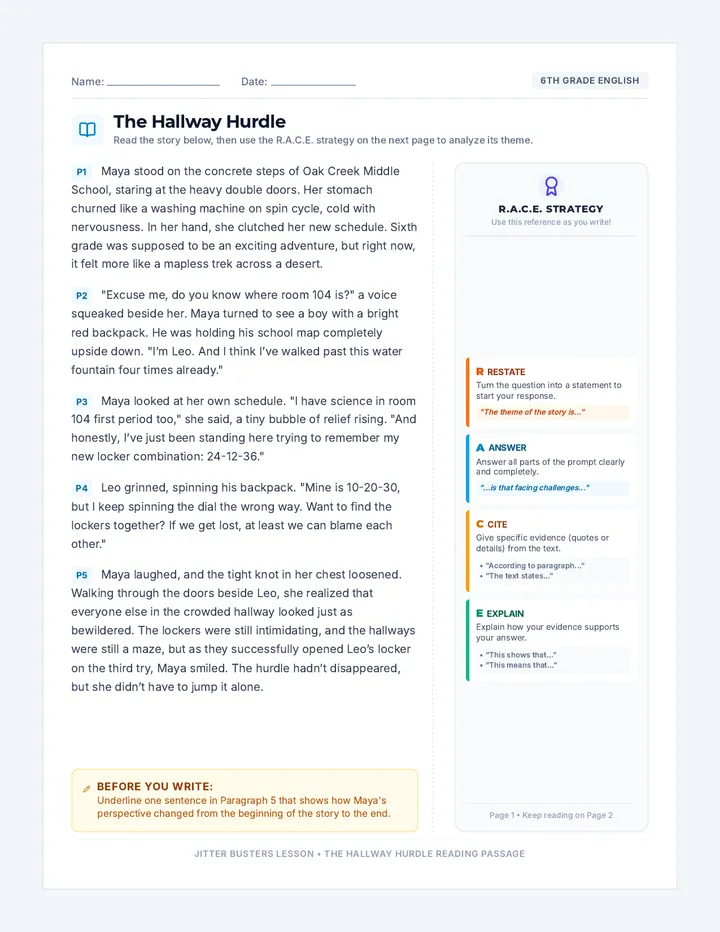
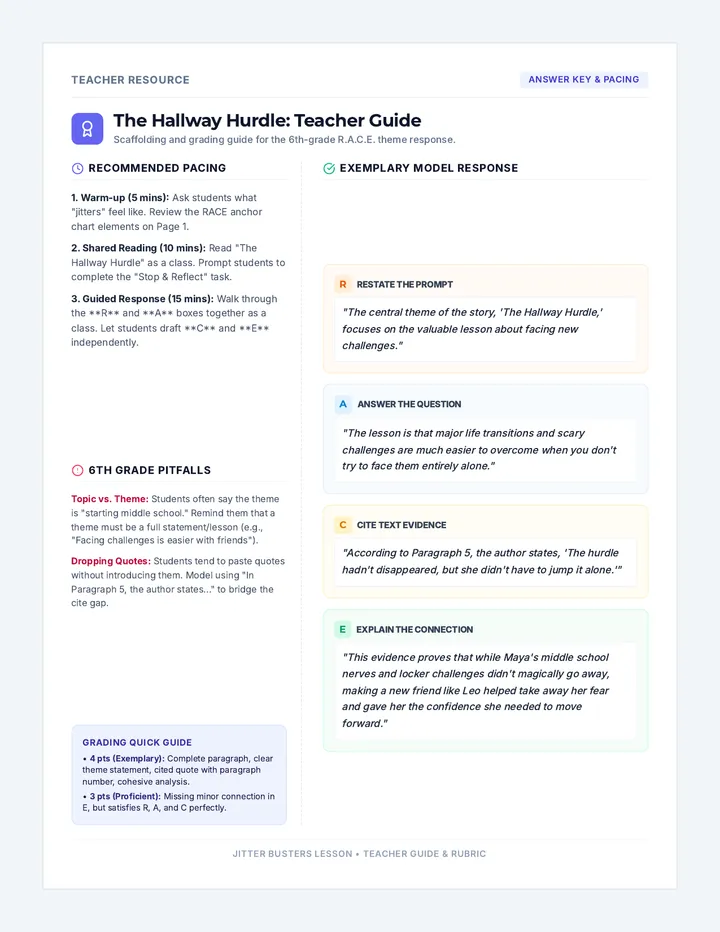
A 30-minute lesson focusing on analyzing a single character's implicit traits and motivations using text evidence. Students read a short story about Mia and her yellow jacket, make inferences, and complete a detailed character profile supported by text quotes.
An introductory ELA lesson for 5th graders focusing on the mechanics of writing narrative dialogue, using relatable school and friendship scenarios. Includes a visual slide deck and a matching interactive student notesheet.
Day 3 focuses on independent execution and performance monitoring. Students independently read, highlight, and analyze paragraph structures to demonstrate mastery, followed by a collaborative review.
Day 2 transitions to guided practice with fading scaffolds. Students collaborate to highlight and unpack paragraphs, learning to distinguish between critical supporting details and interesting but non-essential information.
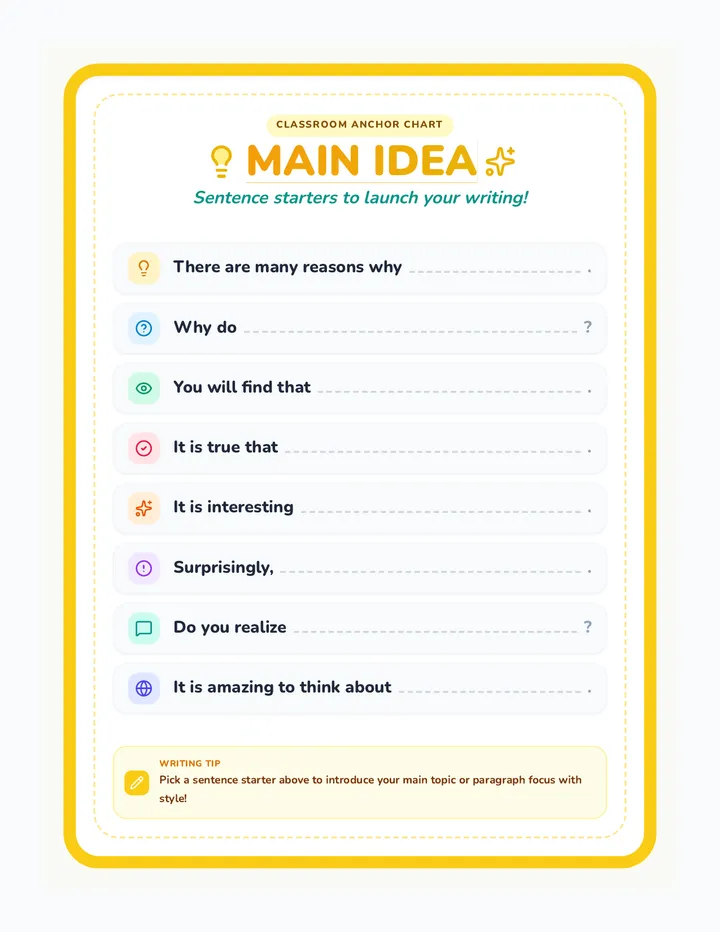
Day 1 of the intervention focuses on explicit teacher modeling of the 'Roof' (Main Idea) and 'Pillars' (Supporting Details) concept. Students learn how a paragraph is built, watch a live highlighting demonstration, and participate in highly guided practice using physical highlighters.
A celebratory end-of-year English Language Arts lesson where students step into the role of literary travel agents, designing promotional brochures and pitching fictional book worlds to classmates to boost summer reading.
A high-stakes spelling adventure game focusing on "au" and "aw" diphthong words. Students navigate a perilous track to reach the Alchemist's Cauldron by spelling and defining challenging vocabulary.
A structured writing unit for Holes by Louis Sachar focusing on the theme of friendship and loyalty. Students analyze Stanley and Zero's relationship and compose a five-paragraph essay using scaffolds, graphic organizers, and sentence frames.
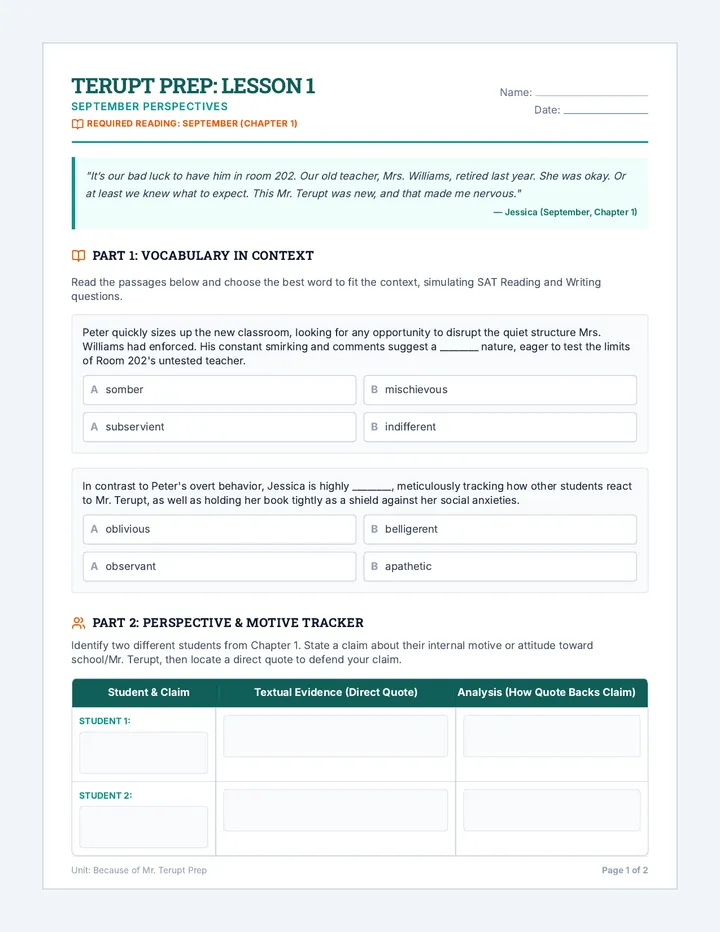
A comprehensive lesson and set of scaffolded graphic organizers designed to help students analyze character traits and master citing text evidence. Includes high, medium, and low levels of scaffolding to differentiate instruction.
A comprehensive 3-day morphology lesson focused on the suffixes -tion, -sion, and -ion. Students explore space-themed multisyllabic vocabulary, analyzing spelling patterns and reading an informational space science passage.
A lesson focused on dividing two-syllable words with adjacent vowels making separate sounds (V/V patterns), featuring a decodable reading passage and comprehension exercises.
An intermediate phonics and structural analysis lesson exploring the prefix 'non-' through morphological breakdown, sentence decoding, and fill-in-the-blank practice.
A construction-themed lesson designed to master coordinating and subordinating conjunctions using visual cues, hands-on activities, and real-world daily life contexts.
A comprehensive training module for primary and middle school students to master public speaking, body language, and vocal projection through interactive games, structural worksheets, and professional rubrics.
A comprehensive professional development module for grades 4-6 educators to transition from teacher-dominated lectures to structured, highly accountable, and engaging student-to-student discourse within the CKLA curriculum, backed by proactive behavior management strategies.
A highly scaffolded 60-minute grammar lesson for EB/Newcomer students to master commas in compound sentences. Uses visual formulas, highly accessible language, and hands-on practice built around school and relationships.
An interactive, versatile reading comprehension and analysis bundle designed for any book. Students complete a customizable 5x5 reading bingo board, document their analytical and creative responses on structured writing templates, and are evaluated using a comprehensive rubric.
A structured spelling lesson exploring the 'full of' suffixes: -ous, -ious, and -tious. Students learn rule-based decision paths and analyze word structures to master these high-frequency adjectives.
A comprehensive reading and writing workshop focusing on analyzing text and drafting structured constructed responses and informational essays. Students engage with diverse passages spanning culinary arts, botany, and narrative mystery.
A high-quality paper-based educational unit exploring meteor impacts, featuring a reading comprehension text on the 2026 Massachusetts meteor and an analytical persuasive essay graphic organizer.
A reading comprehension and vocabulary lesson based on the true story of a D.C. bus driver who went out of his way to return a student's lost trumpet before an important concert. Students develop close reading skills, identify Tier 2 vocabulary in context, and explore themes of community and empathy.
A complete comprehension assessment lesson for J.M. Barrie's Classic Starts: Peter Pan, featuring a student quiz with visual supports and a detailed teacher answer key with page references.
A complete literacy lesson aligned with Wilson Reading System Step 6.2, focusing on multi-syllabic words with suffixes. Students learn to read, scoop, and define complex words while engaging with an inspiring reading passage about NFL wide receiver AJ Brown.
A high-interest, explorer-themed lesson where 3rd-5th grade students design personalized summer reading trail maps, set challenge goals, and pitch books to classmates to embark on a lifelong reading adventure.
A high-interest, detective-themed mixed context clues lesson for 5th graders. Students analyze challenging sentences to uncover word meanings using definition, synonym, antonym, example, and inference clues.
A 5th-grade reading comprehension lesson focused on making inferences. Students read 'Everyday Mysteries'—puzzle-like short passages on printable task cards—and use clues and schema to determine what happened, tracking their thinking on a detective's notebook recording sheet.
An engaging vocabulary review lesson where students use a roll-and-read dice board to practice reading fluency and define key multi-syllable academic words with partners.
A detective-themed, collaborative lesson on relating ideas in a text (cause & effect, chronological connections) for 5th-grade summer school. Includes simplified interactive matching games, movement resets, and peer-to-peer discussion.
An arcade-themed, high-energy lesson on comparing and contrasting characters for 5th graders. Features interactive games, structured movement breaks, collaborative SEL tasks, and a short story analysis.
A high-energy, movement-based reading lesson for 5th-grade summer school students to master Compare/Contrast and Cause/Effect text structures through a 'Wild Survival' theme. Includes visual slides, physical movement activities, and companion student graphic organizers.
A lesson focused on teaching students how to make logical inferences using everyday functional texts, such as text messages, receipts, schedules, and maps. Students act as 'Everyday Detectives' to piece together clues from real-world documents.
A scaffolded narrative writing assessment unit designed to support fifth-grade students, particularly those with IEP accommodations, in planning, drafting, and checking their own creative stories.
A highly scaffolded character analysis lesson designed for English Language Learners (ELL) Level 2. Students analyze either a loathsome or pitiful character using a visual graphic organizer and sentence starters.
A high-interest, independent brain break lesson focused on creative linguistics, lateral-thinking puzzles, visual literacy doodles, and constrained writing challenges. Perfect for keeping students engaged, productive, and mentally refreshed during ELA periods or transition days.
A comprehensive Fountas & Pinnell reading level tracking system for grade-level teams and individual teachers, featuring a master grade-level tracker, individual student profiles, and an F&P levels reference matrix.
An immersive, adventure-themed lesson exploring the eight parts of speech. Students act as language explorers, tracking down and identifying nouns, pronouns, verbs, adjectives, adverbs, prepositions, conjunctions, and interjections in the wild.
An hour-long structured reading lesson focusing on B and W letter-sound association and common sight words. Designed with dyslexia-friendly spacing, color-coded highlights, and picture scaffolding to support struggling oral readers.
A reading comprehension lesson focused on legendary sports figures, featuring graded vocabulary levels and text-based evidence questions for fourth-grade students.