Curious Catalysts Slides
20-Minute Professional Development
K–3 Teacher Librarian Series
Inquiry in the Primary Library
Curious Catalysts:
Questioning for Grades K–3
Moving young readers beyond quiz-show recall into wonder, visual inquiry, and joyful book conversations.
Session Duration
20 Sharp Minutes
Core Outcome
A 4-Tier Question Ladder
Classroom Application
Read-Alouds & Stations
The Mindset Shift
Quiz Show vs. Curiosity Spark
Pacing: Min 02–05
The "Fact-Check" Trap
"Who can tell me what color the bear's hat was?"
- • Single right answer rewards only fastest hand-raisers
- • Signals reading is a test to pass, not a world to enter
- • Produces passive, shut-down listening for quiet students
Impact: Shallow recall with zero student ownership.
The "Curious Catalyst" Prompt
"What do you notice about how the bear is looking at that hat?"
- • Multiple valid viewpoints invite every child into dialogue
- • Honors visual literacy before decoding skills develop
- • Sparks genuine debate, empathy, and predictions
Impact: Active observation, empathy, and shared discovery.
"Our questions set the ceiling for student thinking in the library rug circle."
The Framework
The 4-Tier Primary Question Ladder
Pacing: Min 05–09
01
Tier 1: Notice
Visual & Sensory
Grounds learners in observable details. Low barrier to enter.
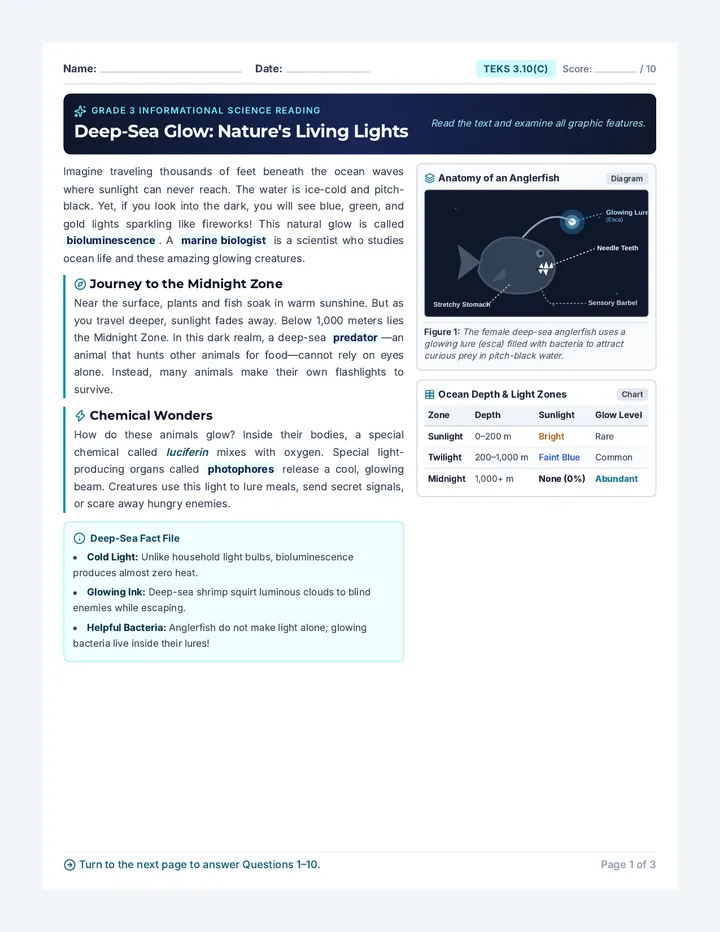
"What detail in this illustration catches your eyes first?"
02
Tier 2: Infer
Feelings & Clues
Unpacking unspoken emotion, subtext, and character motive.
"How can we tell what they are feeling without words?"
03
Tier 3: Connect
World & Self
Bridging book dilemmas to children's real emotional lived worlds.
"When have you ever faced a storm like this one?"
04
Tier 4: Inquire
Author Craft
Investigating author choices, unwritten endings, and wonderings.
"Why did the creator choose shadows instead of color here?"
Golden Rule: Never ask more than 3 heavy questions per 10-minute read-aloud—preserve story joy!
Developmental Tuning
Calibrating Questions by Grade Band
Pacing: Min 09–12
Grades K–1 Visual & Concrete
See, Gesture, & Partner Talk
- Use body & gestures: "Show me with your face how Maya feels on this page."
- Visual anchors: "Point with two fingers to the clue that shows night is coming."
- Knee-to-Knee pairing: 15-second partner whispers before whole-group sharing.
Key Habit: Anchor questions in pictures and physical expressions.
Grades 2–3 Evidence & Perspective
Perspectives, Motives & Evidence
- Cite the clue: "What in the text or illustration made you think that?"
- Alternative perspectives: "How would the neighbor tell this story differently?"
- Inquiry questions: "What lingering question does this page leave you with?"
Key Habit: Invite disagreement, nuance, and author intention.
Both bands require low affective filters: encourage phrasing like "I'm wondering if..." and "Maybe..."
The Micro-Routine
The 3-Step "Pause, Prompt, Probe"
Pacing: Min 12–15
01
PAUSE
Stop reading. Give 5 full seconds of silent looking before speaking a single word.
Why it works: Primary brains process visual clues before auditory prompts.
02
PROMPT
Deliver one open-ended catalyst question. Send learners immediately into Partner Turn-and-Talk.
Why it works: 100% of children speak, rather than 1 hand-raiser.
03
PROBE
Never accept just one answer. Follow up with: "What makes you say that?" or "Who saw it another way?"
Why it works: Deepens evidence and normalizes multiple interpretations.
Librarian Pro-Tip: Count silently to 5 using fingers against the spine of your picture book!
Interactive Practice
3-Minute Book Lab: Live Scenario
Pacing: Min 15–18
Picture Book Case Study
The Empty Bench
Spread description: A stormy blue playground. One child sits alone under a bright yellow umbrella. Other children are huddled under a wooden gazebo laughing.
Traditional Flat Question:
"Where are the other children playing?"
Your Turn: Pair With Your Table Partner
Re-engineer this moment into 2 Catalyst Questions:
Challenge A (Grades K–1): Notice / Infer Craft a prompt focusing on colors, body posture, or emotions.
Challenge B (Grades 2–3): Connect / Inquire Craft a prompt focusing on empathy dilemmas or illustrator contrast.
Partner Talk: 90 Seconds 2 Lightning Share-Outs to Follow
Stem to try: "What do you notice about..." or "Why might the artist have..."
Library Systems
Embedding Inquiry in Library Habits
Pacing: Min 18–19
Librarian Bookmarks
Tape 3 sticky-note question stems directly onto the back cover of your read-aloud book beforehand so your prompts are pre-loaded.
Removes on-the-spot cognitive load.
The Rug "Wonder Wall"
Create an easel or chalkboard next to the reading rug where unanswerable student questions are posted as "Curiosity Quests".
Shows questions are more valuable than answers.
Checkout Stems
As students scan books at checkout, ask: "What question made you choose this book today?" instead of only scanning silently.
Builds metacognitive book selection.
"Small shifts in our routine language build a lifelong culture of inquiry."
Action Wrap-Up
Your 60-Second Commitment
Pacing: Min 19–20
Fill in on your Handout Quick Sheet:
"In my very next K–3 library visit, I will swap out one fact-recall question for:
____________________________________"
Keep your Questioning Toolkit Handout beside your read-aloud chair as a daily prompt anchor.
Curious Catalysts • Elementary Library Inquiry Series
Thank you for inspiring young thinkers!
Curious Catalysts Facilitator Guide
Professional Development Facilitator Guide
Curious Catalysts: Questioning for Grades K–3
A 20-Minute High-Impact Workshop for Elementary Teacher Librarians
Format & Time 20 Minutes Sharp
Target Audience K–3 Teacher Librarians & Media Specialists
Session Objective Shift from fact recall to 4-tier inquiry during read-alouds
Key Takeaway Pause-Prompt-Probe Routine + Planning Matrix
Minute-by-Minute Pacing Agenda (20 Minutes Total)
Keep transitions brisk to protect the 3-minute practice
| Time |
Segment |
Facilitator Focus & Action |
Slide |
| 00:00–02:00 |
Welcome & Purpose |
Frame why K–3 questioning in the library rug circle anchors lifelong inquiry habits. |
1 |
| 02:00–05:00 |
The Core Shift |
Contrast the "Fact-Check Trap" with "Curious Catalyst" prompts. Highlight equitable voice. |
2 |
| 05:00–09:00 |
4-Tier Question Ladder |
Introduce Notice → Infer → Connect → Inquire. Emphasize the 3-question ceiling per story. |
3 |
| 09:00–12:00 |
K–1 vs. 2–3 Tuning |
Contrast visual/gestural scaffolding (K–1) with text evidence & craft prompts (2–3). |
4 |
| 12:00–15:00 |
Pause, Prompt, Probe |
Teach the 5-second silence rule, knee-to-knee pairing, and follow-up evidence prompts. |
5 |
| 15:00–18:00 |
3-Min Book Lab |
Partners spend 90s transforming a flat question into two catalysts, followed by 2 quick shares. |
6 |
| 18:00–19:00 |
Library Space Routines |
Showcase ready-to-use habits: Back-cover bookmarks, rug Wonder Walls, checkout stems. |
7 |
| 19:00–20:00 |
60-Second Commitment |
Individual writing on handout: One question swap for their next library class. Adjourn. |
8 |
Materials & Pre-Session Setup
- ✓ Slides Deck: Loaded on projector (16:9 aspect ratio).
- ✓ Participant Toolkit Handout: 1 copy per attendee printed front/back.
- ✓ Sticky Notes & Pens: Placed at tables for bookmark prep.
- ✓ Sample Picture Books: 2–3 recent picture books on display as visual anchors.
Facilitator Golden Rules
-
- Protect the clock: 20 minutes moves fast. Avoid long open discussions; use pair-talk.
-
- Model wait time: When you ask a question during the PD, pause 5 full seconds.
-
- Celebrate librarians: Frame this as honoring their special superpower as reading coaches.
Curious Catalysts • K–3 Teacher Librarian Professional Development Page 1 of 2 • Facilitator Guide
Instructional Delivery & Coaching
Slide-by-Slide Script & Coaching Protocol
Curious Catalysts Guide
Slides 1–2 Script • Mindset Shift (Min 0–5) Say This Word-For-Word
"When we gather students on the library rug, it is easy to default to fact-checking: 'Who can tell me what color the wagon is?' But notice who answers: the same two students whose hands shoot up first. Fact questions turn reading into a test. Today, we’re learning to ask catalyst questions that invite every child to notice, speculate, and wonder."
Slides 3–4 Script • Question Ladder & Grade Nuance (Min 5–12) Key Framing
"Notice how Tier 1 starts with the eyes: in Kindergarten, visual reading is reading! When we ask 'What do you notice?' there is no wrong answer. In grades 2–3, we scaffold into evidence: 'What clue in the art makes you think the rabbit is nervous?' Don't interrogate the story. Pick 2 to 3 golden moments, pause deeply, and let the children talk to each other."
Slides 5–6 Script • Facilitating the 3-Minute Book Lab (Min 12–18) Facilitator Action
"Look at Slide 6: The prompt on the screen is flat: 'Where are the other children playing?' Turn to your elbow partner right now. You have 90 seconds to re-craft this into one K–1 visual prompt and one Grade 2–3 empathy/craft prompt. Ready? Talk!" [Start 90s timer. Circulate. Call on 2 pairs for 15-second lightning shares.]
Common Facilitation Pitfalls & Real-Time Pivot Moves
Pitfall 1: Time Overrun in Book Lab
Librarians love discussing book titles. If they begin debating book choices, gently redirect: "Hold that great title! Let's focus our spotlight on the question stem itself."
Pitfall 2: "I Don't Have Enough Time to Pause"
Remind them: asking 2 intentional questions with 5-second pauses saves time compared to asking 10 shallow questions where students disconnect and misbehave.
Post-Session Coaching & Drop-In Observation Protocol
Week 1: Sticky Bookmark Check Drop into the library during read-aloud prep. Ask to see the 3 question stems taped inside their read-aloud cover. Offer praise and quick feedback.
Week 2: 10-Min Rug Observation Tally wait time and student response modes: Did the librarian pause 5 seconds? Did students talk knee-to-knee or just call out?
Coaching Debrief Prompt "Which question created the most vibrant student conversation today? What did you notice about who participated?"
Curious Catalysts • K–3 Teacher Librarian Professional Development Page 2 of 2 • Facilitator Guide
Questioning Toolkit Handout
Library Inquiry Toolkit
K–3 Read-Aloud Questioning Matrix
Pocket prompts to transform fact-recall into wonder, inference, and student dialogue.
Librarian:
School/Date:
Tier 1: Notice Visual & Concrete
Observation & Wonder Sparks
- • "What catches your eye first on this spread?"
- • "What colors do you notice that tell us how this place feels?"
- • "Point with two fingers to something surprising in the background."
- • "What is something hidden that an adult might miss?"
Tier 2: Infer Feelings & Subtext
Character Feelings & Clues
- • "Look at their shoulders and eyes. How do they feel inside?"
- • "The author didn't say why they did that. What clue helps us know?"
- • "Why do you think the character chose to stay silent?"
- • "What might they be whispering right now?"
Tier 3: Connect Empathy & Self
World, Self & Ethical Bridges
- • "Have you ever felt a storm like this in your own stomach?"
- • "What would you whisper to them if you were sitting right there?"
- • "Is doing the kind thing always easy in this situation?"
- • "What reminds you of someone in our school community?"
Tier 4: Inquire Craft & Wonder
Author Craft & Wonderings
- • "Why did the illustrator zoom out so far on this page?"
- • "What question do you want to ask the main character?"
- • "If you were the author, what alternate ending might you try?"
- • "What big mystery does this book leave unanswered?"
Primary Library Response Protocols (Replace Hand-Raising)
Knee-to-Knee Whisper
"Turn your knees to your neighbor. Partner A tells Partner B what clue they saw (15 seconds)."
Mirror the Feeling
"Show me with your face and posture how the character feels on count 3: 1... 2... 3, freeze!"
Visual Finger Point
"Find the hidden clue in the illustration with your eyes. Hold up 1 finger when you spot it."
The 3 Essential VTS Questions: 1. "What's going on in this picture?" | 2. "What do you see that makes you say that?" | 3. "What more can we find?"
Curious Catalysts • K–3 Teacher Librarian Professional Development Page 1 of 2 • Matrix & Protocols
Workshop Practice & Implementation
Read-Aloud Questioning Planner
Participant Worksheet
Part 1: 3-Minute Book Lab Practice (From Slide 6) Practice Scenario
Case Spread: A stormy blue playground. One child sits alone under a yellow umbrella while others laugh in the gazebo. Flat: "Where are the other kids playing?"
Your K–1 Question (Notice or Infer / Body / Color):
Your 2–3 Question (Connect or Inquire / Perspective):
Part 2: Planning Your Next Library Read-Aloud
Pick 3 Golden Moments Only
Book Title:
Target Grade:
Date:
Golden Moment 1 • Page/Spread #: _____ Tier: [ ] Notice [ ] Infer [ ] Connect [ ] Inquire
Catalyst Question & Partner Routine:
Golden Moment 2 • Page/Spread #: _____ Tier: [ ] Notice [ ] Infer [ ] Connect [ ] Inquire
Catalyst Question & Partner Routine:
Golden Moment 3 • Page/Spread #: _____ Tier: [ ] Notice [ ] Infer [ ] Connect [ ] Inquire
Catalyst Question & Partner Routine:
Part 3: 60-Second Action Commitment Final Session Step
"In my very next K–3 library visit, I will eliminate one flat fact question and instead ask:"
Peer Accountability Partner: Tape this page inside your library lesson binder!
Curious Catalysts • K–3 Teacher Librarian Professional Development Page 2 of 2 • Planning & Action