Codebreaker Lesson Plan Grade 3–5 ELA Duration: 45–60 Mins
Character Codebreakers
Internal Personality vs. External Physical Characteristics
CASE FILE #042
Reading Comprehension
Learning Objective
Students will accurately distinguish between characters' external traits (physical appearance) and internal traits (personality, motivations, values) by citing textual evidence.
Standards Alignment
CCSS.ELA RL.3.3: Describe character traits and motivations.CCSS.ELA RL.4.3: Explain character thoughts, words, and actions.
Materials Needed
Inside Out Presentation Slides
Trait Detective Activity Sheet
Quick Check Exit Ticket
Pencils & Highlighters (2 colors)
Core Vocabulary & Anchor Definitions
External Trait (The Camera Clue):
Physical traits seen on the outside (height, hair, clothing, physical features). Rule: Can a camera take a photograph of it? If yes, it is external.
Internal Trait (The Heart & Mind):
Personality traits shown over time through choices, words, emotions, and reactions (courageous, greedy, empathetic, witty). Cannot be seen in a single photograph.
Instructional Sequence (Part 1)
10 MIN
Phase 1: The Detective Hook & The Iceberg Analogy
Hook & Engagement
Display Slide 1 and Slide 2. Project an image of an iceberg. Explain that characters in literature are exactly like icebergs: only 10% is visible above the surface (external traits), while 90% is hidden beneath (internal personality, motives, fears).
Teacher Script Prompt: "If you saw a detective wearing a trench coat and glasses, you know what they look like. But do you know if they are brave, greedy, dishonest, or loyal? How do we discover what's inside?"
15 MIN
Phase 2: Direct Instruction & The "Camera vs. Heart" Test
Teacher-Led Concept Modeling
Walk through Slides 3–5. Introduce the litmus test:
📸 Camera Test: If a snapshot reveals it instantly (blue eyes, striped scarf), it is External.
❤️ Heart/Action Test: If you must watch their actions across multiple moments (perseverance, kindness), it is Internal.
Key Caution: Clarify the difference between temporary emotions (e.g., angry right now) vs enduring internal character traits (e.g., short-tempered or patient).
Character Codebreakers • Teacher Lesson Guide Page 1 of 2
Character Codebreakers: Instructional Sequence (Part 2)
Guided Practice, Application, Assessment, and Differentiation
Phase 3–5
10 MIN
Phase 3: Guided Practice Case Analysis (Slides 6–7)
We Do
Read the short case sample of "Maya the Inventor" together. Have students hold up one finger for External or two fingers for Internal as you read trait words aloud (e.g., grease-stained goggles vs tenacious problem-solver ).
Formative Check: Ask, "What text evidence proves Maya is persistent rather than just messy?"
15 MIN
Phase 4: Trait Detective Activity Sheet (You Do)
Independent / Partner Practice
Students complete the two-page Trait Detective Activity :
Part 1: Sort 12 trait cards into External Clues vs. Internal Character Qualities.Part 2: Analyze "The Midnight Clockmaker" passage and cite evidence for both categories.Part 3: Draw & Blueprint an illustrated character, mapping physical features externally and character traits internally.
08 MIN
Phase 5: Debrief & Quick Check Exit Ticket
Synthesize & Assess
Conduct a 2-minute wrap-up discussion: "Why do authors use both internal and external traits? Which one drives the major decisions in the plot?" Distribute the Quick Check Exit Ticket for independent completion.
Targeted Differentiation & Scaffolding
Striving Readers
Provide color-coded highlighters: blue for physical sights, yellow for actions. Pair with peer reading partner.
Multilingual Learners
Use visual icons (eyes/camera for external, brain/heart for internal). Provide sentence stems for trait explanations.
Advanced Learners
Analyze how an external trait can deceive other characters (e.g., an innocent-looking villain with selfish motives).
Mastery Checklist & Scoring Criteria
Formative Assessment Rubric
Skill Dimension Proficient (Meeting Standard) Developing (Needs Support) Categorization Correctly sorts 10+ of 12 traits into internal vs. external categories. Confuses temporary states with enduring internal traits. Evidence Citing Quotes specific dialogue, actions, or descriptions from passage. Makes generic assertions without quoting text details. Trait Blueprint Accurately places physical details outside and values/motives inside. Places physical traits inside the heart/mind area.
Character Codebreakers • Teacher Lesson Guide Page 2 of 2
Inside Out Slides Detective Bureau Case #042 ELA Reading Workshop
Character Analysis
Character Codebreakers
Decoding the Mystery: External Appearance vs. Internal Personality
Outside Clues
What our eyes and camera can see
Inside Qualities
Who they are in their heart and mind
The Character Iceberg
Concept Model
Above the Surface (10%)
External Traits
Visible physical appearance. Anyone looking at the character can spot these details instantly in a single snapshot.
Examples:
Curly red hair, patched jacket, tall frame, crooked smile, thick glasses.
Below the Surface (90%)
Internal Traits
Personality and values. Revealed through their choices, speech, reactions, and motives over the course of time.
Examples:
Courageous, dishonest, generous, stubborn, empathetic, ambitious.
Key Rule: External traits tell us what a character looks like. Internal traits drive what a character DOES.
Category 01
External Traits: The Camera Clues
Body & Frame
Tall, petite, muscular, slender, hunched, athletic, broad-shouldered.
Face & Features
Freckled cheeks, braided dark hair, scar over eyebrow, hazel eyes, sharp chin.
Gear & Clothing
Tattered denim coat, brass goggles, polished boots, knitted wool scarf.
Quick Test: If you drew a picture or took a photo right now, would this detail appear in the image? If yes, it is an external trait !
Category 02
Internal Traits: The Heart & Mind
Moral Values
Honest, loyal, deceitful, fair-minded, selfish, altruistic, principled.
Drive & Willpower
Determined, resilient, lazy, ambitious, reckless, cautious, tenacious.
Social Approach
Empathetic, sarcastic, introverted, bossy, humorous, patient, hostile.
Trait vs. Feeling: Being "sad" or "angry" right now is a temporary mood. Being "optimistic" or "hot-tempered" is an internal trait !
The Litmus Test: Camera vs. Heart
How to Never Guess Wrong
Ask: Can a Camera See It?
One instant snapshot in time
Can a camera photograph freckles? YES (External)
Can a camera photograph a leather vest?
Trait Detective Activity Detective Casebook Field Worksheet
Case #042
Agent Name:
Date:
Badge #:
External Traits: Observed on the outside with your eyes (clothing, hair, physical build).
Internal Traits: Inferred through actions, speech, and choices over time (personality, values).
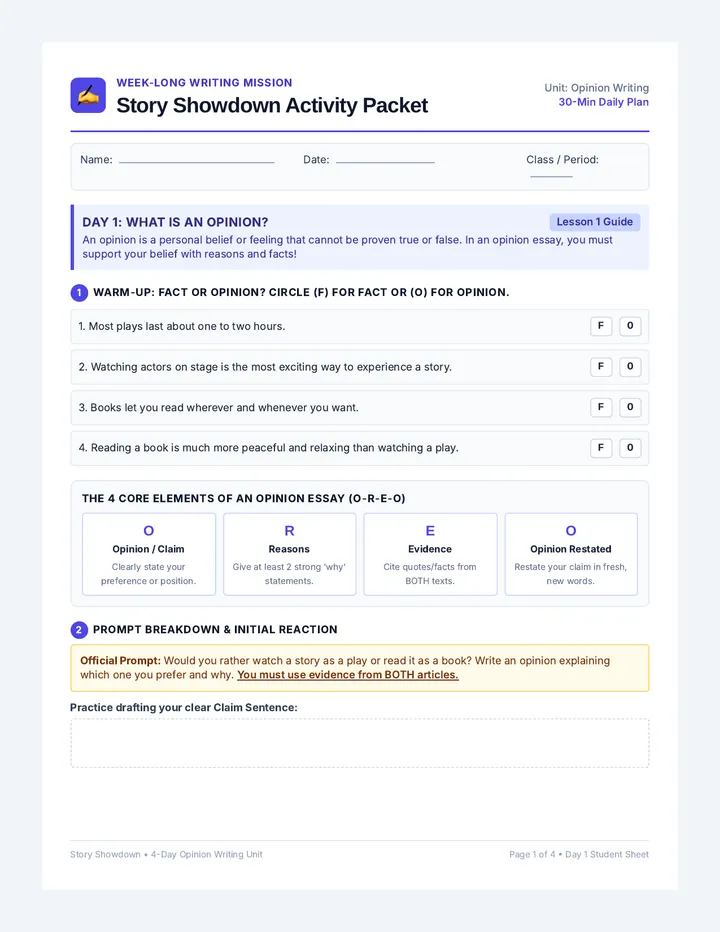
1 Part 1: Evidence Sorting Depot
Sort all 12 traits from the Evidence Bank into the correct table column.
Trait Evidence Bank:
curly red hair generous patched denim vest dishonest tall and slender patient freckled cheeks empathetic wire-rimmed glasses tenacious scuffed combat boots arrogant
External Traits (Camera Clues) (6 traits)
Internal Traits (Heart & Mind) (6 traits)
2 Part 2: Case File Analysis: "The Clockwork Heart"
Read the passage, then answer the evidence questions.
"Silas sat at his work table wearing an old wool vest and round silver glasses on his nose. A young girl stood at his door in the cold rain. She held a broken music box that belonged to her grandmother. Other workers had laughed at her and said it was impossible to fix. Silas did not laugh. He gave the girl a warm cup of sweet tea and spent hours carefully fixing every tiny gear. When the music box finally played its sweet song, Silas smiled. He would not take any of her coins, saying, 'Keep your money. Helping you is my reward.'"
A. Identify two external traits of Silas and write the exact quote from the text that proves each:
External Trait 1:
External Trait 2:
B. Name one internal trait Silas demonstrates. What specific action or choice from the story proves this trait?
Internal Trait:
Textual Evidence:
Trait Detective Casebook • Formative Activity Page 1 of 2
3 Part 3: Character Blueprint: Draw & Decode
Illustrate a character (from a story you know or an original hero), then map inside vs outside traits.
Visual Synthesis
Character Being Analyzed:
Source Book / Story:
External Feature 1
External Feature 2
External Feature 3
OUTSIDE: Physical Appearance INSIDE: Mind & Heart
[ Draw and color your character in this space ]
Internal Trait 1
Trait Detective Answer Key Teacher Reference Answer Key & Scoring
Trait Detective Activity: Answer Key
Model responses, textual citations, and misconception guidance
KEY-042
Grade 3–5 ELA
Part 1: Evidence Sorting Depot (Classification Key) 6 points (0.5 pt each)
External Traits Camera Snapshot
1. curly red hair (physical feature)
2. patched denim vest (clothing)
3. tall and slender (body build/stature)
4. freckled cheeks (facial feature)
5. wire-rimmed glasses (accessory/eyewear)
6. scuffed combat boots (footwear/clothing)
Internal Traits Behavior & Values
1. generous (shares resources willingly)
2. dishonest (lies or deceives others)
3. patient (calm through delays/difficulty)
4. empathetic (feels and shares others' emotions)
5. tenacious (refuses to quit; persistent)
6. arrogant (overly proud; looks down on others)
Part 2: Case File Analysis: "The Clockwork Heart" Exemplar Answers 4 points
A. External Traits (Accept any two with exact textual quotation):
Trait 1: Wears an "old wool vest" (clothing/appearance).Trait 2: Has "round silver glasses on his nose" (eyewear/accessory).Alternate: Silas "sat at his work table" (posture/physical setting).
B. Internal Trait & Textual Evidence (Accept any reasonable trait supported by the text):
Generous / Unselfish: He "would not take any of her coins, saying, 'Keep your money. Helping you is my reward.'" Empathetic / Kind: While others laughed at her, Silas "did not laugh" and "gave the girl a warm cup of sweet tea." Patient / Dedicated: Silas "spent hours carefully fixing every tiny gear."
Part 3 & 4 Rubric Criteria
• Blueprint Outside (3 pts): 3 distinct physical details labeled (not personality terms).
Quick Check Exit Ticket Exit Slip
Character Codebreaker Quick Check
Name:
Date:
1. Circle EXT (External) or INT (Internal) for each trait:
a. Jagged scar on elbow EXT INT
b. Resilient under pressure EXT INT
c. Polished silver armor EXT INT
d. Empathetic toward animals EXT INT
2. Read the short incident below:
"Captain Leo buttoned his gold-braided naval coat and adjusted his wooden peg leg . As thunder cracked and the galley filled with seawater, he stayed behind in the icy tempest until every single crew member was secured inside the lifeboats."
One External Trait:
One Internal Trait:
3. Why is a character's internal trait more important to a story's plot than how they look?
Score: _____ / 5 Character Codebreakers • Formative Assessment
Cut Along Dashed Line (2 Copies Per Sheet)
Exit Slip
Character Codebreaker Quick Check
Name:
Date:
1. Circle EXT (External) or INT (Internal) for each trait:
a. Jagged scar on elbow EXT INT
b. Resilient under pressure EXT INT
c. Polished silver armor EXT INT
d. Empathetic toward animals EXT INT
2. Read the short incident below:
"Captain Leo buttoned his gold-braided naval coat and adjusted his wooden peg leg . As thunder cracked and the galley filled with seawater, he stayed behind in the icy tempest until every single crew member was secured inside the lifeboats."
One External Trait:
One Internal Trait:
3. Why is a character's internal trait more important to a story's plot than how they look?
Score: _____ / 5 Character Codebreakers • Formative Assessment