Fact Detectives Slides
ELA Nonfiction Masterclass | Grades 4–6 Informational Reading
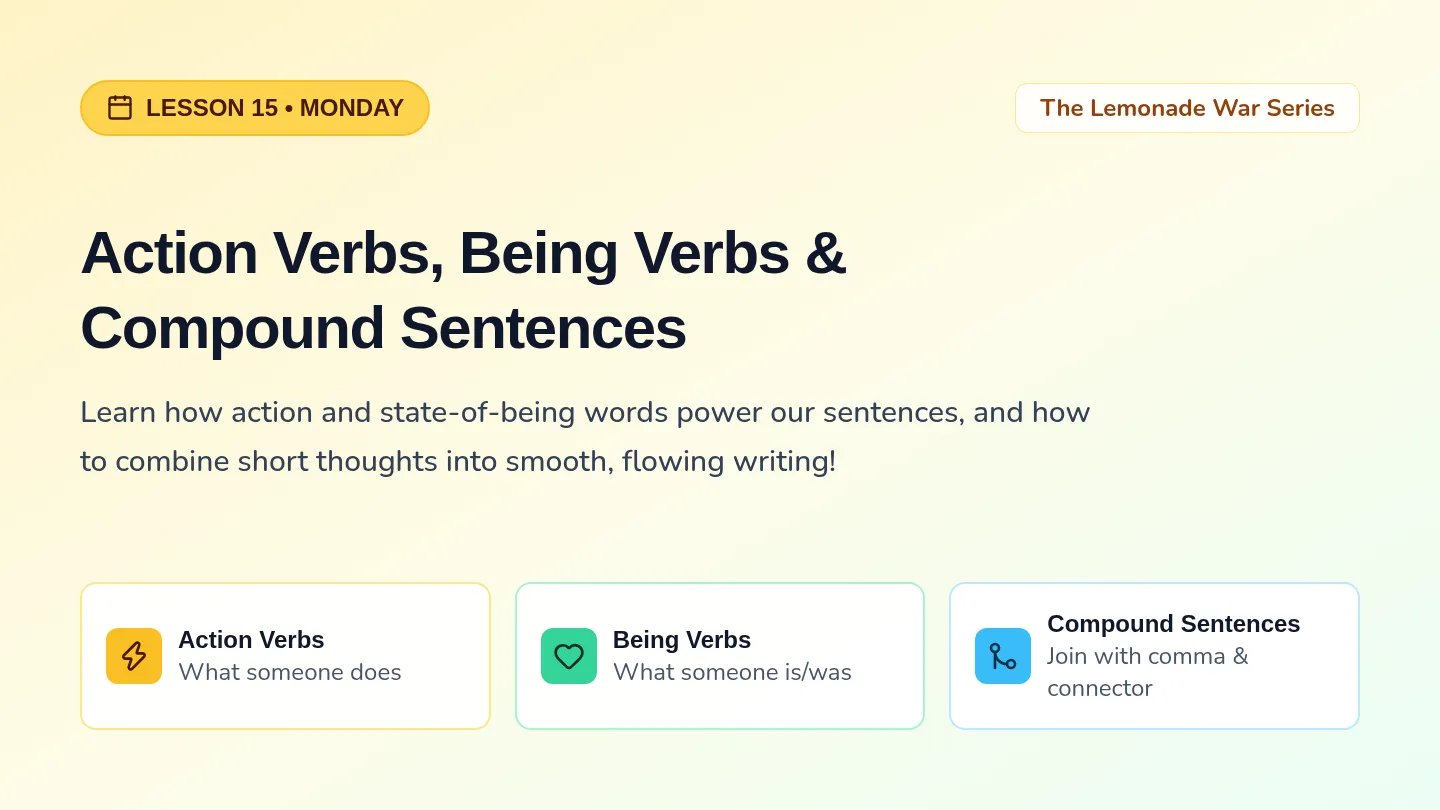
Fact Detectives
Unlocking Central Ideas & Decoding Text Features
Learn how real readers investigate nonfiction articles, track down the author's primary message, and use diagrams, captions, and headings like a secret navigation map.
Central Idea
The author's core point
Supporting Facts
Evidence holding it up
Text Features
Signposts for meaning
Phase 1 • Orientation
The Nonfiction Blueprint
Reading for Information
Stories & Fiction
- Follows made-up characters and plot twists
- Read sequentially from page 1 to the end
- Main goal is entertainment or narrative reflection
Focus: "What happens next to the hero?"
Informational Nonfiction
- Shares accurate facts, discoveries, and real phenomena
- Organized with headings, captions, charts, and diagrams
- Readers can scan and navigate to specific sections
Focus: "What big idea is the author teaching me?"
Detective Rule #1: Nonfiction writers build arguments with facts—your mission is to find the central idea they are proving!
Skill Focus 1
Topic vs. Central Idea
Avoid the Common Trap!
1
The Topic
The general subject of the text. Usually just 1 to 3 words. It only answers: "Who or what is this about?"
Example Topics:
Honeybees
Volcanoes
Mars Exploration
2
The Central Idea
The specific, primary point the author is making. It is always a complete sentence showing the author's message.
Full Central Ideas:
Honeybees use complex dance steps to direct their hive to food sources.
Volcanoes create brand-new fertile land and islands over thousands of years.
Topic + Author's Key Point = Central Idea!
Structure Model
The Stool Test: Central Idea & Details
Evidence Architecture
The Central Idea (The Tabletop)
"Electric eels generate powerful electrical shocks to hunt, navigate, and defend themselves."
Supported By Concrete Evidence Below
1 Hunting Shocks
Emits sudden 600-volt pulses that stun fish instantly in dark, muddy rivers.
2 Radar Navigation
Sends low-voltage sensory pulses like a built-in radar to find hidden prey.
3 Predator Defense
Can leap out of water to deliver direct shocks to predators threatening them.
The Golden Rule: If a fact doesn't hold up or prove the tabletop, it is just an interesting detail, not a supporting pillar!
Skill Focus 2
Text Features: Your Clue Map
Never Skip the Pictures!
Headings & Subheadings
Preview what each section is about. They divide big ideas into manageable clues before you even read!
Clue: Identifies the topic of the next paragraph
Captions & Photos
Captions provide vital facts not found in the body text. Photos show exact real-world evidence.
Clue: Explains what is happening in the picture
Diagrams & Labels
Show the internal parts of an object or demonstrate step-by-step processes visually.
Clue: Shows how parts connect together
Sidebars & Bold Words
Bold words flag key scientific vocabulary. Sidebars share fascinating bonus cases or records.
Clue: Spotlights definitions and fast facts
Pro Tip: 40% of test questions about nonfiction articles come directly from text features!
Mentor Demonstration
Investigating an Informational Page
Watch the Detective at Work
Subheading
Bioluminescence: Deep-Sea Flashlights
Over 3,000 feet beneath the ocean surface, sunlight cannot reach. Yet the midnight zone glows with eerie blue-green light. Animals use a chemical reaction called bioluminescence to survive. Some deep-sea fish glow to lure curious meals into their jaws, while others blink rapid flash signals to warn predators away.
Photophore
Diagram Caption:
A photophore is a light-emitting organ packed with glowing bacteria that acts like an underwater searchlight.
Detective Analysis Log
1. TOPIC: Bioluminescent deep-sea creatures
2. CENTRAL IDEA: Deep-sea animals create their own light to hunt, communicate, and survive in the pitch-black ocean.
3. TEXT FEATURE CLUE: The diagram explains the photophore organ, proving exactly how the light is produced.
Notice how the heading and diagram confirm the main message!
Always verify: Does the central idea cover the whole section, not just one sentence?
Action Strategy
The 4-Step Detective Protocol
Your Repeatable Routine
01
Scan Features
Before reading the text, inspect the title, headings, diagram labels, and photo captions.
Make a quick prediction about the topic!
02
Ask the Core
Read actively and ask: "What single big insight does the author want me to walk away with?"
Look at the first and last sentences for clues.
03
Find 3 Pillars
Locate 3 facts, statistics, or examples that directly hold up the central idea like stool legs.
Underline or note your 3 strongest facts.
04
Draft in Words
Write the central idea in your own words. Never just copy a random sentence from the article.
Test it: Does it summarize the entire piece?
Master detectives never guess—they follow the text evidence from signposts to conclusion!
Your Turn
Field Mission: The Wood Wide Web
Independent Investigation
Grab Your Field Report Worksheet!
You are about to investigate an informational report on how real forest trees communicate through underground fungal networks.
1 Examine the subterranean fungal network diagram
2 Extract the central idea from the forestry report
3 Complete your 3-pillar supporting evidence stool
Detective Checklist
Did I read the diagram caption and sidebars?
Is my central idea a complete sentence (not just a topic)?
Do all 3 supporting details prove my central idea?
Sharpen your pencils and begin your field report!
Nonfiction Reading Strategies • Fact Detectives Good luck, Detectives!
Fact Detectives Worksheet
Fact Detectives Field Report
Nonfiction Reading Lab • Central Idea & Text Features
Name:
Date:
Score:
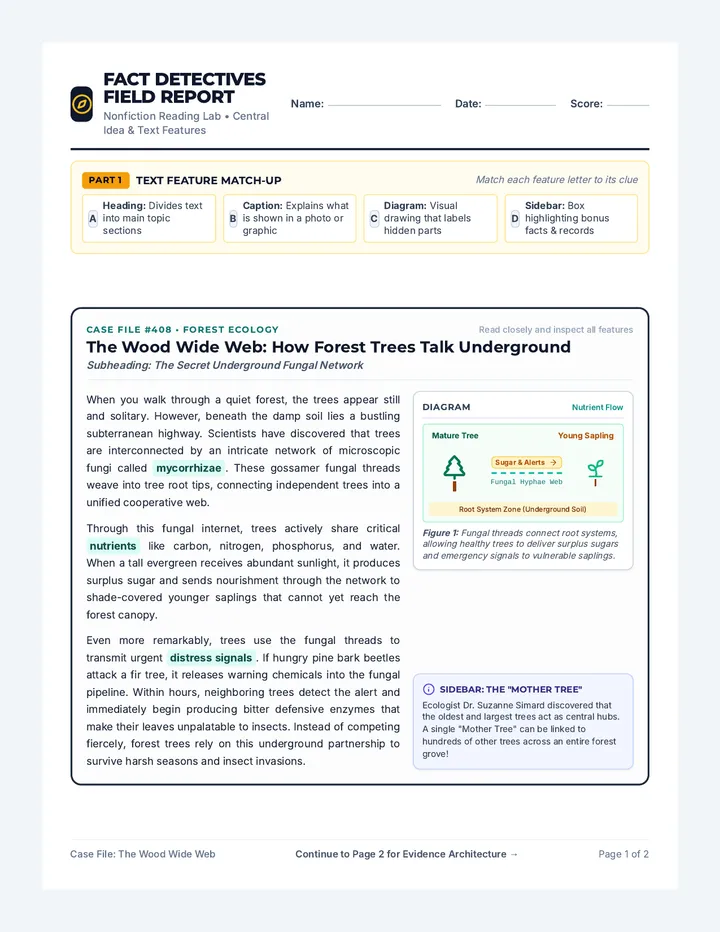
Part 1
Text Feature Match-Up
Match each feature letter to its clue
A Heading: Divides text into main topic sections
B Caption: Explains what is shown in a photo or graphic
C Diagram: Visual drawing that labels hidden parts
D Sidebar: Box highlighting bonus facts & records
Case File #408 • Forest Ecology Read closely and inspect all features
The Wood Wide Web: How Forest Trees Talk Underground
Subheading: The Secret Underground Fungal Network
When you walk through a quiet forest, the trees appear still and solitary. However, beneath the damp soil lies a bustling subterranean highway. Scientists have discovered that trees are interconnected by an intricate network of microscopic fungi called mycorrhizae. These gossamer fungal threads weave into tree root tips, connecting independent trees into a unified cooperative web.
Through this fungal internet, trees actively share critical nutrients like carbon, nitrogen, phosphorus, and water. When a tall evergreen receives abundant sunlight, it produces surplus sugar and sends nourishment through the network to shade-covered younger saplings that cannot yet reach the forest canopy.
Even more remarkably, trees use the fungal threads to transmit urgent distress signals. If hungry pine bark beetles attack a fir tree, it releases warning chemicals into the fungal pipeline. Within hours, neighboring trees detect the alert and immediately begin producing bitter defensive enzymes that make their leaves unpalatable to insects. Instead of competing fiercely, forest trees rely on this underground partnership to survive harsh seasons and insect invasions.
Diagram Nutrient Flow
Mature Tree Young Sapling
Sugar & Alerts
Fungal Hyphae Web
Root System Zone (Underground Soil)
Figure 1: Fungal threads connect root systems, allowing healthy trees to deliver surplus sugars and emergency signals to vulnerable saplings.
Sidebar: The "Mother Tree"
Ecologist Dr. Suzanne Simard discovered that the oldest and largest trees act as central hubs. A single "Mother Tree" can be linked to hundreds of other trees across an entire forest grove!
Case File: The Wood Wide Web Continue to Page 2 for Evidence Architecture → Page 1 of 2
Part 2
Fact Detectives Teacher Guide
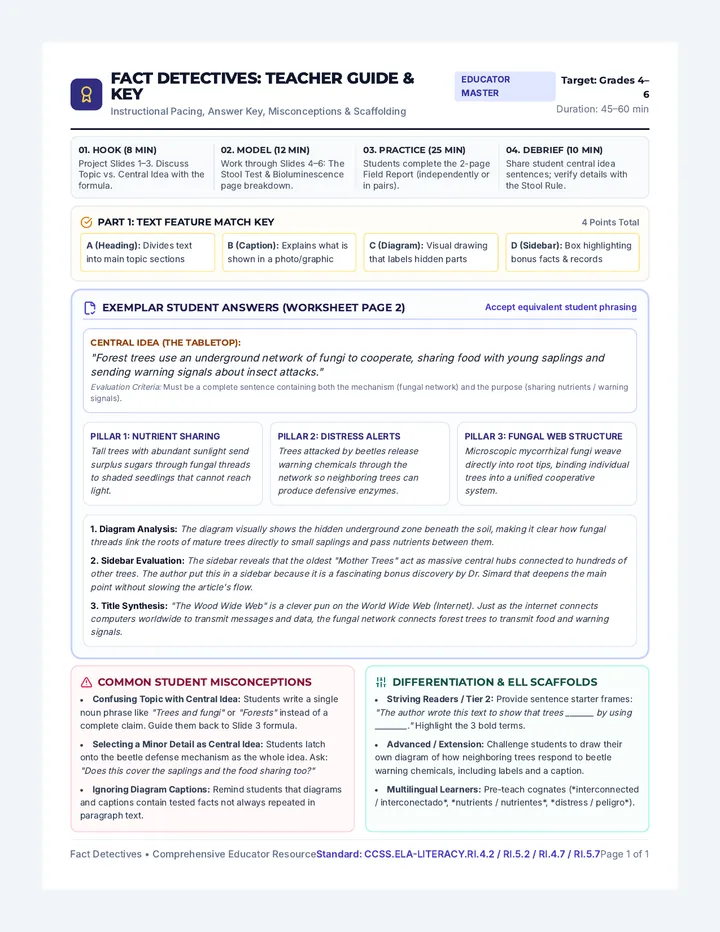
Fact Detectives: Teacher Guide & Key
Educator Master
Instructional Pacing, Answer Key, Misconceptions & Scaffolding
Target: Grades 4–6
Duration: 45–60 min
01. Hook (8 min)
Project Slides 1–3. Discuss Topic vs. Central Idea with the formula.
02. Model (12 min)
Work through Slides 4–6: The Stool Test & Bioluminescence page breakdown.
03. Practice (25 min)
Students complete the 2-page Field Report (independently or in pairs).
04. Debrief (10 min)
Share student central idea sentences; verify details with the Stool Rule.
Part 1: Text Feature Match Key 4 Points Total
A (Heading): Divides text into main topic sections
B (Caption): Explains what is shown in a photo/graphic
C (Diagram): Visual drawing that labels hidden parts
D (Sidebar): Box highlighting bonus facts & records
Exemplar Student Answers (Worksheet Page 2) Accept equivalent student phrasing
Central Idea (The Tabletop):
"Forest trees use an underground network of fungi to cooperate, sharing food with young saplings and sending warning signals about insect attacks."
Evaluation Criteria: Must be a complete sentence containing both the mechanism (fungal network) and the purpose (sharing nutrients / warning signals).
Pillar 1: Nutrient Sharing
Tall trees with abundant sunlight send surplus sugars through fungal threads to shaded seedlings that cannot reach light.
Pillar 2: Distress Alerts
Trees attacked by beetles release warning chemicals through the network so neighboring trees can produce defensive enzymes.
Pillar 3: Fungal Web Structure
Microscopic mycorrhizal fungi weave directly into root tips, binding individual trees into a unified cooperative system.
1. Diagram Analysis: The diagram visually shows the hidden underground zone beneath the soil, making it clear how fungal threads link the roots of mature trees directly to small saplings and pass nutrients between them.
2. Sidebar Evaluation: The sidebar reveals that the oldest "Mother Trees" act as massive central hubs connected to hundreds of other trees. The author put this in a sidebar because it is a fascinating bonus discovery by Dr. Simard that deepens the main point without slowing the article's flow.
3. Title Synthesis: "The Wood Wide Web" is a clever pun on the World Wide Web (Internet). Just as the internet connects computers worldwide to transmit messages and data, the fungal network connects forest trees to transmit food and warning signals.