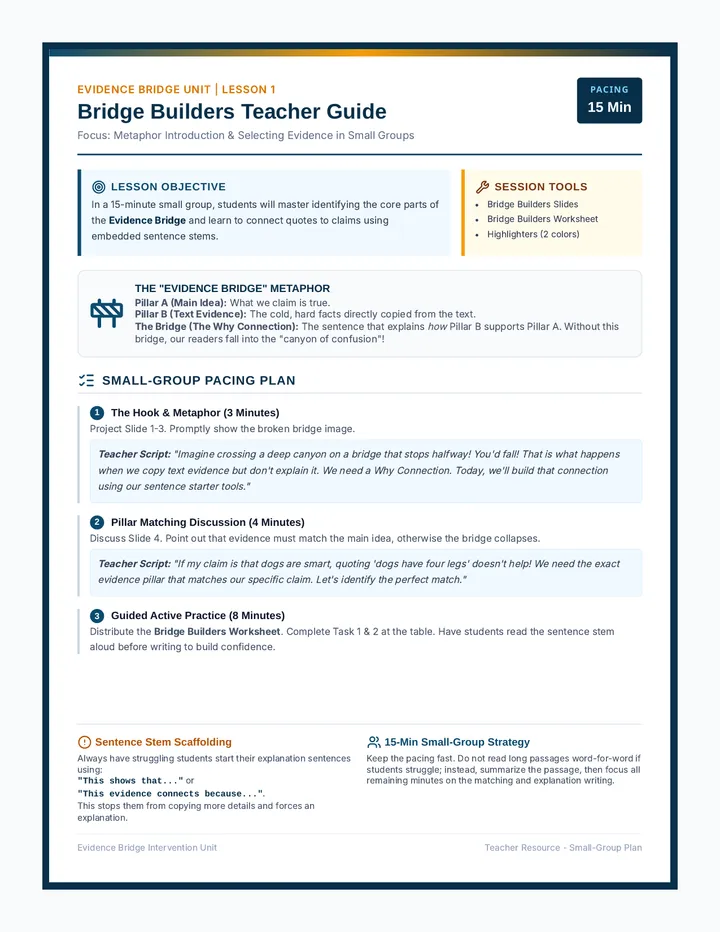
Argument Architect Teacher Guide Argument Architect
Teacher Implementation Guide
Lesson: Blueprint for Bold Claims
Focus: The Essay Anchor
Objective
Students will construct a high-impact argumentative sentence (The Anchor) that serves as the transition from their introduction into the body of their essay.
Pacing
1. Fact vs. Claim5m
2. Intro Funnel10m
3. Mapping Move10m
4. Anchor Draft5m
The Transition Move:
"A claim is more than a sentence; it's a map . If your claim says 'Although [A], both characters [B]', you have just told your reader that Body 1 will prove [A] and Body 2 will prove [B]."
1
Anchor Definition (Fact vs. Claim)
Model the transition from reporting observations to making an argument using the specific character moments:
Fact: Caitlyn
"Caitlyn jumps a fence to find help while a fire burns."
Claim: Caitlyn
"Caitlyn's jump proves that love for family can silence paralyzing fear."
Fact: Sara
"Sara hides under a bush during a thunder storm on the trail."
Claim: Sara
"Sara's hesitation shows that courage is a choice, not an instant feeling."
2
The Intro Funnel Logic
Explain how the Hook catches interest and the Claim anchors the focus. The claim should be the very last sentence of the introduction paragraph.
3
The "Mapping" Move
Model how the sentence structure dictates the essay outline.
Clause 1: Shared Plot Situation (Body 1 Topic)
Clause 2: Action Contrast Argument (Body 2 Topic)
4
The Anchor Draft
"Students use the final task on the worksheet to draft their Anchor. Circulate and 'approve' claims with a star once they have both characters and a strong contrast word."
Quality Control Exemplar
Strong Essay Anchor:
"Although both characters face an unexpected danger, Caitlyn acts immediately while Sara hesitates."
Logic Check: It identifies the shared situation and the specific contrast. Body 1 = Danger; Body 2 = Response Contrast.
Blueprint for Bold Claims Slides Argument Architecture
Blueprint
for Bold
Claims
Building the "Anchor" of your essay.
The Promise
The Definition:
An Argumentative Claim is a bold promise you make to your reader.
Claim vs. Fact
FACT: Caitlyn jumps over a fence.
CLAIM: Caitlyn's courage is shown by her choice to act even when she is afraid.
"A fact just is.
A claim needs proving with evidence."
The Intro Funnel
The Hook (CATCH ATTENTION)
Context (NAME THE TEXTS)
The Claim (YOUR ANCHOR)
The Claim is the most important part of your introduction because it transitions you from "Intro" to "Essay"!
The Essay Engine
The Anchor Claim:
"Although Caitlyn and Sara both face danger, Caitlyn acts while Sara hesitates."
Intro Transition
Body 1 (Situation):
Prove how both characters encounter a terrifying situation that they did not ask for.
Beam 1
Body 2 (Response):
Prove the contrast : Caitlyn's immediate jump vs. Sara's running/hiding.
Beam 2
The Blueprint Formula
Architect Logic
Although (Shared Context), (Contrast in Actions).
Let's transition into writing!
Argument Architect Worksheet Sentence Showdown
Building Strong Arguments
Name:
Date:
"A bold claim is an anchor sentence that makes a promise to your reader."
Blueprint Logic Check
The Transition: A strong intro funnels from a hook catch down to your bold anchor claim.
The Engine: The claim is the map. It tells you exactly what to write in Body 1 & 2!
1
Sorting Your Evidence
Label boxes: D (Difference) or S (Similarity).
Caitlyn faces her fear and jumps a high fence immediately, while Sara races back down the path to hide from a storm.
Both Caitlyn and Sara find themselves in dangerous situations that they did not ask for.
2
The Build-A-Claim
Follow the architecture below to build a strong contrast sentence.
Although
Part A: Shared Situation (Context)
, Caitlyn acts...
Part B: Contrast (Argument)
...while Sara...
3
Master Architect Challenge
Final Essay Prompt:
"Write a response contrasting how the characters respond to conflict. Use details from BOTH passages to support your answer."
Final Draft: Write your Essay Anchor sentence below.
Used Although or While
Contrasted ACTIONS
Included BOTH Names
Evidence from BOTH Texts
Claim Construction Worksheet Claim Construction
The Anchor Sentence Blueprint
Name:
Date:
1
The Blueprint Anatomy
Although [Shared Context], [Char A] acts while [Char B] waits.
Part A: The Shared Situation
Part B: The Contrast in Actions
2
Drafting Dojo: Round 1
Scenario: Response to Danger
Caitlyn jumps a fence immediately to save her home, but Sara runs away to hide from thunder.
Step 1: Describe the situation both characters face
Although
Step 2: Contrast how they acted differently
(Char A) acts while (Char B)...
3
Drafting Dojo: Round 2
Scenario: Overcoming Fear
Both characters are terrified, but eventually find the internal strength to help someone.
Step 1: Describe the initial internal struggle
While
Step 2: Connect them to a shared success
they both...
4
Master Architect Challenge
Final Draft: Write your argumentative Anchor sentence below.
Used Although or While.
Included BOTH names.
Contrasted responses.
Used evidence from texts.
Argument Architect Script Teacher Talk Track
Lesson: Argument Architect
Script: 5th Grade ELA
1
The Hook & Metaphor (5 mins)
"Class, imagine you are building the tallest skyscraper in the world. You have the best materials—the strongest steel beams and the prettiest glass windows. But if you just stack them in a pile on the ground, do you have a building? No. You have a pile of junk."
"An essay is the same way. Your evidence from the story—like Caitlyn jumping the fence or Sara hiding in the storm—those are your steel beams. Your hooks are your windows. But without a Foundation or an Anchor , the whole essay falls down."
"Today, we are going to learn how to build that anchor. We call it an Argumentative Claim . It's the most powerful sentence you'll ever write because it makes a bold promise to your reader."
2
Fact vs. Claim (10 mins)
[Display Slide 2]
"A lot of people think a claim is just a fact. But a fact is just an observation. Look at the board. 'Caitlyn jumps a fence.' Is that true? Yes. Can we argue about it? No. Brendan Wolfe wrote it right there on the page. That's a steel beam, but it's not an anchor."
"Now look at this: 'Caitlyn's jump proves that love for her family silenced her fear.' Now we're talking! I'm making a promise to prove why she did it. That's an argument. That's a claim."
3
The Intro Funnel (5 mins)
[Display Slide 3]
"Think of your introduction like a funnel. You start wide with a general idea about courage. Then you get a little narrower by naming our characters, Caitlyn and Sara. But at the very bottom, at the narrowest point, you hit the Anchor . Your claim is the transition—it carries the reader out of the introduction and straight into the evidence."
4
The Essay Engine (10 mins)
[Display Slide 4]
"The best thing about a strong claim? It writes your essay for you. It's an engine. If our claim says: 'Although they both face danger, Caitlyn acts immediately while Sara hesitates,' we've already created our outline."
"Part A of that sentence says they both face danger. So, what is Body Paragraph 1 going to be about? Exactly—the danger they both faced! Part B says Caitlyn acts while Sara hesitates. So Body Paragraph 2 will be our Contrast . If you build a strong claim, you'll never wonder what to write next."
Master Architect Tip:
"As you move to the 'Claim Construction' worksheet, remember: Don't just tell me what they did. Tell me what their actions about their character. Now, let's start engineering!"