Lenny.com
Explore
Create
ActivitiesNewMathEnglish Language ArtsScience & EngineeringSocial StudiesGlobal LanguagesHealth & Physical EducationSpecial EducationCounseling & Life SkillsArts & CreativityESL
Lenny.com
Lenny.com
Explore
Create
ActivitiesNewMathEnglish Language ArtsScience & EngineeringSocial StudiesGlobal LanguagesHealth & Physical EducationSpecial EducationCounseling & Life SkillsArts & CreativityESL
Lenny.com
Lenny.com

Solutions

Lenny for EducatorsLenny for SchoolsLenny for Districts

Product

ExploreSign inCreateSupportAbout

Resources

Getting startedMTSS Acceleration Program

© 2026 Lenny Learning Inc.

TermsPrivacyAccessibility
LinkedInInstagramX
Lenny
English Language ArtsPhonics & Reading FoundationsLetter IdentificationLearn Letters A-ZLowercase and Uppercase LettersConsonants and VowelsLetter-Sound AssociationsLetter-Sound Associations: LowercaseLetter-Sound Associations: UppercaseBeginning and Ending SoundsRhymingBlending And SegmentingShort VowelsShort Vowel SoundsConsonant BlendsConsonant DigraphsBlends, Digraphs, and TrigraphsDigraphs, Blends, and Silent LettersLong Vowel SoundsLong Vowel PatternsShort and Long VowelsShort and Long Vowel PatternsSilent EVowel SoundsVowel TeamsR-Controlled VowelsDiphthongs: Oi, Oy, Ou, OwVariant VowelsVariant, Diphthong, And R Vowel PatternsSoft G And CSight WordsIrregular WordsWord RecognitionSyllablesSyllable TypesTwo-Syllable WordsMultisyllabic WordsPhoneme ManipulationDecodable TextsVocabularyAction WordsQuestion WordsNouns and AdjectivesClassify WordsCompound WordsSynonyms and AntonymsHomophonesHomophones and HomonymsShades of MeaningContext CluesPrefixes and SuffixesGreek and Latin RootsAnalogiesIdioms and AdagesForeign Words and ExpressionsWord Choice and UsageReference SkillsReading ComprehensionRead-Along Literary TextsRead-Along Informational TextsReality vs. FictionStory ElementsCharacterSequenceMain IdeaCause And EffectCompare And ContrastReading StrategiesText StructureAuthor's PurposeAuthor's Purpose And ToneAuthor's PerspectivePoint Of ViewThemeInference And ThemeInference And AnalysisPoetry ElementsLiterary DevicesAnalyzing LiteratureAnalyzing Informational TextsComparing TextsAudience, Purpose, And ToneBusiness DocumentsNovel StudyNonfiction Book StudyGrammar & MechanicsSentencesNounsVerbsAdjectivesPronounsCapitalizationPunctuationContractionsConjunctionsPrepositionsArticlesAdjectives And AdverbsVerb TypesVerb TensePronouns And AntecedentsPronoun TypesSubject-Verb AgreementDirect And Indirect ObjectsSentences, Fragments, And Run-OnsPhrases And ClausesCommasSemicolons, Colons, And CommasDashes, Hyphens, And EllipsesSpellingAbbreviationsFormattingVerb Tense And MoodMisplaced ModifiersWritingDescriptive DetailsCreative WritingOpinion WritingTopic SentencesOrganizing WritingLinking WordsSentence VarietyIntroductions And ConclusionsPersuasive And Opinion WritingExpository WritingPersuasive StrategiesDeveloping And Supporting ArgumentsTopic Sentences And Thesis StatementsSummarizingResearch SkillsEditing And RevisingActive And Passive Voice=Writing Clearly And ConciselyDebate & Public SpeakingPublic Speaking BasicsPersuasive TechniquesClaims and EvidenceTypes of ArgumentsReasoning TypesLogical FallaciesTopic ResearchOrganizing EvidenceDebate Speech OrganizationAttacking and Defending ArgumentsClash and EngagementImpact CalculusQuestioning and Cross-ExaminationCritical ThinkingInformal LogicFormal LogicInductive Reasoning

ACEZ Argument Craft

A comprehensive instructional lesson introducing the ACE-Z writing framework (Answer, Cite, Explain, Zoom out). Students analyze mentor texts, practice building strong claims and linking evidence with reasoning, and draft a text-based analytical response.

MMmadilyn mudge

ACEZ Argument Craft

A comprehensive instructional lesson introducing the ACE-Z writing framework (Answer, Cite, Explain, Zoom out). Students analyze mentor texts, practice building strong claims and linking evidence with reasoning, and draft a text-based analytical response.

MMmadilyn mudge

Claim Frame: Banning personal smartphones during instructional blocks directly improves... because...

C CITE: Embed Text Evidence with Signal Phrase

Signal Phrase + Speaker/Study + Exact Quotation

Signal Starters: According to Dr. Marcus Ward... // Sociological findings reveal that... // Pew Research reports...

E EXPLAIN: The Reasoning Bridge (Min. 2 Sentences)

Unpack the quote & prove how it supports your claim

Thinking Prompts: This data proves that... // When digital distractions are eliminated... // As a direct result...

Z ZOOM OUT: Concluding Zinger (Universal Significance)

Answer "So what?" Connect to lifelong stamina or community

Zinger Starters: Ultimately, reclaiming screen-free classrooms... // In a world filled with digital noise...

Architect Check: Did you write at least two distinct sentences in Box E? Proceed to Page 3 Draft

ACE-Z Writing Series // Material 02 Page 2 of 3

Phase 3 // Unified Composition

POLISHED ACE-Z PARAGRAPH DRAFT

Goal: 130–160 Words

Synthesize your blueprint blocks into one flowing, cohesive analytical paragraph. Use smooth transitions between your quotation and reasoning.

Student Self-Audit Checklist

A: Stance is clear, defensible, and addresses prompt. C: Quote is introduced with a formal signal phrase. E: Explains HOW evidence proves claim (2+ sentences). Z: Concludes with universal significance or zinger.

Evaluation Stamp Score: ___ / 4.0

A Claim

C Cite

E Reason

Z Zinger

Teacher / Peer Initials: ________ Date: ________

ACE-Z Writing Series // Material 02 Page 3 of 3

The Quote Echoer (E)

Explanation merely restates the quote in slightly different words.

Coaching Move:

"Don't tell me what the quote says; tell me why this result happens in a student's brain."

The Abrupt Stopper (Z)

Stops right after the explanation with no conclusion.

Coaching Move:

"Ask yourself: Why will this matter when students graduate into the adult working world?"
ACE-Z Writing Series // Material 03 Page 1 of 2

Evaluation & Differentiation Toolkit

4-TIER ANALYTIC SCORING RUBRIC

Standards: CCSS.ELA-LITERACY.W.1, W.2, W.9

Trait4 — Exemplary3 — Proficient2 — Developing1 — Emerging
[A] Answer / ClaimClear, highly defensible, nuanced claim directly addressing prompt with explicit reasoning roadmap.Clear stance that answers prompt with identifiable main reason.Vague or basic stance; somewhat unclear or partially sits on fence.Missing claim or purely restates prompt question without taking a stance.
[C] Cite EvidenceAuthoritative evidence seamlessly integrated with dynamic signal phrase, credible speaker, and flawless quotation.Relevant quote embedded with standard signal phrase (e.g., The author states...).Quote is loosely connected, over-long, or dropped without sufficient signal phrasing.No textual evidence cited, or inaccurate citation with zero attribution.
[E] Explain ReasoningExceptional, multi-sentence elaboration analyzing how evidence proves claim; details causal mechanisms.Logical explanation (2 sentences) connecting evidence back to claim without merely repeating quote.Superficial 1-sentence reasoning or predominantly paraphrases the quotation.Missing reasoning entirely or offers off-topic personal opinion unlinked to quote.
[Z] Zoom Out / ZingerProfound concluding insight synthesizing broader societal, cognitive, or philosophical significance.Effective concluding statement addressing 'so what?' beyond simple restatement of claim.Repetitive concluding sentence that merely rewrites the original claim.Abrupt ending with no concluding thought or synthesis.

Tiered Differentiation & Support Pathways

Emerging Writers (Tier 2)

  • Provide sentence stems for Box E: "This quote proves that..." and "Because of this, students..."
  • Pre-highlight two usable pieces of evidence in the anchor text prior to reading.

Multilingual Learners (MLL)

  • Offer a bilingual transition word bank (e.g., furthermore, as a consequence, specifically).
  • Partner students for an oral rehearsal of Box E reasoning before committing to handwriting.

Advanced Extensions (Tier 3)

  • Incorporate a counterargument refutation into the [E] reasoning bridge (e.g., "While critics argue...").
  • Weave two distinct evidentiary quotes into a dual-evidence synthesis paragraph.

ACE-Z Writing Series // Material 03 Page 2 of 2

You might also like

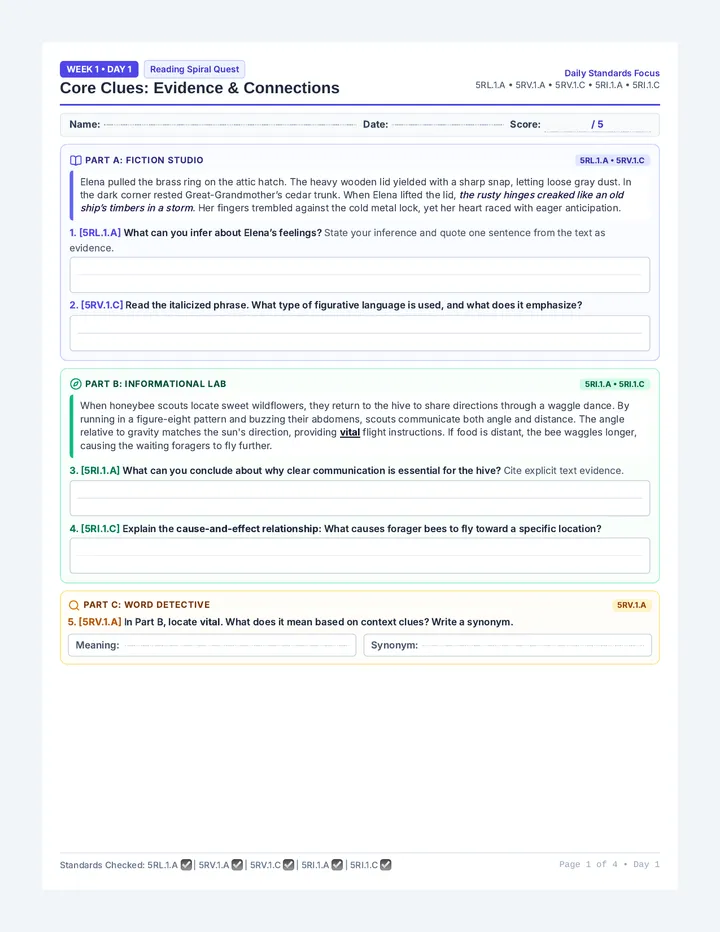
Core Clues Homework Packet

Reading Spiral Quest

A twelve-day, three-week daily reading comprehension and vocabulary homework spiral systematically covering Missouri ELA standards 5RV.1.A, 5RL.1.A, 5RV.1.C, 5RI.1.A, and 5RI.1.C. Each daily task builds critical thinking through paired literary and informational excerpts, targeted evidence-based questions, and rigorous word study.

TG

Tolisha Goldston

6
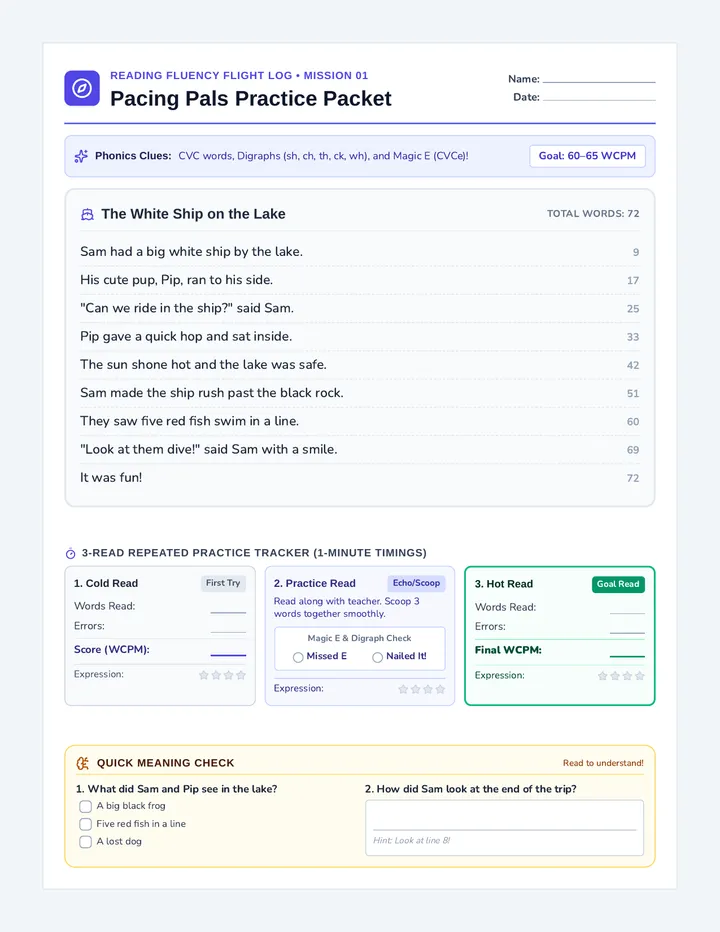
Pacing Pals Practice Packet

Fluent Reader Power Pack

A targeted reading fluency intervention toolkit tailored for 3rd-grade readers at 54–56 WPM. Combines explicit decoding warm-ups, phrase-scooped repeated reading passages, prosody expression drills, and a structured coaching protocol.

MH

Martha Hanson

4
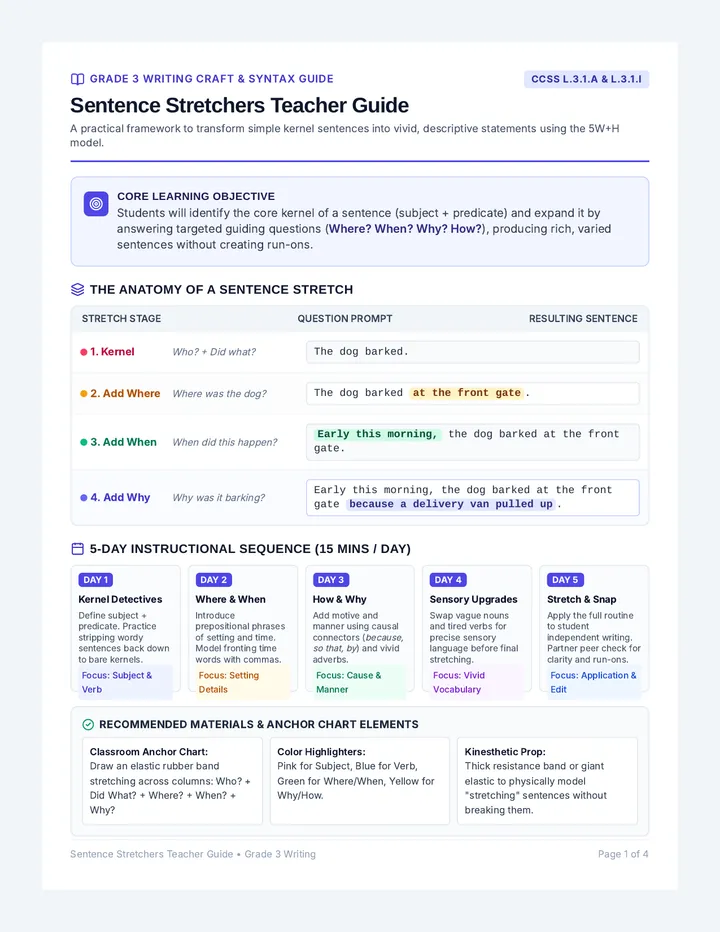
Sentence Stretchers Teacher Guide

Sentence Stretchers Teacher Guide

A comprehensive 4-page teacher guide for Grade 3 educators detailing the 'Sentence Stretchers' routine, modeling scripts, classroom games, differentiation, and a specialized 'Sentence Clinic' for correcting 'and-then' run-ons and adjective stacking.

MH

Martha Hanson

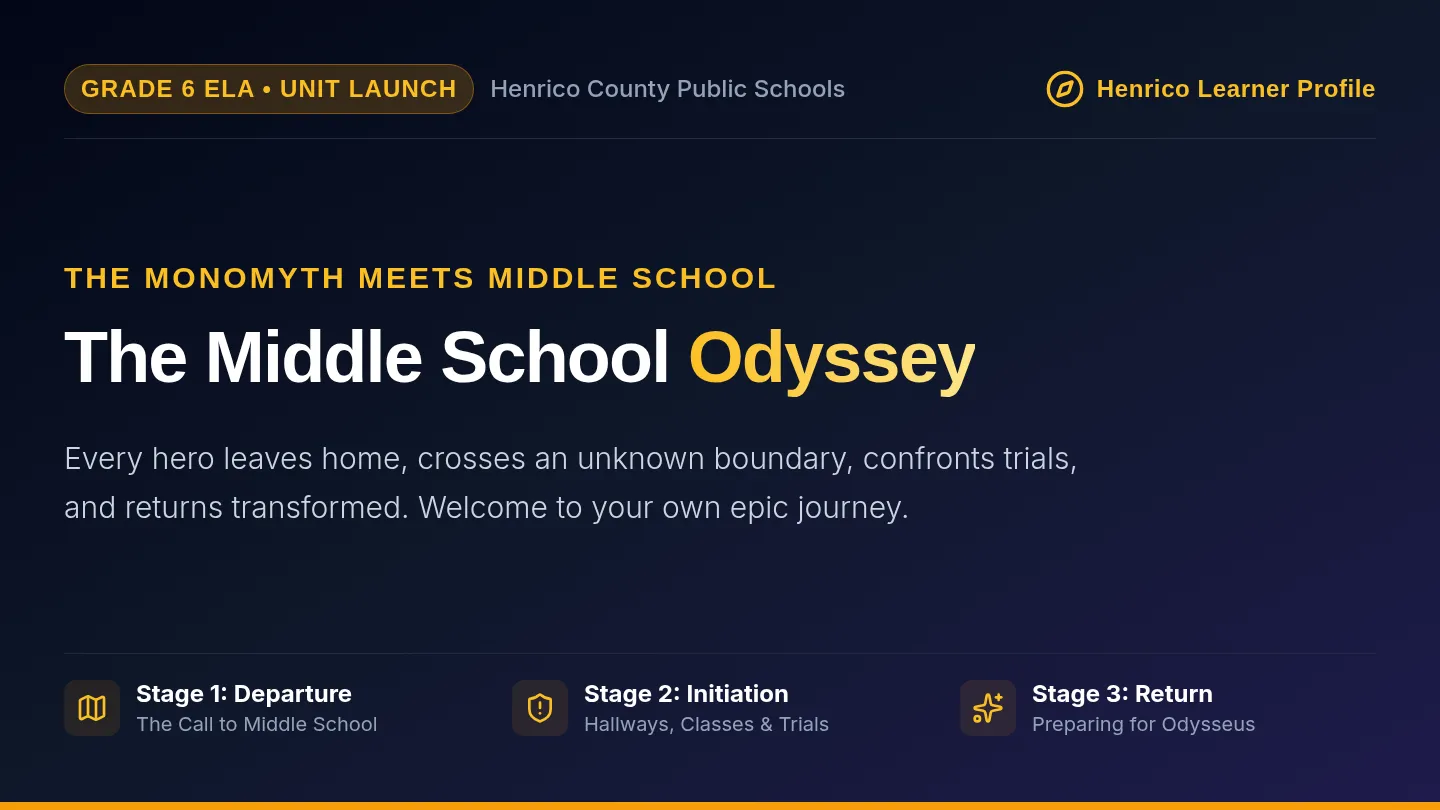
Hero Departure Slides

Middle School Odyssey

A five-day sixth-grade English language arts mini-unit connecting Joseph Campbell's Hero's Journey to the middle school transition, Henrico County's Learner Profile attributes, and Gillian Cross's retelling of The Odyssey.

CL

Charlotte L. Douthit

14
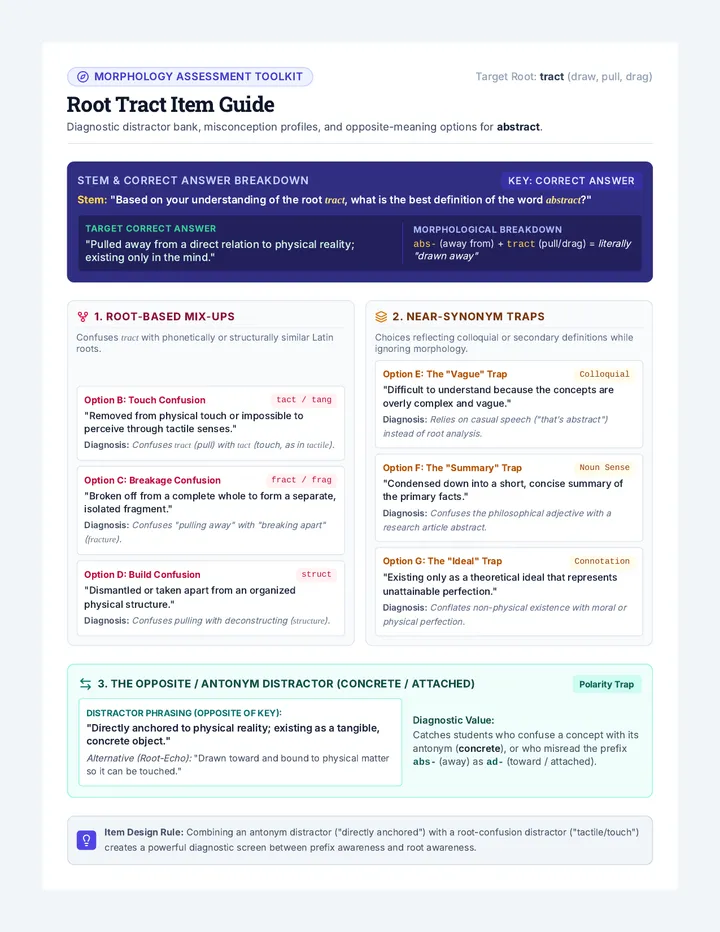
Root Tract Item Guide

Root Item Builders

A collection of educator assessment guides and distractor toolkits designed to analyze Latin roots and diagnose student misconceptions.

J

JENNY.WEIS

3
Meeting Protocols Analysis Worksheet

Meeting Protocols Analysis Worksheet

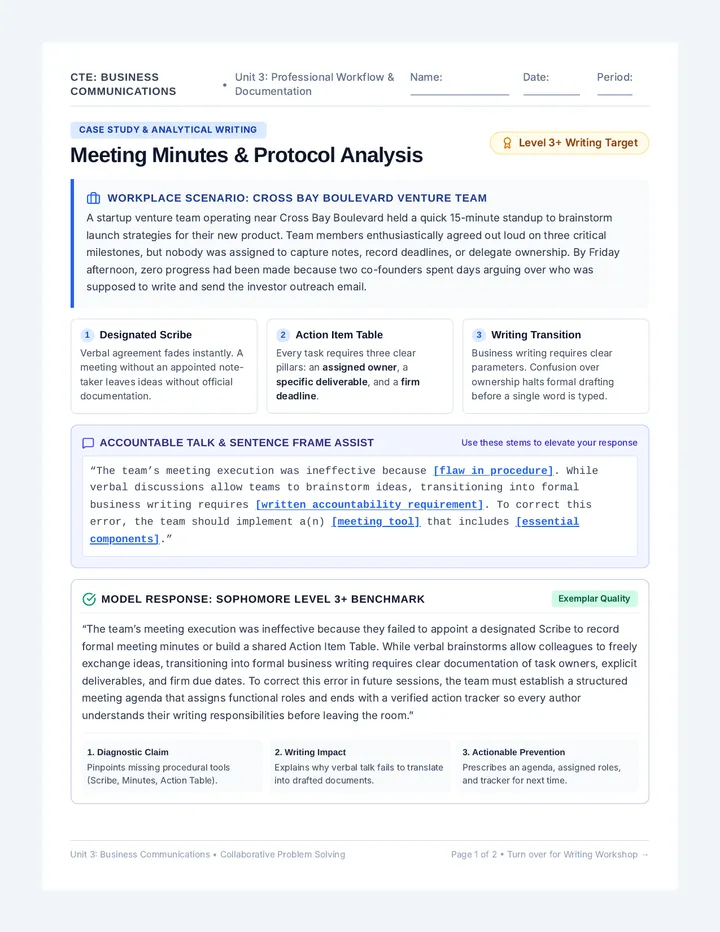
A two-page sophomore-level business communications activity worksheet analyzing meeting protocols, verbal versus written commitments, and transition to formal business writing based on the Cross Bay Boulevard venture scenario. It includes guided sentence frames, an annotated Level 3+ exemplar, accountable talk stems, a student response area, an action item table drill, and a self-assessment rubric.

Lenny Avatar
Lenny
Big Picture Slides

Idea Detectives

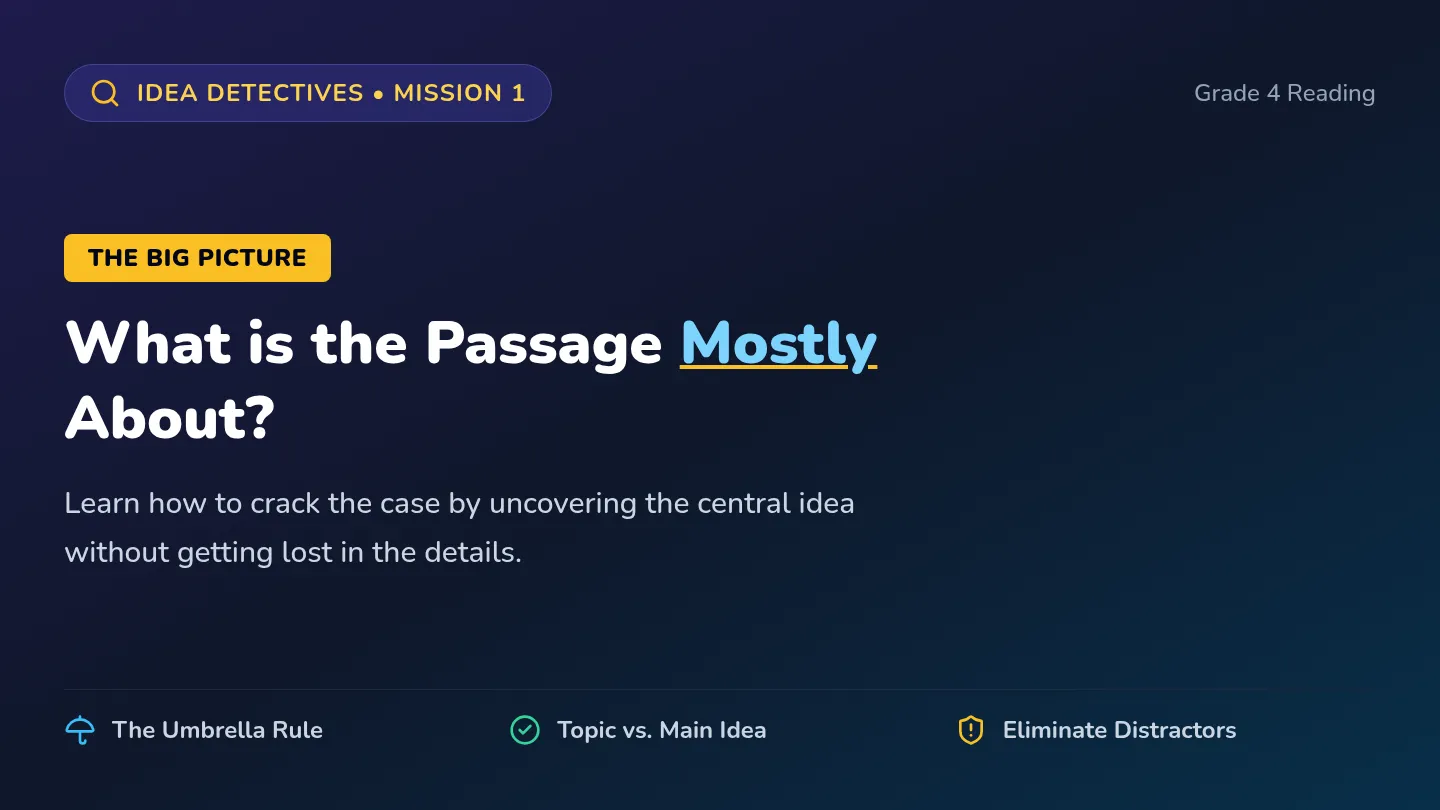
A scaffolded, multi-day reading comprehension sequence aligned to Texas TEKS 4.9(D)(i) and designed for fourth-grade special education students. Across three focused lessons, students learn to recognize the characteristics of informational text by distinguishing topics from central ideas, connecting supporting details, and citing text evidence using structured visual frameworks.

G

gonzalezs

10
Summit Proof Homework Packet

Summit Proof Mastery

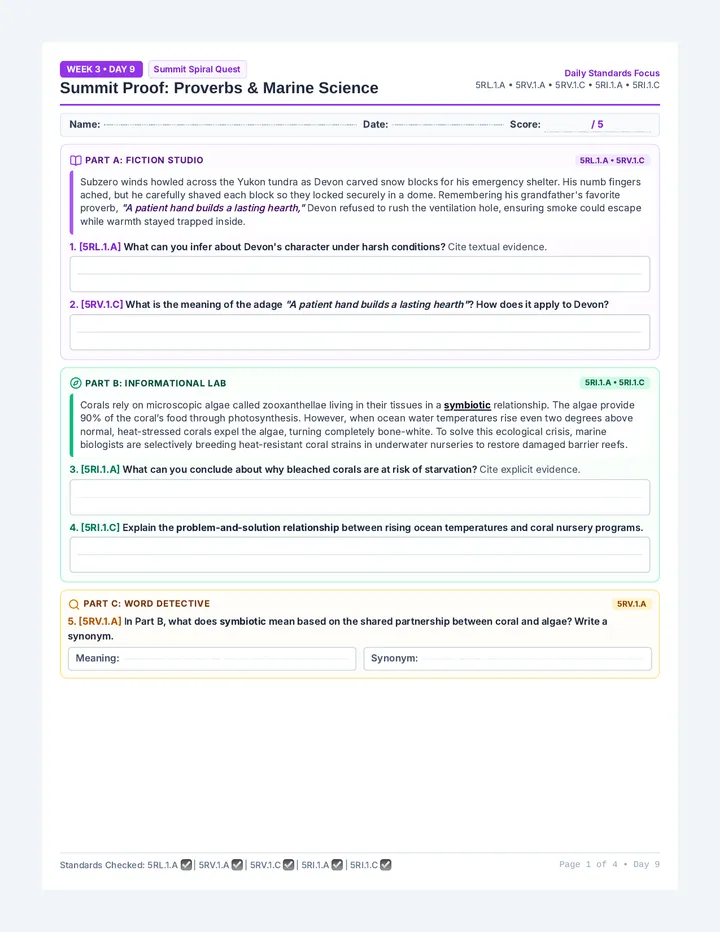
Week three culminates across Days 9 through 12 with high-level inferential reasoning, synthesis of complex textual evidence, interpretation of adages and nuanced connotations, and intricate problem-and-solution interactions between ideas and individuals.

TG

Tolisha Goldston

2
Solton RFP Comprehension Slides

Solton RFP Comprehension Slides

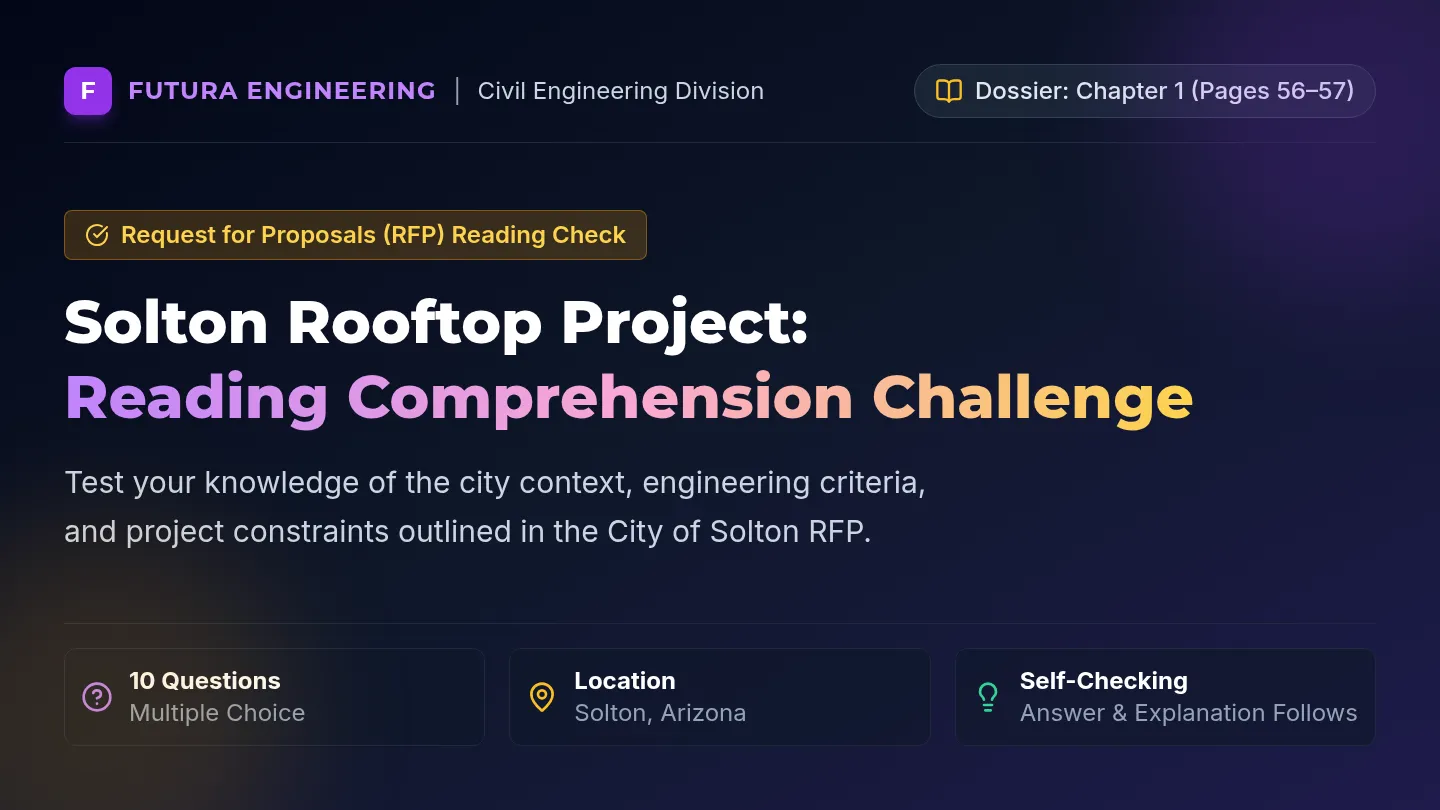
A 21-slide interactive presentation featuring 10 multiple-choice questions with alternating answer and explanation slides covering the Request for Proposals (RFP) article for Solton, Arizona (pages 56-57).

K

KATIE.CADLE

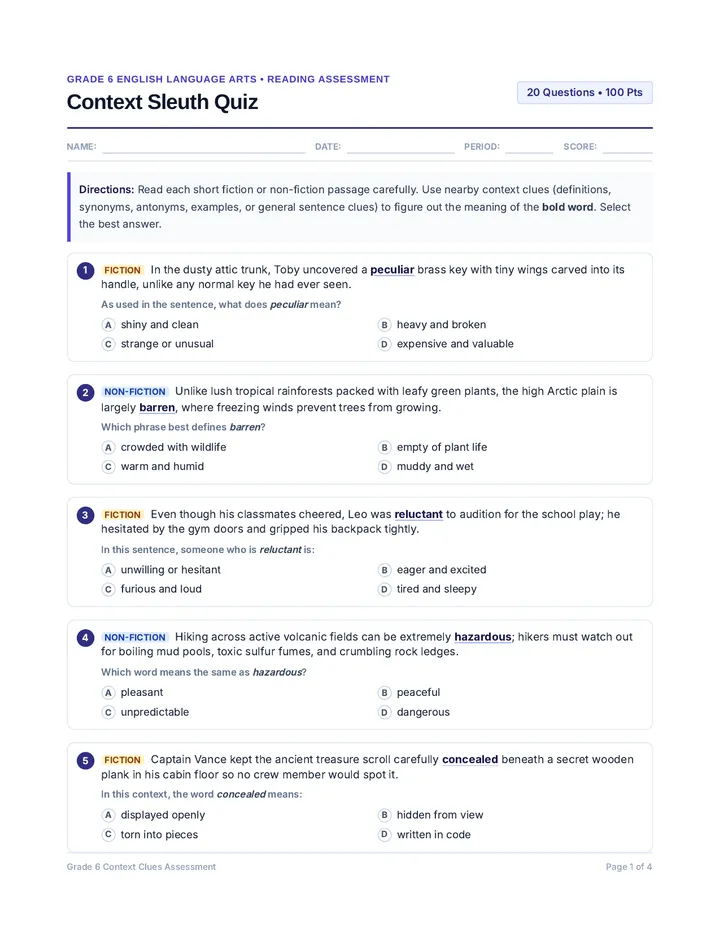
Context Sleuth Quiz

Reading Skill Arsenal

A comprehensive 6th-grade ELA assessment unit focused on foundational reading comprehension, vocabulary acquisition, and literary and informational text analysis across fiction and non-fiction.

SH

Sarah Hunter

6
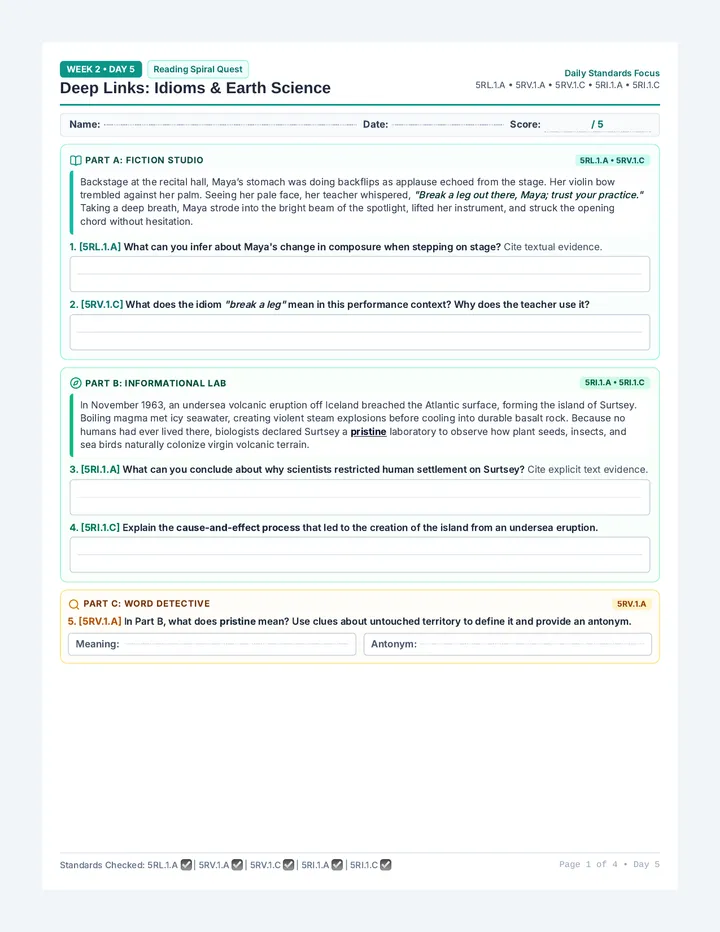
Deep Links Homework Packet

Deep Links Connections

Week two advances analytical rigor across Days 5 through 8 with deeper literary character inferences, idiom and personification analysis, context clues utilizing contrast and antonyms, and informational text structures comparing concepts and analyzing multi-step processes.

TG

Tolisha Goldston

2
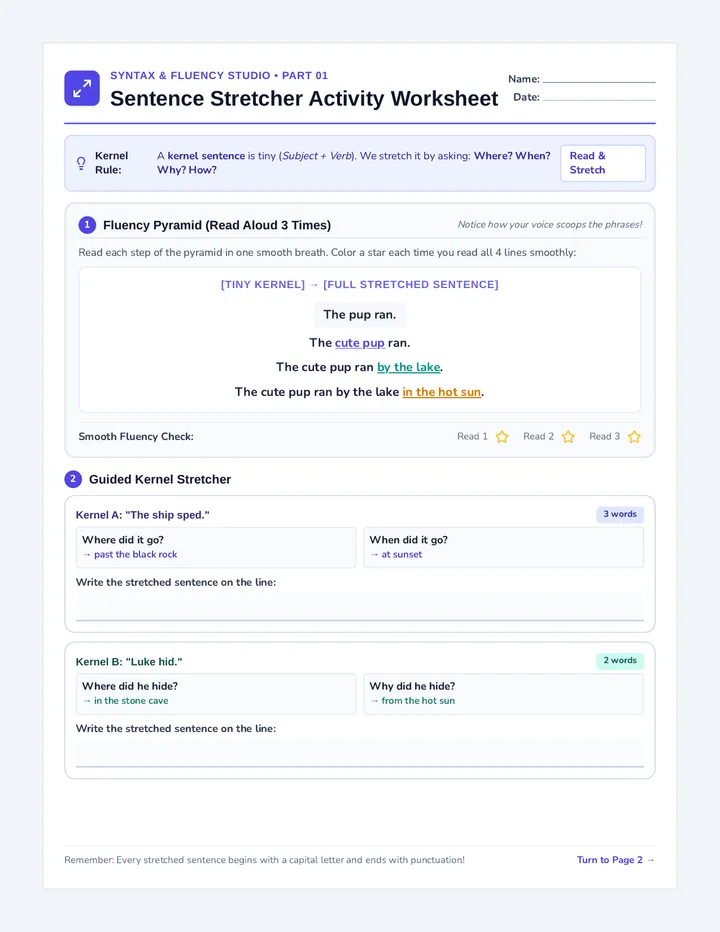
Sentence Stretcher Activity Worksheet

Sentence Stretcher Activity Worksheet

A 2-page sentence expansion worksheet designed for 3rd graders. Connects kernel sentences with reading fluency through sentence pyramid reading ladders and structured Wh-question expansion prompts using accessible CVC, digraph, and CVCe decodables.

MH

Martha Hanson