Blackrock Signal Worksheet Reading & Writing
Name: __________________________ Date: ______________
The Signal at Blackrock Point
Read the story carefully. Use the paragraph numbers to help you find answers.
[1] Every night at sunset, Maya walked up the tall stairs of the lighthouse with her Grandpa Sam. For many years, Grandpa Sam cleaned the big glass lamp. Its bright beam shone far out over the dark sea. The fishing boats trusted that light to stay safe.
[2] One day, the town leaders held a big meeting. Ms. Lee held up a new solar lamp. She said a person in the tower was useless now. "A machine never gets tired," Ms. Lee said. "It costs less money, and it can do the job all by itself."
[3] Grandpa Sam sat quietly, but Maya felt sad and upset. She knew machines could not see everything. Last winter, thick fog hid the harbor. Grandpa Sam heard a boat horn in trouble and flashed the big lamp to guide the boat home.
[4] That night, a big storm hit the town. Hard rain hit the windows, and strong wind blew across the water. Down by the rocks, the town’s new machine light blinked once and went dark. The cold waves had broken it.
[5] "Look out there!" Grandpa Sam called. Through the rain, a small white boat was drifting close to the sharp rocks. Its radio was broken. Without a light, the boat could crash.
[6] Grandpa Sam and Maya ran to the big brass lamp. Together, they pulled the handle three times to flash a warning. Flash! Flash! Flash! Seconds later, the little boat turned away from the rocks and sailed safely into the harbor.
[7] In the morning, the storm was over. When Ms. Lee came to the lighthouse door, Maya showed her the storm notes. "Machines are neat," Maya said. "They can shine a light. But they cannot listen for a boat in trouble, and they do not care who gets home safe."
Part 1: Reading Questions
Circle the best answer for each question.
1. In paragraph [2], what does the word useless mean?
A. very loud
B. not needed anymore
C. too heavy to lift
D. brand new
2. Which sentence from paragraph [2] best helps you know what useless means?
A. "One day, the town leaders held a big meeting."
B. "Ms. Lee held up a new solar lamp."
C. "It costs less money, and it can do the job all by itself."
D. "She said a person in the tower was useless now."
3. What is the main problem in the story?
A. Maya is afraid to climb the tall lighthouse stairs at night.
B. Town leaders want a machine to replace Grandpa Sam, even though people still need him.
C. Grandpa Sam forgets how to clean the big glass lamp.
D. Ms. Lee will not let the fishing boats come into the harbor.
4. Which detail from the story best shows this main problem?
A. The fishing boats trusted the bright beam over the dark sea.
B. Ms. Lee says a machine can work alone, while Maya knows Grandpa Sam saves boats in storms.
C. Hard rain hit the windows and strong wind blew across the water.
D. In the morning, the storm was over and the sky cleared.
5. What is the big lesson of this story?
A. Machines are always better than people at every job.
B. Fishing boats should never go out on the water.
C. Caring people can do important things that machines cannot do.
D. Storms always break new machines at night.
6. Which sentence from the story best shows this lesson?
A. "Every night at sunset, Maya walked up the tall stairs of the lighthouse."
B. "That night, a big storm hit the town."
C. "But they cannot listen for a boat in trouble, and they do not care who gets home safe."
D. "When Ms. Lee came to the lighthouse door, Maya showed her the storm notes."
Part 2: Write Your Opinion
Use complete sentences and story details.
Writing Prompt
Should the town keep Grandpa Sam as the lighthouse helper, or use only the new machine? Write your opinion and give two details from the story to prove why you are right.
Blackrock Signal Answer Key Teacher Resource · Grade 2
Answer Key: The Signal at Blackrock Point
MCQs 1–6
1. Vocabulary in Context (VIC) Answer: B
Rationale: "Not needed anymore" matches Ms. Lee’s claim that a new solar lamp can replace a person in the tower.
2. Best Evidence for Question 1 Answer: C
Rationale: Saying the machine "can do the job all by itself" directly explains why Ms. Lee thinks a human helper is useless (not needed).
3. Central Conflict Answer: B
Rationale: The main problem is the disagreement between town leaders who want a machine and Maya/Grandpa Sam who know people still need a human helper.
4. Best Evidence for Question 3 Answer: B
Rationale: Option B shows both sides of the problem—Ms. Lee wanting a machine to work alone versus Maya knowing Grandpa Sam saves boats.
5. Theme Answer: C
Rationale: When the new machine breaks in the storm, Grandpa Sam and Maya save the boat, showing that caring people do things machines cannot.
6. Best Evidence for Question 5 Answer: C
Rationale: Maya’s closing words in paragraph [7] state the story’s big lesson: machines cannot listen or care like people do.
Part 2: Opinion Writing Guide & Rubric
Both opinions are valid if supported by 2+ story details.
Side A: Keep Grandpa Sam
The new machine light broke in the storm ([4]).
Grandpa Sam and Maya flashed the lamp to save the white boat ([6]).
Last winter, Grandpa Sam heard a boat horn in the fog and guided it home ([3]).
Side B: Use the New Machine
A machine never gets tired ([2]).
It costs the town less money ([2]).
It can do the job by itself on normal nights ([2]).
Criteria
3 – Proficient
2 – Developing
1 – Emerging
Opinion
Clearly states whether to keep Grandpa Sam or use the machine.
States an opinion, but it is a little unclear.
Does not state an opinion.
Story Details (2+)
Gives 2+ accurate details from the story to support the opinion.
Gives 1 story detail or 2 vague details.
Gives no details from the story.
Explanation
Explains how the details prove the opinion is right.
Gives a short or partial explanation.
Does not explain the details.
Sample 2nd-Grade Response (Side A)
I think the town should keep Grandpa Sam as the lighthouse helper. First, in paragraph [4], the town’s new machine light blinked once and broke in the storm. This shows that machines can stop working when the weather is bad. Second, in paragraph [6], Grandpa Sam and Maya flashed the big lamp three times to save a little boat from the sharp rocks. A machine could not see the boat in trouble. That is why the town still needs Grandpa Sam!
Blackrock Signal Teacher Guide Instructional Guide
Lanterns of Blackrock: Teacher Guide
45 Min · Grade 2 ELA
Learning Objectives
Use context clues to figure out the meaning of an unfamiliar word (Vocabulary in Context ).
Identify the main problem (conflict) and big lesson (theme) and find the best evidence in the story.
Write a persuasive opinion using two details from the story .
45-Minute Lesson Pacing
Time
Phase
Teacher & Student Actions
5 min
Warm-Up (Slides 1–2)
Ask: "Can a machine do every job, or do we still need people to help?" Turn and talk.
10 min
Read Aloud & VIC (Slides 3–4)
Read "The Signal at Blackrock Point" together. Model the 3-step VIC strategy on useless ([2]).
10 min
Questions 1–6 (Slide 5)
Students answer Part 1 (or do Q1–Q2 together, then Q3–Q6 in pairs). Check evidence choices together.
10 min
Town Meeting Activity (Slide 6)
Use the Harbor Council Debate Activity sheet to collect 2 story clues for each side and share aloud.
10 min
Opinion Writing (Slide 7)
Students write their Part 2 opinion paragraph with two details from the story.
Model Think-Aloud: Vocabulary in Context (Paragraph [2])
"I see the word useless in paragraph [2]. Let’s read the sentences right after it! Ms. Lee holds up a new solar lamp and says, 'A machine never gets tired. It costs less money, and it can do the job all by itself.' If the machine can do the job all by itself, then Ms. Lee thinks a person is not needed anymore. So useless means not needed anymore!"
Classroom Activities & Differentiation
Grade 2 Facilitation Notes
Activity: Town Meeting Clue Hunt (10 Minutes)
Partner Clue Hunt (4 min): Give pairs the Harbor Council Debate Activity sheet. Have them find two clues for keeping Grandpa Sam and two clues for using the machine.Stand & Share (4 min): Ask half the class to speak for Grandpa Sam and half for the machine. Each partner group shares one clue aloud using the paragraph number.Pick Your Side (2 min): Have students circle or write their true opinion at the bottom before starting Part 2 on the worksheet.
Watch Out For: Common 2nd-Grade Pitfalls
Paired Evidence Trap (Q2, Q4, Q6): Second graders often pick a sentence just because it sounds familiar. Teach them to ask: "Does this sentence prove my exact answer above?" Retelling vs. Lesson (Q5): Remind students that the big lesson is something we can learn for our own lives, not just what happened to one boat.Forgetting the Second Detail (Part 2): Have students number their two details ("First..." and "Second...") so they remember to include both.
Support for Developing Readers
Echo-read or choral-read paragraphs [1]–[7] together first.
Provide a sentence starter for Part 2: "I think the town should ___. First, in the story, ___. Second, ___."
Let students underline clues in paragraph [2] and [7] with a crayon.
Extension for Ready Writers
Add a closing sentence explaining why the other side’s idea wouldn’t work in a big storm.
Draw a quick sketch on the back showing how Maya and Grandpa Sam saved the boat.
Harbor Council Debate Activity Classroom Activity
Name: __________________________ Date: ______________
Town Meeting: Story Clue Hunt
Work with a partner to find two story details for each side before you pick your own opinion.
Side A
Keep Grandpa Sam
Clue 1 (Detail + Paragraph #):
Clue 2 (Detail + Paragraph #):
Side B
Use Only the Machine
Clue 1 (Detail + Paragraph #):
Clue 2 (Detail + Paragraph #):
My Opinion Sentence
Write your main opinion sentence to start Part 2 on your worksheet:
Blackrock Signal Slides Grade 2 Reading & Writing
Lanterns of Blackrock
Reading "The Signal at Blackrock Point" to find word clues, the main problem, the big lesson, and story details!
Warm-Up · 5 Minutes
People vs. Machines
"Can a machine do every job, or do we still need people to help?"
Turn and tell a partner what you think!
Word Detective
Using Context Clues
1. Read Around
Look at the sentences right before and after the new word.
2. Find Clues
Ask: What is happening here? What clues does the author give?
3. Try It Out
Put your meaning into the sentence to see if it makes sense.
Prove It!
Finding the Best Evidence
Questions 1, 3, and 5 ask what a word means, the main problem, or the big lesson.
Questions 2, 4, and 6 ask you to prove your answer with a sentence from the story.
Check yourself: Does this sentence really prove my answer above?
Story Elements
Main Problem vs. Big Lesson
Main Problem
What goes wrong or what the characters are arguing about in the story .
Big Lesson
The important message we can learn for our own lives .
Class Activity · 10 Minutes
Town Meeting: Clue Hunt
Step 1: Work with a partner to find 2 story clues for each side.
Step 2: Share your favorite clue out loud with the class.
Step 3: Write your own opinion sentence at the bottom of your sheet!
Part 2 · Write Your Opinion
Time to Write!
Should the town keep Grandpa Sam as the lighthouse helper, or use only the new machine?
• Tell your opinion clearly.
• Give two details from the story to prove you are right.
• Use complete sentences with capital letters and periods.
Harbor Stories Worksheet Reading & Writing · Text 1
Name: __________________________ Date: ______________
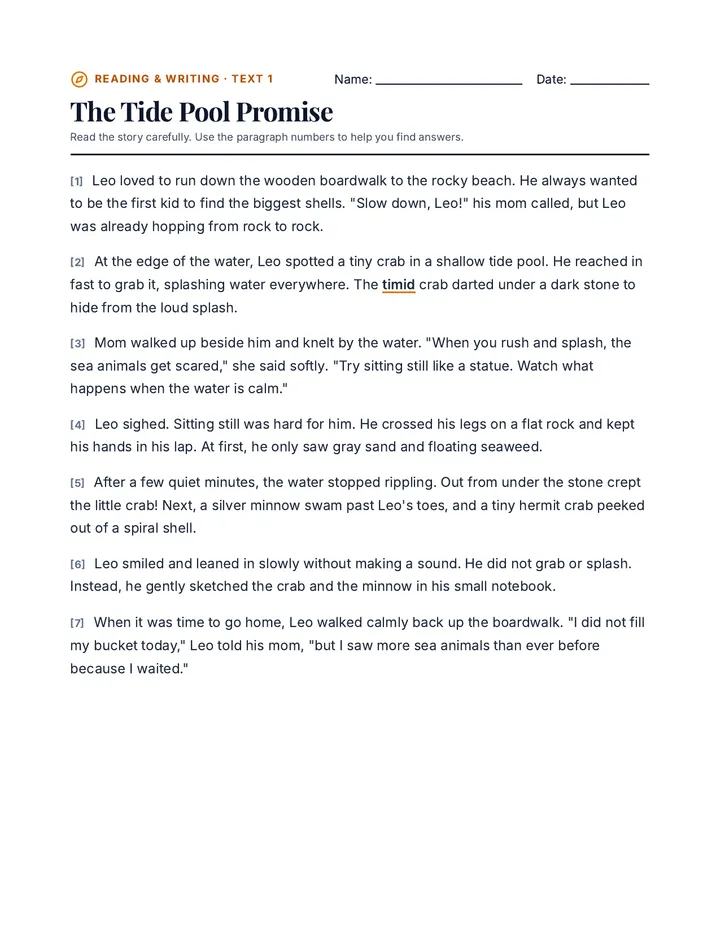
The Tide Pool Promise
Read the story carefully. Use the paragraph numbers to help you find answers.
[1] Leo loved to run down the wooden boardwalk to the rocky beach. He always wanted to be the first kid to find the biggest shells. "Slow down, Leo!" his mom called, but Leo was already hopping from rock to rock.
[2] At the edge of the water, Leo spotted a tiny crab in a shallow tide pool. He reached in fast to grab it, splashing water everywhere. The timid crab darted under a dark stone to hide from the loud splash.
[3] Mom walked up beside him and knelt by the water. "When you rush and splash, the sea animals get scared," she said softly. "Try sitting still like a statue. Watch what happens when the water is calm."
[4] Leo sighed. Sitting still was hard for him. He crossed his legs on a flat rock and kept his hands in his lap. At first, he only saw gray sand and floating seaweed.
[5] After a few quiet minutes, the water stopped rippling. Out from under the stone crept the little crab! Next, a silver minnow swam past Leo's toes, and a tiny hermit crab peeked out of a spiral shell.
[6] Leo smiled and leaned in slowly without making a sound. He did not grab or splash. Instead, he gently sketched the crab and the minnow in his small notebook.
[7] When it was time to go home, Leo walked calmly back up the boardwalk. "I did not fill my bucket today," Leo told his mom, "but I saw more sea animals than ever before because I waited."
Part 1: Text 1 Questions
Circle the best answer for each question.
1. In paragraph [2], what does the word timid mean?
A. very large
B. shy or easily scared
C. bright red
D. fast at swimming
2. Which sentence from paragraph [2] best helps you know what timid means?
A. "At the edge of the water, Leo spotted a tiny crab in a shallow tide pool."
B. "He reached in fast to grab it, splashing water everywhere."
C. "The timid crab darted under a dark stone to hide from the loud splash."
D. "Leo loved to run down the wooden boardwalk to the rocky beach."
3. What is the main problem in the story?
A. Leo loses his notebook on the wooden boardwalk.
B. Leo rushes and splashes, which scares away the tide pool animals he wants to see.
C. Leo's mom will not let him go near the rocky beach.
D. The tide pool dries up before Leo can reach the water.
4. Which detail from the story best shows this main problem?
A. "He always wanted to be the first kid to find the biggest shells."
B. "'When you rush and splash, the sea animals get scared,' she said softly."
C. "At first, he only saw gray sand and floating seaweed."
D. "Instead, he gently sketched the crab and the minnow in his small notebook."
5. What is the big lesson of this story?
A. Filling a bucket with shells is the best way to enjoy the beach.
B. Crabs only come out when the tide is high.
C. Being patient and calm helps us notice wonderful things.
D. Drawing pictures is easier than walking on rocks.
6. Which sentence from the story best shows this lesson?
A. "'Slow down, Leo!' his mom called, but Leo was already hopping from rock to rock."
B. "He crossed his legs on a flat rock and kept his hands in his lap."
C. "'I did not fill my bucket today,' Leo told his mom, 'but I saw more sea animals than ever before because I waited.'"
D. "When it was time to go home, Leo walked calmly back up the boardwalk."
Reading & Writing · Text 2
Read carefully and use paragraph numbers.
The Painted Boat
Read the story carefully. Use the paragraph numbers to help you find answers.
[1] Nora loved to paint pictures of sailboats in her bedroom, where nobody else could see them. Whenever her teacher asked to hang her art in the hallway, Nora shook her head and hid her paper in her desk.
[2] One Friday, Mr. Alvarez announced that the class would paint a big mural on the wooden fence by the harbor. Nora felt anxious as she stared at the huge blank boards. Her stomach felt fluttery, and she worried that everyone walking by would laugh at her brushstrokes.
[3] "I can't paint out here," Nora whispered to her friend Ben. "What if I mess up the waves?" She held her brush tightly and stood behind the paint cans so no one would notice her.
[4] Ben dipped his brush into bright blue paint and made a big swooping line across the fence. Oops! A drop of blue splashed right onto the brown dock he was painting. Instead of getting upset, Ben smiled and turned the stray drop into a little seagull flying overhead.
[5] Nora blinked in surprise. She looked at the empty space near the corner of the fence. Slowly, she dipped her brush into yellow paint and added a small, crooked lantern on the pier.
[6] Soon, Nora painted a red sailboat beside the lantern. A woman walking her dog stopped to watch. "That little yellow lantern makes the whole harbor look warm and welcoming!" the woman said with a big smile.
[7] Nora grinned and picked up a wider brush to paint the sunset sky. By the time the mural was finished, she did not want to hide her work anymore. She even signed her name in bright yellow paint right at the bottom.
Part 2: Text 2 Questions
Circle the best answer for each question.
1. In paragraph [2], what does the word anxious mean?
A. sleepy and tired
B. worried and nervous
C. angry and loud
D. proud and excited
2. Which sentence from paragraph [2] best helps you know what anxious means?
A. "One Friday, Mr. Alvarez announced that the class would paint a big mural on the wooden fence by the harbor."
B. "Nora felt anxious as she stared at the huge blank boards."
C. "Her stomach felt fluttery, and she worried that everyone walking by would laugh at her brushstrokes."
D. "Nora loved to paint pictures of sailboats in her bedroom, where nobody else could see them."
3. What is the main problem in the story?
A. Nora is too scared of making mistakes to share her painting in public.
B. The class runs out of blue and yellow paint before the mural is done.
C. Mr. Alvarez forgets to bring brushes to the wooden fence by the harbor.
D. Ben splashes paint on Nora's favorite sailboat picture.
4. Which detail from the story best shows this main problem?
A. "Nora loved to paint pictures of sailboats in her bedroom, where nobody else could see them."
B. "She held her brush tightly and stood behind the paint cans so no one would notice her."
C. "Ben dipped his brush into bright blue paint and made a big swooping line across the fence."
D. "A woman walking her dog stopped to watch."
5. What is the big lesson of this story?
A. Only paint pictures inside your bedroom where it is quiet.
B. Never use bright yellow paint on a wooden fence.
C. Being brave enough to try and share your work can bring joy to you and others.
D. Painting seagulls is harder than painting sailboats.
6. Which sentence from the story best shows this lesson?
A. "Whenever her teacher asked to hang her art in the hallway, Nora shook her head."
B. "Slowly, she dipped her brush into yellow paint and added a small, crooked lantern on the pier."
C. "By the time the mural was finished, she did not want to hide her work anymore."
D. "A drop of blue splashed right onto the brown dock he was painting."
Part 3: Character Change
Use complete sentences and story details.
Writing Prompt
Choose one main character from either story (Leo from The Tide Pool Promise or Nora from The Painted Boat ). Explain how that character changed from the beginning to the end of the story. Give two details from the story to show how they changed.