Anatomy Joke Slides The Anatomy of a Joke
Dissecting the DNA of Humor
What makes this funny?
"Why don't scientists trust atoms?"
"Because they make up everything!"
Meaning 1:
Atoms are the tiny building blocks that compose all physical matter.
Meaning 2:
To "make up" can mean to lie or invent a false story.
The Secret Ingredients
Homophones
Words that sound the same but have different spellings and different meanings .
Knight / Night Sea / See
Homonyms
Words that are spelled the same and sound the same , but have different meanings .
Bark (tree/dog) Bat (sports/animal)
The "Pivot Point" is where the word shifts between meanings!
Let's Dissect One Together
"I'm reading a book about anti-gravity..."
"It's impossible to put down!"
The Pivot Word
Put down
Context A (Anti-gravity)
Physically lowering something to the ground (which gravity prevents).
Context B (Reading)
Stopping a book because it is so interesting you can't stop reading.
Pun Masterclass
Watch this comedian use wordplay. Can you spot the homophones and homonyms they use as "pivot points"?
[Comedian Video Clip: Example of Brian Regan or Milton Jones]
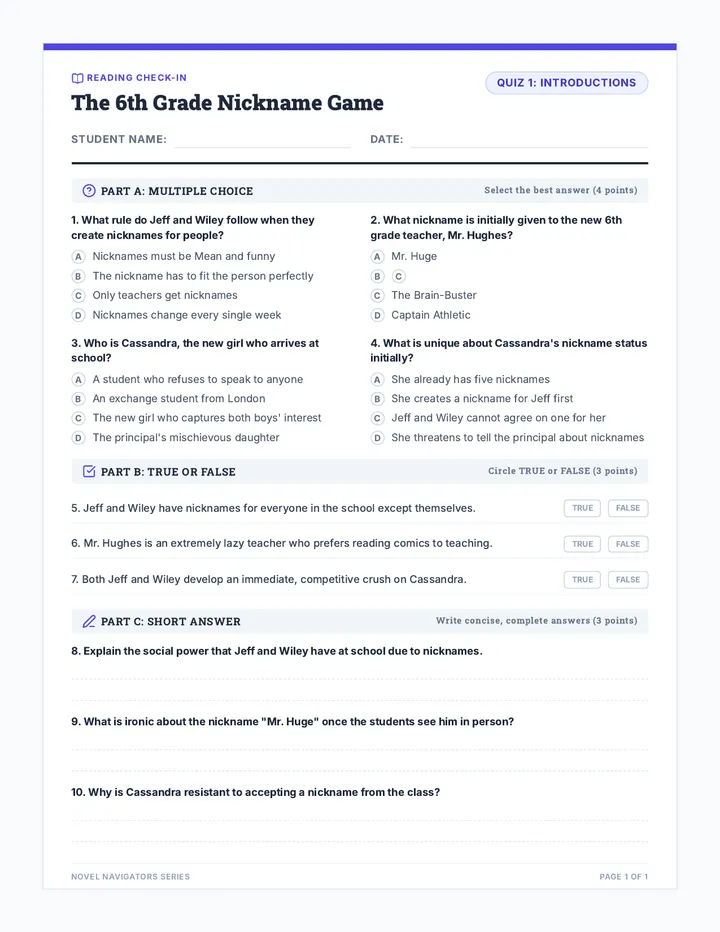
Joke Lab Worksheet The Joke Lab
Linguistic Dissection & Analysis
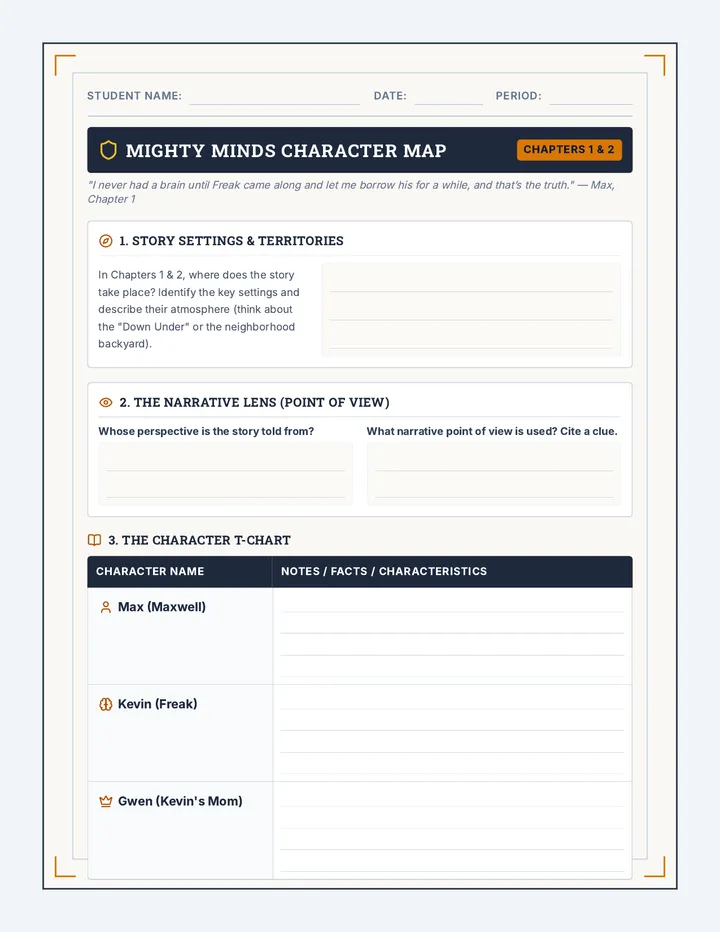
Student Name:
Class Period:
Lab Instructions
Every pun has a pivot point —a word or phrase that shifts the meaning of the sentence. Your job is to act as a linguistic scientist and dissect the jokes below. Identify the pivot word and explain the two different meanings that make the joke work.
SPECIMEN #01
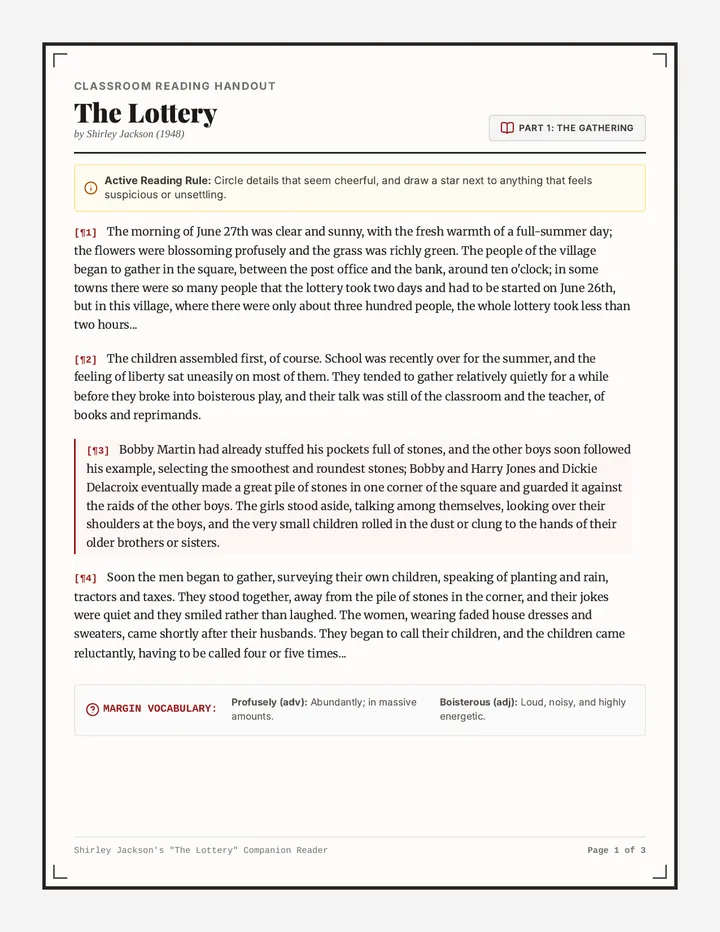
"I'm a big fan of whiteboards. I find them quite re-markable."
1. Identify the Pivot Word(s):
2. Meaning A (Whiteboard Context):
3. Meaning B (Figurative Context):
SPECIMEN #02
"What do you call a fake noodle? An Impasta."
1. Identify the Pivot Word(s):
2. Meaning A (The Food Word):
3. Meaning B (The Funny Sound-Alike):
SPECIMEN #03
"The wedding of the two antennas was great. The ceremony was okay, but the reception was incredible!"
1. Identify the Pivot Word(s):
2. Meaning A (Wedding Context):
3. Meaning B (Technology Context):
Linguistic Conclusion
Based on your analysis, explain how a writer creates a "double meaning." Does the humor come from the word's sound (homophone) or its multiple definitions (homonym)? Use examples from the Specimens above.
Anatomy Joke Teacher Guide Teacher Guide: Anatomy of a Joke
Lesson 1: Structural Analysis of Wordplay
Grade Level: 6th Grade
Duration: 45-60 Minutes
Lesson Objective
Students will be able to identify homophones and homonyms within puns and explain how multiple meanings contribute to the humor of a joke by identifying the linguistic "pivot point."
Key Vocabulary
Homophone: Same sound, different spelling/meaning.
Homonym: Same sound/spelling, different meaning.
Pivot Point: The specific word or phrase where the meaning of a pun shifts.
Wordplay: The witty exploitation of the meanings and ambiguities of words.
Facilitation Tips
Embrace the Groans: Dad jokes are designed to be "bad." Encourage students to groan, then challenge them to explain why the joke is technically clever.
Scaffolding: For students struggling to see the shift, have them draw two different pictures for the pivot word.
Instructional Steps
1
The Hook (5-10 mins)
Display the "Atoms" joke from the slides. Ask students why it's funny. Guide them to see that the phrase "make up" is doing two things at once. Show a quick clip of a pun-heavy comedian (e.g., Tim Vine or Milton Jones) to build excitement.
2
Direct Instruction (15 mins)
Use the slides to define Homophones and Homonyms. Introduce the concept of the Pivot Point . Model the dissection process using the "Anti-gravity" book example.
3
The Joke Lab Analysis (20 mins)
Students work individually or in pairs to complete the Joke Lab Worksheet . Circulate to ensure students are identifying the specific word/phrase and not just describing the general situation.
Answer Key: Joke Lab
Specimen #01 (Whiteboards)
Pivot: Remarkable
Meanings: (A) Can be written on again / (B) Extraordinary or worth noting.
Specimen #02 (Impasta)
Pivot: Impasta / Imposter
Meanings: (A) A type of noodle (Pasta) / (B) A fake person (Imposter). This is a homophone pun.
Specimen #03 (Antenna Wedding)
Pivot: Reception
(A) A post-wedding party / (B) The quality of a radio or TV signal received by an antenna.
Headlines Advertising Slides Puns in the Wild
Headlines, Ads, and Brands
Why use puns in ads?
Attention
The "mental hiccup" of a pun makes people stop and look twice.
Memory
Solving a small linguistic "riddle" helps us remember the brand better.
Emotion
Humor creates a positive feeling toward the product.
Candy Bar Ad:
"A Mid-Day Snack That's Simply Sweet!"
Product: A bar of chocolate with honey.
The Double Play
Meaning 1: Taste
The candy is literally sugary and delicious.
Meaning 2: Character
A "sweet deal" or a "sweet person" – positive and pleasing.
Headlines that Pop
The Sports Gazette
"Lions Coach Denies Being A Cheetah"
Homophone!
The Culinary Times
"New Bakery Opening: Bread-y or Not!"
Wordplay!
Outdoor Weekly
"Camping is In-Tents"
Homophone!
Your Mission: Ad Detectives
In your worksheet, you will analyze 5 different ads and headlines. You must find the Pivot Word and explain how it connects the product to the pun.
Analyze the Word
Draft the Meaning
Ad Detective Worksheet Ad Detective Agency
Case File: The Language of Selling
Agent Name:
Assignment Date:
Linguistic Briefing
Advertisers and journalists are masters of the pivot word . They use homophones and homonyms to create clever connections that stay in a reader's mind. Your mission is to analyze the following examples and uncover the dual meanings.
Campaign #442
"Our Eyeglasses Are Speck-tacular!"
Brand: ClearSight Optics
Identify the Pivot Word:
Meaning 1 (Product Related):
Meaning 2 (Figurative):
Campaign #109
"Tread Lightly With Our New Shoes."
Brand: FeatherStep Running
Identify the Pivot Word:
Meaning 1 (Literal Action):
Meaning 2 (Shoe Component):
Campaign #881
"This Sale is Un-Bee-Lievable!"
Brand: Honeypot Crafts
Identify the Pivot Word:
Meaning 1 (The Animal):
Meaning 2 (Adjective):
Your Turn to Pitch
Choose one of the products below and write your own clever pun-based slogan. Identify your pivot word and explain why it will grab attention.
An Umbrella Company
A Math Tutoring Service
A Car Repair Shop
My Slogan:
Pivot Word:
Why it works:
Ad Detective Teacher Guide Teacher Guide: Puns in the Wild
Lesson 2: Media Literacy & Persuasion
Grade Level: 6th Grade
Focus: Homophones/Homonyms in Advertising
Learning Objectives
Students will analyze how homophones and homonyms are used as rhetorical devices in advertising and news to grab attention and build brand identity.
Media Literacy Connection
Puns aren't just for jokes; they are powerful tools for persuasion. When a consumer "solves" a pun, they feel a moment of accomplishment that they then associate with the product.
Preparation Checklist
Gather physical examples (optional): Candy wrappers, newspaper front pages, or screenshots of local business billboards.
Review the "Pivot Point" concept from Lesson 1.
Activity Guide
1. The Hook (10 mins)
Show the slide with "Lions Coach Denies Being A Cheetah." Ask: "Is the coach a big cat?" No. "Is the coach dishonest?" Possibly. Explain that newspapers use these to make dry news more clickable/readable.
2. Guided Analysis (15 mins)
Work through the "Sweet Snack" example on the slides. Explicitly map out Meaning 1 vs. Meaning 2. Emphasize that in advertising, both meanings are usually positive.
3. Ad Detective Investigation (20 mins)
Students complete the worksheet. For the "Your Turn to Pitch" section, encourage them to look for homophones related to their product (e.g., Umbrella -> Rain/Reign, Car -> Wheel/Wheelie, Brake/Break).
Answer Key: Ad Detective
Ad 1: Speck-tacular
Pivot: Speck-tacular (Spectacles)
Meanings: (1) Glasses (spectacles) / (2) Amazing (spectacular).
Ad 2: Tread Lightly
Pivot: Tread
Meanings: (1) To walk / (2) The bottom of a shoe.
Ad 3: Un-Bee-Lievable
Pivot: Un-Bee-Lievable (Bee)
Meanings: (1) The honey bee (Honey product) / (2) Impossible to believe.
Constructing Puns Slides The Pun-O-Matic
Engineering Original Wordplay
How do you BUILD a pun?
Step 1: Pick a Pair
Find a homophone or a homonym.
Step 2: Find a Link
What scenario connects both meanings?
Step 3: Draft the Joke
Write the setup and the punchline.
The Algorithm in Action
WORD: STEAL / STEEL
LINK: A robot or a superhero?
"Why did the robot go to jail?"
"He was caught stealing (steeling) metal!"
Let's Warm Up!
OBJECT 1
Bicycle
(Homophone: Two-tired / Too tired)
OBJECT 2
Carrot
(Homophone: Carrot / Karat)
Can we make a joke about a very sleepy bicycle?
Pro-Tips for Punsters
Keep it Simple
The best puns are short and punchy. Don't over-explain the setup.
Context is Key
Make sure both meanings of the word actually fit the story you are telling.
Example:
"I wondered why the baseball was getting bigger. Then it hit me."
Pivot: Hit me (Physical strike / Sudden realization)
Pun Workshop
Open your Pun Builder Worksheet. It's time to manufacture some laughs!
Step 1: The Word Bank Step 2: The Blueprint Step 3: The Pitch
Pun Builder Worksheet Pun Construction Kit
Blueprint #001: The Wordplay Workshop
Lead Engineer:
Project Date:
1
Select Your Raw Materials
Circle ONE word pair from the "Linguistic Stockroom" below to build your pun around.
FEET / FEAT
SORE / SOAR
DEER / DEAR
KNIGHT / NIGHT
SALE / SAIL
BEAR / BARE
BOARD / BORED
SCALE (Fish/Weight)
2
Design the Connection
Meaning A Definition:
Meaning B Definition:
The "Meeting Point" (What scenario involves both?):
3
The Final Build
Setup (The Question or Opening):
Punchline (The Pivot Point):
Note: Ensure your homophones are spelled correctly for the punchline!
Pun Builder Teacher Guide Teacher Guide: Constructing Puns
Lesson 3: Creative Writing & Lateral Thinking
Grade Level: 6th Grade
Skills: Synthesis, Homophone Mastery
Lesson Objective
Students will apply their knowledge of homophones and homonyms to create original puns by identifying a shared context between two meanings and drafting a setup/punchline structure.
Lateral Thinking
Punning is essentially "forced connection." Encourage students to find a commonality between seemingly unrelated things (e.g., a "Scale" connects a fish to a weight loss center). This builds cognitive flexibility.
The "Pun-O-Matic" Steps
1 Selection: Choose a homophone pair.
2 Brainstorming: List associations for both words.
3 The Bridge: Find where the lists overlap.
4 Drafting: Hide the punchline!
Instructional Steps
1. The "Robot Jail" Model (10 mins)
Use the slides to model the robot joke. Ask: "If I choose 'Knight/Night', what are things associated with knights (swords, armor, horses) and night (sleeping, darkness, stars)? How can I put a knight in the night?" (e.g., A knight who couldn't stay awake for his shift... he was a _night_mare.)
2. Collaborative Construction (15 mins)
Pick a word from the worksheet list (like FEET/FEAT). As a class, brainstorm a scenario. (e.g., a giant's feat). "Why did the giant get a trophy? It was quite a feat !"
3. Independent Workshop (25 mins)
Students work on the Pun Builder Worksheet . Monitor for "False Puns" where the word doesn't actually have a double meaning or correct homophone.
Scaffolding Suggestions
For Struggling Writers:
Provide the scenario and have them fill in the pivot word. Give them a list of "Topic-Word" pairings (e.g., Topic: School / Word: Board-Bored).
For Advanced Writers:
Challenge them to use spoonerisms (switching initial letters) or compounded puns (puns that require two pivots to work together).
Visual Puns Slides Literal Thinkers
The Art of the Visual Pun
Meet the Literal Queen
"Amelia Bedelia, I need you to draw the drapes ."
What happened?
She sat down with a sketchbook and a pencil and drew a picture of the curtains!
Literal vs. Figurative
Puns and Idioms rely on the difference between what words actually say and what they actually mean .
Literal
Exactly what the words describe.
Figurative
A hidden or symbolic meaning.
Seeing is Believing
🍯
A Honey-Boo
A ghost made of honey.
A Hoarse Horse
A horse that lost its voice.
Time Flies
An idiom taken literally.
The Visual Rulebook
A Visual Pun
Uses **Homophones** or **Homonyms**. One drawing represents two sound-alike words.
Example: A "Mussel" (the shellfish) with big "Muscles" (biceps).
A Literal Idiom
Takes a **Figurative Phrase** and draws it exactly as said, ignoring the hidden meaning.
Example: "Break a leg" showing someone actually snapping a wooden table leg.
The Literal Gallery
You will receive a prompt. You must create a high-quality drawing of the LITERAL interpretation. Don't worry about being an artist—worry about being clever!
Step 1
Pick a Prompt
Step 2
Draft Literal Look
Step 3
Label the Pivot
Literal Gallery Drawing Prompt The Literal Gallery
Exhibition: Figurative vs. Literal Space
Artist Name:
Artist's Instructions
Choose ONE of the prompts below. Your goal is to draw the LITERAL interpretation of the phrase. Ignore the actual meaning of the idiom or the "clever" part of the pun—just draw exactly what the words say.
Selected Exhibit Prompts:
"A Piece of Cake"
Idiom
"Butterflies in my stomach"
Idiom
"A Bear (Bare) Foot"
Homophone Pun
"A Night (Knight) Owl"
Homophone Pun
Canvas
The Literal Description:
The Figurative Meaning:
Vocabulary Focus: Literal vs. Figurative Language Interpretation
Visual Puns Teacher Guide Teacher Guide: Visual Puns
Lesson 4: Literal vs. Figurative Interpretation
Grade Level: 6th Grade
Skills: Visualization, Semantic Mapping
Why Visuals Matter
Visualizing a pun requires students to hold two competing meanings in their head simultaneously. This "semantic conflict" is exactly what we want to cultivate to improve reading comprehension and vocabulary depth. By drawing the literal version, students solidify their understanding of the words' surface meanings while acknowledging the figurative depth.
Part 1: Amelia Bedelia Hook (10 mins)
Read a brief excerpt from Peggy Parish's Amelia Bedelia . Focus on a moment of linguistic confusion (e.g., "dressing the chicken" by putting clothes on it). Ask students: "What was the figurative meaning? What was the literal action?"
Part 2: Seeing the Shift (10 mins)
Use the slides to show the "Hoarse Horse" and "Time Flies" examples. Emphasize that the "funny" part is that the image ignores our common sense and only follows the dictionary definition of the words.
Part 3: The Literal Gallery (25-30 mins)
Hand out the Literal Gallery Drawing Prompt . Encourage students to be as detailed as possible in their "literalness." For example, if doing "Night Owl," the owl should have a sword, a shield, and armor.
Extensions & Classroom Display
Gallery Walk:
Tape the finished drawings to the wall. Give students sticky notes and have them try to guess the original phrase based only on the literal drawing.
Caption Contest:
Have students write "Serious Exhibit Descriptions" as if they are museum curators explaining the linguistic significance of the "Honey-Boo."
Prompt Breakdown for Discussion:
Piece of Cake
Literal: A slice of cake. Figurative: Something easy.
Butterflies in Stomach
Literal: Insects in belly. Figurative: Nervousness.
Bear/Bare Foot
Literal: A grizzly paw. Figurative: No shoes.
Night/Knight Owl
Literal: Owl in armor. Figurative: Stays up late.
The Class Pun Off Slides The Great Pun-Off
The Championship of Wordplay
The Rules of the Game
1. The Delivery
You must present your original pun with perfect timing. A brief pause before the punchline is key!
2. The Dissection
The opponent must correctly identify your **Pivot Word** and the two meanings to "survive" the round.
Scoring Criteria
Linguistic Accuracy (It's a real pun!)
Creativity/Originality
Crowd Groan Level (The higher the better)
Tournament Tracker
Round 1: The Groan-Zone
PUNSTER A
PUNSTER B
PUNSTER C
PUNSTER D
THE FINAL
PUN MASTER
Audience Participation
Even if you aren't currently "on stage," you are working. Use your **Peer Review Sheet** to analyze every pun you hear.
1. Spot the Word
What was the pivot word or homophone pair?
2. Map the Meaning
Can you explain both meanings used?
3. Grade the Groan
1 (Meh) to 5 (Truly Painful Humor)!
Why Wordplay Matters
Understanding puns means you are a master of language structure . You can see the invisible gears and pulleys that make English work.
"Puns are the highest form of literature." — Alfred Hitchcock
Pun Master Analysis Sheet Pun Master Analysis
Official Tournament Scouting Report
Scout Name:
Scout's Mission
As your classmates present their original puns, your job is to analyze the linguistic architecture of their jokes. For each round, choose one presenter to analyze in detail.
Observation #01
Punster:
Pivot Word/Phrase:
Word Type:
Homophone
Homonym
Meaning A:
Meaning B:
Groan Meter (1-5):
Observation #02
Punster:
Pivot Word/Phrase:
Word Type:
Homophone
Homonym
Meaning A:
Meaning B:
Groan Meter (1-5):
Tournament Final Reflection
Consider the most successful pun of the day. Why did it work so well? Was it the rarity of the homophone pair, the cleverness of the bridge, or the delivery?
Wordplay Mastery Assessment Unit Assessment: Wordplay Mastery
Structural Analysis of Puns & Homophones
Student:
Score:
Section 1: The Building Blocks
1. Explain the difference between a homophone and a homonym. Provide one example of each.
2. What is a "pivot point" in the context of a pun or joke?
Section 2: Identification & Analysis
For each sentence below, underline the pivot word and explain the two different meanings.
"I was wondering why the ball was getting bigger. Then it hit me."
Meaning A:
Meaning B:
"The skeleton didn't go to the dance because he had no body to go with."
Meaning A:
Meaning B:
Section 3: Visual Translation
3. Describe what a literal drawing of the idiom "To be in the same boat" would look like. Why is this different from the figurative meaning?
Pun Off Teacher Guide Teacher Guide: The Class Pun-Off
Lesson 5: Performance, Presentation & Summative Assessment
Grade Level: 6th Grade
Final Performance Task
Lesson Objective
Students will demonstrate mastery of homophones and homonyms by presenting original puns and analyzing the linguistic structure of their peers' wordplay during a tournament-style event.
Tournament Etiquette
Establish a culture where "bad puns" are celebrated. The goal is linguistic cleverness, not high-brow comedy. Ensure every student feels safe to present, regardless of whether their joke "lands" as funny.
Final Checklist
Tournament bracket drawn on board.
Analysis sheets distributed to all scouts.
Summative assessment ready for end-of-class.
The Pun-Off Tournament (35 mins)
1. The Face-Off
Pairs of students come to the front. Punster A delivers their pun. Punster B must correctly identify the homophone/homonym and the two meanings to "block" the pun. If they fail, Punster A wins the point.
2. The Analysis
Between matches, pause for 30 seconds to allow "Scouts" (the audience) to fill out their **Pun Master Analysis Sheets**. Randomly call on a scout to explain the pivot of the previous match's winning pun.
3. The Crowning
The class votes on the "Pun Master" based on the scoreboard. Deliver a small prize (a 'pun' prize like a "Smartie" for being smart, etc.).
Answer Key: Mastery Assessment
Section 2: Identification
"The ball... hit me."
Meaning A: To strike physically. Meaning B: To realize suddenly.
"Skeleton... no body."
Meaning A: Lacking a physical torso. Meaning B: No person (Nobody).
Section 3: Visual Translation
Literal: Two or more people sitting in a rowboat in water. Figurative: Being in the same difficult situation together.