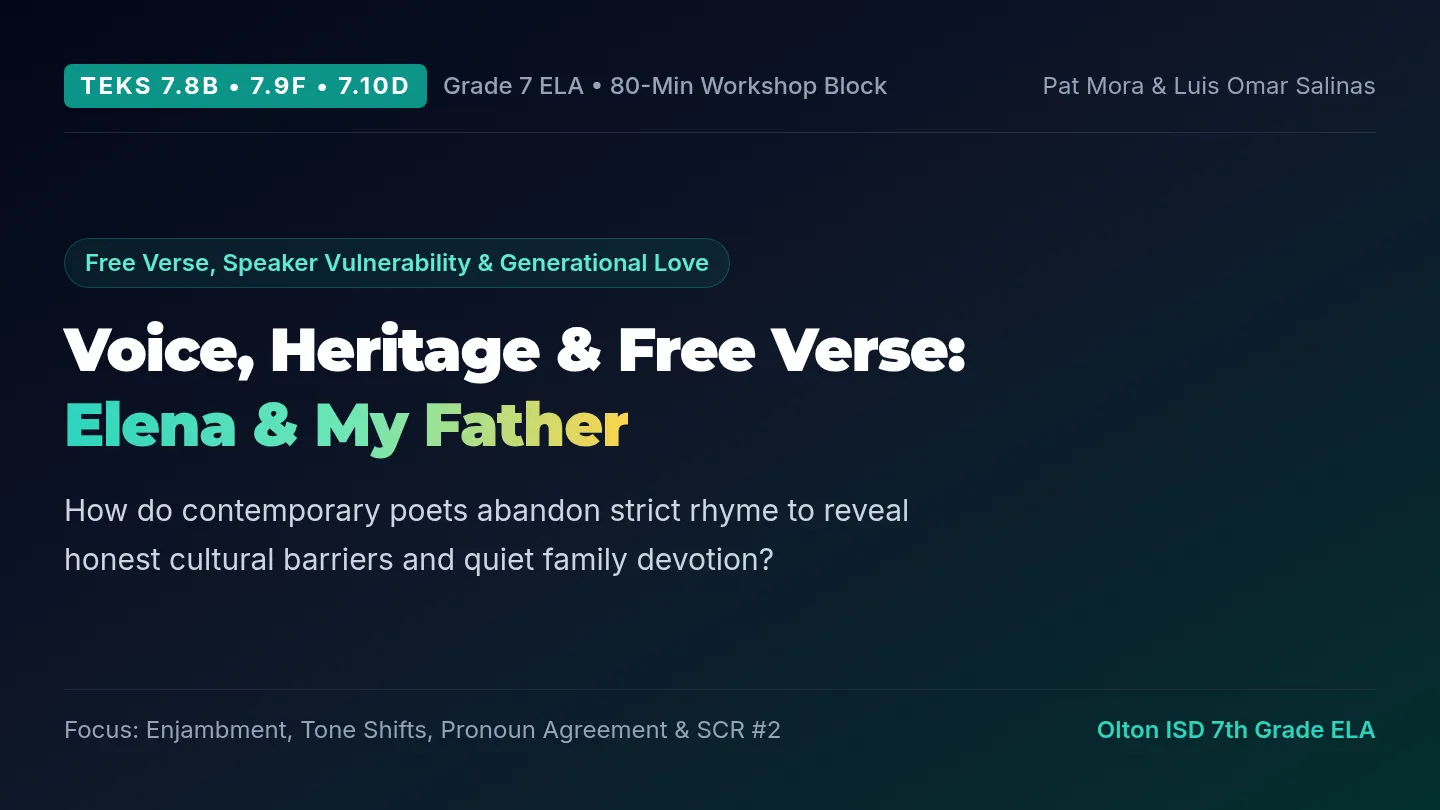
A comprehensive 6-week Grade 7 ELA unit sequence covering narrative meter, sound devices, free verse, speaker perspective, and cross-genre synthesis across StudySync texts and TEKS Readiness Standards. Includes pacing guides, instructional slides, tiered worksheets, and STAAR-aligned SCR/ECR assessments.
Join two independent clauses with a comma + coordinating conjunction (for, and, nor, but, or, yet, so).
Complex Sentences AAAWWUUBBIS
"When the redcoats marched into the inn, Bess waited in silence."
When a dependent clause starts the sentence, always place a comma after the introductory clause.
STAAR Rule Check: Never connect two complete sentences with only a comma (Comma Splice)!
Editing & Revising Lab
TEKS 7.10(C/D) STAAR Item Types
STAAR Editing: Spot the Error
"The soldiers tied Bess to the heavy bedpost, they gagged her mouth with a handkerchief."
Error: Comma splice (two complete sentences joined by a comma).
Correction: Insert and after the comma, or replace with a semicolon (;).
STAAR Revising: Sentence Combining
"Bess heard the horse hooves. She pulled the trigger. She warned her love."
Better Synthesis:"As soon as Bess heard the galloping horse hooves, she pulled the trigger to warn her love."
Mastering compound and complex sentences directly improves both your editing score and your analytical writing.
STAAR SCR Writing Formula
2-Point Response (TEKS 7.8B / 7.11B)
1. Claim (Answer)
State the specific sound or rhythm technique and its precise impact on suspense.
2. Embedded Evidence
Weave a direct quotation into a complex sentence using a signal phrase.
3. Analytical Reasoning
Explain exactly how the auditory beat influences the reader's feeling of urgency.
Today's Practice SCR Prompt:
Explain how Alfred Noyes uses rhythm and sound devices in The Highwayman to create a sense of urgency. Support your answer with evidence from the poem.
2-Point Score Point 2 (Mastery Exemplar): TEA 2/2 Score
"In The Highwayman, Alfred Noyes uses a galloping anapestic rhythm and repetitive sound devices to create an intense sense of urgency. For example, the poet repeats the word 'riding' and uses onomatopoeia when he writes, 'Tlot-tlot; tlot-tlot! Had they heard it? The horse-hoofs ringing clear.' This rhythmic repetition mimics the rapid clatter of approaching hooves, quickening the reader's pulse and building dramatic tension right before the soldiers' ambush."
Score Point 2: Clear claim + accurate direct text evidence with quotation marks + deep explanation of rhythmic effect.
Score Point 1: Claim provided but lacks direct quote or offers vague/general explanation of sound devices.
Tiered Differentiation & Accommodations Matrix
Emergent Bilinguals (ELs)
Provide sentence frames for compound sentences ("[Sentence 1], but [Sentence 2]"). Use color-coding for coordinating conjunctions.
Special Education / Tier 2
Use Highwayman Guided Worksheet with pre-filled word bank and structured SCR starter stems. Chunk tasks into 15-min intervals.
GT & Advanced Extensions
Challenge students to write an original compound-complex stanza imitating Noyes' anapestic rhythm with internal dialogue and semicolons.
Read the selection and answer the questions that follow.
(1) In Alfred Noyes' poem The Highwayman, rhythm plays a critical role in storytelling. (2) The poet uses anapestic meter to imitate the sound of galloping horse hooves, this rhythm quickens the pulse of the reader. (3) When the redcoats arrive at the inn, they tie Bess to the bed and position a musket at her chest. (4) Bess knows the soldiers plans to kill the highwayman, so she sacrifices her own life to warn him.
4. What change should be made in sentence 2?
A Change imitate to imitates
B Change the comma after hooves to a semicolon
C Change quickens to quickened
D Delete the word of after pulse
5. What change should be made in sentence 4?
A Change knows to knowing
B Change soldiers plans to soldiers' plan
C Delete the comma after highwayman
D Change sacrifices to sacrificed
Part 4: STAAR 2-Point SCR Studio (TEKS 7.8B & 7.11B)
Rubric: 2 Pts (Claim + Text Evidence + Reasoning)
Prompt:
Explain how Alfred Noyes uses rhythm and sound devices in The Highwayman to create a sense of urgency. Support your response with evidence from the text.
Self-Editing Checklist: Direct claim Embedded quote Complex/Compound sentence Conventions check
Parts 1 & 2: Mentor Sentences & Sentence Combining Key
1. Mentor Sentence Analysis:
• Type: Compound Sentence
• Conjunction:but (comma placed before but to link two independent clauses).
2. Sentence Crafting Exemplar:
"Because Tim the ostler was consumed with jealous love for Bess, he listened in the shadows."
(Accept "When Tim..." or placement of dependent clause at end without comma).
3. STAAR Sentence Combining:Correct Answer: C
Rationale: Option C creates a clear, fluent complex sentence using the introductory time clause "When Bess heard..." followed by a comma. A is a comma splice. B uses illogical causation ("because she warned"). D distorts the meaning with the contrasting conjunction "but".
Part 3: STAAR Editing Passage Key (TEKS 7.10D)
4. Sentence 2 (Comma Splice): B
Rationale: The clause "this rhythm quickens the pulse of the reader" is a complete independent clause. A comma alone creates a comma splice. Changing the comma to a semicolon correctly connects two closely related independent thoughts.
5. Sentence 4 (Apostrophe Rule): B
Rationale: The redcoats (plural soldiers) own the ambush plan. The plural possessive is formed by placing the apostrophe after the 's' (soldiers' plan). Option A creates an improper participle, and D causes an inconsistent verb tense shift.
"In The Highwayman, Alfred Noyes utilizes a galloping triple rhythm and repetitive sound devices to establish an intense sense of urgency. When the poet writes, 'Tlot-tlot; tlot-tlot! Had they heard it? The horse-hoofs ringing clear,' the onomatopoeia mimics the physical clatter of hooves on stone. This relentless sound accelerates the poem's tempo right before the ambush, keeping the reader on edge."
Teacher Note: Contains a direct claim, correctly embedded quote with signal phrase, complex sentence structure, and deep commentary explaining reader urgency.
Score Point 1 (Partial Anchor): 1 / 2 Points
"Noyes uses rhythm and sounds to make the story feel fast. In the poem it says, 'Tlot-tlot; tlot-tlot!' This shows that the horse is running fast to the inn and it makes the reader feel nervous."
Teacher Note: Has a basic claim and quote, but explanation is shallow ("makes the reader nervous") and lacks specific analysis of meter or how onomatopoeia functions.
"Annabel Lee, the speaker's lost bride, was buried in a seaside tomb."
An appositive phrase renames a nearby noun and is set off with commas when non-essential.
Apostrophe Mastery Possessives
• Singular: speaker's grief (one speaker)
• Plural: angels' envy (many angels)
Add 's for singular possession; add only an apostrophe (') after plural nouns ending in s.
STAAR Rule Check: Never use an apostrophe for simple plural words (e.g., seraphs, not seraph's).
Comparative Analysis
TEKS 7.5(E) Synthesis
The Highwayman (Alfred Noyes)
• Form: Narrative Ballad
• Rhythm: Fast, galloping anapestic meter
• Sound Effect: Mimics horse hooves (tlot-tlot)
• Purpose: Builds pulse-pounding suspense
Annabel Lee (Edgar Allan Poe)
• Form: Melodic Lyric Poem
• Rhythm: Swaying, hypnotic ocean-wave meter
• Sound Effect: Internal rhymes (beams/dreams)
• Purpose: Conveys immortal love & sorrow
Synthesis Takeaway: Both poets use repetitive sound devices to reflect the emotional core of their tragic lovers.
STAAR SCR Formula
Comparative 2-Point Protocol
1. Comparative Claim
State how both poets use specific sound devices (rhythm or rhyme) to shape emotional mood.
2. Dual Evidence
Embed short quotes from both The Highwayman and Annabel Lee with transition stems.
3. Synthesis Impact
Explain how Noyes creates suspense while Poe creates haunting, mournful sorrow.
Today's Comparative SCR Prompt:
Compare how Alfred Noyes in The Highwayman and Edgar Allan Poe in Annabel Lee use sound devices to convey tragic love. Support your answer with evidence from both poems.
4. What is the function of the phrase ", his childhood bride" in sentence 1?
A It acts as an appositive phrase renaming Annabel Lee.
B It is a dependent clause starting with a preposition.
C It introduces a comma splice into the sentence.
D It creates an incomplete sentence fragment.
5. Why is the apostrophe in narrator's used correctly in sentence 2?
A It forms a contraction for narrator is.
B It shows singular possession of the noun devotion.
C It indicates there are multiple narrators in the poem.
D It separates a subject from its main action verb.
Part 5: Paired Cross-Poem SCR Studio (TEKS 7.5E & 7.11B)
2-Point Comparative Protocol
Comparative Prompt:
Compare how Alfred Noyes in The Highwayman and Edgar Allan Poe in Annabel Lee use sound devices to convey tragic love. Support your response with evidence from both poems.
Self-Editing Checklist: Dual-poem claim Evidence from both texts Comparative transition Appositive / Complex sentence
Score Point 2 (Comparative Mastery Anchor): TEA 2/2 Score
"Both Alfred Noyes in The Highwayman and Edgar Allan Poe in Annabel Lee use repetitive sound devices to reflect tragic love, but they create opposite emotional tempos. In The Highwayman, Noyes uses anapestic meter and onomatopoeia ('Tlot-tlot; tlot-tlot!') to mimic rapid horse hooves and build tense suspense. In contrast, Poe uses internal rhyme ('beams/dreams') and the haunting '-ee' refrain in Annabel Lee to create a slow, hypnotic rhythm that mirrors the speaker's enduring grief beside the sea."
Score Point 2: Accurate comparative claim + integrated text evidence from BOTH poems + clear synthesis explanation.
Score Point 1: Mentions both poems but provides evidence from only one text, or offers superficial comparison without analyzing sound devices.
Tiered Differentiation & Accommodations Matrix
Emergent Bilinguals (ELs)
Provide side-by-side vocabulary support for archaic words (seraphs, highborn kinsmen, sepulchre). Highlight internal rhyme pairs in yellow.
Special Education / Tier 2
Use Annabel Lee Guided Worksheet with pre-filled sentence stems. Provide a comparative transition word bank (While, In contrast, Both).
GT & Advanced Extensions
Have students analyze how Poe's use of hyperbole reflects the psychological stages of grief and write an analytical paragraph comparing speaker sanity.
"Each of the children speaks their new language rapidly."
Why it's wrong:Each is singular, but their is plural.
Corrected Agreement Singular Match
"Each of the children speaks his or her new language rapidly."
Always match pronouns in number (singular vs. plural) and gender with their antecedents.
Rule Checklist: Indefinite pronouns (everyone, each, somebody) take singular pronouns!
STAAR Revising Lab
TEKS 7.10(C) Strengthening Evidence
Weak Analysis Draft
"Elena feels sad when her kids speak English. She locks herself in the bathroom to practice."
Lacks precise text evidence and does not explain why she locks the door.
Revised with Precise Evidence
"Elena feels alienated as her children master English; therefore, she locks herself in the bathroom with a dictionary, fearful that her children will look at her with pity."
Connects setting details directly to the speaker's emotional vulnerability.
In your writing, always link the character's physical actions to their internal emotional stakes.
STAAR SCR #2 Protocol
2-Point Response (TEKS 7.9F / 7.11B)
1. Tone Shift Claim
State how the speaker's tone shifts from quiet frustration to determined resilience.
2. Embedded Evidence
Quote the lines where Elena describes her children's laughter and her bathroom study.
3. Perspective Analysis
Explain how Mora uses free-verse structure to reveal the pain of generational distance.
Today's SCR #2 Milestone Prompt:
In Pat Mora's poem Elena, how does the speaker's perspective shift regarding her relationship with her children? Support your answer with evidence from the poem.
3. What change should be made in sentence 2?
A Change Neither to None
B Change realize to realizes
C Change their to his
D Delete the word in before silence
4. What is the correct way to fix the comma splice in sentence 3?
A Replace the comma with and (without a comma)
B Replace the comma with a semicolon (;) or , and
C Change practices to practicing
D Add a comma after the word dictionary and delete she
Part 4: STAAR SCR #2 Studio (TEKS 7.9F & 7.11B)
2-Point Tone Shift Response
SCR #2 Milestone Prompt:
In Pat Mora's poem Elena, how does the speaker's perspective shift regarding her relationship with her children? Support your answer with evidence from the poem.
Self-Editing Checklist: Tone shift claim Embedded quote with signal phrase Pronoun agreement check Conventions check
"In Pat Mora's poem Elena, the speaker's perspective shifts from feeling helpless and alienated to adopting a quiet, determined resolve to bridge the language gap. At first, Elena feels humiliated when her children speak English quickly, noting that 'my mouth feels dumb, / tongue lost in the dark.' However, instead of surrendering to isolation, her attitude shifts as she locks herself in the bathroom with a dictionary, demonstrating her persistent love and determination to remain connected with her children."
Score Point 2: Precise identification of the 2-part tone shift + embedded quote with signal phrase + explanation of character motivation.
Score Point 1: Mentions Elena is sad or practicing English but fails to explain the shift from fear to determination, or quote lacks commentary.
Tiered Differentiation & Accommodations Matrix
Emergent Bilinguals (ELs)
Leverage students' linguistic background to discuss code-switching and generational language dynamics. Highlight cognates (vulnerable, perspective).
Special Education / Tier 2
Use Free Verse Guided Worksheet with pre-filled sentence stems. Provide a "Before vs. After" graphic organizer for the SCR tone shift.
GT & Advanced Extensions
Have students compose an original 12-line free-verse poem utilizing intentional enjambment to capture an authentic personal family moment.
• Topic sentence (heritage)
• Embedded memoir quote
• Commentary on pride & dignity
¶4: Synthesis
• Restate thesis in new words
• Paired cross-genre contrast
• Universal life lesson
Transition Tip: Begin Paragraph 3 with: "Similarly, in Museum Indians, Susan Power illustrates..."
Quote Integration
Signal Phrases (TEKS 7.10D)
Weak: Floating Quote (0 Pts)
"Elena is sad. 'My mouth feels dumb, tongue lost in the dark.' She practices in secret."
Quotes dropped abruptly without context or transitional framing.
Mastery: Embedded Quote (Score 2)
"Pat Mora captures Elena's profound vulnerability when she admits that 'my mouth feels dumb, / tongue lost in the dark,' illustrating her fear of isolation."
Blends the quotation smoothly into the student's own complex sentence.
Use signal verbs: emphasizes, illustrates, conveys, reveals, depicts, demonstrates.
Specific embedded quotes from BOTH texts with in-depth commentary explaining cultural themes.
3. Conventions (1 Pt)
Consistent sentence variety, correct punctuation of quotes, pronoun agreement, and capitalization.
Summative ECR Prompt:
Read Pat Mora's poem Elena and Susan Power's memoir Museum Indians. Write an essay analyzing how both authors explore the bond between parents and children amidst cultural differences. Support your essay with evidence from BOTH texts.
(1) In both Elena and Museum Indians, the profound sacrifices of mothers shapes the identity of their children. (2) Susan Power describes her mother with admiration, she notes that her mother walked through the city streets like a tall Dakota warrior. (3) Both authors demonstrate that parental devotion transcends cultural boundaries.
4. What change should be made in sentence 1?
A Change sacrifices to sacrifice
B Change shapes to shape
C Change their to her
D Delete the word of before mothers
5. What is the correct way to fix sentence 2?
A Insert and after the comma
B Delete the comma entirely
C Change notes to noted
D Change walked to walk
Part 5: Summative ECR Drafting Studio (TEKS 7.5E & 7.11B)
TEA 5-Point Summative Prompt
Summative Prompt:
Read Pat Mora's poem Elena and Susan Power's memoir Museum Indians. Write an essay analyzing how both authors explore the bond between parents and children amidst cultural differences. Support your essay with evidence from both texts.
Q4 (Subject-Verb):B (Change shapes to shape for plural sacrifices).
Q5 (Comma Splice):A (Insert and after comma).
TEA 5/5 Score Point Exemplar Essay (Annotated)
Score: 5 / 5 (Max)
¶1 Intro: Immigrant and indigenous families frequently navigate the complex tension between adapting to mainstream society and preserving ancestral roots. Although both Pat Mora's poem Elena and Susan Power's memoir Museum Indians explore the profound bond between mothers and children, Mora emphasizes a mother's quiet vulnerability in confronting a language barrier, while Power highlights a mother's fierce dedication to keeping tribal heritage alive.
¶2 Elena: In Elena, Pat Mora illustrates the deep emotional isolation an immigrant mother experiences as her children quickly assimilate. As her children master English, Elena feels alienated in her own home, noting that "my mouth feels dumb, / tongue lost in the dark." Despite feeling humiliated, Elena refuses to give up; she secretly locks herself in the bathroom with a dictionary. This poignant detail illustrates that her willingness to struggle with a new language stems entirely from her devotion to maintaining a connection with her children.
¶3 Museum Indians: Similarly, in Museum Indians, Susan Power depicts a mother who actively instills cultural pride in her daughter amidst the bustle of modern Chicago. Power describes her mother walking through city streets with the commanding grace of a Dakota warrior. When visiting the museum, the mother connects with a traditional buckskin dress, ensuring her daughter understands their sacred history. This reveals that Power's mother uses storytelling and personal example to protect her daughter from cultural erasure.
¶4 Conclusion: Ultimately, both authors prove that maternal love bridges generations across cultural divides. While Elena endures personal discomfort to learn her children's language, Power's mother ensures her daughter honors ancestral traditions. Together, both selections demonstrate that whether through learning a new tongue or preserving ancient pride, mothers will make extraordinary sacrifices to safeguard their children's futures.