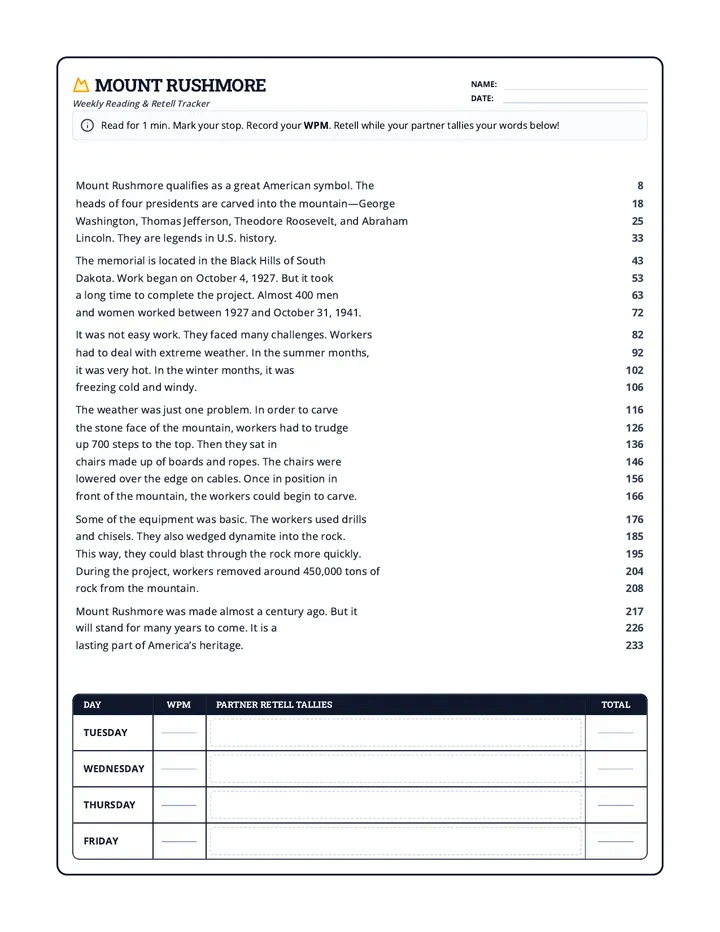
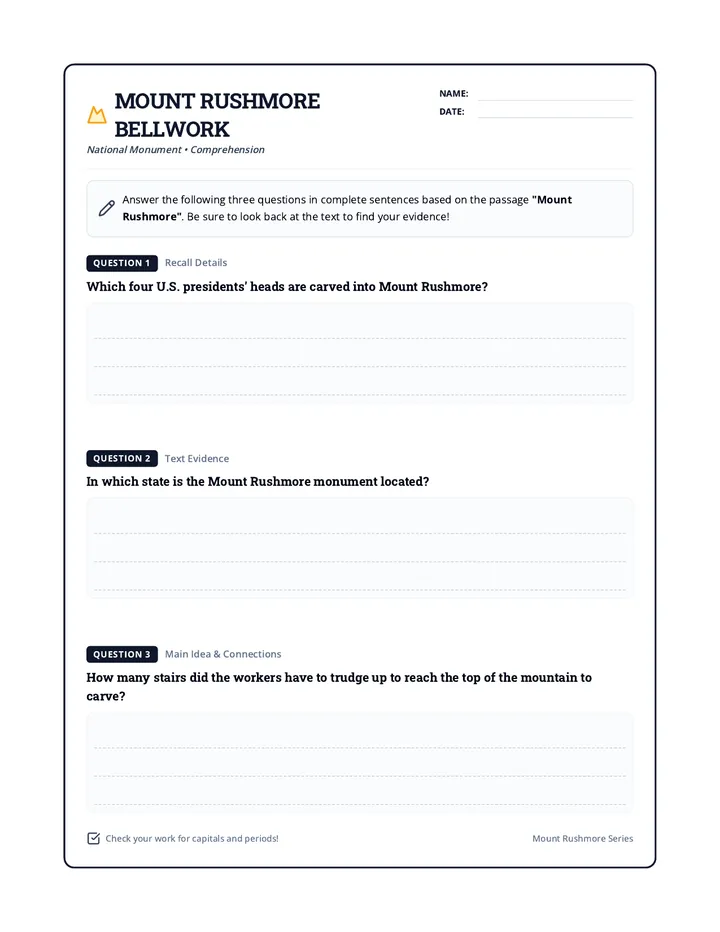
A collection of thematic reading fluency worksheets designed to improve student reading speed, accuracy, and comprehension through repeated readings and partner retelling.
A Grade 3 unit focused on describing relationships in informational texts, specifically targeting cause and effect connections in history and science.
A collection of five fractured fairy tale reader's theater scripts designed for groups of five students, focusing on fluency, expression, and creative retelling.
A two-part exploration of Chapters 19 and 20 of 'Because of Winn-Dixie', focusing on the emotional depth of Littmus Lozenges through sequencing and sensory analysis.
A two-day extension unit for 5th grade students focused on mastering the characteristics of literary fiction and informational non-fiction, aligned to MAP RIT 211-220 and TEKS. Students analyze story elements in fiction and text structures/features in non-fiction, with a heavy emphasis on citing text evidence to support inferences.
A two-day extension sequence for 5th grade students focused on advanced reading analysis skills, including author's perspective, rhetorical word choice, and the impact of text and graphic features. Aligning with MAP and TEKS standards, students use detective-themed tools to investigate narrative, persuasive, and informational texts.
A unit exploring environmental responsibility and school-based sustainability efforts through reading, sequencing, and critical thinking.
A comprehensive unit focusing on essential literature skills: character analysis, making inferences with text evidence, and identifying themes and summaries. Students act as literary detectives to uncover deeper meanings in texts.
A 3-day intensive reteach sequence for 5th grade students focused on Author's Craft, Point of View, and Text Structure, aligned to RIT 191-200 and TEKS standards. Students act as 'Craft Detectives' to investigate how authors use language and structure to convey meaning.
A 3-day reteach sequence for 3rd grade students focused on Author's Craft, aligned with MAP RIT 181-190 and TEKS. Students investigate how graphics, illustrations, and tone contribute to an author's message and audience assumptions across nonfiction, fiction, and persuasive texts.
A series of targeted small-group lessons focused on identifying author's purpose using STAAR-style questions for 3rd-grade students. Includes materials for three approaching-level groups and one higher-level group across fiction, non-fiction, and persuasive texts.
A multi-level series of homework packets centered on space exploration, adapted for Kindergarten, 2nd Grade, and 4th Grade students. Each packet includes a grade-appropriate reading passage and three nightly assignments focusing on comprehension, vocabulary, and structural analysis.
A comprehensive unit focusing on vocabulary acquisition and word relationships (L.4 and L.5). Students act as 'Lexicon Engineers' to decode meanings, analyze affixes, and master figurative language through a high-tech laboratory lens.
A unit focused on reading comprehension skills, specifically focusing on comparing and contrasting different texts and perspectives.
A comprehensive exploration of the Theseus and Minotaur myth, covering historical origins, narrative structure, and character archetypes.
A literary analysis unit focusing on how structure and perspective shape the theme of resilience across poetry and short stories.
A week-long exploration of literary elements using fables, myths, and realistic fiction. Students act as 'Story Architects' to deconstruct plot, character, theme, and setting.
A sequence designed for WIDA Levels 1-2 (Entering/Emerging) focused on the Language of Language Arts. Students learn to identify and describe characters, settings, and story sequences using high-visual support and scaffolded sentence frames.