Desert Water Savers Worksheet Grade 2 Nonfiction Fresh Read
Desert Water Savers
Name:
Date:
Directions: Read the passage carefully. Think about the main idea and the details that support it. Then answer the questions on the next page.
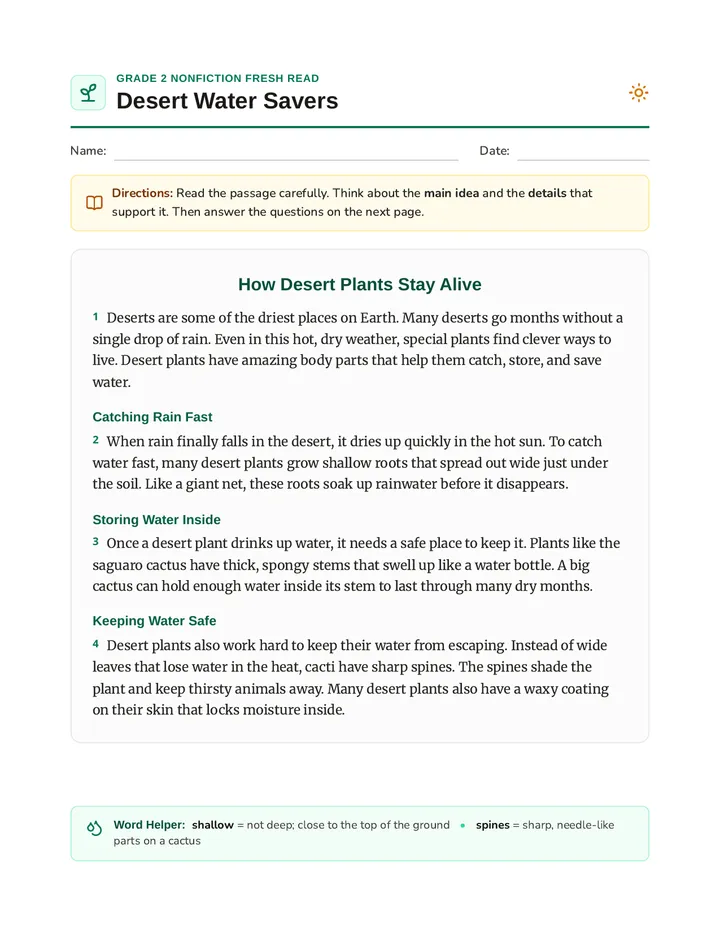
How Desert Plants Stay Alive
1 Deserts are some of the driest places on Earth. Many deserts go months without a single drop of rain. Even in this hot, dry weather, special plants find clever ways to live. Desert plants have amazing body parts that help them catch, store, and save water.
Catching Rain Fast
2 When rain finally falls in the desert, it dries up quickly in the hot sun. To catch water fast, many desert plants grow shallow roots that spread out wide just under the soil. Like a giant net, these roots soak up rainwater before it disappears.
Storing Water Inside
3 Once a desert plant drinks up water, it needs a safe place to keep it. Plants like the saguaro cactus have thick, spongy stems that swell up like a water bottle. A big cactus can hold enough water inside its stem to last through many dry months.
Keeping Water Safe
4 Desert plants also work hard to keep their water from escaping. Instead of wide leaves that lose water in the heat, cacti have sharp spines. The spines shade the plant and keep thirsty animals away. Many desert plants also have a waxy coating on their skin that locks moisture inside.
Word Helper: shallow = not deep; close to the top of the ground • spines = sharp, needle-like parts on a cactus
Comprehension Questions
Main Idea & Supporting Details
1. What is the main idea of the whole passage?
A. Deserts are the hottest places on Earth.
B. Desert plants have special parts that help them get and save water.
C. Animals like to eat cacti when they are thirsty.
D. Rain never falls in the desert.
2. Which detail best supports the idea that desert plants catch rain fast?
A. Cacti have sharp spines that shade the plant.
B. Desert plants have a waxy coating on their skin.
C. Many desert plants grow wide, shallow roots just under the soil.
D. A big cactus can hold water for many dry months.
3. Look at paragraph 3, “Storing Water Inside.” What is the main idea of this section?
A. Desert plants use thick stems to hold water for dry months.
B. Water bottles are useful when visiting the desert.
C. Saguaro cacti grow faster than other desert plants.
D. Hot sun dries up rainwater on the ground.
4. According to the passage, how do sharp spines help a cactus save water?
A. They soak up rain from the clouds.
B. They push roots deeper into the dirt.
C. They shade the plant and keep thirsty animals away.
D. They turn into wide leaves during the winter.
5. Read this sentence from paragraph 4: “Many desert plants also have a waxy coating on their skin that locks moisture inside.” What does the word moisture mean?
A. sunlight
B. water
C. soil
D. shade
6. Write one detail from the passage that explains how desert plants keep water from escaping.
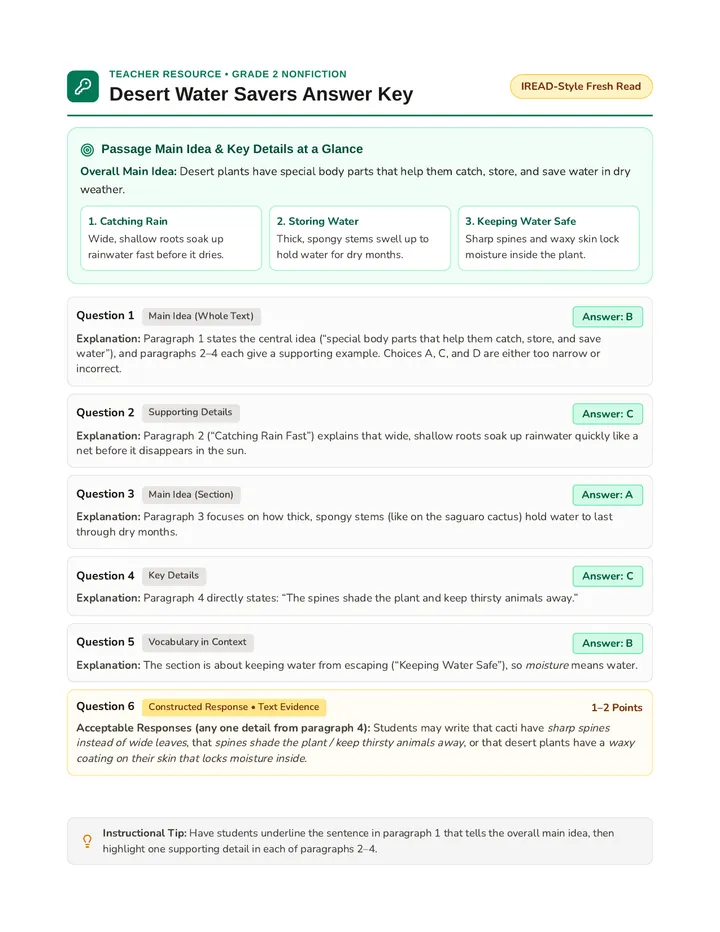
Desert Water Savers Answer Key Teacher Resource • Grade 2 Nonfiction
Desert Water Savers Answer Key
IREAD-Style Fresh Read
Passage Main Idea & Key Details at a Glance
Overall Main Idea: Desert plants have special body parts that help them catch, store, and save water in dry weather.
1. Catching Rain
Wide, shallow roots soak up rainwater fast before it dries.
2. Storing Water
Thick, spongy stems swell up to hold water for dry months.
3. Keeping Water Safe
Sharp spines and waxy skin lock moisture inside the plant.
Question 1 Main Idea (Whole Text)
Answer: B
Explanation: Paragraph 1 states the central idea (“special body parts that help them catch, store, and save water”), and paragraphs 2–4 each give a supporting example. Choices A, C, and D are either too narrow or incorrect.
Question 2 Supporting Details
Answer: C
Explanation: Paragraph 2 (“Catching Rain Fast”) explains that wide, shallow roots soak up rainwater quickly like a net before it disappears in the sun.
Question 3 Main Idea (Section)
Answer: A
Explanation: Paragraph 3 focuses on how thick, spongy stems (like on the saguaro cactus) hold water to last through dry months.
Question 4 Key Details
Answer: C
Explanation: Paragraph 4 directly states: “The spines shade the plant and keep thirsty animals away.”
Question 5 Vocabulary in Context
Answer: B
Explanation: The section is about keeping water from escaping (“Keeping Water Safe”), so moisture means water.
Question 6 Constructed Response • Text Evidence
1–2 Points
Acceptable Responses (any one detail from paragraph 4): Students may write that cacti have sharp spines instead of wide leaves , that spines shade the plant / keep thirsty animals away , or that desert plants have a waxy coating on their skin that locks moisture inside .
Instructional Tip: Have students underline the sentence in paragraph 1 that tells the overall main idea, then highlight one supporting detail in each of paragraphs 2–4.
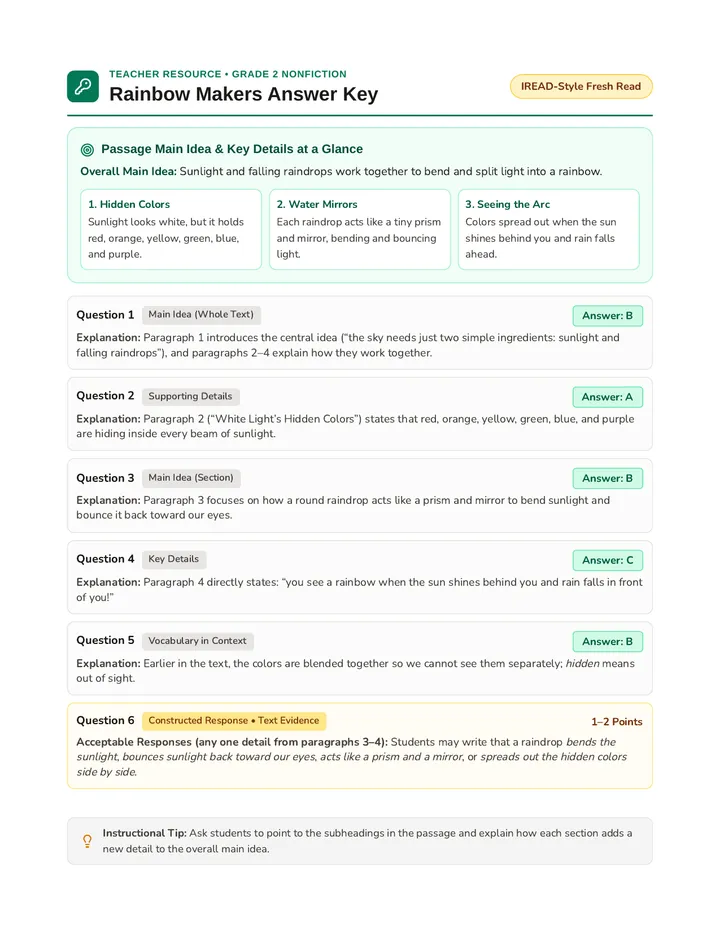
Rainbow Makers Worksheet Grade 2 Nonfiction Fresh Read
Rainbow Makers
Name:
Date:
Directions: Read the passage carefully. Think about the main idea and the details that support it. Then answer the questions on the next page.
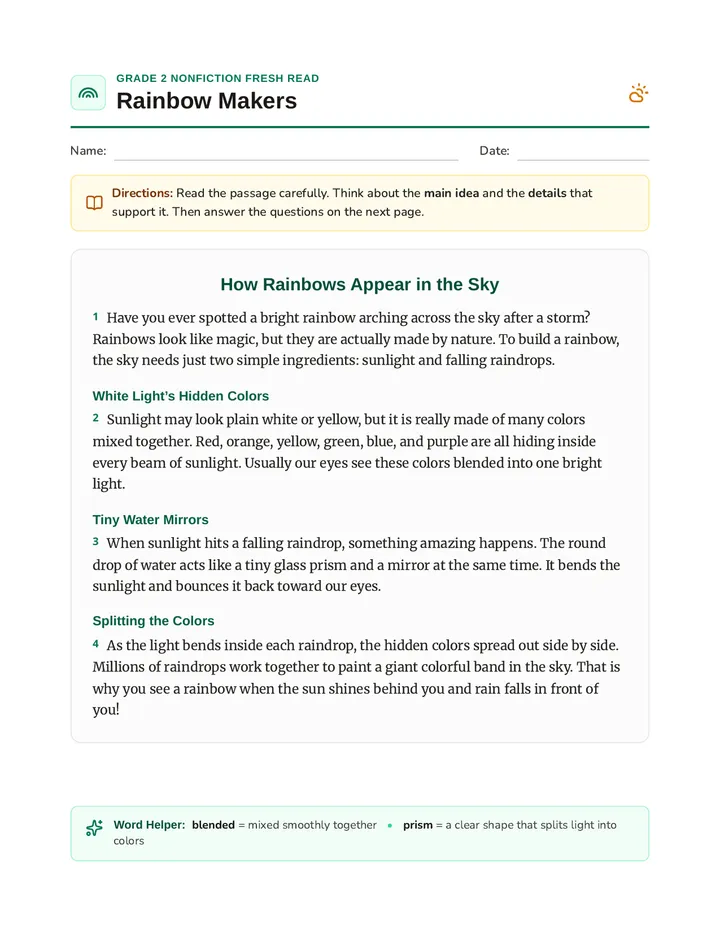
How Rainbows Appear in the Sky
1 Have you ever spotted a bright rainbow arching across the sky after a storm? Rainbows look like magic, but they are actually made by nature. To build a rainbow, the sky needs just two simple ingredients: sunlight and falling raindrops.
White Light’s Hidden Colors
2 Sunlight may look plain white or yellow, but it is really made of many colors mixed together. Red, orange, yellow, green, blue, and purple are all hiding inside every beam of sunlight. Usually our eyes see these colors blended into one bright light.
Tiny Water Mirrors
3 When sunlight hits a falling raindrop, something amazing happens. The round drop of water acts like a tiny glass prism and a mirror at the same time. It bends the sunlight and bounces it back toward our eyes.
Splitting the Colors
4 As the light bends inside each raindrop, the hidden colors spread out side by side. Millions of raindrops work together to paint a giant colorful band in the sky. That is why you see a rainbow when the sun shines behind you and rain falls in front of you!
Word Helper: blended = mixed smoothly together • prism = a clear shape that splits light into colors
Comprehension Questions
Main Idea & Supporting Details
1. What is the main idea of the whole passage?
A. Storms always happen in the afternoon.
B. Sunlight and raindrops work together to make a rainbow.
C. Raindrops are shaped like tiny glass cups.
D. Purple is the brightest color in a rainbow.
2. Which detail best supports the idea that sunlight has hidden colors?
A. Red, orange, yellow, green, blue, and purple are mixed inside every beam of sunlight.
B. Millions of raindrops fall during a summer storm.
C. Rainbows appear when the sun shines behind you.
D. Water drops bounce light back toward the ground.
3. Look at paragraph 3, “Tiny Water Mirrors.” What is the main idea of this section?
A. Glass mirrors are used to study the weather.
B. Raindrops bend and bounce sunlight like tiny mirrors.
C. Storms stop as soon as the sun comes out.
D. Water falls faster when the wind blows hard.
4. According to the passage, where must the sun be for you to see a rainbow?
A. Hidden behind dark clouds
B. Directly above your head
C. Shining behind you while rain falls in front of you
D. Setting far below the ocean
5. Read this sentence from paragraph 4: “As the light bends inside each raindrop, the hidden colors spread out side by side.” What does the word hidden mean?
A. very bright
B. out of sight
C. cold and wet
D. moving fast
6. Write one detail from the passage that explains what a raindrop does to sunlight.
Rainbow Makers Answer Key Teacher Resource • Grade 2 Nonfiction
Rainbow Makers Answer Key
IREAD-Style Fresh Read
Passage Main Idea & Key Details at a Glance
Overall Main Idea: Sunlight and falling raindrops work together to bend and split light into a rainbow.
1. Hidden Colors
Sunlight looks white, but it holds red, orange, yellow, green, blue, and purple.
2. Water Mirrors
Each raindrop acts like a tiny prism and mirror, bending and bouncing light.
3. Seeing the Arc
Colors spread out when the sun shines behind you and rain falls ahead.
Question 1 Main Idea (Whole Text)
Answer: B
Explanation: Paragraph 1 introduces the central idea (“the sky needs just two simple ingredients: sunlight and falling raindrops”), and paragraphs 2–4 explain how they work together.
Question 2 Supporting Details
Answer: A
Explanation: Paragraph 2 (“White Light’s Hidden Colors”) states that red, orange, yellow, green, blue, and purple are hiding inside every beam of sunlight.
Question 3 Main Idea (Section)
Answer: B
Explanation: Paragraph 3 focuses on how a round raindrop acts like a prism and mirror to bend sunlight and bounce it back toward our eyes.
Question 4 Key Details
Answer: C
Explanation: Paragraph 4 directly states: “you see a rainbow when the sun shines behind you and rain falls in front of you!”
Question 5 Vocabulary in Context
Answer: B
Explanation: Earlier in the text, the colors are blended together so we cannot see them separately; hidden means out of sight.
Question 6 Constructed Response • Text Evidence
1–2 Points
Acceptable Responses (any one detail from paragraphs 3–4): Students may write that a raindrop bends the sunlight , bounces sunlight back toward our eyes , acts like a prism and a mirror , or spreads out the hidden colors side by side .
Instructional Tip: Ask students to point to the subheadings in the passage and explain how each section adds a new detail to the overall main idea.