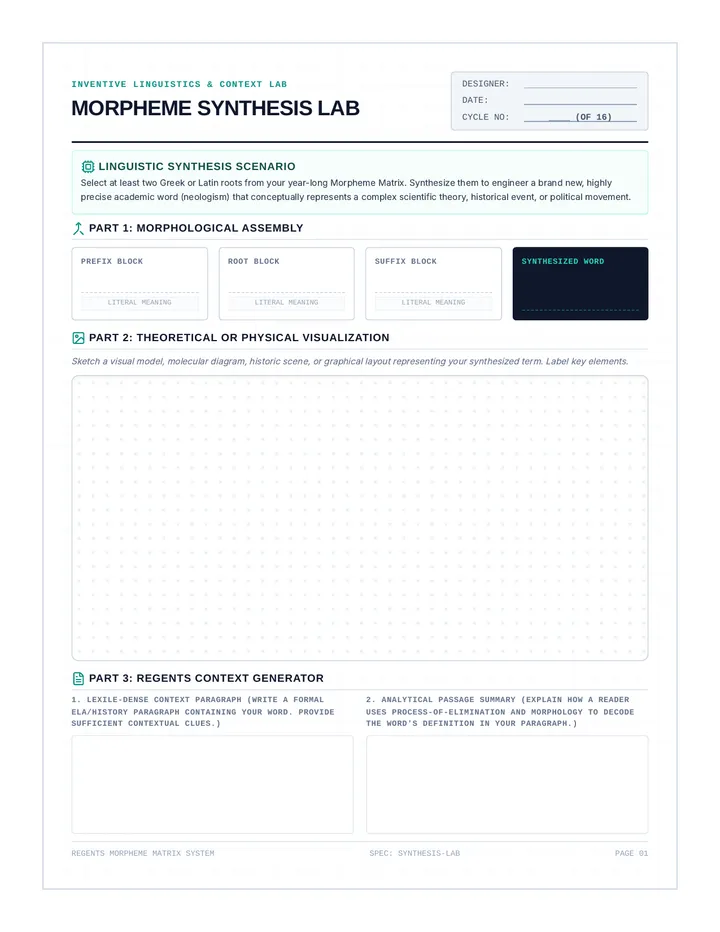
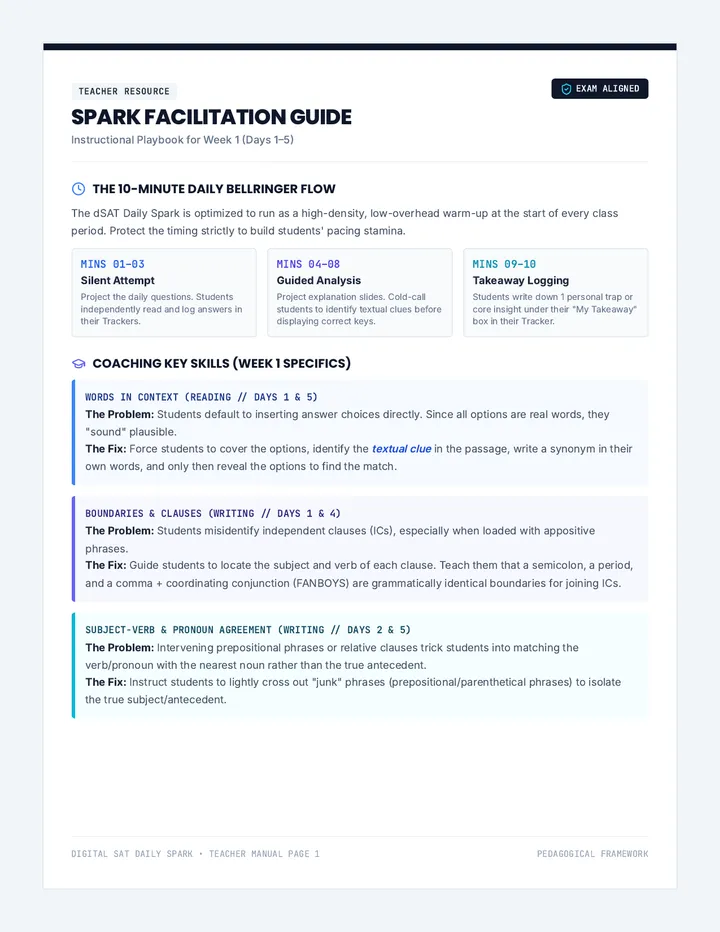
Word Shades Worksheet Word Shades
Modifier Mastery: Lesson 1
Connotation & Nuance
Student Name:
Date:
The Investigator's Palette
Adjectives and adverbs aren't just "extra" words; they are the colors on an author's palette. Choosing "gloomy" over "dark" or "strutted" (verb + implied adverb) over "walked proudly" changes the entire atmosphere of a story.
Part 1: The Nuance Spectrum
Rank the following adjectives from 1 (most positive/gentle) to 5 (most negative/harsh). Explain your reasoning for the extremes.
Set A: Character Traits
Confident
Arrogant
Proud
Conceited
Self-assured
Set B: Atmosphere
Quiet
Eerie
Serene
Still
Stagnant
Why is the #5 word in Set B more negative than the #1 word?
Part 2: Author's Intent
"The ancient house stood resolute against the howling wind, its gaunt windows staring blindly into the relentless night."
1. Identify the tone of the passage above. What specific modifiers create this feeling?
2. How would the tone change if "gaunt" was replaced with "large" and "blindly" with "quietly"?
Part 3: The Mood Shift
Rewrite the following passage. Keep the basic nouns and verbs, but replace every bolded adjective and adverb to change the mood from threatening to enchanting .
The shadowy forest path wound treacherously through the jagged trees. A bitter frost clung to the shriveled leaves, and the stale air smelled faintly of decay.
Your Enchanted Version
Shades of Meaning Slides Shades of Meaning
The Rhetoric of Modifiers
The Hook: Visual Vocabulary
Image A: A glowing cottage in a sunlit meadow.
Image B: A sagging shack in a foggy swamp.
"Which ONE adjective perfectly captures each mood?"
The Power of Choice
Denotation
The literal, dictionary definition of a word. (e.g., "inexpensive" and "cheap" both mean low cost.)
Connotation
The emotional or cultural association a word carries. (e.g., "inexpensive" sounds smart; "cheap" sounds poor quality.)
"In literature, modifiers are never neutral."
Ranking the Nuance
Consider these synonyms for "walking slowly" . How does the vibe change?
Sauntering
Ambling
Trudging
Lumbering
Prowling
Sauntering = Relaxed, carefree confidence.
Trudging = Exhausted, heavy-hearted effort.
Prowling = Predatory, dangerous intent.
Activity: The Mood Shift
"The stiff wind bit coldly at her frail fingers."
How can we make this feel comforting?
Stiff →
Gentle
Coldly →
Playfully
Frail →
Slim
Word Shades Answer Key Word Shades Key
Teacher Resource
Connotation & Nuance Answer Key
Part 1: The Nuance Spectrum (Possible Rankings)
Note: Rankings may vary slightly based on student interpretation; the focus should be on the relative difference between terms.
Set A: Character Traits
1
Self-assured (Positive, internal)
2
Confident (Neutral to positive)
3
Proud (Varies: can be a virtue or a sin)
4
Conceited (Negative, vain)
5
Arrogant (Most negative, implies hostility)
Set B: Atmosphere
1
Serene (Peaceful, beautiful)
2
Quiet (Neutral, absence of noise)
3
Still (Neutral, absence of motion)
4
Eerie (Negative, creepy)
5
Stagnant (Most negative, implies decay/rotting)
Sample Reasoning for Set B:
"Stagnant" implies more than just stillness; it suggests something is trapped, rotting, or lifeless, whereas "Serene" implies a stillness that is healthy and restorative.
Part 2: Author's Intent (Sample Responses)
1. Identify the tone and modifiers:
Tone: Foreboding, resilient, or Gothic. Modifiers like "gaunt" and "blindly" personify the house as a ghost-like figure, while "relentless" and "howling" make the environment seem hostile.
2. Tone change with "large" and "quietly":
The tone becomes more neutral and factual. "Large" removes the haunting imagery of "gaunt" (thin/bony), and "quietly" removes the sense of vulnerability or lack of control implied by "blindly."
Part 3: The Mood Shift (Example)
"The luminous forest path wound gracefully through the sculpted trees. A sparkling frost clung to the velvet leaves, and the crisp air smelled faintly of pine."
Distinction Slides Distinction & Function
Adjectives vs. Adverbs
The Hook: "I Feel Badly"
"I feel bad."
Means: I am sorry, or I am sick.
"I feel badly."
Means: My sense of touch is broken.
Why does that one little "-ly" change the entire meaning?
Who do they work for?
Adjectives
Modify nouns or pronouns .
The blue sky.
She is intelligent.
Adverbs
Modify verbs , adjectives , or other adverbs .
He ran quickly.
A very bright star.
The Linking Verb Trap
Linking Verbs (be, become, feel, seem, smell, taste) connect the subject to a word that describes it.
Action Verb
"The soup smells quickly ."
Adverb modifying the action. (Nonsense: The soup isn't sniffing fast!)
Linking Verb
"The soup smells good ."
Adjective modifying the noun "soup." (Perfect: Describes the state of the soup.)
Rapid Fire Challenge
1
The music sounds beautiful / beautifully.
Linking
2
She plays the piano beautiful / beautifully.
Action
3
The cake tastes delicious / deliciously.
Linking
Functional Maps Worksheet Functional Maps
Modifier Mastery: Lesson 2
Adjective vs. Adverb Distinction
Student Name:
Date:
Part 1: The Connection Map
Draw an arrow from the bolded modifier to the word it describes. Then, identify if the bolded word is an Adjective (Adj) or an Adverb (Adv) .
The sudden storm rattled the windows.
Type:
The storm arrived suddenly during dinner.
Type:
That extremely bright light is blinding.
Type:
He looks weary after the long journey.
Type:
Part 2: The Linking Verb Challenge
Circle the correct word in parentheses. Remember: Linking verbs (feel, seem, appear, taste, etc.) usually require an adjective to describe the subject.
Despite the chaos, the captain remained ( calm / calmly ) at the helm.
The freshly baked bread smells ( wonderful / wonderfully ).
The detective looked ( suspicious / suspiciously ) at the open window.
After the race, the runner appeared ( exhausted / exhaustedly ).
The engine is running ( smooth / smoothly ) now.
Part 3: Why it Matters
Explain the difference in meaning between these two sentences. Use the terms linking verb and action verb in your response.
A: The blind man felt the wall clumsily .
B: The blind man felt clumsy in the dark.
Functional Maps Answer Key Functional Maps Key
Teacher Resource
Adjective vs. Adverb Key
Part 1: The Connection Map (Answers)
The sudden → storm rattled the windows.
Type:
Adjective
The storm arrived ← suddenly during dinner.
Type:
Adverb
That extremely → bright light is blinding.
Type:
Adverb
He looks ← weary after the long journey.
Type:
Adjective
Part 2: The Linking Verb Challenge (Answers)
Despite the chaos, the captain remained calm at the helm. (Linking Verb: remained)
The freshly baked bread smells wonderful. (Linking Verb: smells)
The detective looked suspiciously at the open window. (Action Verb: looked)
After the race, the runner appeared exhausted. (Linking Verb: appeared)
The engine is running smoothly now. (Action Verb: is running)
Part 3: Why it Matters (Sample Response)
"In Sentence A, 'felt' is an action verb . The adverb 'clumsily' describes how the man performed the action of touching the wall. In Sentence B, 'felt' is a linking verb . The adjective 'clumsy' describes the subject (the man) and how he felt internally or how he was perceived, rather than describing a physical action."
Placement Slides Placement & Clarity
The Danger of the Dangling Modifier
The Hook: Literal Logic
"Covered in chocolate sprinkles, my mother served the sundae."
The Intent
The sundae has sprinkles.
The Reality
The mother is covered in sprinkles!
Misplaced Modifiers
A Misplaced Modifier is a word or phrase that is separated from the word it is intended to describe.
The Rule of Proximity
"Modifiers belong next to the word they modify."
Dangling Modifiers
A Dangling Modifier occurs when the word being described is missing from the sentence entirely.
The Error:
"Walking to school, the library looked huge."
(The library isn't walking!)
The Fix:
"Walking to school, I noticed the library looked huge."
(Now we know who is walking.)
Clarity Challenge
!
"He nearly ate the whole cake."
vs.
"He ate nearly the whole cake."
Where you put nearly matters! Did he eat nothing but came close, or did he eat almost everything?
Placement Paradox Worksheet Placement Paradox
Modifier Mastery: Lesson 3
Correcting Structural Errors
Student Name:
Date:
Part 1: Spot the Absurdity
Each sentence below contains a misplaced modifier that creates a humorous or logical error. Explain why the sentence is currently absurd, then rewrite it correctly.
"She saw a dog through the telescope that was wearing a tiny sweater."
The Problem:
The Fix:
"The hikers spotted a bear wearing heavy boots."
The Problem:
The Fix:
Part 2: Taming the Dangler
A dangling modifier describes a word that isn't even in the sentence. Fix these sentences by adding a clear subject.
1. Running for the bus, the backpack fell off.
2. To win the championship, hard work is necessary.
3. Hungry and tired, the kitchen was a welcome sight.
Part 3: Sketching the Logic
In the box below, draw a quick sketch of what the following sentence literally describes. Don't worry about artistic quality—just show the grammar's logic!
"Flying over the city, the skyscrapers looked like tiny toys."
Now, rewrite the sentence so the skyscrapers aren't the ones flying:
Placement Paradox Answer Key Placement Paradox Key
Teacher Resource
Placement & Clarity Key
Part 1: Spot the Absurdity (Answers)
"She saw a dog through the telescope that was wearing a tiny sweater."
The Problem:
The phrase "that was wearing a tiny sweater" is next to "telescope," implying the telescope has a sweater.
The Fix:
"Through the telescope, she saw a dog that was wearing a tiny sweater."
"The hikers spotted a bear wearing heavy boots."
The Problem:
"Wearing heavy boots" modifies "bear," implying the bear is dressed for a hike.
The Fix:
"Wearing heavy boots, the hikers spotted a bear."
Part 2: Taming the Dangler (Sample Fixes)
1. Running for the bus, the backpack fell off.
"As I was running for the bus, my backpack fell off."
2. To win the championship, hard work is necessary.
"To win the championship, the team must work hard."
3. Hungry and tired, the kitchen was a welcome sight.
"Because we were hungry and tired, the kitchen was a welcome sight."
Part 3: Sketching the Logic (Teacher Note)
The Drawing:
Students should draw literal skyscrapers with wings or sitting in an airplane, as the sentence implies they are the ones flying.
Corrected Sentence:
"As we were flying over the city, the skyscrapers looked like tiny toys."
Compounds Slides Compounds & Hyphens
Punctuation for Precision
The Hook: The Tiny Line
"man eating shark"
Without Hyphen:
A man who is currently eating a shark dinner.
With Hyphen:
A man-eating shark!
The Basic Rule
Use a hyphen to join two or more words that act as a single adjective before a noun.
Before Noun
well-known actor
After Noun
The actor is well known.
The "-ly" Exception
No Hyphen
Never use a hyphen with adverbs ending in -ly .
"a highly rated film"
Wrong: highly-rated
Use Hyphen
Use for combinations like number + noun or color + noun.
"ten-year-old boy"
"dark-blue shirt"
Comma or No Comma?
Coordinate Adjectives
"The bright, sunny day."
Can you say "bright AND sunny"? Yes. Can you swap them? Yes. → Use a comma.
Cumulative Adjectives
"The bright blue house."
Can you say "bright AND blue"? No. Can you swap them? No. → No comma.
Editing Lab Worksheet The Editing Lab
Modifier Mastery: Lesson 4
Compounds & Hyphens
Student Name:
Date:
Part 1: The Hyphen Check
Determine if the bolded modifier requires a hyphen. If it does, write the hyphenated version in the box. If it does not, write "No Hyphen" and provide the rule.
A well known author visited the school.
The author is well known for her mystery novels.
She wore a brightly colored scarf.
It was a once in a lifetime opportunity.
Part 2: Comma Logic
Add a comma between the adjectives if they are coordinate . If they are cumulative , leave them as they are.
1
The cold rainy night made me want to stay inside.
2
I found an old leather jacket in the attic.
3
The long difficult exam was finally over.
4
Three tiny kittens slept in the basket.
Part 3: Preventing Ambiguity
Rewrite the following phrase twice to show two different possible meanings, using a hyphen to clarify the first meaning.
"small business owner"
Meaning A (Hyphenated):
Explain the meaning:
Meaning B (No Hyphen):
Explain the meaning:
Editing Lab Answer Key The Editing Lab Key
Teacher Resource
Compounds & Hyphens Key
Part 1: The Hyphen Check (Answers)
A well known author visited the school.
well-known
The author is well known for mystery novels.
No Hyphen (After Noun)
She wore a brightly colored scarf.
No Hyphen (-ly Exception)
It was a once in a lifetime opportunity.
once-in-a-lifetime
Part 2: Comma Logic (Answers)
1
The cold, rainy night... (Coordinate: cold and rainy)
2
I found an old leather jacket... (Cumulative: "old and leather" doesn't work)
3
The long, difficult exam... (Coordinate: long and difficult)
4
Three tiny kittens... (Cumulative: Three and tiny)
Part 3: Preventing Ambiguity (Answers)
Meaning A:
small-business owner
This refers to the owner of a business that is small in size or revenue.
Meaning B:
small business owner
This refers to a business owner who is small in physical stature.
Precision Slides Descriptive Precision
The Culminating Workshop
The Challenge: Forbidden Words
Describe a "Storm" in five sentences. But there's a catch... you cannot use these words:
Windy
Rainy
Loud
Scary
"Precision forces you to find the soul of the scene."
The Death of "Very"
The Lazy Way
Very cold
Really fast
Extremely loud
Very sad
The Precise Way
Glacial / Bitter
Meteorically / Bolted
Deafening / Thunderous
Melancholy / Despondent
Don't just add an adverb. Choose a stronger adjective or vivid verb .
Final Mission: The Scene
Draft a 150-200 word descriptive scene. Focus on one specific moment.
Nuanced Modifiers
Compound Hyphens
Clarity of Placement
No "Lazy" Words
"Paint the scene so vividly that the reader doesn't need to be told how to feel."
The Editor's Eye
Swap scenes. Your job as an editor:
Check for "The Float"
Are there any misplaced or dangling modifiers that make the scene confusing or funny?
Highlight the "Shades"
Highlight the 3 best modifiers. Why do they work better than their common synonyms?
Precision Workshop Guide The Precision Scene
Final Creative Workshop
Modifier Mastery
Culminating Project
Student Name:
Date:
I. The Mission
Draft a 150–200 word descriptive scene that focuses on a single, intense sensory moment. Your goal is not to "tell" a story, but to "paint" a moment using the technical skills we've mastered.
Scene Suggestions:
Entering a long-abandoned library.
The first thirty seconds of a high-stakes competition.
A busy kitchen during a dinner rush.
Waiting at a train station at 2:00 AM.
II. The Draft
Mastery Rubric
Criteria Exceeds (5) Meets (3-4) Developing (1-2) Rhetorical Nuance Selection of modifiers creates a precise, evocative mood; zero "lazy" words. Strong modifier choice; clear tone; minimal "lazy" words (very, really). Modifiers are generic or repetitive; mood is unclear or inconsistent. Syntactic Clarity Zero misplaced or dangling modifiers. All connections are logically perfect. Minimal errors in modifier placement; meaning remains clear. Several misplaced modifiers create confusion or accidental humor. Technical Accuracy Masterful use of compound hyphens and coordinate/cumulative commas. Correct hyphenation for basic compound adjectives; consistent commas. Frequent hyphenation errors; confusing or missing commas in lists of descriptors. Descriptive Impact The scene is vivid and immersive; reader is completely transported. Scene is clear and descriptive; uses sensory details effectively. Scene is brief or lacks sensory grounding; relies on telling over showing.
Teacher Feedback: