Evidence Lexicon Cards Case File: Vocabulary
TOP SECRET // ELA TEST PREP // GRADES 6-8
Agent Name:
Date:
Main Idea
The central point or biggest takeaway the author wants the reader to understand about a topic.
Clue
"What is this mostly about?"
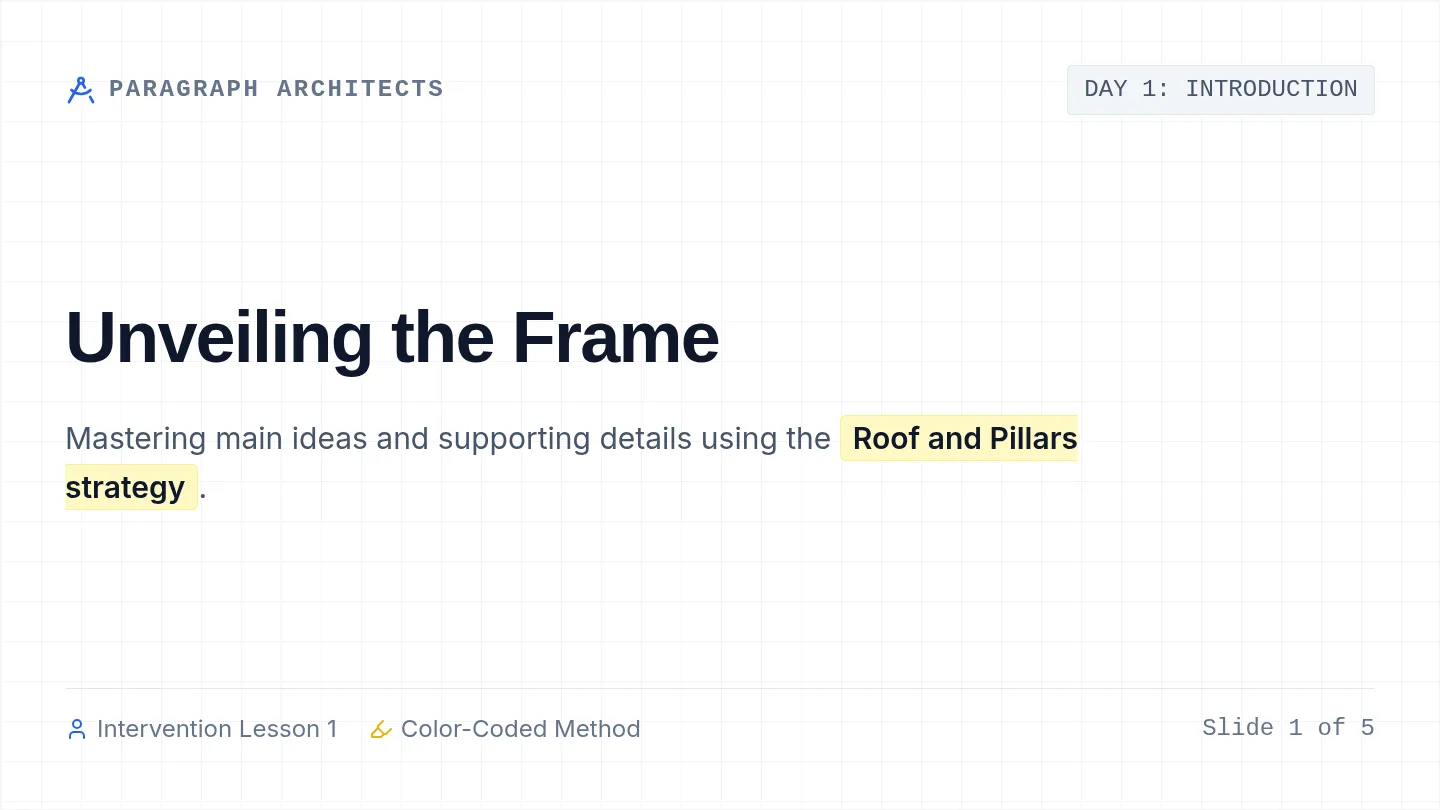
Supporting Detail
Specific facts, examples, or statistics that back up and prove the main idea.
Clue
Legs of a table holding up the top.
Text Structure
How an author organizes information in a text (e.g., Cause/Effect, Description).
Clue
The "skeleton" of the writing.
Compare & Contrast
Examining similarities and differences between two or more people, places, or things.
Clue
Look for: "Both," "Unlike," "However."
Claim
The author's position or opinion on a topic that they intend to prove with evidence.
Clue
The "thesis" or main argument.
Counterclaim
The opposite point of view; an argument made by the "other side."
Clue
"Some may argue..."
Instructions
Cut along the borders to create individual flashcards. Use these as a reference guide while completing the rest of the Case Files.
Structural Blueprints Organizer Structural Blueprints
Visual Organizers for Text Analysis
FORM: SB-990
Unit: Text Structure
Student Name
Date
Organizer A: Compare & Contrast
Similarities
Topic 1:
Topic 2:
Organizer B: Cause & Effect
The Cause (Why?)
The Effects (Results)
Instruction: Identify keywords such as "because," "as a result," "similarly," or "on the other hand" before mapping.
Main Idea Missions Worksheet Mission: Central Idea
OBJECTIVE: IDENTIFY MAIN IDEA & KEY DETAILS
Classified Document
LEVEL: GRADES 6-8
Field Agent:
Date of Report:
Protocol: Read the passage below. Your mission is to extract the central idea and the specific evidence that supports it.
TRANSCRIPT #442
The Hidden Architects of the Forest
While often overlooked, the intricate fungal networks beneath our feet—commonly called the "Wood Wide Web"—are essential to a healthy forest ecosystem. These underground threads, or mycelium, connect individual trees to one another, allowing them to share vital resources. Through these connections, older, larger "mother trees" can actually send nutrients like sugar and nitrogen to smaller, struggling saplings. Furthermore, these networks allow trees to "warn" each other of impending dangers. When one tree is attacked by insects, it releases chemical signals through the fungi, prompting neighboring trees to boost their immune defenses before the pests reach them. Without this collaborative system, many forests would struggle to survive environmental stressors.
1. Which statement best expresses the central idea of the passage?
A
Fungi are a type of plant that grows only in old-growth forests.
B
Individual trees compete for resources to ensure their own survival.
C
Fungal networks enable trees to communicate and share resources for forest survival.
D
Scientists have discovered that insects use fungal networks to track down trees.
Evidence Finder
Quote Extraction
Evidence Piece #1: Support for resource sharing
Evidence Piece #2: Support for warning signals
2. As used in the passage, what does the word "collaborative" most likely mean?
A. Competitive
B. Secretive
C. Cooperative
D. Temporary
The Test Lab: Main Idea & Structure Practice Test: Phase 1
Assessment: Main Idea & Text Structure
Time Limit 20:00
Student:
Class:
The Rise of the Electric Commute
[1] Over the last decade, urban transportation has undergone a dramatic transformation. While traditional gas-powered cars once dominated city streets, a new wave of electric vehicles (EVs) and e-bikes is quickly claiming the lane. This shift is primarily driven by a growing global awareness of environmental impact. Unlike internal combustion engines, which emit carbon dioxide and contribute to smog, electric motors produce zero tailpipe emissions. Consequently, cities that have invested in EV infrastructure are seeing measurable improvements in local air quality.
[2] However, the transition is not without its hurdles. One major challenge is "range anxiety"—the fear that a vehicle will run out of power before reaching a charging station. To combat this, city planners are redesigning urban layouts. While older cities were built around the needs of the gas station, modern hubs are installing charging ports in grocery stores, parking garages, and even along curbsides. This structural change is similar to how cities transitioned from horse-drawn carriages to automobiles over a century ago; both shifts required a complete rethinking of public space.
[3] In addition to environmental benefits, electric commuting offers significant economic advantages for the individual. While the initial purchase price of an electric bike or car may be higher, the long-term savings are substantial. Electricity is generally cheaper than gasoline, and EVs have fewer moving parts, which means they require less frequent maintenance. Owners no longer need to worry about oil changes or complex transmission repairs. As technology continues to improve and battery costs drop, the electric commute is likely to become the standard rather than the exception.
Go on to the next page for questions.
Questions
1. Which statement best summarizes the main idea of the passage?
A. Electric vehicles are too expensive for the average urban commuter to afford.
B. The shift to electric transportation is driven by environmental, economic, and structural changes.
C. City planners are struggling to keep up with the demand for new gas stations.
D. Range anxiety is the primary reason why most people refuse to buy electric bikes.
2. In paragraph 1, how does the author organize the information?
A. By describing the history of the internal combustion engine.
B. By comparing and contrasting electric motors with horse-drawn carriages.
C. By presenting the cause of the shift to EVs and its effect on air quality.
D. By listing the different types of e-bikes available in modern cities.
Test Lab Answer Key Answer Key
Material ID: main-idea-practice-test-1
Teacher Use Only
Section 1: Multiple Choice
Question 1 (Main Idea) B
Question 2 (Text Structure) C
Question 3 (Evidence) C
Section 2: Short Response
Exemplary Response (2 Points):
"The author compares the current shift to electric vehicles to the historical transition from horse-drawn carriages to automobiles. This comparison helps the reader understand that massive changes in city infrastructure are not new. The author notes that 'both shifts required a complete rethinking of public space' and that city planners are now 'redesigning urban layouts' to include charging ports, just as they once had to build gas stations for cars."
Scoring Rubric:
2 Points: Clearly identifies the comparison (horses/cars) and explains its purpose with two specific details.
1 Point: Identifies the comparison but lacks clear explanation or only uses one detail.
0 Points: Response is incorrect, irrelevant, or not based on the text.
Misconception Alert
Students often confuse "Main Idea" with "Topic." Remind students that the topic is just "Electric Vehicles," while the main idea is what the author says *about* that topic (it's a full sentence/thought).
Argument Armor Worksheet Argument Armor
Evaluating Claims and Strengthening Evidence
Agent Name
Date
Strengthening Your Case
Not all evidence is equal. **Strong evidence** is specific, factual, and directly related to the claim. **Weak evidence** is vague, based on one person's opinion, or unrelated.
Phase 1: Sort the Intel
CLAIM: Middle schools should start later in the morning to improve student performance.
"A study by the American Academy of Pediatrics found that middle schoolers who sleep more than 8 hours have higher test scores."
Weak
Strong
"My cousin goes to a school that starts at 9:00 AM, and he says he likes it way better than his old school."
Weak
Strong
"Most teachers agree that students seem tired in the morning, and it is hard to teach them when they are yawning."
Weak
Strong
Phase 2: The Logic Bridge
Good arguments need **Reasoning** (the bridge that connects your evidence back to your claim). Explain WHY the evidence proves the point.
Evidence Provided
"Statistics show that 70% of car accidents involving teenagers occur when drivers are sleep-deprived."
Write Your Reasoning
(How does this prove that school should start later?)
Unit 3: Persuasion Protocol Build Your Case.
The Final Brief Practice Test Final Brief: Argument
Assessment: Claim, Evidence, & Counterclaim
EXAM ID: AR-700
The Case for Cursive
¶1 Many modern school districts have removed cursive writing from their curriculum to make room for more typing classes. However, this is a significant mistake. Learning cursive is not just about decorative penmanship; it is a neurological exercise that improves brain development. Studies have shown that the fluid motion of cursive writing helps students develop fine motor skills and improves memory retention compared to simply hitting keys on a laptop.
¶2 Opponents argue that cursive is an outdated skill that is no longer necessary in a digital world. While it is true that most work is typed, being able to read cursive is essential for historical research. Many of our nation’s founding documents, as well as family letters from just two generations ago, are written in cursive. If children cannot read it, they are effectively cut off from a vital part of their own history.
¶3 Ultimately, cursive offers a unique connection between the mind and the hand. By teaching both typing and cursive, schools can ensure that students are prepared for the future while remaining grounded in the skills of the past.
1. Which sentence from the passage represents a counterclaim?
A. "Learning cursive is not just about decorative penmanship..."
B. "Opponents argue that cursive is an outdated skill that is no longer necessary..."
C. "Studies have shown that the fluid motion of cursive writing helps students..."
D. "By teaching both typing and cursive, schools can ensure students are prepared..."
2. How does the author respond to the argument that cursive is no longer necessary?
A. By admitting that typing is actually more important for brain development.
B. By explaining that cursive helps students read important historical documents.
C. By suggesting that all historical documents should be re-typed for students.
D. By providing statistics on how many hours students spend on laptops.
Writing Prompt: The Final Verdict
In the passage, the author argues that cursive should still be taught in schools. Do you agree or disagree with the author's position? Write an argumentative paragraph that supports your claim with at least **two** pieces of evidence from the text. Be sure to explain how the evidence supports your point.
Final Checklist
Clear Claim
Reasoning Provided
Evidence #1
Counterclaim Addressed
Evidence #2
Conventions (SPAG)
Final Brief Answer Key Teacher Guide & Key
Material ID: argumentative-practice-test-2
Part 1 Multiple Choice
Question 1: Identifying Counterclaim B
Question 2: Response to Counterclaim B
Part 2 Writing Response
Exemplary Response Outline:
Claim: I agree with the author that cursive should still be taught in schools because it has both mental and historical benefits.
Evidence 1: The text mentions that cursive is a "neurological exercise" that improves brain development and memory.
Evidence 2: The author also points out that many historical documents are written in cursive, and students need to read it to understand history.
Reasoning: This evidence shows that cursive is not just an old hobby but a tool for learning and connecting to the past.
NYS Scoring Rubric (Simplified)
Score Criteria 4 Points Strong claim; 2+ relevant details; logical reasoning; few errors. 3 Points Clear claim; 2 details; some reasoning; minor errors. 2 Points Weak claim; 1 detail; little reasoning; distracting errors. 1 Point Minimal attempt; irrelevant or no evidence.
Teaching Tip: The Rebuttal
When teaching argument, emphasize that a **counterclaim** isn't just "the other side." It's an opportunity for the writer to show they've thought about all angles. Encourage students to use phrases like "While some may argue..." followed by a "However..." to strengthen their own position.