Synthesis Slides Inglés AVID 2
Serie de Repaso para el EOC
CLASE MAESTRA DE
SÍNTESIS
Dominando el arte de conectar temas, evidencia y la técnica del autor a través de pasajes emparejados.
Pasajes Emparejados
Análisis de Evidencia
Técnica del Autor
El Panorama del EOC
Análisis y Evidencia
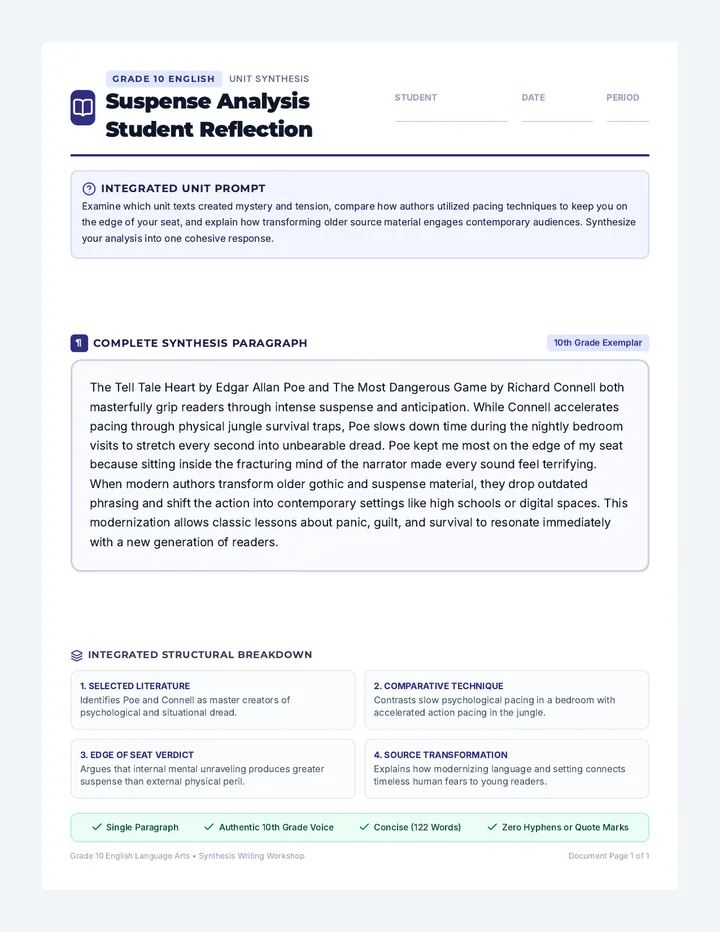
La sección más grande de su examen se centra en su capacidad para analizar un texto y demostrar su comprensión.
Habilidades Críticas
Inferir a partir de detalles sutiles
Vincular afirmaciones con evidencia específica
Conectar temas entre dos textos
La Síntesis es el 30% del Puntaje de Lectura
¿Qué es la Síntesis?
"La síntesis es el proceso de combinar partes o elementos para formar un todo. En el contexto del EOC, significa observar el Texto A y el Texto B y encontrar el 'ADN' que comparten."
Identificar
¿Cuál es el tema o tópico común?
Comparar
¿En qué se diferencian sus perspectivas?
Conectar
¿Qué mensaje se vuelve más fuerte al combinarlos?
Técnica del Autor: El Maletín de Herramientas
El EOC no solo preguntará qué dice el autor; preguntará cómo lo dice y por qué eligió ese camino.
01
Dicción (Elección de palabras)
¿Utiliza el autor palabras clínicas, emocionales o urgentes?
02
Estructura
¿Es una historia cronológica o un argumento basado en la lógica?
03
Recursos Retóricos
¿Están utilizando la lógica (logos), la emoción (pathos) o la credibilidad (ethos)?
CONSEJO PROFESIONAL
Busque el "Giro"
En la poesía y los discursos, busque el momento en que cambia el tono o el enfoque. Este "giro" es a menudo donde se esconde la Opción de Respuesta.
• Pero...
• Sin embargo...
• No obstante...
• De repente...
La Estrategia de "Extraer"
1
Afirmación: Encuentre el punto específico que plantea la pregunta.
2
Extraer: Regrese al texto y "extraiga" la oración que lo demuestre directamente.
3
Verificar: ¿Coincide la evidencia con la totalidad de la opción de respuesta, o solo con una parte?
La Trampa de la "Verdad Parcial"
Los distractores del EOC a menudo usan evidencia que está presente en el texto pero que en realidad no responde a la pregunta específica formulada. ¡Siempre vuelva a leer el enunciado!
Hora de Entrenar
Estamos a punto de analizar un poema y un editorial. Su misión: encontrar los hilos invisibles que los conectan.
A continuación
Práctica de Perspectivas Emparejadas
Paired Perspective Practice PAIRED PERSPECTIVE PRACTICE
Synthesis & Evidence Analysis
Name:
Date:
Strategy Note: As you read, look for shared themes regarding national identity and the promise of opportunity . Use your pencil to underline evidence that supports these ideas.
TEXT A
The New Colossus
— Emma Lazarus (1883)
1 5 10
Not like the brazen giant of Greek fame,
TEXT B
A Nation of Immigrants
— John F. Kennedy (1958)
[1]
Everywhere immigrants have enriched and strengthened the fabric of American life. The anonymous immigrant, the man who brought nothing with him but his skills and his hope, is the man who built our railroads, who cleared our forests, and who settled our frontiers. This is the secret of America: a nation of people with the fresh memory of old traditions who dared to explore new frontiers.
[2]
The contribution of the immigrant can be seen in every aspect of our national life. We see it in religion, in politics, in business, in the arts, in education, even in our sports and in our entertainment. There is no part of our nation that has not been touched by the presence of these people. They were not merely laborers; they were the dreamers who believed that a man’s worth should be measured by his character, not his birth.
[3]
As a nation, we are based on the concept that we are all created equal and that we all have certain inalienable rights. This concept was not merely a dream; it was a promise made to the world. It was a promise that this land would be a haven for those who sought a better life, a place where opportunity was limited only by one's own determination.
Analysis Questions
In The New Colossus, how does the author’s use of the term "Mother of Exiles" (line 6) contrast with the description of the "brazen giant of Greek fame"?
The giant represents a figure of war, while the Mother represents a figure of welcoming protection.
Synthesis Bridge Organizer Synthesis Bridge
AVID Strategy: Organization & Reading
Name:
Date:
Mission: Use this organizer to deconstruct two texts and find the invisible "bridge" that connects them. This is the key to answering high-level EOC synthesis questions.
Text A: Literary / Poem
Central Theme / Message
Key Quote (The Evidence)
Author's Craft / Tone
Text B: Informational
Central Thesis / Claim
Key Quote (The Evidence)
Author's Purpose / Style
The Synthesis Span
Shared Concepts
What ideas or values do both authors agree upon?
Divergent Approaches
How do they approach the topic differently? (Poetic vs. Logical)
Final Synthesis Statement
Combine both perspectives into one powerful conclusion about the topic.
Focus Area: Synthesis & Author's Craft
EOC Strategy Guide Teacher Strategy Guide
EOC Synthesis Masterclass
Target Assessment English 2 EOC
Instructional Goals
This lesson is designed to move students beyond basic comprehension into high-level synthesis. By pairing a classic 19th-century poem with a 20th-century political document, students must identify how the same core American values are adapted across different time periods, genres, and rhetorical purposes.
AVID Connection
WICOR (Writing, Inquiry, Collaboration, Organization, Reading) focuses on inquiry-based analysis of paired texts and organized synthesis mapping.
EOC Weight
Synthesis and Evidence analysis constitute the largest portion of the English 2 Reading exam. Mastering the "Shift" is critical for scoring.
Pacing Guide
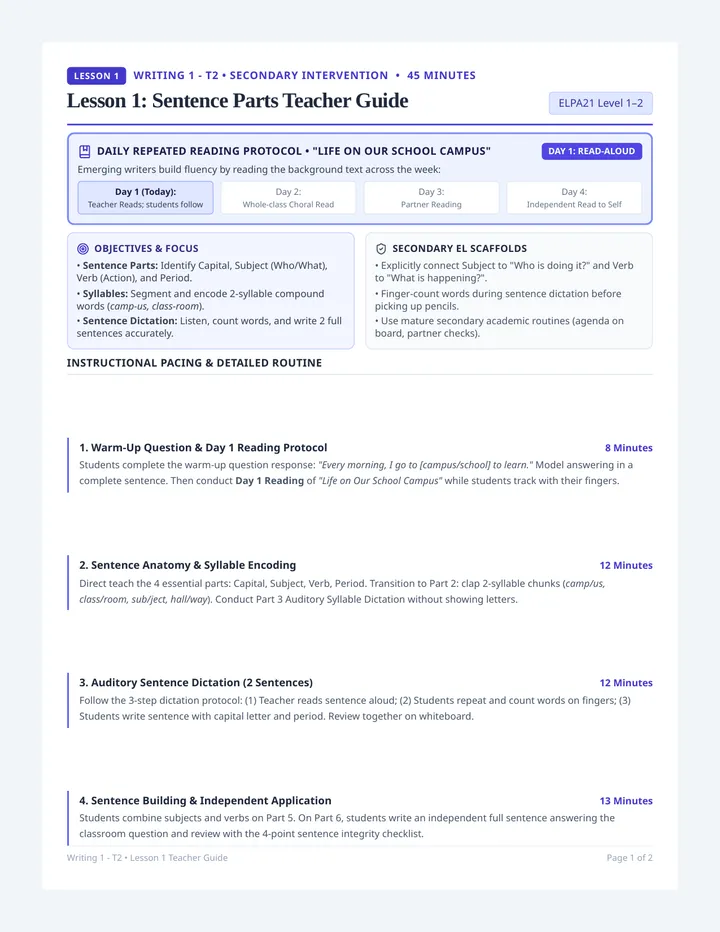
10m Direct Instruction (Synthesis Slides)
20m Guided Reading & Annotation (Worksheet)
20m Collaborative Mapping (Bridge Organizer)
10m Independent Exit Ticket / Synthesis Task
Answer Key & Rationale
Question 01: Inference/Contrast
Correct: Option 1
Rationale: Lazarus deliberately uses "brazen giant" (alluding to the Colossus of Rhodes) as a figure of "conquering" and war to contrast with the "Mother of Exiles" whose purpose is "world-wide welcome." Students must identify the tonal shift from militaristic power to nurturing sanctuary.
Evidence Lift:
"Give me your tired, your poor, / Your huddled masses yearning to breathe free..." (Lines 10-11)
Question 02: Craft/Structure
Correct: Option 2
Rationale: Kennedy employs a parallel structure—listing religion, politics, business, etc.—to create an overwhelming sense of the immigrants' universal impact. This list demonstrates that no part of the American "fabric" remains untouched.
Key Strategy:
Ask students: "Why didn't JFK just say 'everything'? Why list every specific category?" (Answer: To emphasize the breadth and depth of influence).
AVID Inquiry Prompts
Level 2: Interpretive
"How does Emma Lazarus’s choice of the word 'refuse' (line 12) challenge the common perception of immigrants during the 1880s?"
Level 3: Universal
"If Kennedy were alive today, what 'new frontiers' would he argue modern immigrants are helping to clear?"
Common Misconceptions
• The Genre Trap: Students may assume poems don't have "claims" like articles do. Remind them that poets use imagery to make arguments.
• Partial Evidence: Students often stop at the first quote they find. Encourage them to find the quote that covers the whole answer choice.
Argument Slides AVID English 2
EOC Review Series
ARGUMENT
ARCHITECTURE
Deconstructing claims, evidence, and rhetorical power in informational texts.
Claims & Evidence
Rhetorical Appeals
Structure Analysis
The Anatomy of a Claim
Informational Analysis
An argument isn't just an opinion; it's a structured house built on a foundation of evidence.
Building Blocks
The Claim: The central argument or thesis.
The Evidence: Facts, data, or anecdotes.
The Warrant: Explaining why evidence proves the claim.
CLAIM
Evidence + Warrant
No Evidence = No Argument
The Big Three
How authors persuade their audience
Logos
Appeal to Logic. Look for numbers, data, and cause-and-effect reasoning.
Pathos
Appeal to Emotion. Look for vivid imagery and charged diction.
Ethos
Appeal to Ethics/Credibility. Look for expert titles or a sense of shared values.
Organizational Patterns
Problem / Solution
Highlights a conflict and proposes a specific path forward.
Cause / Effect
Focuses on how one event or decision leads to another.
Compare / Contrast
Juxtaposes two ideas to show why one is superior.
EOC Question Strategy
When asked how an author develops their argument, look at the transitions between paragraphs.
Consequently Furthermore In contrast As a result
The Counter Catch
Strong authors don't ignore the other side; they acknowledge it, then rebut it.
Look for:
• "Critics may argue..."
• "While it is true that..."
• "Some may say..."
EOC Focus Area
You will often be asked: "Why does the author include the perspective in paragraph X?"
To strengthen their own argument through rebuttal
Claim & Conquer
You are about to analyze a high-stakes editorial. Identify the structure, lift the evidence, and name the appeals.
Up Next
Editorial Evidence Practice
Editorial Evidence Practice EDITORIAL EVIDENCE PRACTICE
Architecture of Argument
Name:
Date:
Informational Text
The Last Green Acre
— Dr. Elena Vance (2025)
[1]
The relentless march of concrete across our cityscapes is not merely an aesthetic tragedy; it is a public health crisis waiting to erupt. As we replace urban parks with high-rise luxury apartments, we are trading the long-term well-being of our citizens for short-term economic gain. Research from the Global Wellness Institute indicates that city dwellers with access to green space have 20% lower cortisol levels than those without. To pave over our remaining parks is to pave over our collective sanity.
[2]
Critics of green preservation often point to the dire need for housing. It is a compelling argument, on its face. We do need homes for our burgeoning population. However, the solution is not the destruction of the very lungs that keep our city breathable. Instead, we must look to "brownfield" development—repurposing abandoned industrial sites rather than clearing the few remaining stands of ancient oak and elm.
[3]
Beyond health and housing, we must consider the ethical weight of our stewardship. These parks are the only wild places many of our children will ever know. If we allow them to vanish, we are telling the next generation that profit is the only value that matters. A city without green is a city without a soul, and a soul, once lost, cannot be rebuilt with bricks and mortar.
Deconstructing the Argument
Which sentence best summarizes the author’s primary claim in "The Last Green Acre"?
Urban developers should focus exclusively on building luxury high-rise apartments.
Green spaces must be preserved because they are essential to urban health and ethics.
The city's housing crisis can only be solved by destroying existing parks.
Industrial brownfields are the only places where high-quality trees can grow.
Identifying Appeals
In paragraph 1, the author cites research from the Global Wellness Institute. Which rhetorical appeal is being used, and why?
How does the author’s inclusion of the counter-argument in paragraph 2 contribute to the overall structure of the editorial?
It confuses the reader by presenting conflicting data about city growth.
It provides historical context for why the parks were built originally.
It acknowledges a valid concern before proposing a more sustainable alternative.
It shifts the focus of the article from public health to industrial archaeology.
Analysis Response
Argument Strategy Guide Teacher Strategy Guide
Architecture of Argument
Target Focus Informational Text
Instructional Focus
This lesson focuses on the mechanics of persuasion. In English 2, students must move beyond identifying "what" is being said and begin articulating "how" the author constructs their case. The featured editorial uses all three rhetorical appeals (logos, ethos, pathos) and a classic counter-argument/rebuttal structure.
AVID Inquiry
Encourage students to use Costa’s Levels of Thinking when discussing the editorial. Push for Level 3: "How might urban planning reflect the values of a society?"
EOC Watch
Questions about rhetorical appeals and "how the author develops an argument" are high-frequency on the English 2 EOC.
Class Flow
15m Analyze "Big Three" appeals using Argument Slides.
25m Independent or paired analysis of "The Last Green Acre".
20m Whole-class debrief: Evaluating the rebuttal effectiveness.
Answer Key & Rationale
Question 01: Central Claim
Option 2 is correct
Rationale: The editorial argues for park preservation as both a health necessity and an ethical duty. Option 2 captures this dual focus. Options 1 and 3 are the exact opposite of the author's stance.
Identifying Appeals: Paragraph 1
Correct Response: Logos. The author uses research data from an institution (Global Wellness Institute) and specific statistics (20% lower cortisol) to provide logical, scientific proof for the claim.
Question 02: Counter-Argument Structure
Option 3 is correct
Rationale: In paragraph 2, Vance acknowledges the "dire need for housing"—a common counter-argument—to build ethos by showing she isn't ignoring real problems. She then immediately pivots to a solution ("brownfield development") that addresses both needs.
Teaching "The Shift"
"The most common area where English 2 students struggle is identifying the tone shift. In paragraph 3, the tone shifts from logical and clinical to high-stakes and ethical."
Key Diction to Highlight
• "Relentless march of concrete" (Personification)
• "Ethical weight of our stewardship" (High Diction)
• "City without a soul" (Metaphor)
Extension Question
"How does the author's use of 'the city’s lungs' serve as a recurring metaphor for environmental health?"