A two-part cross-curricular sequence exploring character morality and psychological depth through literature and creative digital music production.
Primal Desire / Ambition:
To secure fate's promise of sovereignty; absolute security on the throne.
Psychological Motives & Traumas:
Deep insecurity and paralyzing fear of being powerless.
Intense sense of destiny catalyzed by the Weird Sisters.
Anxiety regarding gender and courage provoked by Lady Macbeth.
The Moral Crossroads (Dilemma):
Macbeth must choose between preserving his moral soul (honoring host-guest hospitality laws and loyalty to Duncan) and seizing the throne through premeditated regicide.
Compromising Actions (The Descent):
Premeditated assassination of King Duncan while sleeping.
Ordering the brutal murder of Banquo (his close friend/ally).
The absolute slaughter of Macduff’s innocent children and wife.
Sacrifice vs. Gain:
Sacrificed: Eternal peace, sound sleep, sanity, and public love. Gained: Absolute earthly power and temporal control.
Moral Coordinate Plotting Description:
Macbeth starts at "Tragic Hero" (S)—a noble, courageous soldier fighting for his king, though possessed by ambition. He transforms directly into an "Anti-Villain" then "Pure Villain" (E), whose absolute tyranny destroys Scotland. The arrow moves drastically from left to right, illustrating how active compromise of conscience strips a hero of human empathy.
Anticipating Student Pitfalls
The Sympathy Trap
Students often think that understanding a character's sad backstory means they must excuse their horrific actions. Guide them to see that explanation is not justification. Acknowledge the pain, but name the crime.
Anachronistic Judgment
Remind students to evaluate the character within the ethical rules of their historical setting, not just modern standards. (e.g., hospitality rules in ancient Greek or medieval narratives were sacred, life-or-death laws).
SHADOW PLAY TEACHER SUPPORT PACK PAGE 2 OF 2
LEITMOTIF LAB PART 3 & 4: DAW COMPOSITION & LOG
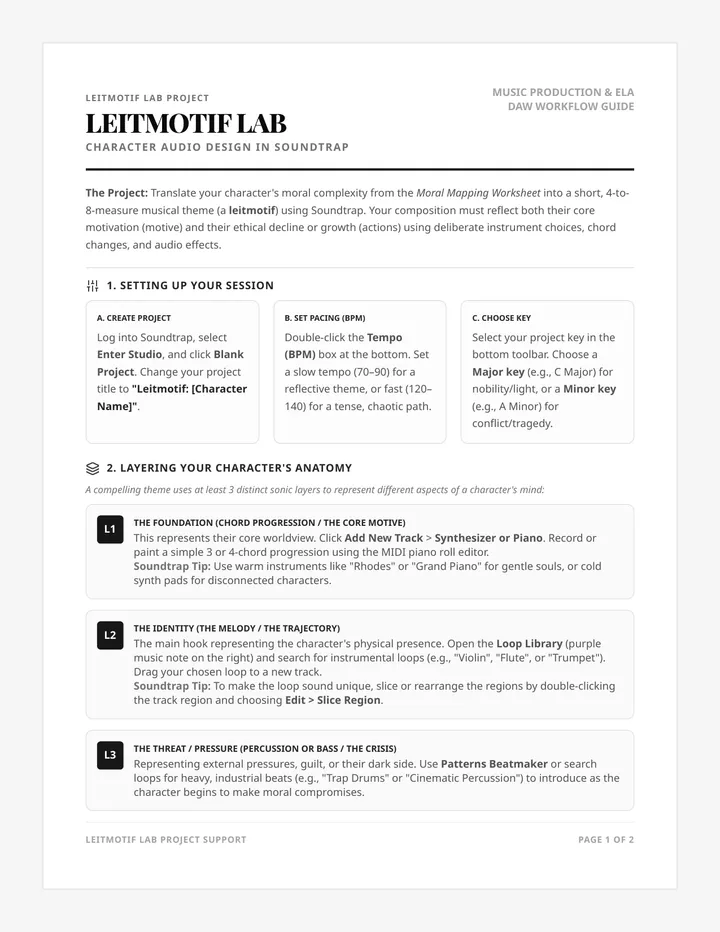
3. Music Production Techniques for Morality
How do we represent "good" and "bad" or the shift between them without using words? Experiment with these sound design tools inside Soundtrap:
Using Automation (Transitions)
To show a character slowly falling from grace, use Volume or Pan Automation (the split-line icon on the track). Gently draw a fading volume curve on a bright, acoustic element while raising the volume on a distorted synthetic bass line over time.
Adding FX (The "Wound")
Give a sound emotional scarring by double-clicking the track header, opening the FX Panel, and adding "Delay", "Reverb", or "Distortion". Overwhelming reverb can evoke isolation; distortion represents corruption.
4. Your Leitmotif Composition Log
Document your design decisions below. Explain exactly how your production choices correspond to your character's psychological profile.
Tempo (BPM):
Key / Scale:
Number of Tracks:
Instrumentation Choice: (What did you assign to the core melody, and why?)
Audio FX or Automation: (Where did you use FX or volume curves to show a change in state?)
The Moral Climax: (How does the music mimic the character's main moral crossroads?)
Soundtrap Submission Checklist:
Ensure your project is saved and your private shareable link is copied.
Link Ready
LEITMOTIF LAB PROJECT SUPPORT PAGE 2 OF 2
}
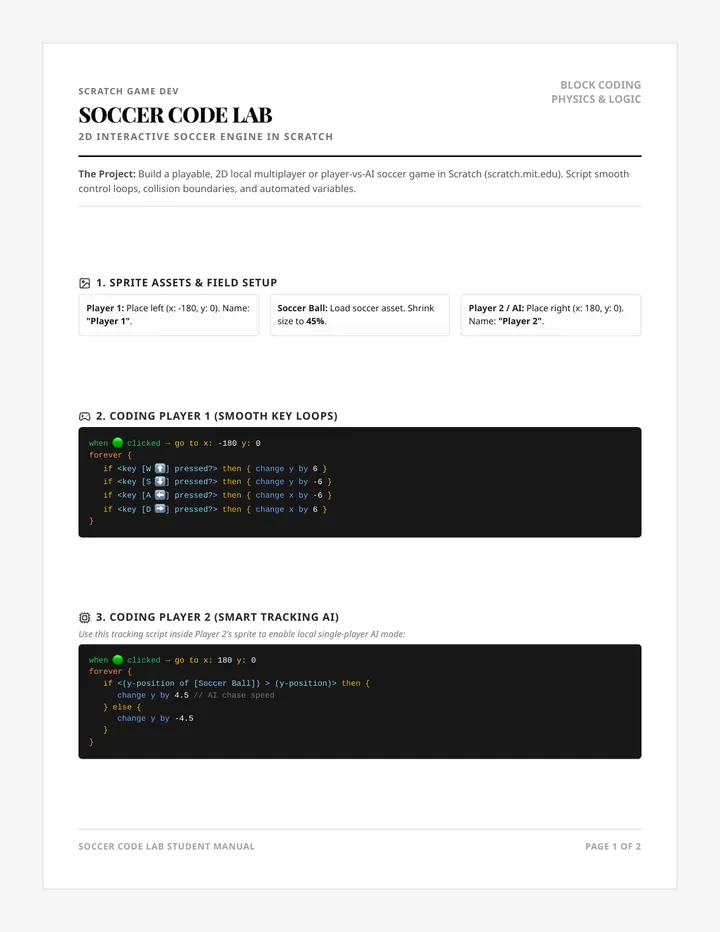
6. Debugging & Physics Customization Log
Friction Scale: (What changes when you modify 0.97?)
Kick Velocity: (How did variable values modify gameplay?)
Sandbox Mechanic: (What custom rules did you code—powerups, obstacle barriers, or sound triggers?)