Spot and Describe Slides Day 1: Animal Sentence Explorers
Kindergarten Writing
Looks and Colors
We can write sentences to tell what an animal looks like!
Today's Goal: Use color and body part words.
🦁
🐾 Look closely • 🗣️ Say it out loud • ✏️ Write it down
Our Sentence Pattern
Pattern 1: Color & Size
The animal is color.
Example: The frog is green.
Pattern 2: Body Parts
It has body parts.
Example: It has long legs.
Remember: Start with a capital letter and end with a period! A ... .
Animal Clue #1 Look and Say Together!
🦁 Lion
What color is it?
The lion is yellow.
What body part does it have?
It has a big mane.
Clue Words: yellow • brown • big mane • sharp teeth
Animal Clue #2 Your Turn to Finish!
🐘 Elephant
What color is it?
The elephant is .
What body part does it have?
It has .
Word Bank: gray big ears a long trunk
Animal Clue #3 Build It Together!
🦒 Giraffe
Tell how it looks:
The giraffe is .
Tell what it has:
It has .
Word Bank: tall brown spots a long neck
Explorer Writing Time
Now It Is Your Turn!
1️⃣
Pick an Animal
Look at the picture on your page.
2️⃣
Say Your Sentence
Tell a partner what color or body part it has.
3️⃣
Trace & Write
Use finger spaces and a period at the end.
🐾 Good writers check: Capital letter • Finger spaces • Period
Animal Looks Practice Day 1 • Animal Sentence Explorers
Animal Looks & Colors
🦁
Name:
Date:
Explorer Word Bank
green
gray
tall
yellow
long legs
big ears
spots
mane
Directions: Look at each animal. Finish the sentences using the Word Bank.
🐸 frog
The frog is .
It has .
🐘 elephant
The elephant is .
It has .
🦒 giraffe
The giraffe is .
It has .
Turn the page to draw and write your own animal sentences!
Day 1 • Independent Practice
Draw & Describe Your Animal
🎨
1. Draw an animal. Color it carefully!
2. Write 2 sentences about how your animal looks.
Need help starting? Try: The ___ is ___. or It has ___.
My Writing Check
Capital letter
Finger spaces
Period at the end
Looks Lesson Guide Day 1 Teacher Guide • Animal Sentence Explorers
Looks and Colors
Kindergarten Writing
25–30 Minutes
Learning Target
Students will orally rehearse and write simple sentences describing an animal's color, size, and body parts using visual clues.
Sentence Frames & Sight Words
• "The ___ is ___."
• "It has ___."
Sight Words: the, is, it, has
Lesson Pacing & Oral Rehearsal
1. Warm-Up & Slides (8 min): Show Spot and Describe Slides . Model pointing to each word as the class reads the lion example aloud. Have students touch their nose when they hear a color word and clap for a body part.
2. Guided Practice (8 min): On Slides 4–5 (Elephant & Giraffe), have students turn and talk to a partner using the frame before filling in the blanks together on the board.
3. Independent Practice (10 min): Distribute Animal Looks Practice . Read the Word Bank together first. Encourage students to say each sentence aloud before writing.
4. Share & Check (4 min): Have 2–3 students share their Page 2 drawing and read one sentence while the class checks for a capital letter, finger spaces, and a period.
Differentiation
Support: Highlight the matching word in the Word Bank, or write the word in yellow highlighter for the student to trace.
Extend: Challenge early finishers to write a 3rd sentence on Page 2 using two describing words (e.g., "It has big gray ears.").
Page 1 Answer Key
Frog: The frog is green. / It has long legs.
Elephant: The elephant is gray. / It has big ears.
Giraffe: The giraffe is tall (or yellow). / It has spots.
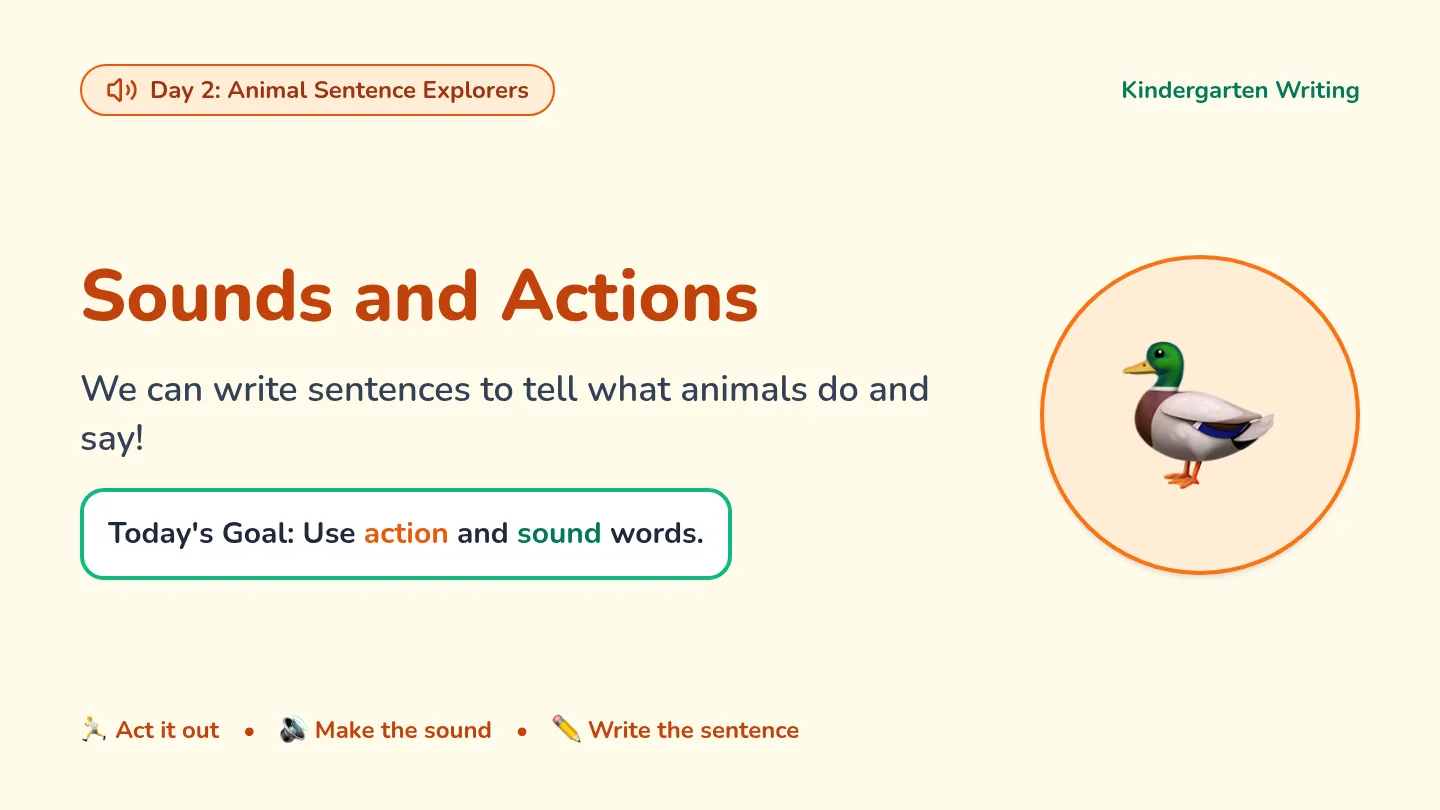
Move and Roar Slides Day 2: Animal Sentence Explorers
Kindergarten Writing
Sounds and Actions
We can write sentences to tell what animals do and say!
Today's Goal: Use action and sound words.
🦆
🏃 Act it out • 🔊 Make the sound • ✏️ Write the sentence
Our Sentence Pattern
Pattern 1: Action
The animal can action.
Example: The duck can swim.
Pattern 2: Sound
It says sound!
Example: It says quack!
Tip: Excited sound sentences can end with an exclamation mark! !
Animal Clue #1 Read and Act It Out!
🐶 Dog
What can it do?
The dog can run.
What sound does it make?
It says woof!
Action & Sound Words: run • jump • dig • bark • woof
Animal Clue #2 Your Turn to Finish!
🐒 Monkey
What can it do?
The monkey can .
What sound does it make?
It says !
Word Bank: climb swing ooh-aah
Animal Clue #3 Build It Together!
🐦 Bird
What can it do?
The bird can .
What sound does it make?
It says !
Word Bank: fly hop chirp
Explorer Writing Time
Now It Is Your Turn!
🎭
Act the Action
Show how the animal moves with your hands.
🗣️
Say the Sentence
Use "can" for actions and "says" for sounds.
✏️
Write & Check
Add finger spaces and end marks (. or !).
🐾 Good writers check: Capital letter • Finger spaces • End mark
Animal Actions Practice Day 2 • Animal Sentence Explorers
Animal Sounds & Actions
🦆
Name:
Date:
Action & Sound Word Bank
swim
climb
fly
run
quack
ooh-aah
chirp
woof
Directions: Look at each animal. Write what it can do and what it says.
🦆 duck
The duck can .
It says !
🐒 monkey
The monkey can .
It says !
🐦 bird
The bird can .
It says !
Turn the page to draw an animal in action and write your own sentences!
Day 2 • Independent Practice
Draw & Write an Animal Action
🏃
1. Draw an animal moving or making a sound!
2. Write 2 sentences about what your animal can do and say.
Need help starting? Try: The ___ can ___. or It says ___!
My Writing Check
Capital letter
Finger spaces
End mark (. or !)
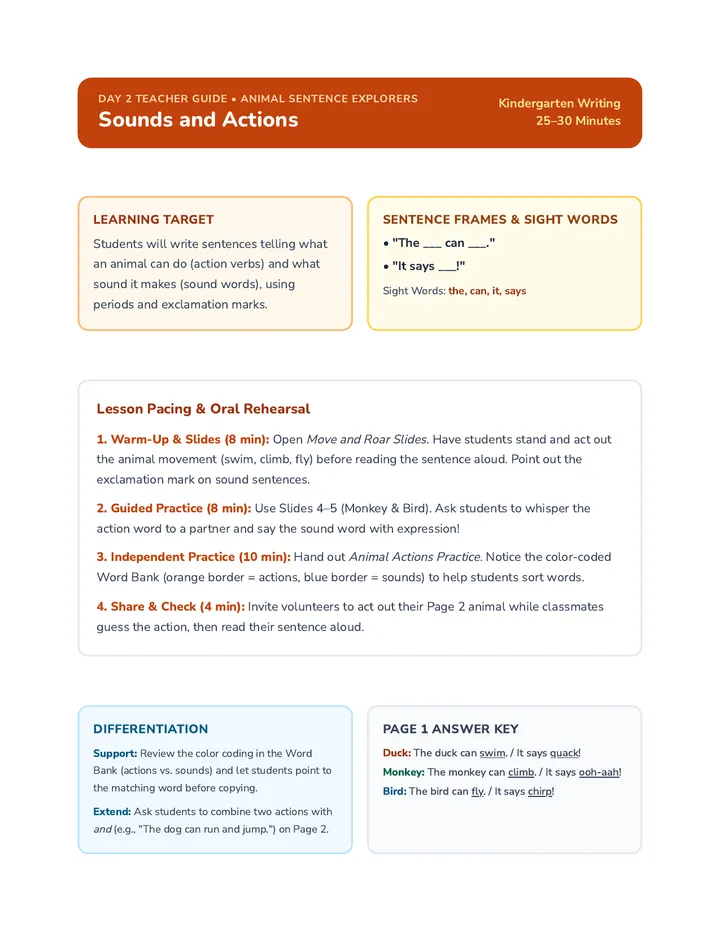
Actions Lesson Guide Day 2 Teacher Guide • Animal Sentence Explorers
Sounds and Actions
Kindergarten Writing
25–30 Minutes
Learning Target
Students will write sentences telling what an animal can do (action verbs) and what sound it makes (sound words), using periods and exclamation marks.
Sentence Frames & Sight Words
• "The ___ can ___."
• "It says ___!"
Sight Words: the, can, it, says
Lesson Pacing & Oral Rehearsal
1. Warm-Up & Slides (8 min): Open Move and Roar Slides . Have students stand and act out the animal movement (swim, climb, fly) before reading the sentence aloud. Point out the exclamation mark on sound sentences.
2. Guided Practice (8 min): Use Slides 4–5 (Monkey & Bird). Ask students to whisper the action word to a partner and say the sound word with expression!
3. Independent Practice (10 min): Hand out Animal Actions Practice . Notice the color-coded Word Bank (orange border = actions, blue border = sounds) to help students sort words.
4. Share & Check (4 min): Invite volunteers to act out their Page 2 animal while classmates guess the action, then read their sentence aloud.
Differentiation
Support: Review the color coding in the Word Bank (actions vs. sounds) and let students point to the matching word before copying.
Extend: Ask students to combine two actions with and (e.g., "The dog can run and jump.") on Page 2.
Page 1 Answer Key
Duck: The duck can swim. / It says quack!
Monkey: The monkey can climb. / It says ooh-aah!
Bird: The bird can fly. / It says chirp!
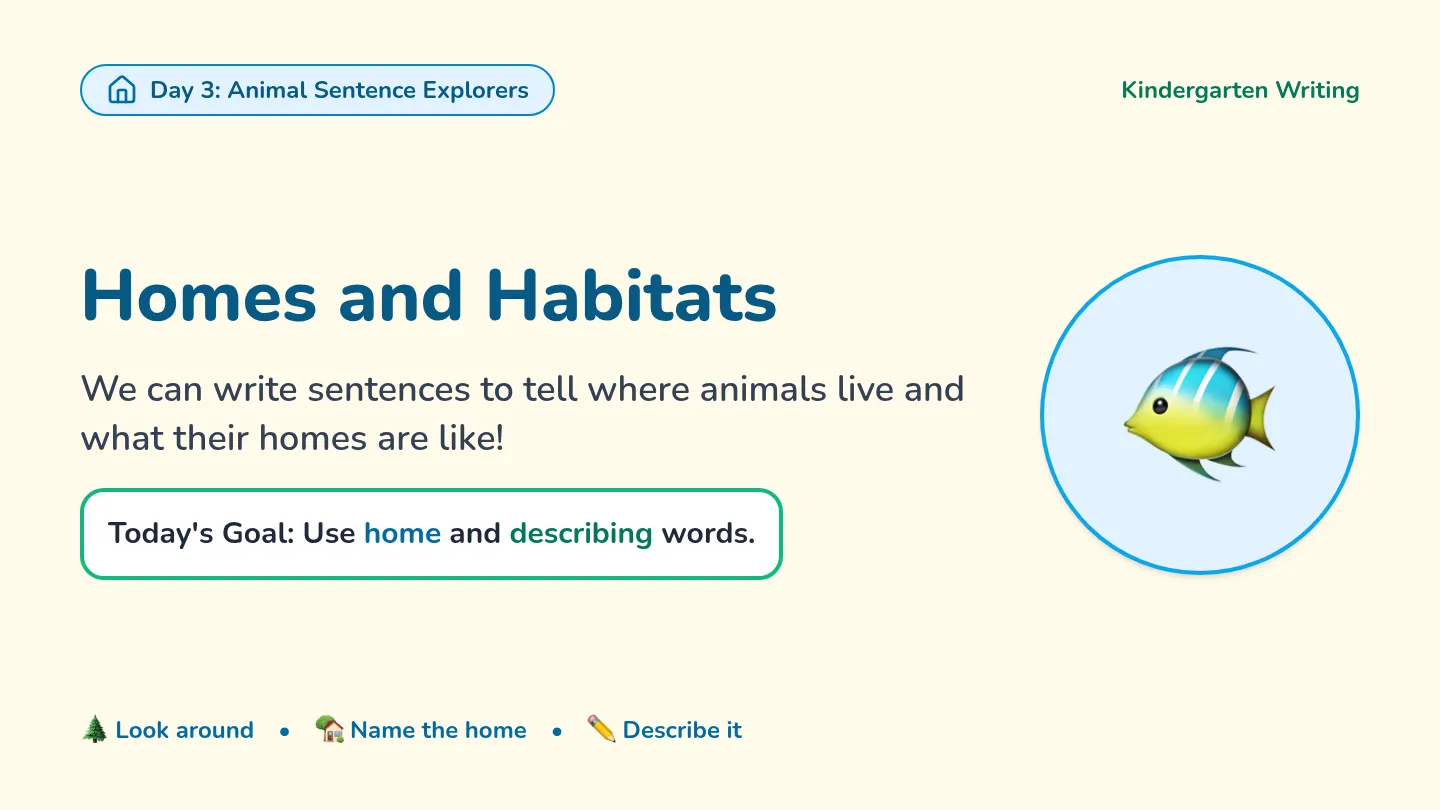
Wild Homes Slides Day 3: Animal Sentence Explorers
Kindergarten Writing
Homes and Habitats
We can write sentences to tell where animals live and what their homes are like!
Today's Goal: Use home and describing words.
🐠
🌲 Look around • 🏡 Name the home • ✏️ Describe it
Our Sentence Pattern
Pattern 1: Where It Lives
The animal lives in a home.
Example: The bird lives in a nest.
Pattern 2: Describe Home
Its home is describing word.
Example: Its home is high in a tree.
Habitat means the natural home where an animal lives! 🏡 Habitat
Habitat Clue #1 Look and Say Together!
🐠🌊 Fish • Ocean
Where does it live?
The fish lives in the ocean.
What is its home like?
Its home is big and blue.
Habitat Words: ocean • wet • blue • deep • salty
Habitat Clue #2 Your Turn to Finish!
🐻⛰️ Bear • Cave
Where does it live?
The bear lives in a .
What is its home like?
Its home is .
Word Bank: cave dark cozy
Habitat Clue #3 Build It Together!
🐝🍯 Bee • Hive
Where does it live?
The bee lives in a .
What is its home like?
Its home is .
Word Bank: hive busy sweet
Explorer Writing Time
Now It Is Your Turn!
🗺️
Find the Home
Match each animal to where it lives.
🗣️
Describe It
Tell a partner one word about that home.
✏️
Write & Draw
Write your sentences and draw the habitat.
🐾 Good writers check: Capital letter • Finger spaces • Period
Animal Homes Practice Day 3 • Animal Sentence Explorers
Animal Homes & Habitats
🏡
Name:
Date:
Habitat Word Bank
ocean
cave
hive
nest
blue
dark
busy
cozy
Directions: Look at each animal and its home. Finish the sentences.
🐠🌊 fish
The fish lives in the .
Its home is .
🐻⛰️ bear
The bear lives in a .
Its home is .
🐝🍯 bee
The bee lives in a .
Its home is .
Turn the page to draw an animal home and write your own sentences!
Day 3 • Independent Practice
Draw & Describe an Animal Home
🌲
1. Draw an animal inside its habitat!
2. Write 2 sentences about where your animal lives.
Need help starting? Try: The ___ lives in ___. or Its home is ___.
My Writing Check
Capital letter
Finger spaces
Period at the end
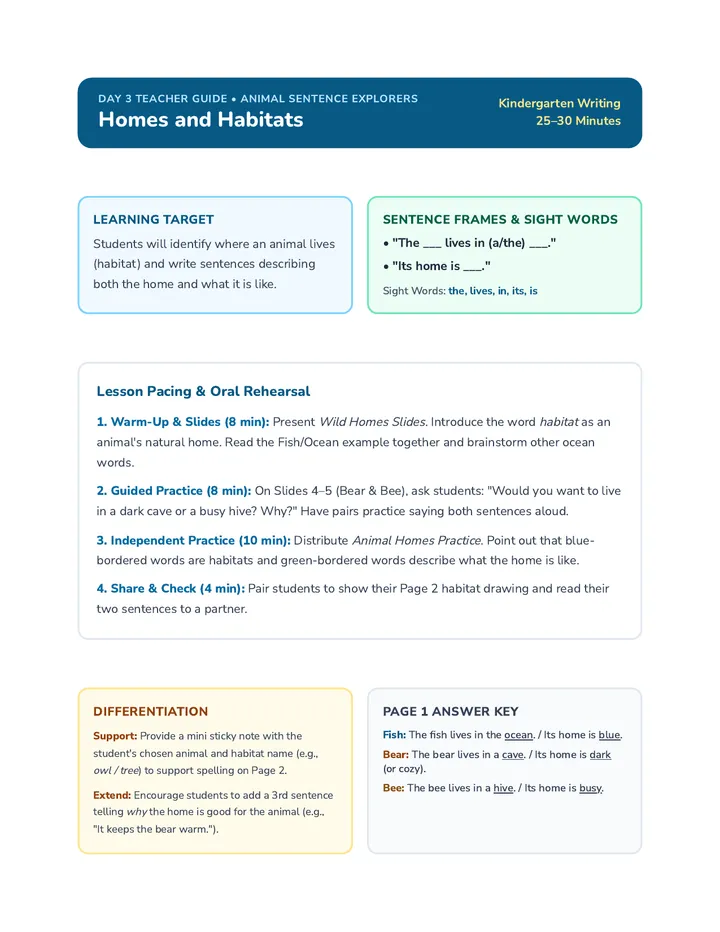
Homes Lesson Guide Day 3 Teacher Guide • Animal Sentence Explorers
Homes and Habitats
Kindergarten Writing
25–30 Minutes
Learning Target
Students will identify where an animal lives (habitat) and write sentences describing both the home and what it is like.
Sentence Frames & Sight Words
• "The ___ lives in (a/the) ___."
• "Its home is ___."
Sight Words: the, lives, in, its, is
Lesson Pacing & Oral Rehearsal
1. Warm-Up & Slides (8 min): Present Wild Homes Slides . Introduce the word habitat as an animal's natural home. Read the Fish/Ocean example together and brainstorm other ocean words.
2. Guided Practice (8 min): On Slides 4–5 (Bear & Bee), ask students: "Would you want to live in a dark cave or a busy hive? Why?" Have pairs practice saying both sentences aloud.
3. Independent Practice (10 min): Distribute Animal Homes Practice . Point out that blue-bordered words are habitats and green-bordered words describe what the home is like.
4. Share & Check (4 min): Pair students to show their Page 2 habitat drawing and read their two sentences to a partner.
Differentiation
Support: Provide a mini sticky note with the student's chosen animal and habitat name (e.g., owl / tree ) to support spelling on Page 2.
Extend: Encourage students to add a 3rd sentence telling why the home is good for the animal (e.g., "It keeps the bear warm.").
Page 1 Answer Key
Fish: The fish lives in the ocean. / Its home is blue.
Bear: The bear lives in a cave. / Its home is dark (or cozy).
Bee: The bee lives in a hive. / Its home is busy.
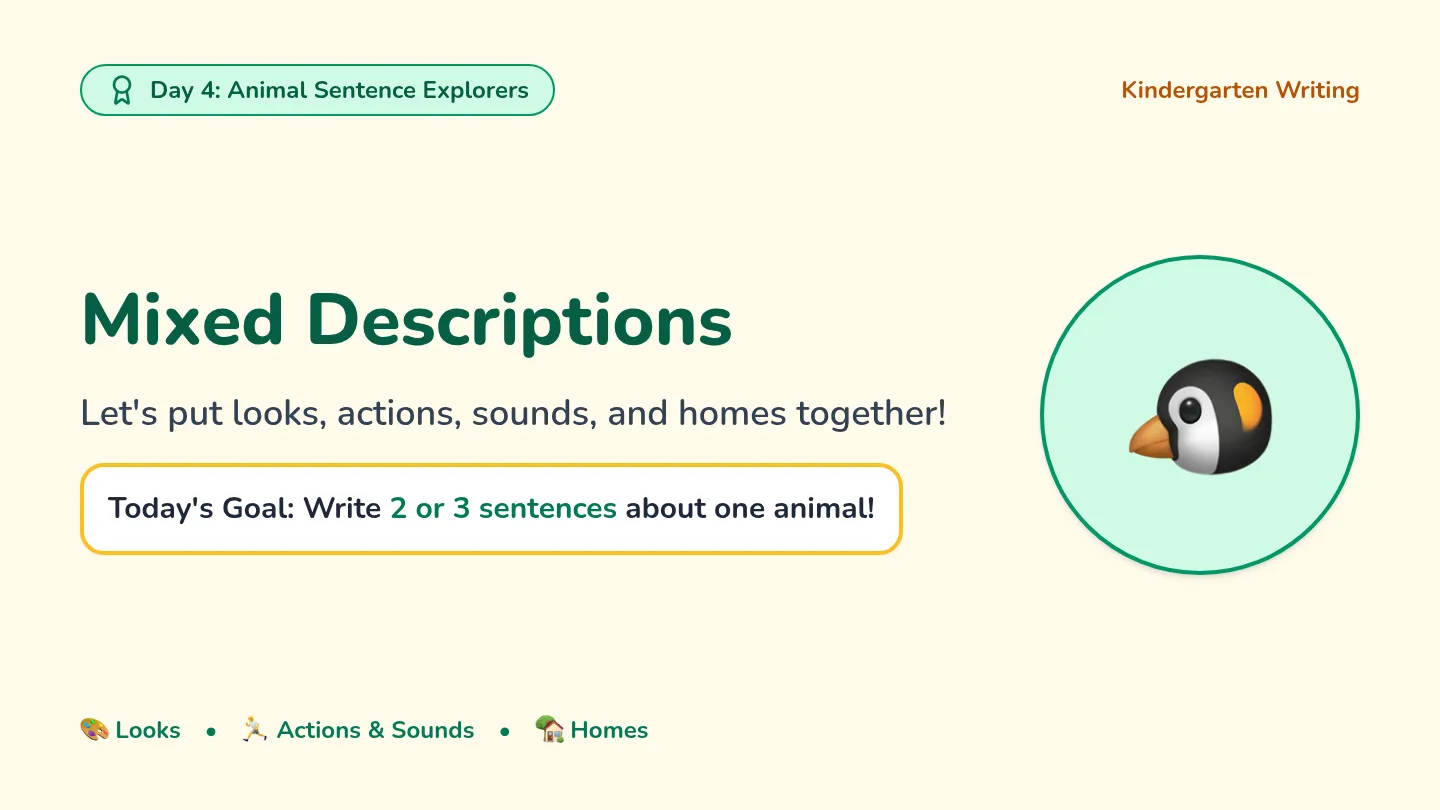
Super Animal Slides Day 4: Animal Sentence Explorers
Kindergarten Writing
Mixed Descriptions
Let's put looks, actions, sounds, and homes together!
Today's Goal: Write 2 or 3 sentences about one animal!
🐧
🎨 Looks • 🏃 Actions & Sounds • 🏡 Homes
Super Writer Recipe
Clue 1: Looks
The ___ is ___.
Tell its color or body part.
Clue 2: Action / Sound
It can ___.
Tell what it does or says.
Clue 3: Home
It lives in ___.
Tell where its home is.
When we put all 3 clues together, our reader can picture the animal! ⭐ 3 Clues
Super Model #1 Read All 3 Sentences!
🐧❄️ Penguin
The penguin is black and white.
It can swim and waddle.
It lives on cold ice.
🎉 Look! We used looks, actions, and a home in one story!
Super Model #2 Finish Together!
🐯🌿 Tiger
The tiger has .
It says !
It lives in the .
Word Bank: stripes roar jungle
Mystery Animal! Read the Clues and Guess!
1. I am green with long legs.
2. I can hop and say ribbit!
3. I live in a pond.
Who Am I?
🐸 🐶 🦉
Point to the animal that matches all 3 clues!
💡 Great descriptions help others guess your animal!
Super Animal Writers
Your Super Animal Page!
🎨
Draw & Color
Draw your favorite animal in its home.
📝
Write 3 Clues
Tell how it looks, what it does, and where it lives.
🎤
Share!
Read your sentences to a friend.
🐾 Explorer Check: Capital letters • Finger spaces • Periods
Super Animal Practice Day 4 • Animal Sentence Explorers
Super Animal Descriptions
🐧
Name:
Date:
Super Word Bank
black and white
swim
ice
stripes
roar
jungle
Directions: Use all 3 clues (looks, action/sound, home) to finish each story.
🐧 penguin
The penguin is .
It can .
It lives on .
🐯 tiger
The tiger has .
It says !
It lives in the .
Turn the page to create your own Super Animal Page!
Day 4 • Super Animal Project
My Favorite Animal Story
⭐
1. Draw your favorite animal in its home. Show what it looks like and what it is doing!
2. Write 3 sentences about your animal (Looks, Action/Sound, Home).
Super Writer Check
I told how it looks.
I told what it does.
I told where it lives.
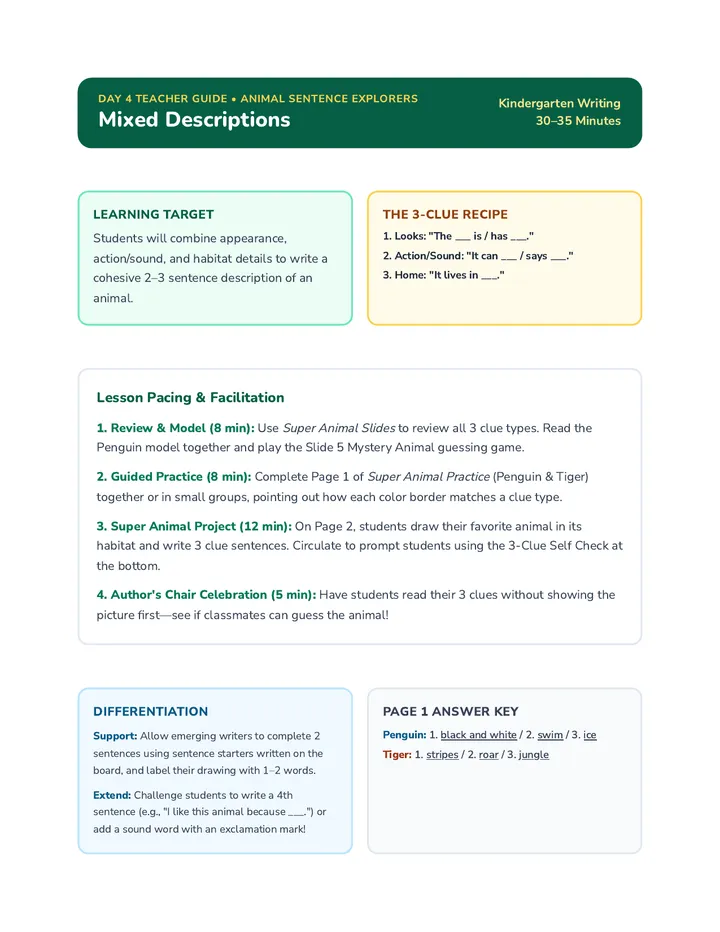
Mixed Lesson Guide Day 4 Teacher Guide • Animal Sentence Explorers
Mixed Descriptions
Kindergarten Writing
30–35 Minutes
Learning Target
Students will combine appearance, action/sound, and habitat details to write a cohesive 2–3 sentence description of an animal.
The 3-Clue Recipe
1. Looks: "The ___ is / has ___."
2. Action/Sound: "It can ___ / says ___."
3. Home: "It lives in ___."
Lesson Pacing & Facilitation
1. Review & Model (8 min): Use Super Animal Slides to review all 3 clue types. Read the Penguin model together and play the Slide 5 Mystery Animal guessing game.
2. Guided Practice (8 min): Complete Page 1 of Super Animal Practice (Penguin & Tiger) together or in small groups, pointing out how each color border matches a clue type.
3. Super Animal Project (12 min): On Page 2, students draw their favorite animal in its habitat and write 3 clue sentences. Circulate to prompt students using the 3-Clue Self Check at the bottom.
4. Author's Chair Celebration (5 min): Have students read their 3 clues without showing the picture first—see if classmates can guess the animal!
Differentiation
Support: Allow emerging writers to complete 2 sentences using sentence starters written on the board, and label their drawing with 1–2 words.
Extend: Challenge students to write a 4th sentence (e.g., "I like this animal because ___.") or add a sound word with an exclamation mark!
Page 1 Answer Key
Penguin: 1. black and white / 2. swim / 3. ice
Tiger: 1. stripes / 2. roar / 3. jungle