Clue Categories Slides Clue Categories Slides
Advanced Inference & Context Clue Strategies
LEXICAL INVESTIGATION UNIT: 01
The Hook: Mystery Dialect
CHALLENGE
"There was me, that is Alex, and my three droogs, that is Pete, Georgie, and Dim, Dim being really dim, and we sat in the Korova Milkbar making up our rassoodocks what to do with the evening..."
Questions to Consider:
• What is a droog? How do you know?
• What is a rassoodock? What clue told you?
Your brain is already using Syntactic and Semantic clues to translate this language.
The Linguistic Toolkit
Semantic Clues
Clues based on meaning and ideas.
• Synonyms/Antonyms: Direct comparisons.
• Examples: Lists that illustrate the word.
• Cause/Effect: Relationships between events.
Syntactic Clues
Clues based on structure and grammar.
• Part of Speech: Is it a verb? A noun?
• Word Order: Where does it sit in the sentence?
• Punctuation: Commas, dashes, or parentheses.
Nonsense Challenge
"The glubious student splonked his heavy books onto the desk."
Step 1: Syntax
Glubious comes before a noun and after an article. It ends in -ious. It is likely an Adjective.
Step 2: Semantics
Splonked involves "heavy books" and a "desk." The sound of the word suggests a loud, forceful action. It is likely a Verb (to drop heavily).
Detective Workshop
You will now receive the Nadsat Decoder. Your goal is to use syntactic and semantic clues to map out an entirely unfamiliar dialect.
STATUS: MISSION ACTIVE
Nadsat Decoder Worksheet Nadsat Decoder Worksheet
Linguistic Investigation Unit: Lesson 01
Name:
Date:
Mission Briefing
Analyze the following excerpt from a fictional dialect. Using Syntactic Clues (grammar, parts of speech, punctuation) and Semantic Clues (meaning, associations), determine the probable definition of each bolded term.
"It was a moloko-plus morning. We were all viddying the chelloveck walking down the street with his gulliver hanging low. He looked plattish, as if he hadn't slept in chais. Dim, that glupyy boy, wanted to start a razrez, but I told him to keep his kartoffel shut."
The Lexical Ledger
Term Syntactic Clue (Part of Speech?) Semantic Clue (Context?) Inferred Definition moloko-plus viddying chelloveck gulliver plattish razrez
Syntactic Analysis
Choose one word from above. Explain how its suffix or position in the sentence helped you determine its part of speech.
Semantic Synthesis
How does the tone of the passage help you define "razrez"? What other words in the sentence provided a "vibe" that informed your choice?
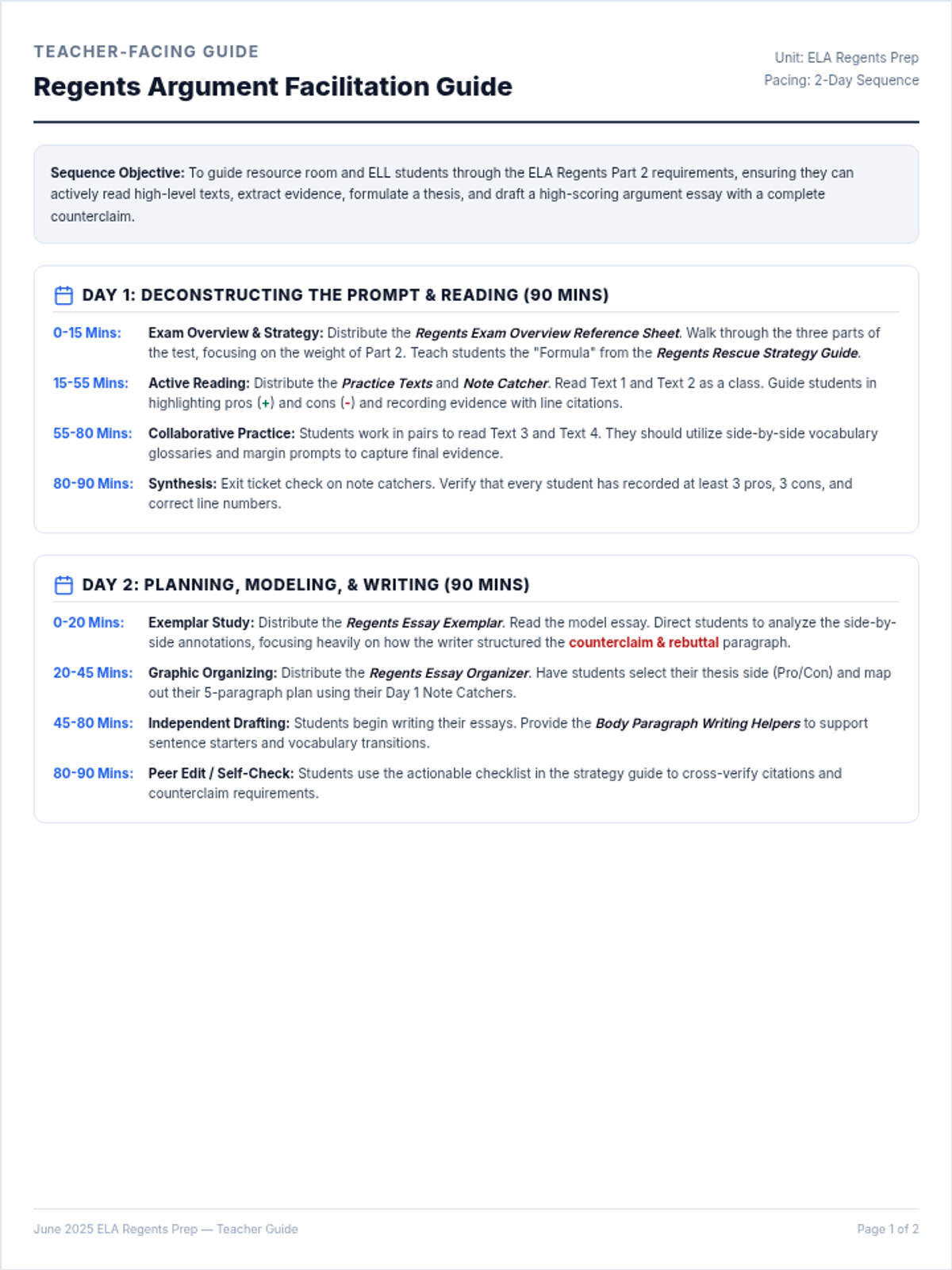
Syntax Workshop Teacher Guide Syntax Workshop Teacher Guide
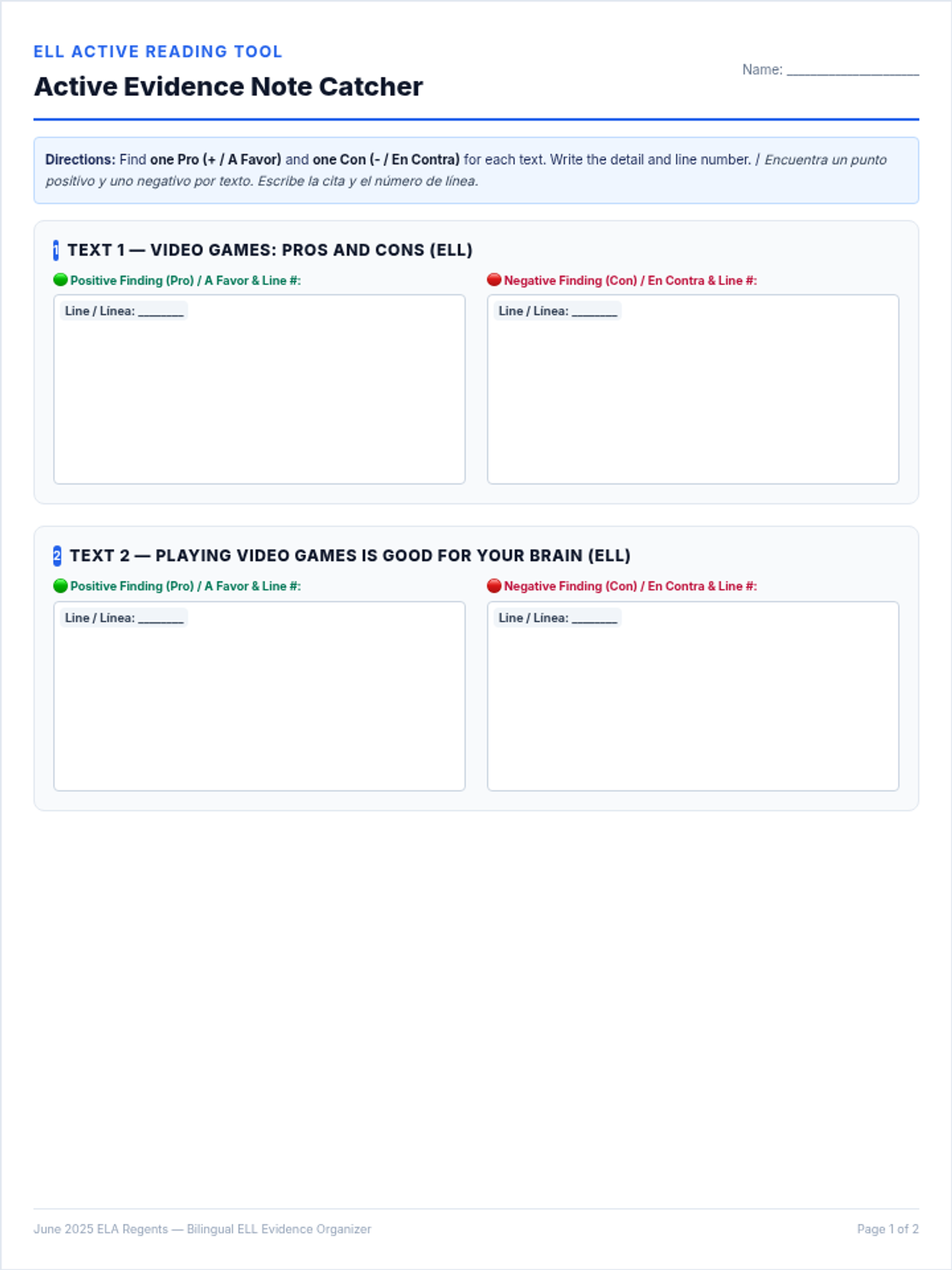
Lesson 1: Categorizing Clue Types
Lesson Phase
DIAGNOSTIC
Learning Objective
Students will be able to categorize context clues as either syntactic (grammatical structure, part of speech) or semantic (meaning-based associations) to infer the definitions of unfamiliar words in a constructed dialect.
The Hook: "Nadsat" Introduction
Begin with Slide 2. Do not tell students the definitions yet. Ask them: "Why can you understand this even though half the words are nonsense?" Guide them toward the realization that their brain is automatically filling in the blanks based on where the word is and what vibe it has.
Key Vocabulary
Syntactic Clue
Clues derived from grammar, punctuation, and sentence position.
Semantic Clue
Clues derived from the actual meaning of the surrounding words and logic.
Nadsat Decoder: Answer Key
Word Syntactic Evidence Semantic Evidence Probable Meaning moloko-plus Adjective (modifies "morning") "Morning" suggests a type of weather or mood. Bright, cold, or milky. viddying Verb (ends in -ing, follows "were") "Walking down the street" is something you watch. Watching, seeing. chelloveck Noun (follows "the", precedes "walking") Only a person or animal walks down a street. Person, man, fellow. gulliver Noun (possession "his") "Hanging low" suggests a body part or item. Head. plattish Adjective (ends in -ish, follows "looked") Linked to "hadn't slept." Tired, pale, flat. razrez Noun (follows "a") Contrast: "wanted to start... but I told him to keep shut." Fight, argument, riot.
Discussion Prompts
"Which was easier to identify: the part of speech or the actual meaning? Why?"
"What happens to the sentence if you decide 'razrez' is a verb instead of a noun?"
"How did punctuation (like the comma before 'but') help you define 'razrez'?"
Common Misconceptions
Gothic Shadows Slides Gothic Shadows
Navigating Archaic Diction
The Redacted Shadow
"It was a _________, _________ night in the moors; the _________ wind howled through the _________ corridors of the manor, carrying the _________ scent of decay."
The Challenge
What mood is being created? What specific adjectives would fit these blanks?
"Mood and Tone are 'Macro-Context' clues. Even if you don't know a specific word, the 'vibe' of the passage dictates what it must mean."
Macro-Context Clues
1. Atmospheric Consistency
Authors of the 19th century rarely mixed moods. If a scene is gloomy, an unfamiliar word likely has a gloomy definition.
2. Archaic Syntax
Older texts use longer, more complex sentences. Look for the subject and verb first to anchor your understanding.
Case Study: Poe
"The sepulchre was cold and damp."
Mood: Death, gloom, silence.
Synonym: Tomb, grave.
The Annotation Loop
1
Identify the Mood
Scan for "feeling" words. Is it oppressive? Joyful? Scientific?
2
Bracket Unfamiliar Diction
Circle words you don't know. Don't stop reading yet!
3
Test the Inference
Does a "mood-appropriate" word fit in that slot? Try it out.
Gothic Mystery
Open your Atmospheric Annotation Worksheet. You are entering a 19th-century manor. Use the shadows to find the light.
OBSERVE
ANNOTATE
DECODE
Atmospheric Annotation Worksheet Atmospheric Annotation
Lexical Investigation Unit
CASE FILE 02: ARCHAIC DICTION
Investigator:
Date:
Phase 1: Detecting the Atmosphere
Read the following passage. Before focusing on specific words, identify the overall mood. Circle any "feeling" words that contribute to this mood.
"The day was gloomy and somber. Upon the precipice of the ruined abbey, a forlorn figure stood, gazing into the abyssal depths below. The sepulchral silence was broken only by the plaintive cry of a lone raven, a sound that seemed to evince a deep and ancient sorrow within the very stones of the manor."
Primary Mood:
Evidence (3 specific words):
Phase 2: The Macro-Context Decode
Archaic Term precipice
Clues in the Shadows
Positioned after "upon the" and involves an abbey and "depths below."
Inferred Definition
Archaic Term sepulchral
Clues in the Shadows
Describes "silence." Linked to the mood of ruin and sorrow.
Inferred Definition
Archaic Term plaintive
Clues in the Shadows
Describes a "cry of a raven." Linked to "ancient sorrow."
Inferred Definition
Archaic Term evince
Clues in the Shadows
Syntactic: A verb following "seemed to." Semantic: Shows sorrow.
Inferred Definition
Investigative Synthesis
How does the 19th-century author's use of mood act as a safeguard for your vocabulary? In other words, how does knowing the "feeling" prevent you from guessing a definition that is technically possible but contextually wrong?
Archaic Language Teacher Guide Archaic Language Teacher Guide
Lesson 2: Macro-Context Clues
Strategy Focus
MOOD & TONE
Lesson Objective
Students will apply the "Atmospheric Annotation" strategy to infer the meaning of archaic vocabulary, using the overarching mood of a 19th-century text as a secondary filter for their inferences.
Macro-Context defined:
"The understanding that vocabulary exists within a thematic ecosystem. In a Gothic text, words rarely mean 'happy' or 'bright' unless used ironically."
Atmospheric Annotation Answer Key
Target Mood Analysis:
Gloomy, Melancholy, Desolate, Oppressive.
precipice
A very steep rock face or cliff, typically a tall one.
Clue: "Upon the..." + "depths below" implies height/edge.
forlorn
Pitifully sad and abandoned or lonely.
Clue: Describes the figure standing alone in ruins.
sepulchral
Relating to a tomb or interment; gloomy/dismal.
Clue: Describes "silence" in an "abbey" and "ruins."
evince
To reveal the presence of (a quality or feeling); indicate.
Clue: The raven's cry "seemed to [show]" sorrow.
Pedagogical Pivot Points
The Redacted Challenge
During the Slide 2 activity, if students struggle to find adjectives, provide a "word bank" of conflicting moods (e.g., *effervescent, grim, jovial, menacing*). Ask them to explain why *effervescent* is a "wrong" choice for a Gothic corridor.
Syntactic Support
Remind students that 19th-century authors loved appositives . Often, an unfamiliar word like "sepulchre" is followed immediately by a description: "The sepulchre, that cold house of the dead..."
Check for Understanding
"If the mood of the passage shifted from gloomy to scientific, would the word 'precipice' still mean the same thing? How would our decoding process change?"
Expected Answer: The core definition remains, but the "macro-clue" shifts from emotional resonance to physical description/measurement.
Technical Decoding Slides Unit 03: Precision Decoding
Technical Decoding
Structural Clues in Academic & Domain-Specific Jargon
Mystery Manual
Device Operating Procedures:
"Ensure the cylindrical obsidian core is properly aligned with the serrated distal aperture to initiate carbon-based mark deposition."
What common object is this describing?
The "Internal Map" Strategy
Appositives
Technical writers often define words immediately after using them, separated by commas or dashes.
"The hypotenuse , the longest side of a right triangle, is..."
Concept Clues
Look for definitions hiding in parentheses or after words like "or", "that is", or "namely."
"The study of entomology (insects) is..."
The Translation Workflow
Step 1
Identify the "Core" Sentence
Strip away the adjectives and jargon. What is the basic subject/verb?
Step 2
Locate "Bridge" Punctuation
Find commas, dashes, or parentheses that separate the jargon from its definition.
Step 3
The "Plain English" Flip
Rewrite the sentence using only words a 5th grader would understand.
Systems Check
You are now analyzing a technical abstract on Bioluminescence. Use your structural maps to navigate the jargon.
INITIATING DECODER.EXE
Jargon Jumble Worksheet Jargon Jumble Worksheet
Linguistic Investigation Unit: Lesson 03
Name:
Appositives: Look for commas.
Concept Clues: Look for "that is" or "namely."
Synonyms: Parenthetical definitions.
Text Alpha: Biological Engineering
"Deep-sea organisms often utilize bioluminescence—the biochemical emission of light by living organisms—as a primary adaptation for predation and camouflage. This process is triggered by a catalyst, namely a protein called luciferase, which accelerates the reaction between luciferin and oxygen. In the bathypelagic zone (the layer of the ocean between 1,000 and 4,000 meters), this light serves as a photophore, or a light-producing organ, that can confuse piscivorous predators who rely on visual identification."
Structural Map
Jargon Term The Structural Clue (What punctuation/word led you?) Inferred Definition bioluminescence adaptation catalyst photophore piscivorous
The "Plain English" Flip
Now that you've decoded the jargon, rewrite the entire passage as if you were explaining it to a 5th-grade student. You must keep all the scientific facts but remove all the complex vocabulary.
Begin your translation here...
Academic Language Teacher Guide Academic Language Teacher Guide
Lesson 3: Structural Jargon Decoding
Strategy Focus
INTERNAL MAPS
Lesson Objective
Students will identify and utilize structural context clues (appositives, parenthetical definitions, and concept markers) to decode domain-specific jargon in informational texts.
Structural Map Defined:
"The ability to recognize punctuation and transition words as literal arrows pointing to a word's meaning, provided intentionally by the author for clarity."
Jargon Jumble: Answer Key
Term Structural Evidence Inferred Definition bioluminescence Dash (—) followed by a definition. Living things making light. adaptation Syntactic: "for predation and camouflage" explains the word's function. Survival tool/trait. catalyst Marker word "namely" followed by an example (luciferase). Something that starts a reaction. photophore Appositive: set off by "or" and commas. Light-producing organ. piscivorous Semantic: "predators who rely on visual identification" and the "pisc-" root. Fish-eating.
Paraphrasing Challenge: Evaluation Criteria
Sample "Plain English" Response
"Animals in the deep ocean often make their own light. This is a special trick they use to hunt and hide. A chemical in their body makes this light happen faster. In the dark parts of the sea, they use special light-organs to trick fish-eating hunters who are looking for them."
Common Error:
Students often keep words like "reaction" or "primary." Challenge them to go even simpler: "action" or "main."
Hook Follow-up
The "Mystery Manual" from Slide 2 describes a No. 2 Pencil .
• Obsidian core: Graphite.
• Serrated distal aperture: Pencil sharpener.
• Carbon-based mark deposition: Writing.
Teaching Point:
Jargon is often just a very precise (and sometimes unnecessarily complex) way of describing something common. Decoding it removes the "power" the text has over the reader.
Morphology Matrix Slides Morphology Matrix
Roots & Affixes in Context
PREFIX + ROOT + SUFFIX CONTEXT CLUE PRECISION
When Context Fails
"The scientist observed the multicellular structure under the lens."
In this sentence, "multicellular" could mean complex , simple , tiny , or dead .
Context alone isn't enough to give us a precise definition.
The Tie-Breaker
Morphology
"Multi" (many) + "Cellular" (cells) =
Having many cells.
The Word Dissection
Prefix
Adds direction or quantity.
Re-, Un-, Dis-
Root
The core meaning.
Scrib, Path, Phil
Suffix
Determines the Part of Speech.
-ion, -ate, -able
"Morphology tells you what the word is. Context tells you how it's being used."
The Synthesis Protocol
1
Identify the Root . What is the fundamental concept?
2
Identify the Affixes . How is the meaning modified?
3
Check the Surrounding Evidence . Does the morphological definition make sense in the sentence?
Word Math
Root (Greek) "Bio" (Life)
Suffix "-ology" (Study)
Result Biology
"The study of life."
Workshop Phase
You are now entering the Word Math Lab. Use your knowledge of Greek and Latin roots to resolve linguistic ambiguities.
STATUS: CALIBRATING MORPHEMES
Word Math Workshop Worksheet Word Math Workshop
Linguistic Investigation Unit: Lesson 04
Name:
Morpheme Reference Lab
Roots
Chron : Time
Gnos : Knowledge
Morph : Form/Shape
Bene : Good/Well
Prefixes
Syn- : Together/With
A- : Without
Anti- : Against
Mis- : Wrong/Bad
Suffixes
-ize : To make/become (v)
-ous : Full of (adj)
-ic : Relating to (adj)
-ism : Belief/System (n)
01
"The ancient ritual required the dancers to move in synchronous motion, following the beat of a single drum."
Step 1: Dissect
Syn + Chron + Ous
Step 2: Literal Math
Together + Time + Full of
Step 3: Context Precision
02
"The monster was amorphous, shifting its jelly-like body to fit through the narrowest cracks."
Step 1: Dissect
A + Morph + Ous
Step 2: Literal Math
Without + Shape + Full of
Step 3: Context Precision
03
"The doctor's prognosis offered little hope for a quick recovery, given the severity of the infection."
Step 1: Dissect
Pro + Gnos + Is
Step 2: Literal Math
Forward + Knowledge + Act
Step 3: Context Precision
The Reverse Equation
Create your own "Word Math" problem. Use a prefix or root from the lab (or one you know) and write a sentence where context alone is ambiguous, but the morphology provides the answer.
Your Word Dissection:
Your Literal Math:
Your Context Sentence:
Root Analysis Teacher Guide Root Analysis Teacher Guide
Lesson 4: Etymology in Context
Strategy Focus
TIE-BREAKERS
Lesson Objective
Students will combine morphological analysis (dissecting roots and affixes) with surrounding context clues to resolve ambiguity and produce high-precision definitions for complex vocabulary.
Morphology as Tie-Breaker:
"When context clues are 'soft' (vague or suggestive), morphological clues are 'hard' (fixed and structural). Students must learn to cross-reference both."
Word Math Workshop: Answer Key
01: synchronous Level: Basic
"Together" + "Time" + "Full of"
Precision Definition: Happening at the same time; simultaneous.
CONTEXT TIE: "following the beat of a single drum" reinforces the 'same time' concept.
02: amorphous Level: Intermediate
"Without" + "Shape" + "Full of"
Precision Definition: Lacking a clearly defined shape or form.
CONTEXT TIE: "shifting its jelly-like body" reinforces the lack of structure.
03: prognosis Level: Advanced
"Forward/Before" + "Knowledge" + "Act"
Precision Definition: A forecast of the likely course of a disease or situation.
CONTEXT TIE: "offered little hope for a quick recovery" implies a future-facing prediction.
Instructional Facilitation
The "Word Math" Hook
During the Slide 4 activity, emphasize that roots are like numbers and context is like the operator (plus/minus). If the root says 'Life' but the context says 'Death,' there is a tension (like irony or paradox) that the reader must resolve.
Crucial Distinction:
"Don't let students rely on morphology alone. A word like 'nice' has a root meaning 'ignorant' (nescius). Context always has the final veto."
Syntactic Check
"How does the suffix -ous in 'synchronous' and 'amorphous' change the role of the word in a sentence compared to the suffix -ism in 'synchronism'?"
Teaching Point:
-ous makes it an adjective (describing the motion/monster), while -ism makes it a noun (the state of being synchronous). This connects Lesson 4 back to Lesson 1's syntax focus.
Lexicographer Challenge Slides Lexicographer Challenge
Mastery Level Synthesis
The Discovery
"A fragment of a lost manuscript has been discovered in a remote archive. It contains five words that haven't been seen in centuries. As the head lexicographer, it is your job to define them for the new edition of the dictionary."
MISSION: RECONSTRUCT THE GLOSSARY
Your Full Toolkit
Syntactic Analysis
Part of speech and sentence position.
Atmospheric Evidence
Mood and tone (Macro-context).
Structural Clues
Appositives and punctuation markers.
Morphology
Root and affix tie-breakers.
The Editorial Board
Once your glossary is complete, you will present your findings to the Editorial Board (your peers). You must justify your definitions using Evidence Citations.
Claim
"This word means X..."
Evidence
"...because the root says Y..."
Reasoning
"...and the mood of the text is Z."
Begin Synthesis
The "Lexicographer's Ledger" is on your desk. The fragment awaits.
ESTABLISH DEFINITIONS
Lexicographer Ledger Assessment Lexicographer's Ledger
Final Mastery Assessment: Textual Synthesis
Investigator:
Official Date:
Confidential Manuscript Fragment
"The explorer's itinerancy had led him to the confluence—the junction where the two rivers meet—yet he remained perturbed. A malevolent shadow stretched across the valley, a darkness so profound it seemed to obfuscate the very path he had carved with such care."
Lexical Investigation
Term itinerancy
Primary Strategy (Syntax/Mood/Root?)
Evidence Citation (Cite specific clues)
Dictionary-Ready Definition
Term confluence
Primary Strategy
Evidence Citation
Dictionary-Ready Definition
Term perturbed
Primary Strategy
Evidence Citation
Dictionary-Ready Definition
Term malevolent
Primary Strategy
Evidence Citation
Dictionary-Ready Definition
Term obfuscate
Primary Strategy
Evidence Citation
Dictionary-Ready Definition
The Editorial Justification
Choose the word from your ledger that was the most difficult to define. Explain how you synthesized at least two different strategies (e.g., morphology AND mood) to reach your final conclusion.
Official Rationale:
Mastery Assessment Rubric Mastery Assessment Rubric
Lesson 5: Synthesis and Peer Evaluation
Phase
SUMMATIVE
Lexicographer's Ledger: Answer Key
Word Strategies to Look For Acceptable Definitions itinerancy Syntax: Noun. Semantic: "Explorer" + "led him to." Root: "Itiner" (journey).Traveling from place to place; a journey. confluence Structural: Appositive (the junction where two rivers meet). Root: "Con" (together) + "Flu" (flow).A coming together; specifically of rivers. perturbed Mood: Shift from neutral discovery to "malevolent" darkness. Semantic: explorer's reaction to the dark valley.Anxious, unsettled, or upset. malevolent Mood: Gothic atmosphere. Root: "Mal" (bad) + "Vol" (will). Semantic: Describes a "shadow."Wishing evil or harm; malicious. obfuscate Syntax: Verb following "seemed to." Semantic: Darkness "obfuscates" a path.To render obscure, unclear, or unintelligible.
Evaluation Rubric
Category
Exceeds (4)
Meets (3)
Approaching (2)
Inference Precision
Definitions are precise and capture nuances of tone and context perfectly.
Definitions are accurate and fit the context of the sentence well.
Definitions are close but may miss the specific connotation (e.g., 'scared' instead of 'perturbed').
Evidence Citation
Cites multiple strategy types (e.g., root AND syntax) for every term.
Consistently cites at least one valid strategy for each term.
Citations are vague (e.g., 'I just guessed from the vibe').
Synthesis Rationale
Articulates a sophisticated interplay between morphology and mood.
Explains how two strategies worked together to confirm a definition.
Mentions two strategies but fails to show how they overlap.
Mastery Discussion Prompt:
"Look at 'obfuscate' and 'malevolent.' If you only had the mood, you might think obfuscate means 'scare.' If you only had the root for malevolent, you might think it means 'illness.' Why is it dangerous to rely on only ONE strategy in a complex text?"