Reading Coaching Cycle Guide
Diane Sweeney Student-Centered Coaching Framework
BOY 2nd Grade Comprehension & Strategy Analysis
Pre-Assessment Diagnostic: "The Mystery in the Garden" | DIBELS Alignment Cohort (n=14)
Coaching Cycle
5 Weeks (BOY)
Target: Gr 2 Comprehension
Q1: Literal Detail
100%
14/14 Correct (B)
Q2: Character Change
57.1%
8/14 Correct (6 Misconceptions)
Q3: Core Motivation
92.9%
13/14 Correct (C)
Active Text Marking
14.3%
Only 2/14 Used Elimination
Student-by-Student Performance Matrix
Pre-Assessment Data Captured August 19–20, 2026
| Student |
Q1 (Detail) |
Q2 (Feeling Δ) |
Q3 (Best Detail) |
Constructed Response Quality |
Strategy Used |
| Gurnaaz |
✓ (B) |
✓ (C) |
✓ (C) |
Fragment ("because maya wants...") |
Meaning accurate |
| Finley |
✓ (B) |
✓ (C) |
✓ (C) |
Complete ("Maya deciped to return... to check on...") |
None |
| Wyatt |
✓ (B) |
✗ (B) |
✓ (C) |
Pronoun stem ("She wanted to see...") |
Accurate |
| Rylan |
✓ (B) |
✓ (C) |
✓ (C) |
Pronoun stem ("She wanted to see how...") |
None |
| Ryka |
✓ (B) |
✓ (C) |
✓ (C) |
Conjunction lead ("so that she sees...") |
High inference |
| Jaminn |
✓ (B) |
✗ (A) |
✗ (B) |
Full Restate ("Maya decide to return evry day because...") |
None |
| Reinna / Leia |
✓ (B) |
✓ (C) |
✓ (C) |
Pronoun stems ("Maya wotid to..." / "So she can...") |
None |
| Zeke |
✓ (B) |
✓ (C) |
✓ (C) |
Infinitive phrase ("To watch the caterpillar...") |
None |
| Charlotte / Payton |
✓ (B) |
✓ (C) |
✓ (C) |
Strong synthesis ("change/grow into a butterfly") |
None |
| Aneesh |
✓ (B) |
✗ (A) |
✓ (C) |
Pronoun stem ("She wanhted to se how...") |
Elimination ✕ |
| Alice / Isaac / Jesse |
✓ (B) |
✓ (C) |
✓ (C) |
Accurate response |
Minimal restatement |
| Marcia / Blake / Lydia |
✓ (B) |
✓ (C) |
✓ (C) |
Full Restate ("She reruins to the garden evry day...") |
None |
| Noah / Zoe / Olevia |
✓ (B) |
✗ (A/B) |
✓ (C) |
Fragment / phonetically encoded ("cuz she whons to...") |
None |
Results-Based Coaching Goal Diane Sweeney Student-Centered Target
Student Learning Goal: By the end of this 5-week coaching cycle, 85%+ of students will independently demonstrate active text annotation (underlining proof, numbering paragraphs), apply systematic distractor elimination on paired-concept questions, and construct complete-sentence written responses using restatement and subordinating conjunctions ("because", "so that").
Deep Diagnostic Analysis
Comprehension Pitfalls & Strategy Breakdown
Finding 1: Chronological Reversal & Multi-Part Options (Q2)
42.9% Error Rate
The Problem: 6 students selected Option A ("interested at first but became bored") or Option B ("nervous at first"). Students recognized the vocabulary words ("bored", "interested") from the passage but reversed the chronological order or matched isolated words without tracking Maya's emotional arc from paragraph 1 (unexcited) to paragraph 4 (curious/excited).
Instructional Implication: Students need explicit instruction in multi-part answer validation (checking "First" vs. "Then" against the beginning and ending of the text) using a visual "Feeling Trajectory" timeline.
Finding 2: Lack of Active Text Annotation & Passage Rereading
85.7% Strategy Void
The Problem: Despite explicit test directions ("As you work, you may mark on the passage..."), 12/14 students made zero pencil marks on the passage. Wyatt and Aneesh attempted distractor elimination on the back page, but Aneesh eliminated the correct answer because he did not cross-check the text. Students treat the test as a "memory test" rather than an "open-book investigation."
Instructional Implication: Implement a mandatory "Detective Reading Routine" requiring numbered paragraphs, underlined text proof, and evidence-tagging before choosing an answer.
Finding 3: Constructed Response Stems & Syntax Scaffolding
High Concept / Varied Form
The Problem: All 14 students demonstrated strong conceptual understanding of why Maya returned (observing the metamorphosis). However, syntax ranged from complete restated sentences (Finley, Lydia, Marcia, Blake, Jaminn) to incomplete clauses/fragments starting with "because" (Gurnaaz), "so that" (Ryka), "To watch" (Zeke), or "cuz" (Zoe).
Instructional Implication: Teach the RAP Routine (Restate the question, Answer the prompt, Prove with textual evidence) to convert comprehension into academic writing proficiency.
Student-Centered Learning Targets (Diane Sweeney Model)
Target 1: Text Coding
Underline Proof & Number Text
Students will number paragraphs and underline exact sentences that justify their answer.
Target 2: Option Slicing
Distractor Slicing & Verification
Students will mark ✕ on trick choices (opposites, out-of-order, not in text) before bubbling.
Target 3: RAP Writing
Restate & Connect with "Because"
Students will turn prompts into complete sentence starters with uppercase letters and end marks.
Tiered Coaching Focus Groups (DIBELS & Pre-Assessment Alignment)
Group 1: Strategy Polish Finley, Charlotte, Payton, Marcia, Blake, Lydia
Focus: Evidence quotation, complex syntax, self-checking.
Group 2: Chronology & Text Mark Gurnaaz, Rylan, Ryka, Zeke, Alice, Isaac, Jesse, Leia
Focus: Emotional trajectory, sentence fragments, distractor ✕.
Group 3: Intensive Support Jaminn, Wyatt, Aneesh, Noah, Zoe, Olevia
Focus: Multi-part options, decoding fluency, sentence frames.
Instructional Coaching Roadmap
5-Week Student-Centered Coaching Plan
Weekly targets, high-impact teacher-coach moves, and formative checks
WEEK 1
Text Detective: Paragraph Numbering & Proof Underlining
Co-Planning & Modeling
Target: Students treat passages as reference evidence; 100% number paragraphs (¶1, ¶2, ¶3) and underline proof sentences in yellow/pencil before touching questions.
Coaching Move: Fishbowl modeling "Think-Aloud Reread" with teacher; coach pauses for student choral highlighting.
WEEK 2
Character Feeling Trajectories & Chronological Tracking
Co-Teaching & Small Groups
Target: Deconstruct multi-part MC questions (e.g., "At first... but became..."). Map character feelings across Beginning, Middle, and End on an "Emotion Rollercoaster" visual.
Coaching Move: Station teaching—Coach runs the "Emotion Timeline" station; Teacher facilitates paired passage reading.
WEEK 3
The "Slice the Lies" Distractor Elimination Routine
Guided Practice & Micro-Conferencing
Target: Explicitly categorize wrong answers: "Opposite of text", "True fact but wrong question", "Totally made up". Require students to slash ✕ two wrong answers with proof.
Coaching Move: Micro-conferencing at desks with a 30-second checklist: "Show me the lie you slashed and why."
WEEK 4
Constructed Response Mastery: The RAP Protocol
Co-Facilitation & Writing Sprints
Target: Eliminate fragments starting with "because" or "cuz". Master: Restate prompt + Answer idea + Prove with text connector ("because", "when").
Coaching Move: Interactive Whiteboard "Sentence Surgery"—live editing student-generated sentence fragments together.
WEEK 5
Post-Assessment, Data Debrief & Growth Celebration
Assessment & Co-Analysis
Target: Administer post-assessment passage (parallel complexity). Analyze student growth data against Sweeney baseline rubric; celebrate student metacognition.
Coaching Move: Post-cycle data reflection meeting: Compare pre/post student artifacts and set next instructional targets.
Diane Sweeney Coaching Cycle Commitments
1. Focus on Student Work: Weekly coaching conversations center directly on student written artifacts, not teacher evaluation.
2. Co-Teaching Partnership: Coach and teacher share the room daily, alternating between lead modeling and guided support.
3. Formative Agility: Adjust small group rosters weekly based on 3-minute exit tickets rather than waiting for unit tests.
Student-Centered Coaching Cycle • Diane Sweeney Method • Grade 2 BOY Reading Comprehension
High-Engagement Classroom Practice
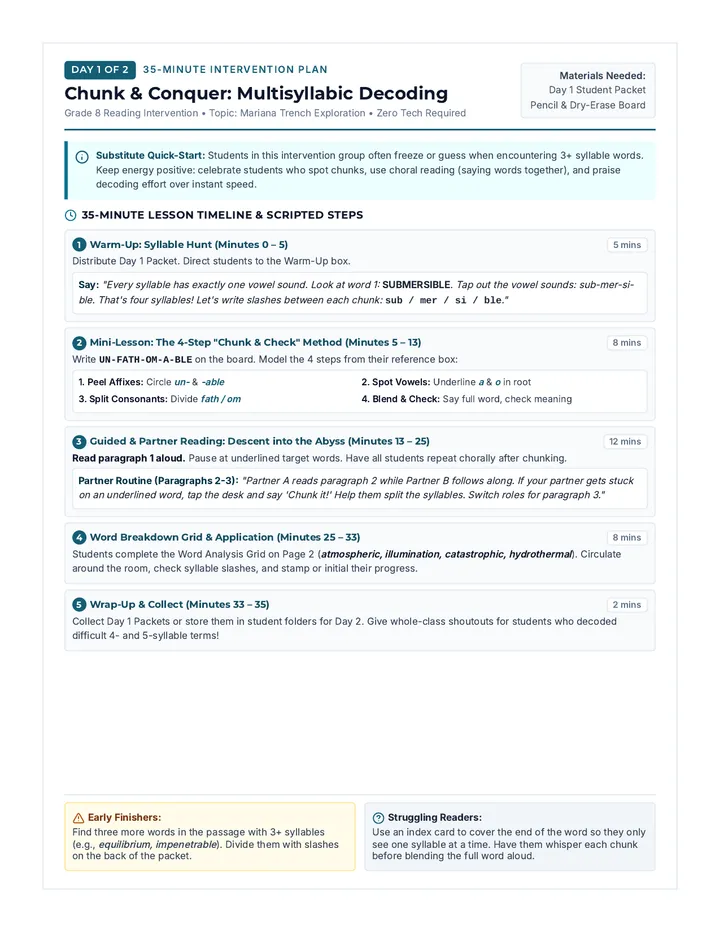
Interactive "Detective Reading" Daily Routine
15-minute multi-sensory routine to embed test-taking metacognition and active text marking
1
Number & Preview (1 Min)
Students scan passage and write large circled paragraph numbers (¶1, ¶2, ¶3). Choral chant: "Number the clues before you choose!"
Kinesthetic Cue: Two-finger tap on each paragraph header.
2
Underline the Proof (3 Min)
When reading a question, students identify keywords, return to the text, and underline the exact sentence with a pencil underline + write the question # in margin.
Kinesthetic Cue: Magnifying glass hand gesture to eye.
3
"Slash the Trash" (3 Min)
Before picking an answer, students must put a diagonal ✕ across at least TWO wrong choices and explain aloud to partner: "That's trash because..."
Kinesthetic Cue: Karate chop gesture across wrong letter.
4
RAP the Response (5 Min)
For open-ended items: Restate question into a sentence stem, Answer with accuracy, Prove using text details joined by "because" or "so".
Kinesthetic Cue: Clapping rhythm on each letter (R - A - P).
Weekly Coaching Walkthrough Observation Tracker
Teacher & Coach Co-Tool
| Observation Look-For (Sweeney Rubric) |
Baseline |
Wk 2 Goal |
Wk 4 Goal |
Post Target |
| 1. Paragraphs numbered on student copies |
0% (0/14) |
60% |
90% |
100% |
| 2. Text proof underlined with Q# in margin |
0% (0/14) |
50% |
80% |
90%+ |
| 3. Distractor elimination marks visible on choices |
14.3% (2/14) |
55% |
85% |
95%+ |
| 4. Written response restates prompt in full sentence |
35.7% (5/14) |
60% |
85% |
90%+ |
| 5. Multi-part chronological question accuracy (Q2 type) |
57.1% (8/14) |
70% |
85% |
85%+ |
Student Detective Desk Anchor Card
"1. Number ¶ | 2. Underline Proof | 3. Slash 2 Lies ✕ | 4. RAP with Because"
Print Ready